

The thing everyone whispers in hallways but never says out loud is this: leadership does not care about your signing bonus nearly as much as they care about your RVUs.
They will act flexible on the bonus. They will be mysteriously rigid on RVUs and productivity expectations. That is not an accident.
Let me walk you through what actually happens in the C-suite and partner meetings when your contract is being built and “approved.”
How administrators really think about money
In every hospital or large group I’ve worked with, the conversation about a new hire sounds something like this behind closed doors:
“Alright, what will this doc earn us three years from now, and what’s the minimum we have to dangle upfront to get them in the door?”
Signing bonus = bait.
RVUs = business model.
The CFO and service line leader view dollars in two buckets:
- One-time, non-recurring costs (signing bonuses, relocation, loan repayment stipends).
- Recurring, scalable revenue streams (RVU production, downstream referrals, call coverage, procedural volume).
The first bucket they tolerate. The second bucket they obsess over.
I’ve sat in meetings where an extra $50,000 signing bonus sparked a five-minute discussion and a shrug, but a 5% tweak in RVU conversion factor or lowering the annual RVU target triggered a 45-minute argument, three spreadsheets, and a postponed decision.
Why? Because:
- Signing bonus hits this year’s budget once. Leadership can blame “recruiting market pressure” and move on.
- RVU rates and targets define the ongoing profit margin of your position for years. Change it for you, and every other physician will eventually demand the same.
So when you ask, “What do they value more?” the honest answer is: RVUs. Every time. They’ll throw money at you up front sooner than they’ll loosen the RVU leash.
The signing bonus: candy, not calories
Let me be blunt. The signing bonus is the most psychologically powerful and financially least important piece of your contract long term.
Does it matter? Of course. Debt is real. Childcare is real. But leadership knows exactly how seductive that lump sum looks to a new graduate with $300k in loans.
Here’s what happens in the recruitment meeting:
“Oh, they have three offers? Can we bump the signing bonus another 25k?”
“Yeah, just classify it as a recruitment expense. It’s a one-time hit.”
No one is talking about your well-being. They’re talking about closing a sale.
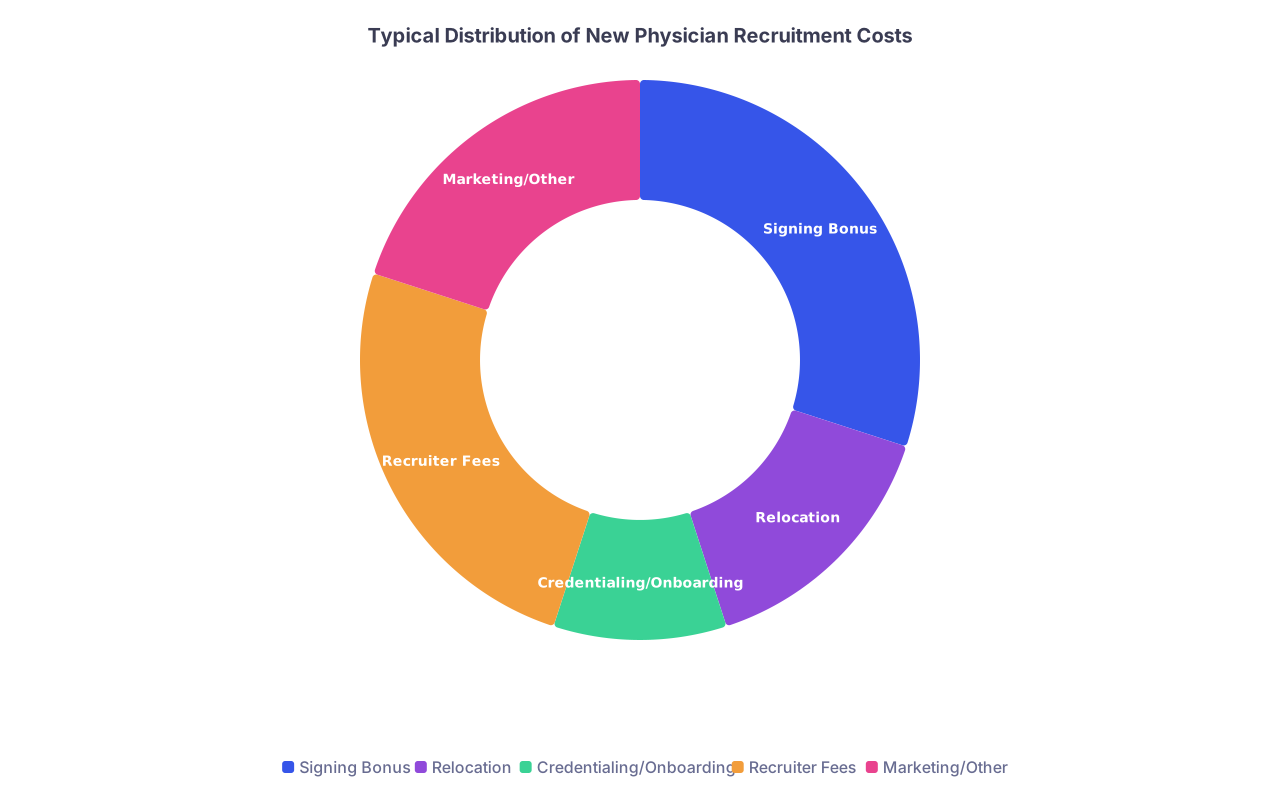
| Category | Value |
|---|---|
| Signing Bonus | 30 |
| Relocation | 15 |
| Credentialing/Onboarding | 10 |
| Recruiter Fees | 25 |
| Marketing/Other | 20 |
That donut chart? That’s roughly how admin sees it. Signing bonus is just one slice of the recruitment spend. They can inflate that slice if they keep the rest of the long-term structure tight.
Here’s the real “gotcha” with signing bonuses that I’ve seen bite people every cycle:
- They’re almost always tied to a repayment/forgiveness period (usually 2–3 years).
- They’re taxable ordinary income. That “$50k bonus” turns into $30–35k in your account.
- If you leave early, you owe the gross amount back, not the net you took home.
So you get $50k, bank account sees maybe $32k. You burn through it fixing a transmission, paying loans, moving twice. Then 18 months later you’re miserable and want out. You owe $50k back. In full.
Leadership knows this. It’s retention by handcuffs, disguised as a “welcome gift.”
Do not misunderstand: you should absolutely negotiate the signing bonus. But you shouldn’t chase it at the expense of your RVU deal. That’s like picking the biggest cupcake on the table while someone quietly signs you up for a five-year diet.
RVUs: the real scoreboard leadership cares about
RVUs are how your work gets turned into numbers. And numbers are what the CFO and the board stare at.
Most new grads only look at the top line:
“$250k base plus incentive above 5,000 RVUs. That seems solid.”
That is how people end up working like maniacs for less than they’re worth.
Here’s what’s actually being debated behind doors when your contract goes through the “comp committee” or the partner meeting:
- “What’s the market rate per wRVU in our region?” (You’ll hear 45–60+ thrown around in many specialties.)
- “What are our current docs producing? We can’t undercut our existing comp model.”
- “Can we set a high enough RVU target to protect our margin but still look recruitable on paper?”
They’re not starting with: “What’s a fair life for this physician?”
They’re starting with: “What keeps our contribution margin healthy and our existing doctors from revolting?”
So when you look at your offer, leadership is hyper-focused on three knobs:
- RVU target – How many work RVUs you must generate before incentives or to justify your salary.
- Conversion factor – Dollars paid per work RVU (wRVU).
- Guarantee structure – How long they’ll “eat the loss” while you ramp up.
I watched a hospital in the Midwest refuse to move the RVU conversion factor from $48 to $52 for an interventional cardiologist who had competing offers. Same meeting, they bumped the signing bonus from $40k to $100k without blinking.
That’s what I mean when I say: they care way more about RVUs.
Because that 4-dollar difference, multiplied across 8,000–10,000 RVUs a year, every year, is a six-figure swing. The signing bonus is a rounding error compared to that cumulative effect.
| Scenario | Signing Bonus | wRVU Rate | Annual RVUs | 3-Year Extra Earnings |
|---|---|---|---|---|
| A | $50k | $45 | 6,000 | Baseline |
| B | $25k | $50 | 6,000 | +$90k |
| C | $0 | $55 | 6,000 | +$180k |
Scenario C looks “worse” to most graduating residents who’ve been fed the signing-bonus mythology. It’s actually the best deal by far.
How leadership reacts when you push on each lever
This is where experience matters. I’ve seen the same movie play out at academic centers, large multispecialty groups, and community hospitals.
When you push for a higher signing bonus
Their internal monologue: “Annoying, but fine.”
They might say:
“We’re already at the top of our usual range.”
“This is above what we’ve done historically.”
But if they’re worried you’ll walk, they’ll find money.
Maybe not all of what you ask. But movement is common.
The constraints on bonuses are usually:
- HR “policy ranges” for recruitment. (These get bent when needed.)
- Fear of setting precedent if other docs find out. (Hence the hush-hush tone.)
- Current-year budget optics.
Nevertheless, they can justify a bigger bonus as a one-time cost of doing business. So from a negotiation standpoint, signing bonus is low-resistance leverage.
When you push for a better RVU structure
Totally different tone.
You’ll hear:
“We have to be consistent with our current providers.”
“Our comp model has been vetted with consultants.”
“This is standardized across the system; we can’t alter just one person’s agreement.”
Now, sometimes that’s true. Many systems are locked into a formal comp plan. Sometimes it’s just protective posturing. They don’t want to crack the door.
What leadership really fears when you ask for better RVU terms:
- Existing physicians finding out you got a better deal and demanding the same.
- Eroding departmental margins if they overpay per RVU.
- Losing control of the “template” that recruitment and legal rely on.
So they resist. Harder. Not because it’s unfair. But because it’s more dangerous to their long-term model.
This is exactly why you should pay more attention to RVUs than to your signing bonus.
You need to see your job like they do: a 3–5 year revenue engine, not a one-year sugar high.
The ramp-up trap: guarantees, clawbacks, and RVU expectations
Another behind-the-scenes reality: almost every new grad leaves money on the table by not understanding ramp-up structure.
Here’s how leadership frames it in their heads:
“We’ll guarantee $260k for two years while they build a panel. If they don’t hit 5,000 RVUs by year three, we mis-hired.”
Notice the phrasing: mis-hired, not we failed to support them. That mentality drives how aggressive your targets will be.
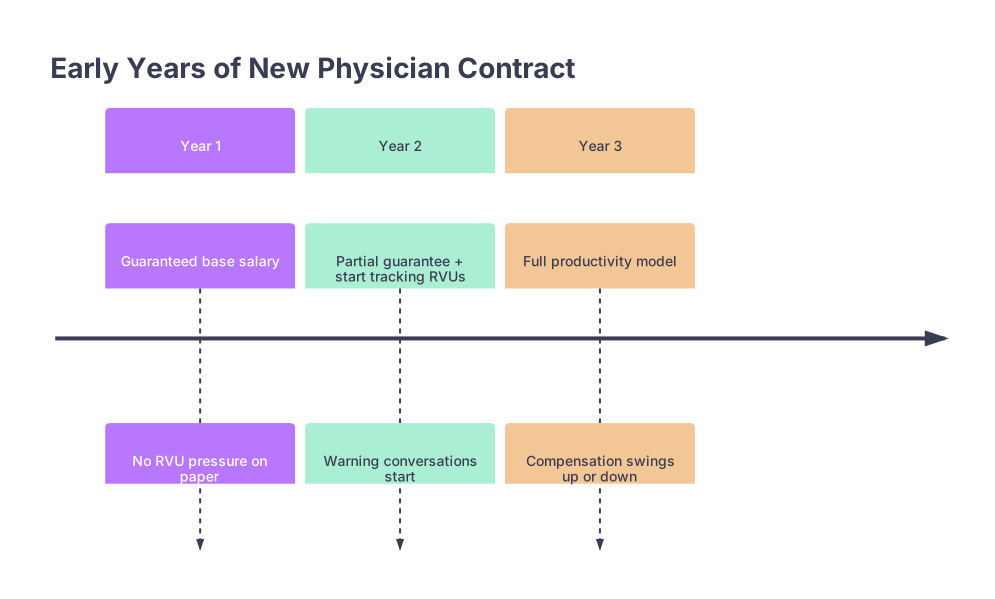
| Period | Event |
|---|---|
| Year 1 - Guaranteed base salary | No RVU pressure on paper |
| Year 2 - Partial guarantee + start tracking RVUs | Warning conversations start |
| Year 3 - Full productivity model | Compensation swings up or down |
What you need to dig into during negotiation:
- Are RVU expectations during the guarantee real or just theoretical?
- Is there an expectation to “reconcile” once the guarantee ends? (Translation: you’re under the gun in year 3.)
- How did recent hires in your specialty actually do by year 2 and 3? Get numbers, not platitudes.
I’ve seen contracts where they “guaranteed” $280k for two years—then in year 3 dropped the base to $190k plus wRVU incentives, with a target so high the doc effectively took a pay cut for working harder. Why? Because all the leverage was used on the front-end dollars instead of the RVU engine.
When leadership looks at your 3-year cost to the organization, they’re not thinking “We gave them 80k in signing and relocation.” They’re thinking, “By year 3, we better be net positive on this FTE.”
If you don’t understand the RVU ramp, you’re walking into a test you don’t know you’re taking.
Private practice vs employed: the RVU story changes, but the priority doesn’t
In a pure private practice or partnership-track model, they may not even use RVUs formally. But they absolutely track your production and collections. RVUs just become a different set of numbers: new patients, procedures, collections per visit, overhead share.
Here’s the thing most applicants don’t see:
- Hospital admin = RVUs + downstream hospital revenue (imaging, procedures, admissions).
- Private group = collections – overhead + call value + eventual buy-in.
Different spreadsheet. Same underlying question: “How much does this physician produce for what we’re paying them?”
In private groups, the “bonus” equivalent is often:
- A small signing bonus or stipend.
- Temporary income guarantee backed by a hospital.
- Early partnership promises.
But what they actually care about is: will you carry your share of revenue when the guardrails come off?
I watched a group in Texas gladly bump a signing bonus from $20k to $40k to land a GI fellow. But when he tried to negotiate a faster path to full profit share without being call-heavy, they froze. Because his long-term share of the pie threatened the partner economics far more than an extra $20k ever would.
Again: short-term bonus flexible. Long-term production economics sacred.
What you should actually prioritize when negotiating
Let me be as direct as possible.
If you’re choosing between:
- Another $40–50k in signing bonus
vs - A better long-term RVU/production structure
You pick the RVUs. Almost every time.
This is what I tell residents before they go on-site:
Your real financial life depends on:
- The wRVU conversion factor (or equivalent production rate).
- The RVU target required to “unlock” incentive pay.
- The expected and realistic RVU volume based on current physicians’ actual numbers.
- The guarantee period and what happens after it.
- Whether you’re paid for non-billable work (admin roles, teaching, leadership, medical directorships).
You ask each of these questions explicitly on your visit:
“How many wRVUs did your last 3 hires in my specialty produce in year 1, 2, and 3?”
“What’s the average wRVU production of your physicians in my specialty right now?”
“At what point in RVU production do people here actually start to out-earn their base?”
“What percentage of your physicians hit or exceed target by year 2?”
Do not accept, “Oh, most of our folks do fine,” or “We don’t have that exact number.”
They have the numbers. Leadership looks at them all the time. If they won’t share, that’s a signal.
Then, when the contract hits your inbox, you weigh:
- An extra $30–50k bonus, taxed and one-time
against - 3–5 years of better wRVU economics worth $150–300k or more.
I’ve watched two hospitalists choose different offers with the same base salary:
- Doc A: $40k bonus, $55/wRVU above 4,000 RVUs.
- Doc B: $10k bonus, $65/wRVU above 3,500 RVUs.
Three years in, Doc B was ahead by almost $200k total. Doc A was still bragging about his “great signing bonus” as he quietly picked up extra shifts to make up the difference.
How to actually use this when you sit down to negotiate
Here’s how you use leadership’s true priorities to your advantage.
You push hard on the thing they value more—but you do it with data and professionalism so they can justify it “up the chain.”
You come in saying something like:
“I understand you have a standard compensation model, and I don’t want to blow that up. But based on MGMA and current market data for my specialty in this region, I’d like to focus more on the long-term alignment than the bonus number. I’d be comfortable with a more modest signing bonus in exchange for a slightly higher wRVU rate or a lower initial RVU threshold for incentive pay.”
You’ve just:
- Signaled you’re not just chasing quick cash.
- Framed it in terms of market data and alignment, not greed.
- Given them cover to say to their comp committee: “We held the signing bonus low, but adjusted the RVU rate modestly to stay competitive.”
Some will still say no. But here’s the uncomfortable secret: the candidates who actually push—politely, with data—get more. Leadership expects you to accept the first offer. When you do not, they suddenly “discover” flexibility that mysteriously didn’t exist before.
If they absolutely refuse on RVUs but are willing to play with bonus and guarantee length, fine. But at least you tested their real boundaries instead of assuming the first draft was sacred.

Quick reality checks before you sign
Three blunt gut-checks I’ve seen save careers:
- If they’re extremely generous on signing bonus but cagey and evasive about actual RVU data from current physicians, that’s a problem.
- If every question about RVUs and production triggers long, vague answers about “team culture” and “we’re like family,” they’re hiding something.
- If another offer has a smaller bonus but a clearly better long-term RVU/production deal, you’re almost always better taking the smaller bonus and better structure.
Run the math. On paper. Over 3–5 years. Do not let your brain get hijacked by that big one-time number.


