

The worst mistake new attendings make is not lowball pay. It is signing the first offer that lands in their inbox. Fast. Grateful. And locked in.
If you are about to finish residency or fellowship, you are exactly the person recruiters hope will do this.
You are tired. You want certainty. You want to tell your family, “It’s done.” That desire for closure is exactly what gets physicians trapped in bad jobs with bad contracts and bad leverage for years.
Let me be blunt: accepting the first attending offer without comparison, negotiation, or legal review is a career risk. Not a small one. A multi‑year, high‑six‑figure kind of risk.
The Trap Behind “We Need an Answer in 7 Days”
Hospitals and groups know new grads are vulnerable. They use it.
Standard maneuver:
- They invite you for a nice site visit.
- They flatter you. “You’re exactly what we’ve been looking for.”
- They send an offer quickly.
- Then the line: “We do need an answer soon because we’re interviewing other candidates.”
That “urgency” is rarely real. It is a tactic.
Here is what happens when you bite:
- You accept before seeing what the market will pay you.
- You commit before exploring better locations or schedules.
- You lose almost all negotiation power because you have already said “yes.”
Especially dangerous if:
- You have not yet talked to other employers in the same region.
- You have not had a physician contract attorney review the agreement.
- You have not compared compensation models (wRVU vs base + bonus vs salary).
- You have not thought deeply about noncompete + tail coverage + call burden.
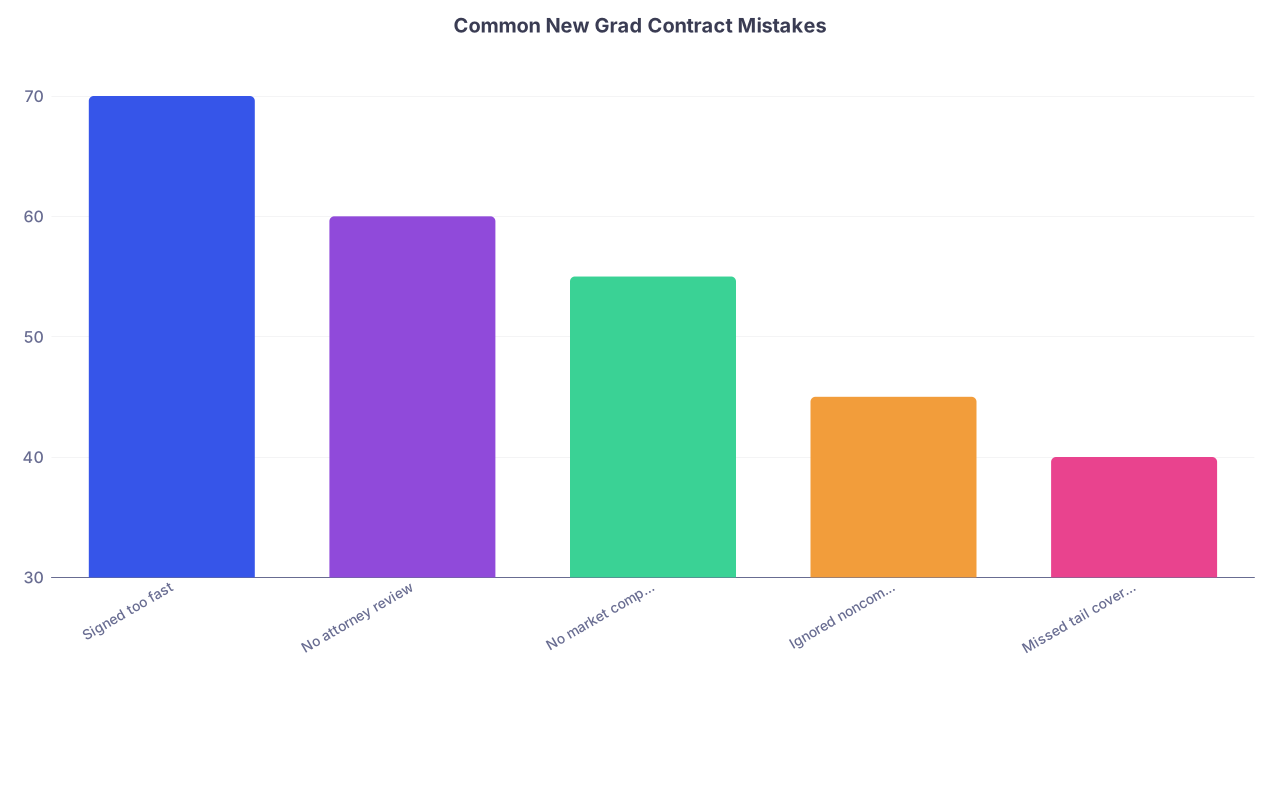
| Category | Value |
|---|---|
| Signed too fast | 70 |
| No attorney review | 60 |
| No market comparison | 55 |
| Ignored noncompete | 45 |
| Missed tail coverage | 40 |
I have watched people sign in October of PGY‑3 because “it seemed good” and be completely stuck by PGY‑5 when they realize:
- Their colleague across town makes $80,000 more for fewer clinic days.
- Their call schedule is abusive compared to other local groups.
- Their noncompete blocks them from working anywhere they actually want to live.
That mistake is not fixable with “working hard.” It is baked into the contract you rushed to sign.
Why Accepting the First Offer Is So Dangerous
The issue is not that the first offer is always bad. Sometimes it is fine. The danger is that you do not know whether it is good, average, or predatory without context.
1. You Have Zero Market Context
You cannot judge “$260,000 for outpatient IM” in a vacuum. You need:
- MGMA or other specialty‑specific benchmarks
- Regional data
- Comparison of benefits, call, productivity expectations
| Job | Base Salary | Call | Noncompete | Tail Coverage |
|---|---|---|---|---|
| Offer #1 | $260k | 1:4 | 20 miles / 2 years | Physician pays |
| Offer #2 | $290k | 1:6 | 10 miles / 1 year | Employer pays |
| Offer #3 | $240k + RVU bonus | 1:5 | None | Employer pays |
If you sign Offer #1 without ever seeing Offers #2 and #3, you never even realize how much you left on the table. Or how much risk you took on with tail and noncompete.
You will just feel “burned out and underpaid” three years later without fully understanding why.
2. You Lock Yourself Into Bad Structural Terms
The salary number is what everyone obsesses over. The more serious danger sits in the structure and fine print:
- Noncompete clauses – how far, how long, and how broad
- Tail coverage obligations – can easily cost $40,000–$120,000
- Termination clauses – who can walk away and how easily
- Compensation model – guaranteed salary vs aggressive RVU targets
- Call coverage definitions – is “backup” call counted? Compensated?
Rushed signers make the same mistakes:
- They assume “This must be standard.” It is not.
- They do not ask what older partners negotiated out years ago.
- They do not ask what the previous physician in the role left over.
Nobody volunteers, “Oh by the way, the last three people left within two years because the call is brutal and the bonus metrics are unreachable.”
You have to slow down and look for the red flags. You cannot do that if you feel you “owe” an immediate yes.
3. You Give Up Negotiation Leverage Before You Use It
Your biggest leverage as a candidate is:
- You are still deciding.
- You are interviewing at multiple places.
- You are willing to walk away.
Once you accept, you remove all of that leverage. Even informally. If you tell them, “I’m in, I’ll sign when I get a chance,” they stop selling and start protecting their interests. You shift from “woo the candidate” to “enforce the contract.”
Common mistake sequence:
- Verbal “yes” out of excitement and gratitude.
- Employer stops recruiting and tells colleagues you are coming.
- You later ask, “Could we tweak the noncompete?”
- Response: “That will be hard now; we already stopped interviewing.”
They did not trick you. You did that to yourself by committing before negotiating.
4. You Underestimate How Hard It Is to Leave
Every new grad says the same thing: “If it is bad, I will just leave after a year.”
No, you will not “just” leave. You will:
- Be pregnant or have a new baby.
- Have just bought a house based on that salary.
- Feel guilty about “abandoning patients.”
- Be worried another move will look bad on your CV.
- Be facing a 20‑mile, 2‑year noncompete and a $70,000 tail bill.
The cost of leaving a bad job is much higher than the cost of spending 2–3 more months comparing offers and negotiating your first one properly.
The Psychological Tricks That Push You to Sign Too Early
If you understand the pressure points, you can resist them.
The Gratitude Trap
You are finishing residency, used to being underpaid and underappreciated. A recruiter flies you out, puts you up in a hotel, buys you dinner, tells you:
- “We are really excited about you.”
- “We think you’ll be a great fit.”
- “We want to move quickly before other systems grab you.”
You feel grateful. Seen. You want to reciprocate by being “easy” and “decisive.”
Do not confuse professional courtship with personal kindness. This is business. Their job is to secure a physician on the best terms for the organization, not for you.
The Scarcity Myth
They will say some version of:
- “We have other candidates we are considering.”
- “We really need to fill this by X date.”
- “Budget approvals are tied to this quarter.”
Reality check: experienced physicians in certain specialties know they are the scarce resource. New grads often forget that.
Unless you are in a truly flooded specialty in a highly desirable area, you are not the fragile one here. Their clinics lose real money every month a spot sits empty. They need you. Those “deadlines” are often flexible once you push back.
The Fear of “Losing” the Offer
Here is the mental error: thinking that not signing now means you have “lost” something.
You have not. A slower “Maybe, I need to complete my interview process and have my attorney review” is not a rejection. It is normal.
The employers who respond with:
- “If you do not sign in 7 days, the offer is gone.”
are telling you something important about their culture: they rely on pressure instead of transparency. That is not a great sign for a long‑term relationship.
How to Slow Down Without Burning Bridges
You do not need to be combative. You just need to be deliberate. Here is a sane way to avoid the “signed too early” trap.
Step 1: Have Your Process Ready Before the Offers Come
The worst time to decide how you will evaluate contracts is after you receive one that flatters you.
Before peak recruiting season:
- Make a short list of 2–4 regions you would seriously consider.
- Decide your must‑haves vs nice‑to‑haves (noncompete radius, call frequency, academic vs private, etc.).
- Identify a physician contract attorney in your state (not a random general lawyer).
- Talk to 1–2 senior physicians about typical compensation and red flags in your specialty.
So when the first offer lands, you are not starting from zero.
Step 2: Standard Response to Any First Offer
Use a version of this line. Every time.
“Thank you for the offer. I am very interested. My standard process is to complete all my interviews, then have any potential contract reviewed by my attorney. I expect that to take a few weeks. I’ll get back to you with a clear answer by [date].”
That does three things:
- Signals real interest.
- Establishes that you have a process.
- Puts a timeline in place, so they are less likely to panic or push.
If they respond with, “We really need an answer in 48–72 hours,” treat that as a warning, not as gospel.
Step 3: Keep Interviewing Even After a “Great” First Offer
The biggest self‑sabotage move: cancelling all other interviews after an early offer “you love.”
Do not do this. At least:
- Go to a few more site visits.
- Get at least 2–3 written offers in hand.
- Ask specific, comparative questions at each (call, RVUs, noncompete, tail).
You do not know what you do not know after one visit. I have watched people swear “This is perfect” after the first site visit and then quietly admit “I did not realize how much better it could be” after seeing others.
Step 4: Put Every Offer Through the Same Filter
Do not compare jobs by gut feeling alone. Use a simple comparison framework.

| Step | Description |
|---|---|
| Step 1 | Receive Offer |
| Step 2 | Attorney Review |
| Step 3 | Compare to Other Offers |
| Step 4 | Clarify or Walk Away |
| Step 5 | Assess Fit and Lifestyle |
| Step 6 | Negotiate Key Terms |
| Step 7 | Decide and Sign |
| Step 8 | Major Red Flags |
| Step 9 | Meets Must Haves |
Your filter should at least include:
- Compensation (base, bonus, RVU rate, guarantees)
- Schedule (clinic days, OR days, call frequency, weekends)
- Noncompete (miles, years, scope)
- Malpractice (claims vs occurrence, tail responsibility)
- Termination (with/without cause, notice period)
- Culture (turnover, how long partners stay, how they treat staff)
You cannot run this filter in a weekend. Which is exactly why the “We need an answer in 3 days” thing is so toxic.
The Hidden Long‑Term Costs of Signing Too Early
People think in terms of “I might lose $20,000 a year if I do not negotiate.” That is naïve. The stakes are bigger.
Salary and Bonus Compounding
If you accept:
- $240k instead of $280k, with weaker bonus potential
- Or RVU thresholds that are absurdly high for your clinic’s patient mix
you are setting your floor low for years. Raises are often percentages of current compensation. Start too low and you drag that anchor through your early career.
This difference easily becomes:
- $40k–$80k per year
- Multiplied over 3–5 years
- Plus retirement contributions you did not receive
- Plus bonuses you never had a shot at earning
You will not see that clearly when you are just “happy someone wants me.”
Career Trajectory and Burnout
Worse than lost money: lost trajectory.
The job you take after training heavily influences:
- Your clinical focus and niche.
- Your ability to build a reputation in a geography.
- Your opportunities for leadership or subspecialization.
If you sign a job with:
- Crippling call and no administrative time
- Minimal mentorship
- An abusive culture where you are just RVU‑fuel
you are more likely to burn out, have gaps in CV, and lose the energy to pursue the roles you really wanted.
That can start with one rushed “yes” to the first offer.
Relationship and Life Costs
These are the ones nobody puts on spreadsheets:
- Your partner’s career relocation decisions.
- Your kids shifting schools multiple times if you leave early.
- Being stuck in a town you never actually liked because of a noncompete.
- The resentment that builds when you realize your early decision boxed your family in.
Again: much cheaper, emotionally and financially, to slow down on the front end.
Red Flags That Should Make You Slow Down or Walk
You want specific triggers? Here:
- “We cannot change our noncompete; it is standard.”
- “Everyone signs this as is. We have never had a problem.”
- “We do not usually pay for tail coverage for new grads.”
- “We need an answer by Friday or the offer is withdrawn.”
- “You do not really need an attorney; this is our standard template.”
- They dodge questions about prior physician turnover in the role.
- They are vague on RVU benchmarks, payer mix, or call coverage details.
If two or three of those show up in the first offer conversation, do not sign early. Possibly do not sign at all.
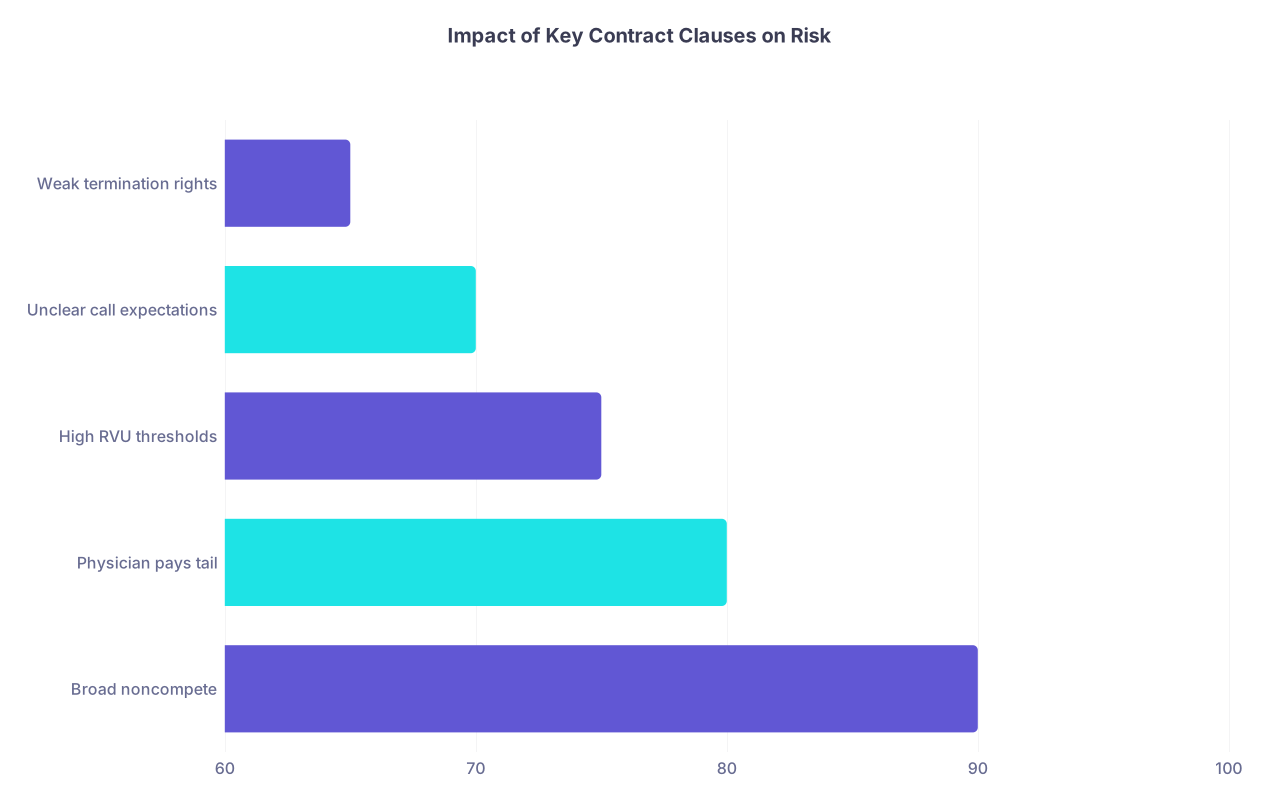
| Category | Value |
|---|---|
| Broad noncompete | 90 |
| Physician pays tail | 80 |
| High RVU thresholds | 75 |
| Unclear call expectations | 70 |
| Weak termination rights | 65 |
When It Is Reasonable to Move Faster
I am not saying you must drag this out for a year. There are scenarios where a quicker acceptance is rational, but only with safeguards:
- You have multiple offers already and the first one is clearly superior.
- You have had the contract reviewed by a physician‑focused attorney.
- You have checked compensation against reliable specialty benchmarks.
- You have spoken with current and former physicians in that group.
- Noncompete is narrow, tail is covered, and termination clauses are fair.
Even then, “fast” should mean a few weeks, not a few days.
If they push for a signature in 72 hours on a 20‑page contract that binds you for years, ask yourself why they want you uninformed and hurried.
They know exactly what they are doing. You should too.
Open the last contract email you received and look at the subject line. If your first instinct is, “I should just sign this and be done,” stop. Instead, send one email today:
“Thank you for the offer. I’m very interested. I plan to complete my other interviews and have this reviewed by my attorney before deciding. I expect that process will take a few weeks. I will get back to you by [specific date].”
That one line might save you hundreds of thousands of dollars and years of frustration.
Use it.


