

The fastest way to burn out a new attending isn’t a tough patient panel. It’s a bad call-schedule clause you didn’t understand before you signed.
If you’re finishing residency and staring at your first attending contract, this is where people get hurt. Not by the base salary. Not by the signing bonus. By the hidden, vague, or one-sided call terms that quietly turn your “great job” into a 2 a.m. notification hellscape.
Let me walk you through the most common mistakes I’ve seen smart, well-trained physicians make—and how you can avoid them.
The Biggest Lie: “Our Call Is Light”
Programs and employers love this phrase. “Call is light.” “Call is very manageable.” “Everyone here is happy with the call.”
Those sentences are useless. They’re not enforceable. And they’re often technically true only because the partners who hate the call already left.
You’re not negotiating vibes. You’re negotiating numbers and definitions. If you sign something that doesn’t spell those out, you’re trusting your sleep, your family, and your sanity to whoever controls the schedule.
Here’s the first big mistake: accepting vague call language.
Typical contract line that should set off alarms:
“Physician will participate equitably in the practice’s call schedule as determined by the group.”
That sentence gives them almost unlimited discretion. “Equitable” is not defined. “Determined by the group” means: if someone leaves, gets pregnant, goes part-time, or refuses weekends, your life can change overnight and you have no recourse.
You need specifics, or at least guardrails.
At minimum, you want answers to:
- How many weeknight call shifts per month?
- How many weekend call shifts per month?
- Is call in-house, home call, or backup?
- What is the maximum number of consecutive call days?
- Are there post-call protections? (clinic cancelation, reduced schedule, etc.)
If you don’t see those detailed anywhere—in the contract or a referenced written policy—you’re setting yourself up to be the flexible one who “helps out” until that becomes your permanent role.
Vague vs. Specific: What It Should Look Like
You do not need a 10-page call addendum. But you do need something more solid than “equitable.”
Here’s the difference:
Bad:
“Call duties will be shared equitably among physicians.”
Better:
“Physician will participate in the call rotation, which currently averages 1 in 6 weeknights and 1 in 6 weekends. Call is home call with an average of 2–4 phone calls per night and 0–2 in-hospital returns per shift.”
Best (for you):
“Call will not exceed 1 in 5 weeknights or 1 in 5 weekends without the written consent of Physician, except for temporary emergency coverage not to exceed 3 months.”
If they push back on any specificity at all, that’s not just a negotiation stance. That’s a red flag about how they use call coverage as a pressure valve when things get tight.
The Silent Trap: Not Capping Call When Partners Leave
This one burns people regularly.
You join a group that “generally” has 1:5 call. Sounds fine. Then two partners leave. One goes on maternity leave. Suddenly you’re at 1:2 or 1:3 “for a little while” and that little while turns into a year.
Your contract? Still says “equitable call as determined by the group.”
Here’s what you should insist on: a cap and a trigger.
A cap: the maximum call frequency the employer can require without additional compensation or your written consent.
A trigger: what happens if the group shrinks and they need more coverage.
Example of reasonable language:
“Call will not routinely exceed 1 in 5 nights and 1 in 5 weekends. If, due to staffing changes, call exceeds this frequency for longer than 60 consecutive days, the parties will either: (a) mutually agree to a temporary call stipend of $X per additional call night/weekend; or (b) adjust the physician’s clinical duties to compensate.”
If they refuse to put anything about what happens after partner departures, understand what that means: they’re planning to solve their staffing problems with your sleep.

Home Call vs. In-House vs. “Home But Not Really”
Another classic trick: they call it “home call” but treat it like in-house call.
I’ve seen “home call” arrangements where:
- You’re required to be within 20–30 minutes of the hospital.
- ER is instructed to call you for everything.
- You’re physically in the hospital 4–6 hours a night.
- You still have a full clinic the next morning.
That’s not real home call. That’s low-budget in-house call without formal recognition.
Your mistake if you’re not careful: focusing only on where you sleep, not what you’re actually doing.
You need clarity on:
- Response time expectations (phone and in-person).
- Typical volume (how many calls per night, average admissions/consults).
- In-hospital expectations (are you expected to come in for every consult or only certain cases?).
- Post-call schedule (clinic reduction? protected time?).
If the call is frequent, demanding, and severely disrupts your sleep, the label “home call” is irrelevant. Your brain and body don’t care what the contract calls it.
Ask current physicians directly: “When you’re on call, how many hours of sleep do you usually get?” If that answer is consistently under 4–5 hours, you need either less call, more pay, or both.
The Call Without Pay: Uncompensated Extra Burden
Early-career physicians often make this mistake: they treat call as just “part of the job” without asking whether it’s actually built into their compensation.
Sometimes it is. Sometimes it very much isn’t.
You want to distinguish:
- Base-salary-inclusive call (clearly defined and limited).
- Extra call (beyond standard) that should be paid.
- Hospital call coverage (for unassigned patients or multiple groups) that may be a separate contract.
If your base salary assumes a “normal” call load but there’s no definition of what “normal” means, you’ve just agreed to “whatever we decide later.”
This gets especially ugly when:
- You’re in a pooled-coverage model, covering other groups’ patients.
- They add hospitals or service lines without adjusting your pay.
- Volume grows but staff doesn’t.
The protective move: separate your “standard call” from “extra call” in writing.
Reasonable structure:
- Standard included call: capped and defined (e.g., 1:6 in-house, one weekend out of six).
- Extra call: specific stipend (per night/weekend) or clear RVU credit you actually have a chance of hitting.
When someone says, “We all just help each other out; we don’t nickel-and-dime call,” translation: you will be guilted into taking more call, for free, because “that’s what team players do.”
Backup, Jeopardy, And The Invisible Second Job
Here’s a sneaky burnout factor people don’t factor in: backup call and jeopardy coverage that never shows up in the contract at all.
You see “1:5 primary call” on paper. What they do not tell you: you’re also on backup every third weekend “informally,” because “we’re short.”
Backup is still call. You’re still tethered to your phone, your location, your sleep. If backup means you get activated half the time, that’s barely different from primary call, functionally.
You should ask, directly:
- Is there backup call? How often?
- Is backup scheduled or “voluntary”?
- How often does backup actually get called in?
- Is there any pay or credit for backup call?
If it exists and they won’t define or compensate it, assume it will become a recurring unpaid burden once you’re on board and socially obligated.
The Multi-Site Call Problem (You’re Covering More Than You Think)
Groups love to expand to “one more hospital” or “one more facility.” That’s great for them. It’s not automatically great for your call.
If your contract doesn’t lock your call obligations to specific sites, you can wake up one year in and find yourself:
- Covering calls for two or three hospitals.
- Driving 40 minutes between facilities at 2 a.m.
- Being cross-covered into a subspecialty or service you never planned to touch.
This is especially bad in:
- Hospitalist groups that pick up small satellite facilities.
- Surgical groups that add coverage at an outlying hospital.
- Anesthesia and OB where “we just added a new L&D unit.”
Request explicit language:
- Which facilities are you required to cover via call?
- Any limits on adding new facilities without your consent?
- Pay differential or stipend if they add an extra site?
If they brush off your concern with “We don’t foresee adding more hospitals,” ask them to just put that structure in writing then. If they refuse, that tells you something.
“Equal Call” That Isn’t Equal At All
Almost every group says call is “shared equally.” Often it’s not.
Watch out for these distortions:
- Senior partners mysteriously get fewer weekends and holidays.
- Some partners don’t take certain types of call (OB, trauma, ICU), so others pick up the slack.
- “Admin time” people or service chiefs quietly drop call later, leaving younger physicians to carry the load.
Your mistake: assuming “equal” means equal across all types of call and holidays.
You want to know:
- Are senior physicians treated differently for call?
- Who gets Christmas / New Year / major holidays?
- Are there any exempted roles (medical director, department chair) that don’t take full call?
If the unspoken rule is “You’ll take more call until you’ve been here 10 years,” that may be fine—if the compensation and lifestyle match. But you should know what you’re walking into, not discover it after you’ve rearranged your life.
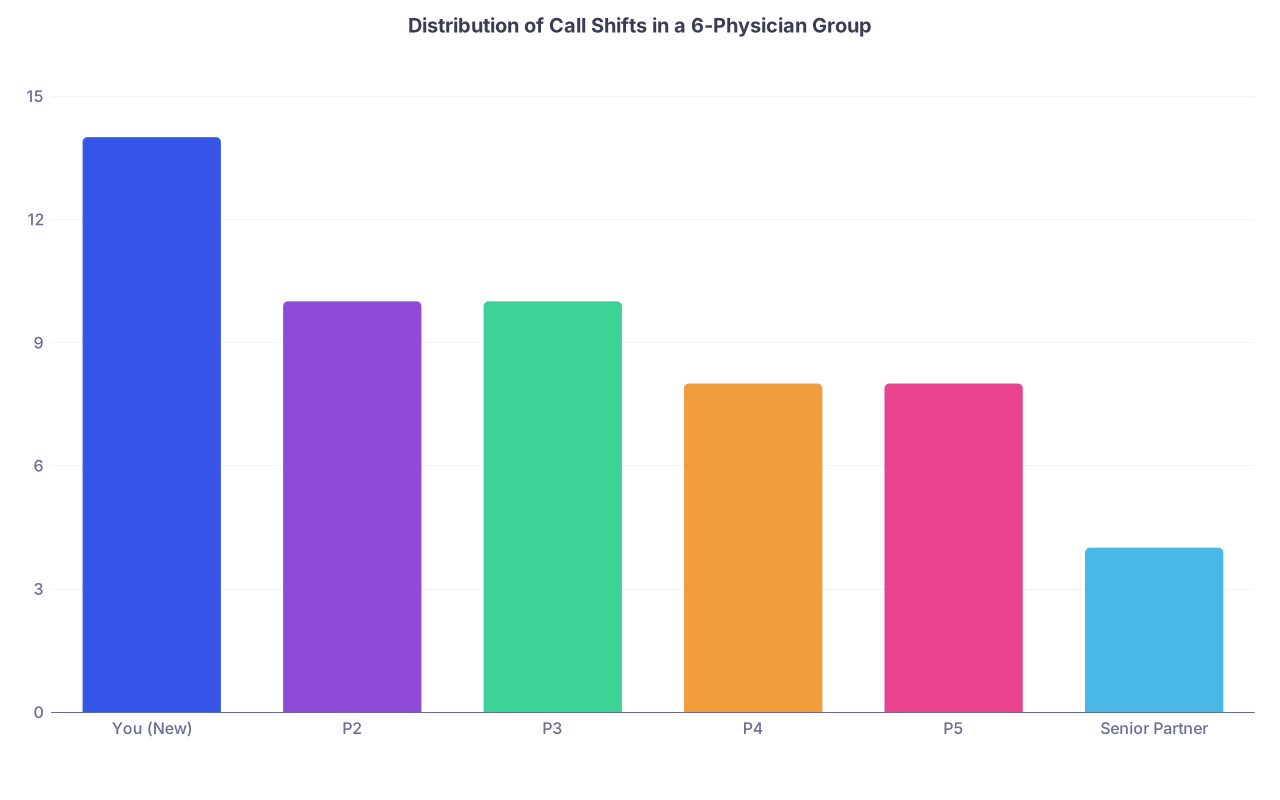
| Category | Value |
|---|---|
| You (New) | 14 |
| P2 | 10 |
| P3 | 10 |
| P4 | 8 |
| P5 | 8 |
| Senior Partner | 4 |
If the new doc is taking triple the senior partner’s call, that’s not a rite of passage. That’s exploitation.
Post-Call Expectations: The Burnout Multiplier
A lot of contracts say absolutely nothing about what happens after call. You assume there’s some sanity baked in: maybe lighter clinic, maybe post-call half days. Often there aren’t.
So you’ve got this brutal pattern:
- Up multiple times overnight.
- Full clinic starting at 8 a.m.
- No protected time to catch up on documentation.
- Repeat weekly (or more).
Over 6–12 months, this is how people end up with anxiety, mistakes, and a gnawing feeling that they chose the wrong specialty.
Before signing, clarify:
- Are you expected to work a full clinic after in-house call?
- Is there a reduced template post-call?
- Are there any rules about no elective procedures post-call?
- How many consecutive nights of call are allowed?
If they say, “We all just push through,” and wear it like a badge of honor, that’s not toughness. That’s denial.
The Maliciously Flexible Phrase: “As Assigned by Employer”
You’ll see this sentence or a close cousin in many health system contracts:
“Physician will perform such duties, including call coverage, as reasonably assigned by Employer.”
This is a blank check. It’s a surrender of your schedule and your future bandwidth to the needs of the system.
Reasonable alternative:
“Physician will participate in call coverage as outlined in Employer’s Call Policy (Exhibit A). Call duties may be adjusted by mutual written agreement or in accordance with changes to the Call Policy, provided that such changes apply uniformly to similarly situated physicians and do not increase Physician’s call frequency beyond 1 in X nights and 1 in X weekends.”
You are not being difficult by asking for this. You’re preventing the hospital from unilaterally deciding that “given staffing shortages,” you’ll now be covering three services and an extra weekend every month.
The “Future Redistribution” Mirage
Another manipulative line: “Call is heavier right now, but we’re recruiting more physicians so it will get better.”
Translation: you are the bridge. You’re signing up to absorb the worst phase of the schedule without any guarantee they’ll actually hire anyone or that the improvement will land on your plate.
Ask two things:
- How many physicians have they actually hired in the last 3 years?
- Are current physicians leaving faster than they’re being hired?
If attrition outpaces recruitment, that “future redistribution” is a fantasy.
You can also protect yourself with temporary, time-limited call obligations tied to extra compensation. For example:
“For the first 6 months of employment, Physician will participate in a 1 in 3 call rotation for an additional stipend of $X per call shift. After 6 months, call will transition to no more frequent than 1 in 5 nights and 1 in 5 weekends.”
If they’re genuinely planning to fix the call load, they shouldn’t mind putting a clock and dollars on the temporary pain.
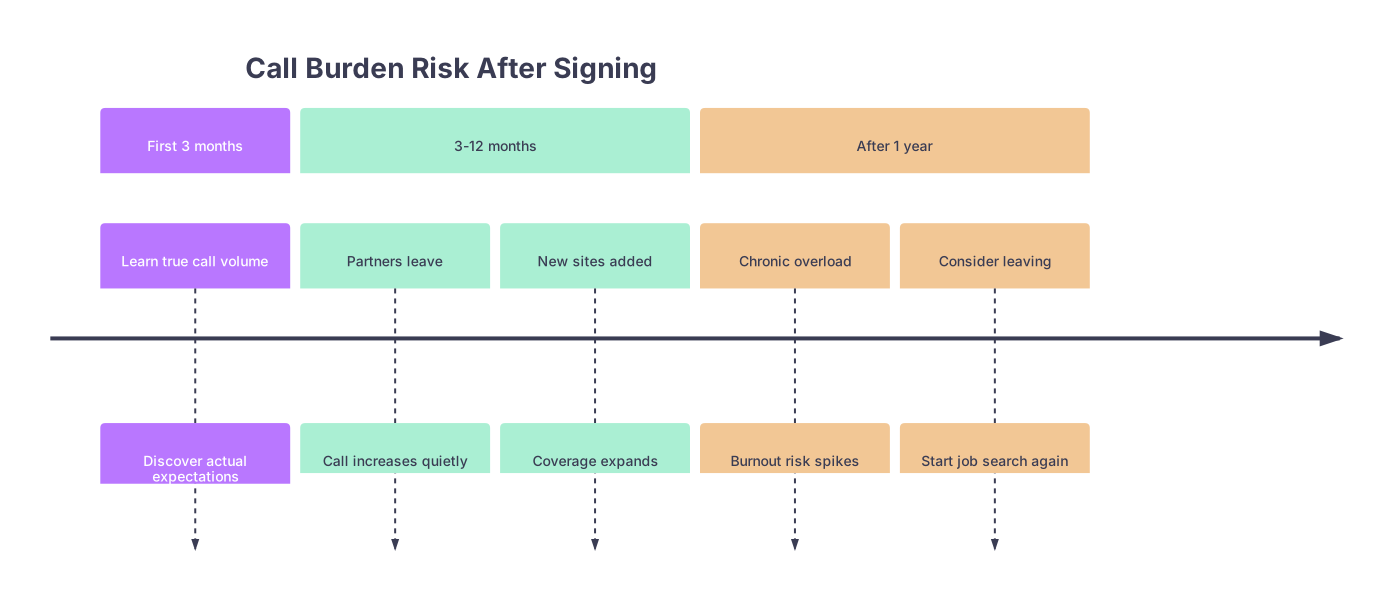
| Period | Event |
|---|---|
| First 3 months - Learn true call volume | Discover actual expectations |
| 3-12 months - Partners leave | Call increases quietly |
| 3-12 months - New sites added | Coverage expands |
| After 1 year - Chronic overload | Burnout risk spikes |
| After 1 year - Consider leaving | Start job search again |
The Metrics Trap: Call Without RVUs or Credit
In RVU-based or productivity-based models, call can quietly wreck you. Here’s the setup:
- Your base is modest.
- Your “bonus” is RVU- or collections-driven.
- Call nights are mostly low-paying, high-hassle cases, or charity/unassigned patients.
- You’re exhausted from nights and weekends, but your RVUs barely move.
You lose twice: your personal time and your bonus.
You want to know:
- Do call encounters generate RVUs attributed to you?
- Are unassigned ER admits fairly distributed and credited?
- Is there a call stipend separate from RVUs?
If the answer is essentially “no, but everyone does it,” you’re subsidizing the hospital with free coverage and unrecognized work.
| Model Type | Standard Call Pay | Extra Call Pay | RVU Credit |
|---|---|---|---|
| Salary only | Included, no cap | Often unpaid | Not applicable |
| Salary + RVU bonus | Included to cap | Sometimes low | Variable |
| Pure RVU | Rarely addressed | Usually unpaid | Critical issue |
In RVU-heavy models, uncompensated or poorly credited call is one of the fastest ways to feel overworked and underpaid.
How To Reality-Check Call Before You Sign
Too many people rely on what the recruiter or department chair says. That’s not enough. You need ground truth from people actually living the schedule.
Here’s what you do, and yes, you need to actually do this:
- Ask to see a recent 3–6 month call schedule.
- Identify who is at your career stage or in your exact role.
- Talk to them privately (phone, not email, if you can).
- Ask very blunt questions:
- How many nights are you on call per month?
- How many weekends?
- How many times do you typically get called in?
- What time do you usually leave the hospital when on call?
- What does the next day look like for you?
- Has call gotten better, worse, or stayed the same in the last 2 years?
Most people will tell you the truth if you speak one-on-one and make it clear you’re trying to avoid getting trapped.
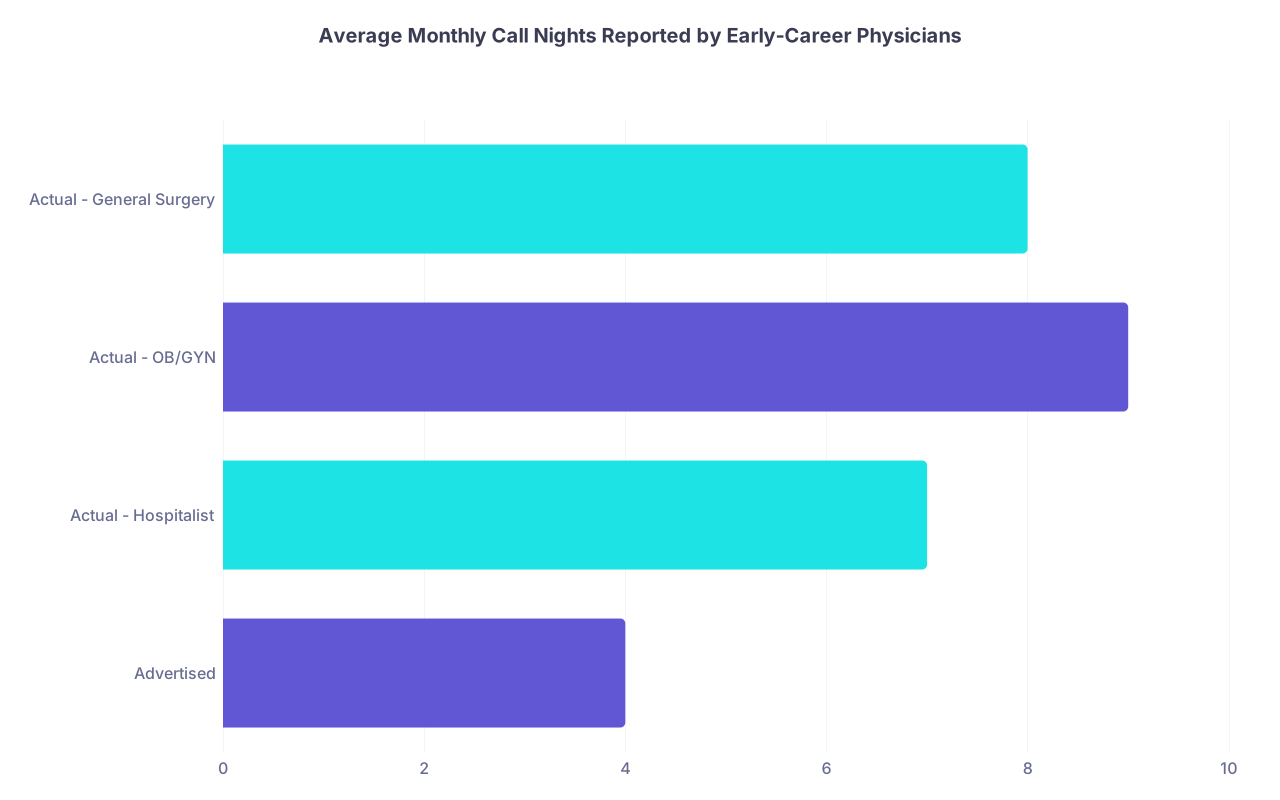
| Category | Value |
|---|---|
| Advertised | 4 |
| Actual - Hospitalist | 7 |
| Actual - OB/GYN | 9 |
| Actual - General Surgery | 8 |
If the advertised number is 4 and everyone you speak with is doing 8–9, you already know how much you can trust their assurances.
Let Your Attorney Be The Bad Cop
You do not need to personally argue all these points. That’s what a healthcare contract attorney is for. Not your cousin who does real estate. Not your neighbor who “handles contracts sometimes.”
A good physician contract lawyer has seen every call trick in the book. Use that. Have them:
- Flag vague or one-sided call language.
- Propose caps, definitions, and stipends.
- Push for written policies or exhibits.
If the employer pushes back hard on any protection around call, ask yourself why. Because if they were planning to treat you reasonably, writing that down shouldn’t be a problem.

When You Should Actually Walk Away
There are jobs you can salvage with better language. And there are jobs where the call situation is so rotten that no draft edits will fix it.
Serious walk-away flags:
- They refuse to define or cap call in any meaningful way.
- Current physicians quietly tell you, “Call is terrible, but it’s just how it is here.”
- Senior partners clearly have cushy call while juniors are ground into dust.
- There’s active turnover driven by call volume and no concrete plan to fix it.
- They’re adding facilities or service lines without adding physicians.
Remember: you can negotiate money later. You can’t negotiate back your health or your family time after a year of brutal call you didn’t see coming.
The Short List: What You Must Lock Down Before You Sign
I’m going to end with the non-negotiables. Before you sign, you should be able to answer, in writing, at least this:
How often am I on call?
- Weeknights per month.
- Weekends per month.
- Any backup/jeopardy expectations.
What does call actually look like?
- In-house vs. home.
- Typical pages/consults/admissions.
- Response time and site coverage.
What happens after call?
- Post-call clinic or procedure expectations.
- Maximum consecutive call days.
How can call change?
- Caps on frequency.
- What if partners leave?
- What if new hospitals/services are added?
If those answers are fuzzy, heavily “trust us”-based, or constantly followed by “we can’t really put that in the contract,” do not let them rush you into signing.
You’re not just agreeing to a job. You’re agreeing to wake-up times, missed birthdays, surgical decisions at 3 a.m., and how your body will feel on a random Wednesday three years from now.
Protect that. Ruthlessly.
Key points to remember:
- Never accept “equitable” or “light” call without hard numbers, caps, and definitions.
- Always reality-check the call by talking to current physicians and reviewing actual schedules.
- Use the contract—and a real physician contract attorney—to lock in limits and protections before you sign, not after you’re already exhausted.


