

The worst call clauses are not abusive. They are vague. And vague call language is how you get trapped.
Most new attendings do not lose their sanity because they take call. They lose it because they agreed to “reasonable call as assigned by the group” and then discovered that “reasonable” apparently means every third night plus every other weekend plus a holiday schedule that punishes anyone under 45.
You can fix this. Even after a weak draft is on the table.
This is how you turn a mushy, one-sided call clause into a fair, enforceable agreement.
Step 1: Diagnose Exactly What Is Wrong With Your Call Clause
Before you “negotiate,” you need a precise problem list. Not vibes. Not “this feels bad.” Concrete defects.
Here is what weak call language usually looks like:
- “Physician shall participate equitably in the call schedule as determined by the Group.”
- “Call coverage shall be provided as needed to ensure appropriate patient care.”
- “Call responsibilities may be adjusted at Employer’s discretion.”
On paper, this sounds harmless. In practice, it is a blank check.
You are looking for four categories of problems:
No numbers
Anything without numbers can be stretched:- No maximum nights per month
- No maximum weekends
- No definition of “equitable”
- No cap on holidays
Unilateral control
Phrases that hand the keys to the employer:- “At Employer’s sole discretion”
- “As assigned by Employer”
- “Subject to change without notice”
Hidden flex points
Things that sound modest but create huge leverage:- “Physician may be required to provide backup call”
- “Physician may provide telemedicine call coverage”
- “Call may include coverage of additional facilities”
No compensation linkage
Heavy call with no:- Stipend
- Differential RVU credit
- Extra pay for extra shifts
Take your draft and literally annotate it. Circle every vague term. Put a question mark where a number should be. If you cannot answer “What is my worst-case call in a bad month?” from the written language, the clause is weak.
Step 2: Get the Real Call Data Behind the Pretty Words
You cannot negotiate from theory. You negotiate from numbers. Ask for them. Calmly. In writing if possible.
You want four pieces of information:
Current call distribution by physician
At minimum:- Number of weeknight calls per physician per month
- Number of weekend calls (Friday–Sunday) per physician per month
- Number of holiday calls per year
Call type and burden
For each type of call:- In-house vs home call
- Average number of pages / calls per night
- Average number of in-person trips, and distance/time if multiple hospitals
- Typical census or service load you are covering
Coverage scope
- How many hospitals?
- Does call include clinic patients, ED consults, outside transfers?
- Is there cross-coverage for other specialties or services?
Trend
- Have they added hospitals in the last 3–5 years?
- Have they lost physicians, increasing call?
- Any upcoming expansions they already know about?
You can phrase the request like this:
“To make sure I understand the expectations and can be a reliable partner, could you share the current call schedule data? Specifically, the average number of weeknight, weekend, and holiday calls per full-time physician over the last 6–12 months, and whether that is in-house or home call.”
If they avoid or minimize this request, your contract needs even stronger guardrails. People who are proud of their call structure are very happy to show their numbers.
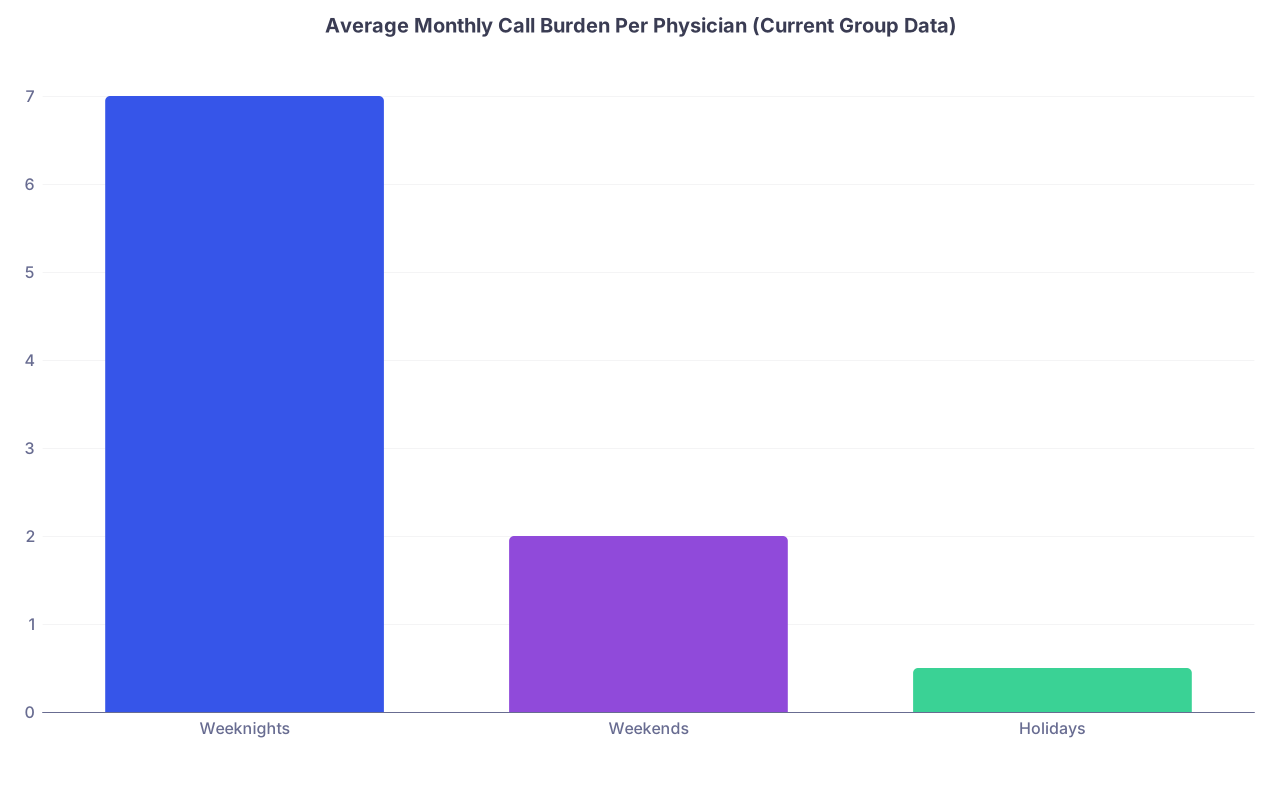
Now turn that data into something you can see.
| Category | Value |
|---|---|
| Weeknights | 7 |
| Weekends | 2 |
| Holidays | 0.5 |
From this, you now know what “equitable” actually means in this group: roughly 7 weeknights, 2 weekend sets, 0.5 holidays per month. That is your baseline.
Step 3: Translate Vague Language Into Hard Numbers
This is where you start turning a weak clause into something enforceable.
You are going to convert:
- “Equitable” → explicit ratios or ranges
- “As assigned” → maximums and process
- “May be required” → defined triggers and limits
Here are levers you can pull, with concrete examples.
A. Put a hard cap on call frequency
Your goal is to define the upper bound of what you can be scheduled for.
Try language like:
“Physician shall not be scheduled for more than 6 weeknight calls and 2 weekend call assignments per month, averaged over a rolling 3-month period, except by mutual written agreement.”
“Call shall be distributed proportionally by 0.8 FTE or greater physicians such that no full-time physician is assigned more than 120 percent of the average number of call shifts for full-time physicians in the same specialty over a rolling 6-month period.”
If they say, “We can’t guarantee; schedules change,” your answer is simple:
“That is precisely why we need a written ceiling, with flexibility if we both agree to exceed it.”
B. Define what “equitable” actually means
“Equitable” is one of the laziest words in physician contracts. Fix it.
You can define equity by:
- FTE (0.5 FTE = 50 percent of call)
- Seniority (e.g., partners vs employees)
- Scope (high-acuity vs low-acuity calls)
Sample improved language:
“Call obligations shall be allocated proportionally according to FTE status among physicians in the same specialty. A 1.0 FTE physician shall not be scheduled for more than 20 percent above the average call burden of other 1.0 FTE physicians in the same specialty over a rolling 6-month period.”
Now “equitable” has math behind it.
C. Lock in call type and locations
Do not let them “upgrade” your call later without your consent.
Your clause should specify:
- In-house vs home call
- Number of facilities
- Max distance / facility list
Example:
“Call shall be home call covering Hospital A and Hospital B only. Any expansion to additional facilities or in-house call requirements shall require Physician’s written consent and a mutually agreed adjustment to compensation.”
When they say, “We might add another hospital next year,” that is exactly the point. You are not agreeing up front to whatever they sign.
D. Define backup call and extra shifts
Backup call is where schedules go to die. If you do not define it, you will be “just on backup” 10 nights a month.
Add this:
“Backup call assignments shall be limited to 3 nights per month and shall not require in-house presence. When backup call converts to active call (defined as more than one in-person trip to the hospital or more than 2 hours of remote clinical work), Physician shall receive the same compensation as for primary call.”
And for extra shifts:
“Any call assignments above the standard monthly allocation shall be voluntary and compensated at a rate of $X per weekday call and $Y per weekend day, or at a rate mutually agreed upon at the time of such assignment.”
Now extra call is an opportunity, not a trap.
Step 4: Tie Call Directly to Compensation
If your call burden is above market, you get something. If they want flexibility, you price the flexibility.
You have four main compensation levers:
- Call stipend (fixed monthly)
- Per-call payment
- RVU credit / differential
- Tiered call rates for “excess” call
| Structure | When It Works Best |
|---|---|
| Fixed monthly stipend | Predictable, stable call |
| Per-call flat rate | Variable, shift-based call |
| RVU differential | High volume call work |
| Tiered excess call pay | Groups that shift call often |
A. Fixed monthly stipends
Simple and common in hospital-employed jobs.
Example:
“In addition to base salary, Physician shall receive a call stipend of $3,000 per month in consideration for participation in the standard call rotation.”
If you are already in a high-call specialty (e.g., general surgery, OB/GYN), a call stipend is standard, not a luxury.
B. Per-call rates
Better when volume or participation is uneven.
Sample language:
“Physician shall be paid $500 per weekday call night and $1,000 per 24-hour weekend or holiday call in addition to base compensation, for each call assignment in the standard rotation.”
If they say, “We do not pay for call,” the response is straightforward:
“You are paying for it through burned-out physicians, turnover, and locums. Either we build it into base comp, or we separate it out transparently.”
C. RVU / productivity adjustments
If call generates substantial billable work, the key is making sure:
- Those RVUs are credited to you, and
- Your call burden is accounted for in wRVU expectations
Add:
“All professional services rendered while on call shall be credited to Physician’s individual wRVU total. Base wRVU targets shall be reduced by 10 percent in recognition of call responsibilities and associated non-billable work.”
If they push high wRVU targets with heavy call and no adjustments, that is not a healthy environment.
D. Pay more for “excess” call
If they are honest that coverage is thin, you can price “flex” into the contract.
Something like:
“Standard call shall consist of 6 weeknight calls and 2 weekend calls per month. Any call assignments exceeding these numbers shall be compensated at an additional $700 per weekday call and $1,200 per weekend or holiday call, or at a rate mutually agreed upon in writing.”
This discourages them from dumping excessive call on you “just this quarter.”
Step 5: Protect Against Future Call Creep
The biggest risk is not the current schedule. It is what happens in year two when a partner retires, someone leaves, and the system adds another hospital.
Your contract needs change control. In writing.
You are trying to avoid the classic line:
“Things have changed; everyone has to pitch in.”
Here is the spine of a decent protection clause:
“Material changes to Physician’s call obligations—including but not limited to increases of more than 20 percent in average monthly call assignments, addition of in-house call requirements, or addition of new facilities to the call coverage list—shall require:
- Physician’s written consent; and
- A mutually agreed-upon adjustment to Physician’s compensation.”
And a related exit right:
“If the parties are unable to agree on revised compensation or call structure within 60 days of such proposed material change, Physician may terminate this Agreement with 90 days’ written notice without penalty, and any restrictive covenant period shall be reduced to 6 months.”
That clause will do more to keep call fair than any verbal promise.
To visualize how call creep happens and where to place guardrails, it helps to see the flow.

| Step | Description |
|---|---|
| Step 1 | Current Call Structure |
| Step 2 | Proposed Change |
| Step 3 | Normal scheduling |
| Step 4 | Written proposal to Physician |
| Step 5 | Negotiation of compensation or structure |
| Step 6 | Amend contract |
| Step 7 | Physician may give 90 day notice |
| Step 8 | Increases call >20 percent or adds facilities |
| Step 9 | Agreement reached |
If they resist any language tying increased call to re-openers or exit rights, they are telling you they expect to use you as a buffer for future problems.
Step 6: Rewrite the Clause – Before You Start Arguing
Do not go into a negotiation with only complaints. Go in with a clean, readable alternative clause.
Here is an example of a weak clause, followed by a strong revision.
Original (weak) clause:
“Physician agrees to participate in the on-call schedule as determined by Employer, which may be modified from time to time at Employer’s discretion to ensure appropriate patient care. Call shall be shared equitably among physicians in the practice. No additional compensation shall be provided for on-call duties.”
Rewritten (stronger) clause:
“Physician shall participate in the on-call rotation for Hospital A and Hospital B, providing home call services.
Standard Call Allocation. Call shall be allocated proportionally according to FTE status among full-time physicians in the same specialty. For a 1.0 FTE Physician, standard call shall consist of no more than 6 weeknight call assignments and 2 weekend call assignments per month, averaged over a rolling 3-month period.
Call Limits. Physician shall not be scheduled for more than 120 percent of the average number of call assignments for 1.0 FTE physicians in the same specialty over a rolling 6-month period, without Physician’s written consent.
Compensation for Call. In consideration for participation in the standard call rotation, Physician shall receive a call stipend of $3,000 per month, in addition to base salary. Any call assignments exceeding the standard allocation described above shall be voluntary and compensated at $700 per additional weekday call and $1,200 per additional weekend or holiday call.
Material Changes. Any material change to Physician’s call obligations, including but not limited to:
(a) an increase of more than 20 percent in average monthly call assignments;
(b) addition of new facilities to the call coverage list; or
(c) conversion of home call to in-house call;
shall require Physician’s written consent and a mutually agreed adjustment to compensation. If the parties are unable to agree within 60 days, Physician may terminate this Agreement with 90 days’ written notice without penalty.Backup Call. Backup call shall be limited to 3 nights per month. When backup call converts to active call (more than one in-person hospital trip or more than 2 hours of remote clinical work), such backup call shall be compensated as primary call.”
They may not accept all of this. That is not the point. The point is, you have defined the battlefield. Negotiation moves from vague reassurance to specific numbers.
Step 7: Frame Your Negotiation So You Do Not Sound Like “The Difficult New Grad”
This is where many physicians blow it. They complain about call in emotional terms:
- “I do not want to be on call that much.”
- “That sounds like too much for me.”
A better strategy: frame it as a patient safety, retention, and sustainability issue.
You say things like:
- “My goal is to be here long term. Heavy, poorly defined call is the number one factor that pushes colleagues out of positions in the first 2–3 years. I want the contract to reflect something sustainable for both sides.”
- “If we put numbers on this, it protects me from burnout and protects you from losing another physician and going back to locums. That is what I am trying to avoid.”
Keep your tone unemotional, data-driven, and calm. This is not a personal plea. It is risk management.
To keep yourself grounded, map what you are willing to accept before you meet:
| Item | Ideal Target | Absolute Limit |
|---|---|---|
| Weeknights per month | 4 | 7 |
| Weekends per month | 1 | 2 |
| Holidays per year | 2 | 4 |
| Additional call pay | $500/night | $300/night |
If their counter offers push you past your “absolute limit” values, you have your answer: this is not your job.
Step 8: Use Probation Periods and Re-Openers If You Cannot Win Now
Sometimes, groups are rigid. They will not change language up front. That does not mean you walk away immediately. You add time-limited protections.
Options:
- Call trial period
“For the first 12 months of employment, Physician’s call obligations shall not exceed 5 weeknights and 2 weekend call assignments per month. The parties shall review call expectations at the end of this period and may mutually agree to adjust Physician’s call obligations and compensation.”
“If Physician’s average monthly call assignments exceed 7 weeknights or 2 weekends over any rolling 3-month period, the parties shall meet within 30 days to negotiate appropriate compensation or adjustment of duties. If no agreement is reached within 60 days, Physician may terminate this Agreement with 90 days’ written notice without penalty.”
- Early-out clause tied to call
“During the first contract year, Physician may terminate this Agreement upon 60 days’ written notice without penalty if average monthly call exceeds 8 total call assignments over any rolling 3-month period.”
Are these perfect? No. But they give you an exit if their “you’ll hardly feel it” call culture turns out to be a lie.
Step 9: Reality Check Your Call Against the Market
You should not negotiate in a vacuum. Your specialty and region matter.
At a minimum, talk to:
- Recent grads in your field (2–5 years out)
- A physician-focused contract attorney in your state
- Colleagues at competing systems
Ask specific questions:
- “How many weeknight and weekend calls do you take?”
- “Home or in-house?”
- “Any call stipend or extra pay?”
- “Have they increased your call since you started?”
Use that to benchmark.
 - Multi-hospital System](https://cdn.residencyadvisor.com/images/articles_svg/chart-sample-call-burden-comparison-by-job-offer-6903.svg "Sample Call Burden Comparison by Job Offer")
| Category | Value |
|---|---|
| Offer A - Community Hospital | 8 |
| Offer B - Academic | 4 |
| [Offer C](https://residencyadvisor.com/resources/physician-contract-negotiation/offer-comparison-blueprint-ranking-physician-contracts-side-by-side) - Multi-hospital System | 10 |
If Offer C expects 10 call nights a month with no stipend while the academic job offers 4 with a stipend, you have leverage. Or at least clarity.
Step 10: Lock It In Properly – No “Side Understandings”
Final rule: if it matters to you, it must be in the contract. Not:
- In a friendly email
- In a verbal assurance from the chair
- On an old PDF of “sample call schedules”
The written agreement controls when things go sideways. HR and legal will not enforce “but he told me over lunch.”
Before you sign:
- Read the final version of the contract line by line.
- Confirm:
- Max call frequency
- Call type and locations
- Compensation mechanism
- Change-control / re-opener language
- Any probation or early-out clauses
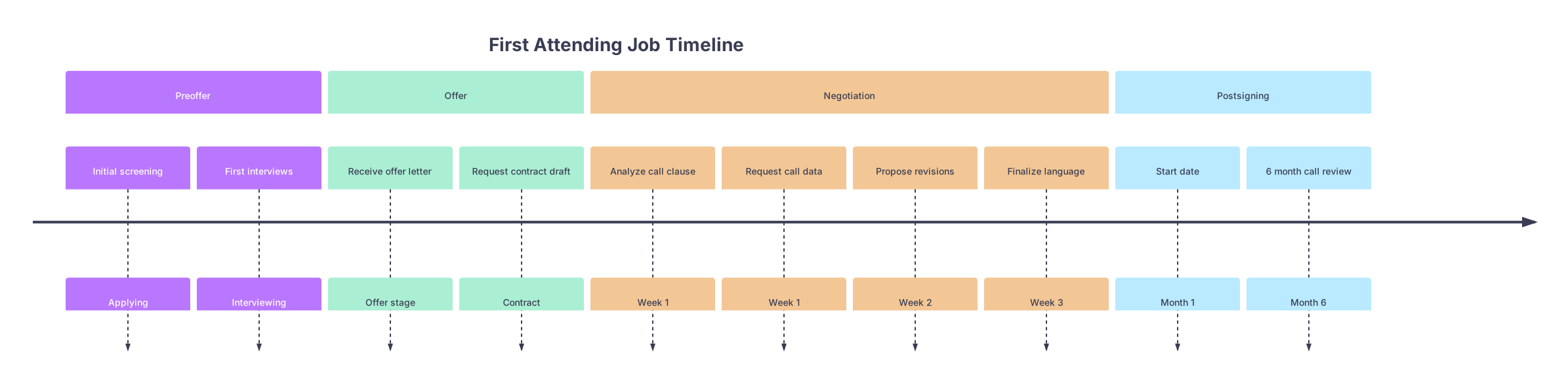
It can help to visualize the full employment agreement timeline, including call negotiation.
| Period | Event |
|---|---|
| Preoffer - Initial screening | Applying |
| Preoffer - First interviews | Interviewing |
| Offer - Receive offer letter | Offer stage |
| Offer - Request contract draft | Contract |
| Negotiation - Analyze call clause | Week 1 |
| Negotiation - Request call data | Week 1 |
| Negotiation - Propose revisions | Week 2 |
| Negotiation - Finalize language | Week 3 |
| Postsigning - Start date | Month 1 |
| Postsigning - 6 month call review | Month 6 |
If they try the “we will sort this out later” line, your answer is very simple:
“Then we will sign later. I cannot rely on unwritten promises once I have moved my life and family.”

Quick Recap: Turning a Weak Call Clause Into a Fair Deal
Force the vagueness into numbers.
Define max call frequency, locations, call type, and what “equitable” means in actual math. If you cannot calculate your worst month from the contract, you are not done.Link call directly to money and exit rights.
Call stipends, per-call pay, RVU adjustments, and material change / early-out clauses turn call from an unbounded obligation into a priced, controlled part of your job.Protect your future self, not your eager new-grad self.
Structure the agreement for what happens when volumes grow, partners leave, and hospitals expand. The goal is simple: you want a contract that keeps you from regretting “reasonable call as assigned” two years from now.


