

It is month 13 of your “dream” attending job.
Your first annual bonus just posted. And it is…embarrassing.
You ran the math three times. Your RVUs are solid. Your schedule is packed. Yet the paycheck does not match what your co-resident at the hospital across town is making—despite similar volume.
You are starting to realize: you signed a bad RVU deal.
Now what?
You have two choices:
- Complain and stay stuck for another contract cycle.
- Treat this like a business problem and methodically fix it.
I am going to assume you want option 2.
1. Diagnose Exactly How Bad Your RVU Deal Is
Before you talk to anyone, you need hard numbers. Feelings do not renegotiate contracts. Data does.
Step 1: Pull every relevant document
Get all of this in front of you:
- Your signed employment contract
- Any compensation addenda or RVU schedules
- Monthly / quarterly RVU reports for the past 12 months
- Collections and payer-mix reports (if you can get them)
- Call schedule and call compensation details
- Any emails clarifying “how it really works” from admin
If you do not have the RVU reports, request them in writing from your practice manager or HR. Be professional, not accusatory:
“For my records and personal productivity tracking, I would like a 12‑month summary of my RVU production by month, along with the RVU rate used for my compensation calculations.”
Step 2: Rebuild your compensation math
You need to reconstruct your deal in plain English. Translate the legalese.
At minimum, know:
- Base salary
- RVU threshold (if any)
- Conversion factor ($ per RVU)
- When RVUs reset (annual? contract year?)
- How and when bonuses are paid
- Any caps or “discretionary” language
Now calculate:
- Total RVUs for year one
- Total compensation paid for year one (base + bonus + call + stipends)
- Your effective $/RVU:
- (Total comp minus any clearly non-RVU pay, like leadership stipends) ÷ total RVUs
Then compare that to benchmarks.
| Specialty | Median $/wRVU | 75th %ile $/wRVU | 90th %ile $/wRVU |
|---|---|---|---|
| Internal Medicine | 55 | 60 | 70 |
| General Surgery | 65 | 72 | 80 |
| Cardiology (non-int) | 70 | 78 | 90 |
| Orthopedic Surgery | 80 | 90 | 105 |
| EM (by hour+RVU) | Varies | Varies | Varies |
(Use current MGMA, AMGA, or SullivanCotter data if you have access. Otherwise, talk to colleagues, recruiters, or your specialty society.)
If your effective $/RVU is 15–30% below local/nearly identical jobs, you have a problem. If it is 40%+ below, it is a bad deal.
Step 3: Identify exactly where the deal is bad
You want to know: is the problem volume, rate, structure, or hidden friction?
Common issues I see:
- Low conversion factor: Everyone else in town is at $60/wRVU; you are at $45.
- High threshold: First 4,500 RVUs “cover your base,” bonus only after that—yet current clinic capacity caps you around 4,600.
- Unpaid work: Hospitalist doing endless “administrative tasks” not counted as RVUs.
- System friction: Poor scheduling, no marketing support, EMR inefficiency killing throughput.
- Bad payer mix: You are in the clinic with 70% Medicaid while others see 30%.
Map it out clearly:
- What you were promised (verbally and on paper)
- What actually happened
- Where the shortfall originates
This diagnosis is your ammo.
2. Build Your Leverage Before You Ask For Anything
You do not walk into admin saying “I feel underpaid.” You walk in saying, “Here is the value I am generating, and here is why adjusting my compensation is in the organization’s best interest.”
That means leverage.
Step 4: Document your value in concrete terms
You are not “hardworking.” You:
- Produced X RVUs vs target Y
- Brought in Z new patients to a service line
- Covered extra call when partners were out
- Took on committee roles, QI projects, or leadership tasks
- Reduced readmissions, complication rates, or LOS (if applicable)
- Expanded clinic access (evenings, weekends, telehealth)
Make a one-page summary. Use numbers, not adjectives.
Example for a hospitalist:
- Target: 4,000 wRVUs/year. Actual: 5,100 (128% of target).
- Picked up 24 extra night shifts due to staffing gaps.
- Led sepsis initiative, dropped door‑to‑antibiotic time by 30 minutes.
- Press Ganey scores increased from 75th to 90th percentile in my census group.
You want leadership thinking: “We cannot lose this person. And we are probably underpaying them.”
Step 5: Quietly understand your market options
I am blunt here: your best leverage is a credible alternative. You do not have to threaten to leave. But you need to know you can.
Without going nuclear:
- Talk to 1–2 physician recruiters (hospital-based and private groups).
- Ask co-residents what they are making for similar RVUs.
- Reach out to one or two chairs / service line directors in your region:
“Curious what typical RVU rates and structures look like for X specialty in your system.”
You are not carpet-bombing ERAS again. You are getting enough data to say, truthfully:
“Based on what I am seeing in the region for my productivity level, my current compensation is well below market.”
If you end up with a soft offer or strong interest from another group, that is even better leverage. Still, you use it carefully.
3. Decide What You Actually Want Changed
“Pay me more” is not a negotiable ask. It is lazy. You need specific, fixable targets.
Step 6: Pick 2–3 concrete changes
Look back at the diagnosis. Then choose your top priorities:
Common levers:
- Increase the per‑RVU conversion factor
- Example ask: from $48 to $60/wRVU
- Lower or restructure thresholds
- Example: bonus starts at 4,000 instead of 4,500; tiered bonuses (higher rate above 5,000)
- Create a hybrid model
- Higher guaranteed base + lower RVU rate or vice versa
- Compensate non-RVU work separately
- Stipends for admin roles, call pay, medical directorship, teaching
- Fix system barriers
- Scribe support, more MA/NP coverage, improved scheduling, protected OR block time
Think business. What has the highest impact and the highest probability of approval?
If you come in with ten demands, you look unfocused. Choose the 2–3 that change your life.
4. Prepare a Structured Renegotiation Plan
Now you plan the actual conversation. You will not improvise this.
Step 7: Get clear on timing and politics
You are trying to fix a bad RVU deal after year one. That is good timing. You now have:
- A full year of productivity data
- A completed “guarantee” period, if you had one
- Some political capital if you have performed well
You need to understand:
- Who actually has authority to change your contract?
- Group president? Service line chief? CFO?
- What is the internal budget cycle?
- Do comp changes usually occur at fiscal year-end?
- Have others in your group renegotiated successfully?
- Quietly ask a senior partner you trust.
You want to talk to the decision maker at a time when they can actually do something.
Step 8: Build your negotiation packet
Yes, an actual packet. You will not staple it and hand it out like a sales brochure, but you will have it with you and ready to email.
Contents:
- One-page Year 1 Productivity Summary
- RVUs, volume, call, key metrics, notable contributions
- Compensation Comparison Snapshot
- Your effective $/RVU vs local/regional benchmarks (clean, not 20 pages of MGMA tables)
- Specific Proposal
- Brief description of changes you are requesting, with numbers
- Business Rationale
- How the change helps retention, recruitment, service line growth, or quality
This is not an emotional letter. This is a business proposal.
5. The Actual Conversation: Script and Tactics
This is where most physicians blow it. They either:
- Come in angry and vague (“I am being exploited”).
- Or they come in timid and apologetic (“Sorry to ask but…”).
You want firm, professional, and data‑driven.
Step 9: Request the meeting the right way
Send a concise email to your direct supervisor or the comp decision maker:
“I would like to schedule 45 minutes to review my first year’s performance and discuss alignment of my RVU compensation structure with my productivity and current market rates. I have summarized my year‑one data and a few concrete proposals that I think are fair and sustainable. Please let me know some times that work in the next few weeks.”
You just signaled three things:
- You have done your homework.
- You are talking about alignment, not a shakedown.
- You have “concrete proposals,” not a rant.
Step 10: Use a clear agenda in the meeting
Rough structure:
Open with appreciation and summary
- “Year one has been busy; I am grateful for the patients I have been able to care for and the trust the group has placed in me.”
- Then pivot: “I want to walk through my year‑one performance and discuss how my current RVU structure could better reflect that value.”
Walk through your data
- “Here are my total RVUs, call coverage, and key contributions.”
- Show your one‑pager. Do not drown them in details. Highlight: you are productive and valuable.
Present the misalignment
- “When I calculate my effective compensation per RVU, I am at approximately $48/wRVU. Regional data for my specialty, productivity tier, and practice setting are typically in the $60–65 range. That is a 20–30% gap.”
Present your proposal calmly and precisely
- “To bring my compensation in line with both my productivity and the market, I would like to propose increasing my RVU conversion factor to $60/wRVU and lowering the bonus threshold from 4,500 to 4,000. At my current RVU level this would place me near the market median for similar positions.”
Tie it to organizational benefit
- “This structure would help ensure I can sustainably continue at my current volume, and it supports recruitment and retention for this service line, where there is already a lot of competition in the region.”
Then stop talking. Let them respond.
6. How to Handle Pushback and Deflection
You will hear some version of:
- “We do not do individual deals.”
- “Budgets are tight right now.”
- “Our comp committee sets these numbers.”
- “Maybe next year.”
Here is how you answer, firmly but constructively.
Common response patterns
1. “We cannot change the RVU rate; it is standard for the group.”
Response:
“I understand the desire for internal equity. What I am asking is for my total compensation to be aligned with my productivity and market norms. If changing the RVU rate is not possible, we could consider other mechanisms: a productivity adjustment bonus, a stipend for my additional non‑RVU work, or modified thresholds. The core issue is the 20–30% gap between my current effective rate and market.”
Force them to solve the problem with you, not just swat away a single solution.
2. “We will review this in the next comp committee cycle; no changes now.”
Response:
“I am glad to hear it can be reviewed. I would like a clear timeline on that process, and I would like my data and proposal formally submitted as part of that review. Given that my year‑one data are strong and the gap is significant, I would also ask that any approved changes be effective at least by the start of the next contract year.”
You are locking them into a process and timeline. Not “someday”.
3. “We cannot match those external numbers.”
Response:
“I recognize not every system can match every dollar. The question is what level keeps this role competitive enough that retention makes sense for both sides. If we cannot get close enough to market to make this sustainable for me long term, then I need to be transparent that I will have to look at other options. I would strongly prefer to stay and continue building what we have started here.”
You did not slam the door. But you clearly stated the consequence.
7. When They Say Yes… And When They Do Not
You will land somewhere on a spectrum:
- Full win (they bump rate/thresholds meaningfully)
- Partial win (smaller raise, some stipends, minor tweaks)
- Polite stall or flat denial
Step 11: If you get movement, nail down the details
Verbal agreements mean nothing without:
- Written contract amendment
- Clear effective date
- Explicit new RVU rate / thresholds / bonuses
Examples:
- “$60/wRVU for all wRVUs above 4,000 annually, effective July 1, 2026.”
- “$20,000 annual stipend for X administrative role, paid in equal monthly installments.”
- “Tiered bonus: $55/wRVU between 4,000–5,000; $65/wRVU >5,000.”
Get it in writing. Review it yourself or with an attorney before signing.
Step 12: If they barely budge (or not at all)
This is where you make a real decision.
Ask yourself:
- With the new offer (if any), what is my effective $/RVU?
- How far from market am I still? 5–10%? Or 30%?
- Is this organization likely to change in the next 1–2 years?
- Do I have or can I get a better offer elsewhere?
If you are still significantly underpaid and leadership basically shrugged, the message is clear:
They do not prioritize physician compensation competitiveness. At least not yours.
At that point, if market data and recruiters say you can do materially better elsewhere, you start a serious search. Quietly but intentionally.
8. Improve Your RVU Reality Even Before the Contract Changes
While you are negotiating (or planning your exit), you can still attack the problem from your side.
Step 13: Optimize your own RVU generation
You are not a factory. But you are running a small business with your name on it. There are usually easy wins:
- Fix scheduling:
- Block “new patient” vs “follow-up” slots intelligently.
- Reduce no‑shows with reminder systems, waitlists.
- Streamline documentation:
- Use templates and smart phrases for common visit types.
- Train your MA/scribe to pre‑load HPI, ROS, and orders.
- Scrub coding:
- Review if you are under-coding. Many new attendings are.
- Meet with coding/billing to review sample charts and E/M levels.
- Protect your high‑RVU work:
- For procedural fields, fight for blocks that are not constantly bumped.
- Offload low‑value, non‑billable work from your schedule where possible.
A lot of physicians whine about RVUs while leaving 10–20% on the table from sloppy operational habits.
Step 14: Get systems fixes that help everyone
Some requests are easier for leadership to swallow because they benefit the whole group:
- Add shared scribes or better MA ratios.
- Improve referral pathways so your schedule is consistently full.
- Push for more efficient EMR templates.
If they will not pay you fairly, at least make it easier to hit high RVU levels with less personal burnout.
9. When and How to Walk Away
Sometimes the honest answer is: this deal is not fixable here.
Signs you should seriously consider leaving:
- They refuse even modest, data‑backed adjustments after high productivity.
- Multiple colleagues quietly say, “Yeah, nobody here ever gets real raises.”
- Market data shows you could earn 30–50% more with similar or better work elsewhere.
- The culture is clearly “administrator-first, physician last.”
You do not need to quit tomorrow. But you do need a deliberate exit plan.
Step 15: Build a 6–12 month exit plan
If you decide a move is likely:
- Polish your CV and get letters / references lined up.
- Talk with trusted recruiters and target systems with transparent compensation.
- Ask detailed RVU questions before signing anywhere else:
- Historical average RVUs of current physicians.
- Specific thresholds and conversion factors.
- Call burden and compensation.
- How often comp plans are revised and by whom.
And yes, you use your bad first deal as a learning tool. You will not repeat the same mistakes twice.
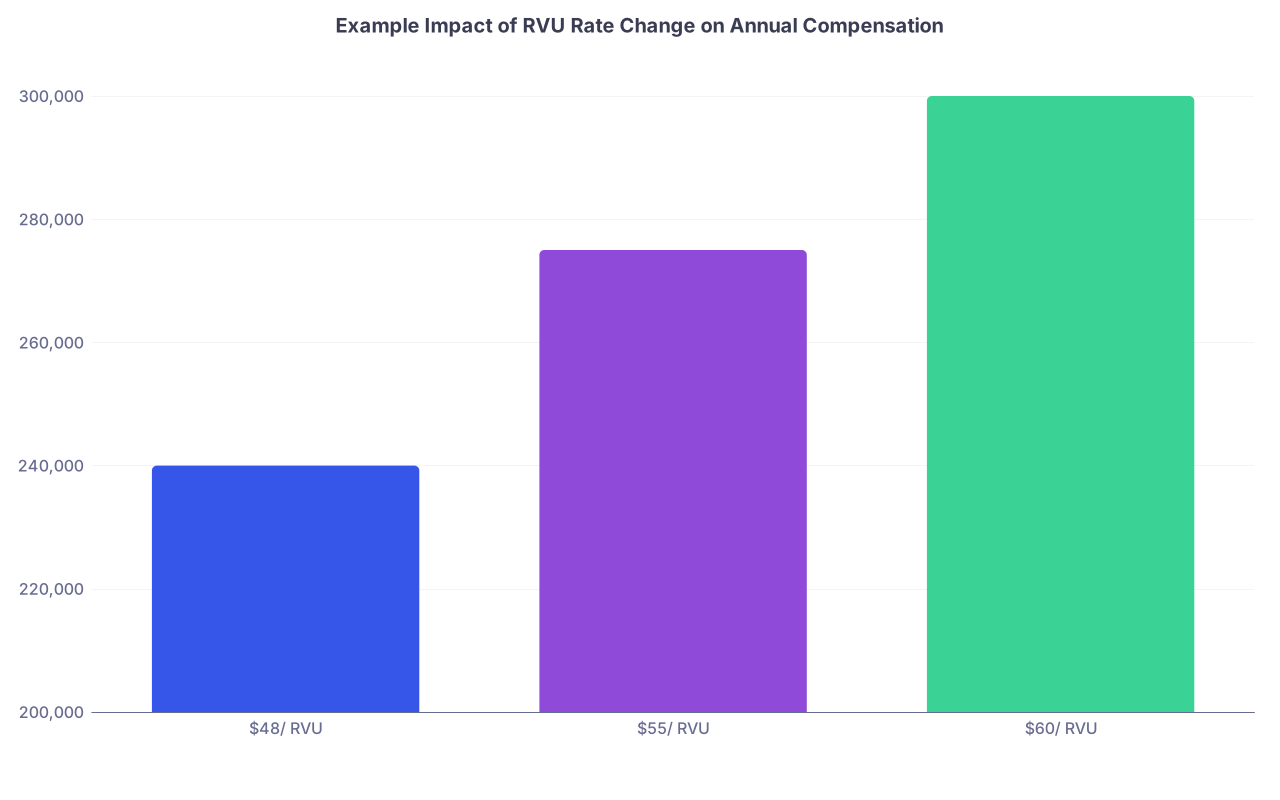
| Category | Value |
|---|---|
| $48/ RVU | 240000 |
| $55/ RVU | 275000 |
| $60/ RVU | 300000 |
(Assuming 5,000 RVUs/year and no other changes.)

| Step | Description |
|---|---|
| Step 1 | Year One Complete |
| Step 2 | Diagnose RVU Deal |
| Step 3 | Build Data and Leverage |
| Step 4 | Define Specific Requests |
| Step 5 | Meet With Leadership |
| Step 6 | Review and Sign Amendment |
| Step 7 | Improve Ops and Reassess |
| Step 8 | Plan Exit and Explore Market |
| Step 9 | Meaningful Change? |
| Step 10 | Still Underpaid? |

FAQs
1. Should I bring up outside offers directly in a renegotiation?
Use outside interest as implicit leverage, not a blunt weapon. If you have concrete offers, you can say:
“Based on discussions I am having with other systems in the region, I am seeing offers in the range of X–Y for my specialty and productivity level. My strong preference is to stay here if we can get reasonably close to that.”
Do not slam an offer letter down on the table unless you are genuinely ready to leave. Empty threats backfire fast.
2. How much of an RVU increase or rate change is realistic to ask for?
If you are badly under market (20–30% below), it is reasonable to aim for closing most of that gap—say 15–25% improvement—either through a higher $/RVU, lower thresholds, stipends, or bonuses. Asking to go from the 10th percentile to the 90th percentile in one jump is unrealistic. Asking to move from 10th to 40–50th percentile with strong performance data is reasonable.
3. Who should review my contract before I sign any amendment?
Use a physician‑side healthcare attorney or a contract review service that actually knows RVU models, not a general business lawyer. Ideally someone who:
- Reviews multiple physician contracts per month
- Has access to current benchmark data
- Understands your specialty’s typical metrics
Spend the $500–$1,500. The return on investment when you are dealing with six‑figure compensation swings is enormous.
Today’s next step is simple:
Pull your contract and your last 12 months of RVU reports. Sit down for 30 minutes and calculate your effective $/RVU. Compare that to one credible benchmark source. That single number will tell you whether you are mildly underpaid, badly underpaid, or in decent shape—and it will determine how aggressively you need to fix this deal.


