

Compensation committees are not neutral arbiters of “fair market value.” They are the mechanism hospitals use to keep a lid on what they pay you.
Let me walk you through how it actually works behind those closed-door meetings where your name is a line item and your “RVU bonus” is a rounding error on a PowerPoint slide.
How Compensation Committees Really Operate
Every hospital and large group loves to say, “Your offer was reviewed and approved by the compensation committee.” Sounds official. Objective. Safe.
Reality: it’s a small group of people whose job is to protect the institution from paying you “too much,” while staying cosmetically compliant with Stark, Anti-Kickback, and IRS rules.
Who’s usually in that room?
- CFO or VP of Finance
- CMO or Physician Executive (often long since converted to admin thinking)
- HR/Legal representative
- Sometimes a board member or two
- Occasionally a senior physician representative who’s been around forever and now thinks in spreadsheets
They’re not sitting there asking, “What would be truly competitive to land and retain this doctor?” They’re asking two questions:
- Can we justify this number to auditors using MGMA/AMGA data?
- If we approve this, how many other doctors will show up pissed asking, “Why are they getting more than me?”
So the default posture is conservative. Clamp down. Contain variation. Avoid setting “bad precedents.”
You feel that as: lowball offers, “caps” on productivity bonuses, mysteriously rigid “bands,” and a lot of hand-waving about “policy.”
The Four Levers They Use to Cap You
They don’t say, “We’re capping you.” They use structures that look reasonable at first glance but are designed to sit on your upside.
Here are the four levers I’ve watched them use again and again.
1. Misusing “Market Data” as a Ceiling, Not a Range
The religion of hospital compensation is MGMA (or AMGA, SullivanCotter, etc.). Everybody quotes “percentiles.” Almost nobody actually understands how those surveys work.
I’ve literally sat in comp meetings where the CFO said, “We do not pay above the 75th percentile. Period.” No nuance. No context.
Here’s the trick: they’re using the total compensation percentile as a hard ceiling instead of using it as a benchmark for what’s defensible.
So the conversation goes like this:
- Recruiter: “Candidate wants $475k base.”
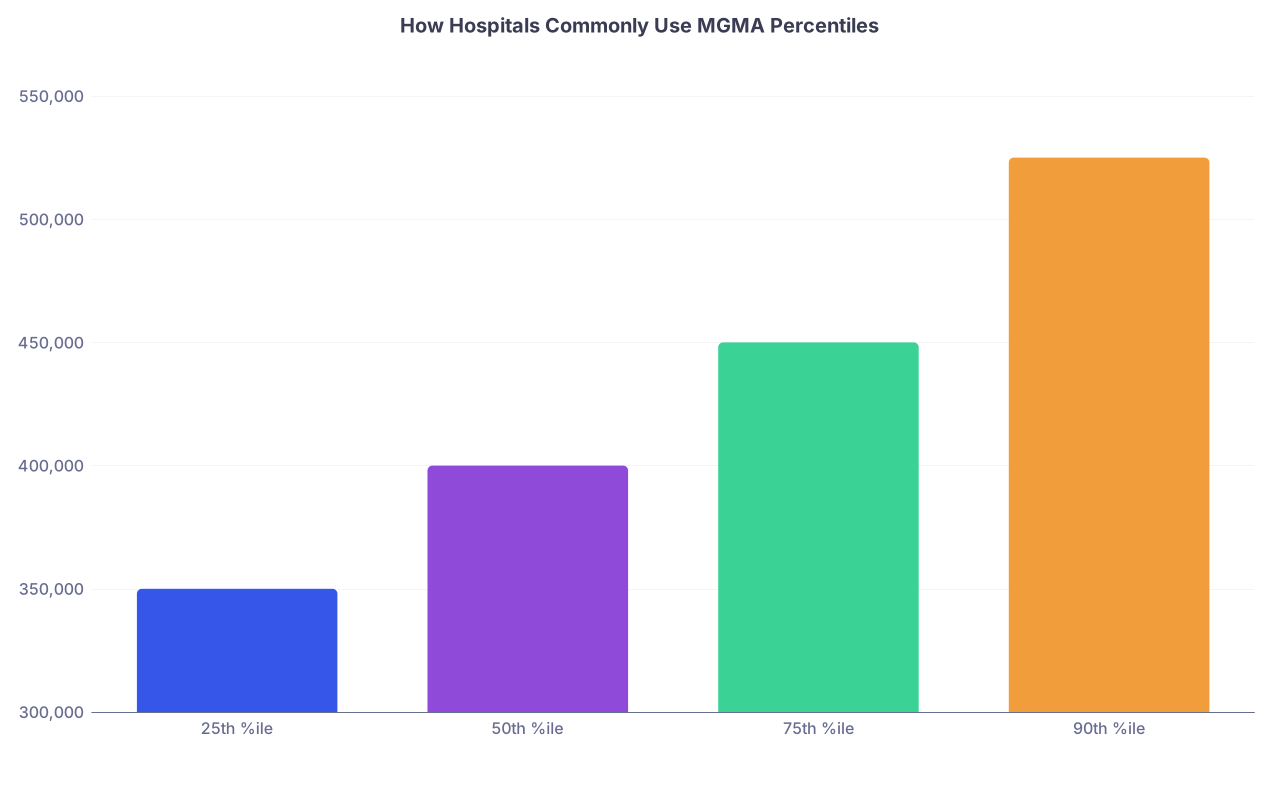
- Finance: “Our MGMA 50th percentile is $400k, 75th is $450k. We can’t justify $475k.”
- CMO: “Can we shift to more bonus?”
- Finance: “Fine, but total potential can’t exceed 75th either.”
End result: base, bonus, total comp — all welded to a pre-decided ceiling. They’ve turned “market data” into a weapon against you.
Here’s the part they rarely admit: those MGMA numbers include people in low-paying markets, inefficient practices, and underperforming docs. They’re averages. Not “what a strong recruit with leverage should accept.”
To see it visually:
| Category | Value |
|---|---|
| 25th %ile | 350000 |
| 50th %ile | 400000 |
| 75th %ile | 450000 |
| 90th %ile | 525000 |
Inside that room, the “policy” often becomes: no base offers above the 50th, no total comp models above the 75th. The 90th might as well not exist.
2. Designing RVU Models That Look Generous but Are Quietly Choked
You’ve seen this:
“Base salary $260,000 plus productivity bonus at $55 per wRVU over 6,000 wRVUs.”
You calculate your residency numbers, see that colleagues hit 7–8k easily, and think, “This is solid. I’ll crush that.”
Then three things happen:
- Your work RVU crediting is tighter than you realized (hospitalist admits split, APPs absorbing codes, attribution games).
- The committee has set the wRVU threshold high enough that you’re sprinting just to get into bonus territory.
- There’s a hard cap on total bonus payout, buried in one sentence on page 7 of the comp plan.
Typical language: “Total compensation (base plus incentives) shall not exceed the 75th percentile of current market data for similarly situated physicians.”
Translation: You can blow past every RVU target they dreamed up, but if your calculated payout crosses that percentile line, they just stop counting. Or they “true up to fair market value” at year-end and quietly trim the excess.
I’ve seen this play out with a high-volume GI doc:
- Contract: $500k base + $65/wRVU above 9,000, no explicit cap listed in the “summary.”
- Reality: buried in the policy manual (not attached to the contract): “Total comp may not exceed MGMA 75th percentile plus 10%.”
- Doc produces like a monster, runs to $850k on paper.
- Year-end: CFO emails, “Per system policy, we’re capping at $720k this year. Appreciate your hard work.”
He threatens to walk. They shrug. Because the committee’s job is to keep that cap intact system-wide.
3. “Equity” and “Internal Parity” as Club Weapons
This one’s insidious because it sounds noble.
The CMO says: “We have to maintain equity. We can’t pay new hires more than people who’ve been here ten years.”
What that really means is: “Our long-tenured people are underpaid relative to current market, and instead of fixing that, we’ll keep new folks down to avoid triggering a revolt.”
Comp committees obsess over “compression.” They’re terrified of the senior doc who finds out the new hire makes more. So they do two things:
- They anchor new offers to existing underpaid faculty.
- They categorically refuse outlier deals, even when market reality has shifted.
I watched a hospitalist group implode over this. They’d been paying $250k for years. Market jumped to $310–330k in that region. They tried to hire new grads at $260–270k “to preserve internal equity.” Guess what happened? Couldn’t hire. Current staff left for nearby systems paying $320k. The committee only adjusted after the exodus.
So when you hear, “We have to be fair to the others,” understand: they’re using someone else’s outdated contract as the excuse for not paying you what the real market is offering.
4. Calling Everything “Policy” So They Don’t Have to Say “We’re Choosing Not to Pay You More”
You’ve heard variations:
- “We don’t negotiate base salary; it’s formula-based.”
- “Our bonus structure is standardized for all physicians in your specialty.”
- “We can’t change that; it’s how the committee approved the model.”
Here’s the behind-the-scenes truth: those policies were created by people. Often in a way that explicitly limited physician pay to stay within pre-set budget targets.
I was once shown a slide deck used to justify a new comp plan at a mid-size system. One slide literally said: “Objective: Reduce top quintile physician compensation by 10–15% over three years while improving retention through non-cash benefits.”
That “objective” later became “policy.”
So when they tell you, “policy,” what they mean is: “We’ve decided our physician labor line is too expensive and built a structure to fix that. You are not special enough to override it.”
The Timeline You Don’t See: When Your Number Gets Locked In
By the time you’re on the phone with a recruiter hearing your “initial offer,” the key decisions about your ceiling were made weeks or months earlier.
Here’s how the machinery typically runs:

| Step | Description |
|---|---|
| Step 1 | Service line says we need a doc |
| Step 2 | Finance sets budget range |
| Step 3 | Draft comp model using MGMA percentiles |
| Step 4 | Comp committee reviews and approves range |
| Step 5 | Recruiter delivers offer to candidate |
| Step 6 | Sign at low end of range |
| Step 7 | Minor tweaks within preapproved band |
| Step 8 | Committee re-approval only if major change |
| Step 9 | Candidate negotiates? |
Key point: the “range” they’re allowed to offer you is nailed down between B and D. Everything after that is theater unless you push hard enough to force a revisit to the committee.
Most candidates never get there. They argue with the recruiter, who has maybe 5–10% wiggle room. The real ceiling — the number Finance and the committee drew a bright line at — never gets touched.
How They Quietly Limit High Producers
If you’re average or a bit above, you’ll just feel underpaid and annoyed.
If you’re a genuine high producer, you will slam straight into the steel beam they installed at the top of your comp model.
You’ll see it in a few forms:
- RVU multipliers that never get adjusted as your volumes climb.
- Thresholds bumped up annually “for budget reasons” but bonus rates held flat.
- Mysterious “recalibration to market” letters that show up the year after you finally had a monster year.
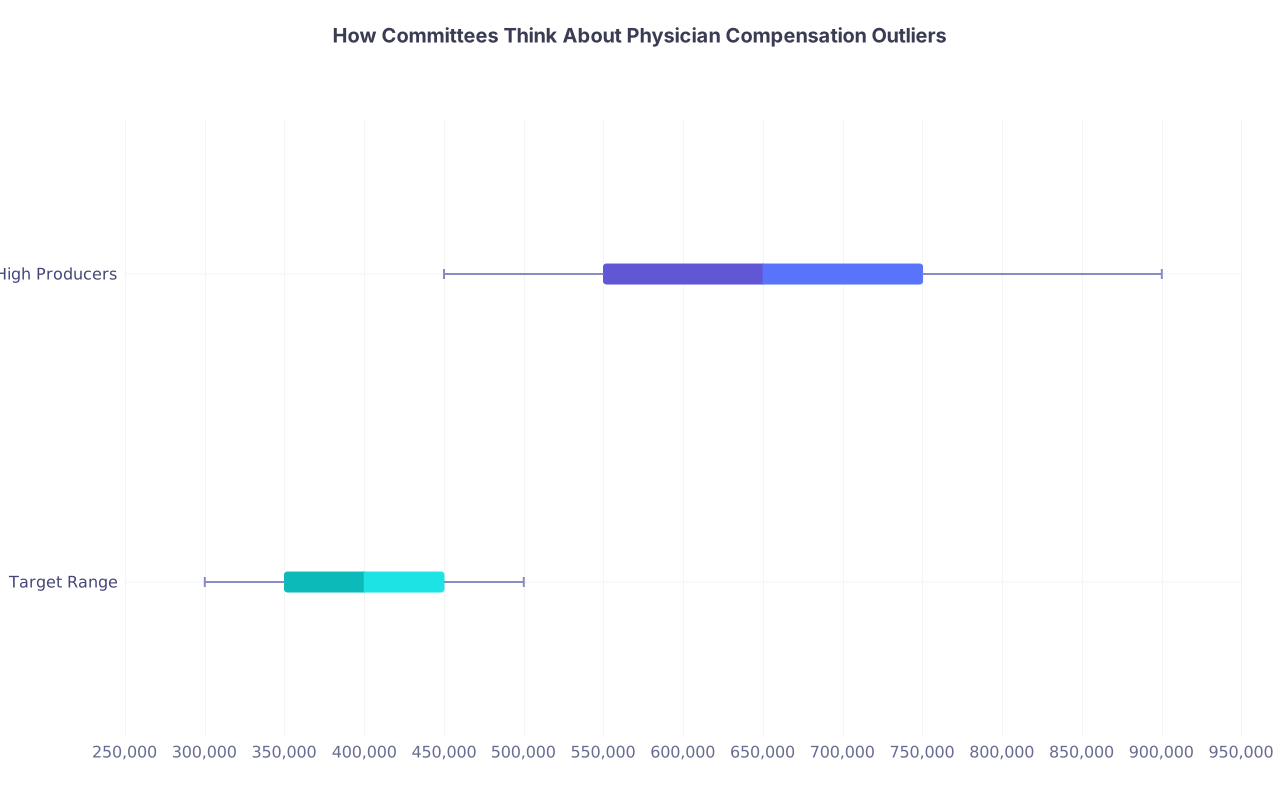
Take a look at how Step 1-style “distributions” look inside their minds when they talk about physician comp:
| Category | Min | Q1 | Median | Q3 | Max |
|---|---|---|---|---|---|
| Target Range | 300000 | 350000 | 400000 | 450000 | 500000 |
| High Producers | 450000 | 550000 | 650000 | 750000 | 900000 |
They’re deeply uncomfortable with that right tail. So they engineer the plan so that:
- The 25th–75th percentile is easy to justify and matches the budget.
- Above the 75th, the marginal dollars per RVU drop effectively to zero due to caps and “fair market” adjustments.
They’ll call it “protecting the organization from compliance risk.” Sometimes that’s even partly true. But they will almost never spend real political capital with the board to design a model where a truly excellent, high-volume physician can land in the 90–95th percentile of pay year after year.
Too messy. Too many awkward conversations with “average” physicians asking why they aren’t paid the same.
The Compliance Shield: How Stark Becomes a Convenient Excuse
Here’s the legal card they love to play when you push:
“We can’t go higher. Stark and Anti-Kickback require that we stay within fair market value.”
Partial truth. Distorted application.
Regulators care that:
- Compensation is commercially reasonable.
- There’s no direct tie to the value or volume of referrals in a way that violates law.
- Total compensation is within a defensible “fair market value” range.
What they quietly skip over: “Fair market value” is not a single number, and there’s no law that says “you may not exceed the 75th percentile under any circumstances.”
But in that committee room, compliance becomes the shield to block every request:
- You want a higher base? “FMV.”
- You want richer RVU rates because you’re in a brutal call pool? “FMV.”
- You want a signing bonus commensurate with an extremely tight market? “FMV.”
I watched one institution pay a cardiothoracic surgeon at the 85–90th percentile because they genuinely had to to keep the service line alive. Compliance signed off. No raids. No fines. It was fine.
But the committee still told every hospitalist, every primary care doc, every non-surgical subspecialist, “We don’t go above 75th. Compliance won’t allow it.”
That was not law. That was policy hiding behind law.
Where You Actually Have Leverage (If You Use It Early)
You can’t bulldoze the compensation committee, but you can force them to reconvene and reconsider you as an exception. That’s the whole game.
Two rules:
- Your leverage is front-loaded. It’s strongest before you sign anything, before they’ve “plugged you into the model,” and ideally before they’ve finished their first committee pass on your slot.
- Your leverage comes from alternatives and risk. The more you can credibly walk away, the more admin will go back to the committee to argue for stretching the range.
Most physicians do the opposite. They fall in love with a job, tell everyone it’s their top choice, move their spouse, then try to negotiate a bigger number. That’s dead on arrival in a committee.
Let me put it in a table you’d never see in an official handbook but absolutely reflects internal behavior:
| Candidate Situation | Committee Response |
|---|---|
| Single offer, very eager | Stay at bottom of range |
| Multiple offers, same region | Move to mid-range if pushed |
| Competing offer significantly higher | Consider upper range or structure tweak |
| Unique skill set / service line at risk | Approve above standard range |
| Already local, no other offers, tied down | Minimal movement, cite 'policy' |
Your job is to be in the third or fourth row when your name hits that committee agenda.
Which means:
- Have real, written competing offers, not just “interest.”
- Be explicit with the recruiter: “Institution X has offered $Y base, $Z sign-on, and a lower call burden. I want to be here, but I can’t justify leaving that on the table.”
- Push them to take a specific ask back to the committee: “If you can get to $___ base and $___ sign-on, I will sign this week.”
Do not just say, “Can you do any better?” That gives the recruiter room to toss you crumbs within their personal wiggle band and never bother the committee.
How to Read (and Break) the Hidden Caps in Your Offer
Most caps are either buried or implied. You have to smoke them out.
Three questions I’d always ask, verbatim:
- “Is there any cap on total compensation under this plan, including base, bonus, and any quality incentives?”
- “Is there any separate policy or document outside this contract that limits total compensation based on benchmarks or percentiles?”
- “If my productivity significantly exceeds the wRVU threshold, is there any point at which additional wRVUs are not compensated?”
If they dance around, you insist — calmly — on written clarification. I don’t care if it’s a one-page email from HR: “There is no cap,” or “Total compensation is limited to $X per year based on current FMV analysis.”
Then you decide if you’re willing to live with that ceiling.
When you see language like “Total compensation shall be consistent with fair market value as determined by the Employer,” translate it as: “We reserve the right to unilaterally decide you’re making too much and claw you back to a number we’re comfortable with.”
That doesn’t mean you walk. It means you:
- Push for higher base if the bonus is effectively capped.
- Push for shorter contract term or earlier renegotiation points.
- Push for higher, guaranteed sign-on or loan repayment that won’t be “FMV-adjusted” later.
Short contracts with big front-end guarantees are often the only way around a conservative committee. Three years from now, you can revisit with leverage from actual performance data and competing offers.
The Emotional Trap: How They Count on You to Self-Cap
There’s one more thing they lean on heavily: your discomfort with conflict and your identity as a “team player.”
I’ve heard C-suite chatter that sounds like this:
- “She seems very mission-driven. She won’t push on comp.”
- “He’s from this area, has family here. He’s not going anywhere.”
- “She said her spouse already took a job in town. Offer the low end; she’ll accept.”
Your personal life becomes part of their risk calculus. The more rooted you seem, the safer it is for them to keep you under the committee’s pre-set caps.
So you have to separate your internal desire to be nice from your external negotiation posture. You can be collegial and collaborative on the surface while being absolutely clear that you won’t subsidize the institution’s labor budget with your lifetime earnings.
That means:
- Not pre-announcing that you’re “definitely coming here” before seeing the contract.
- Not oversharing your lack of options or desperation.
- Not apologizing for asking for more. Ever.
High performers in every other field understand this. Physicians, conditioned by training to be deferential to authority, often don’t. Compensation committees count on that.
A Quick Visual of Where the Money Actually Goes
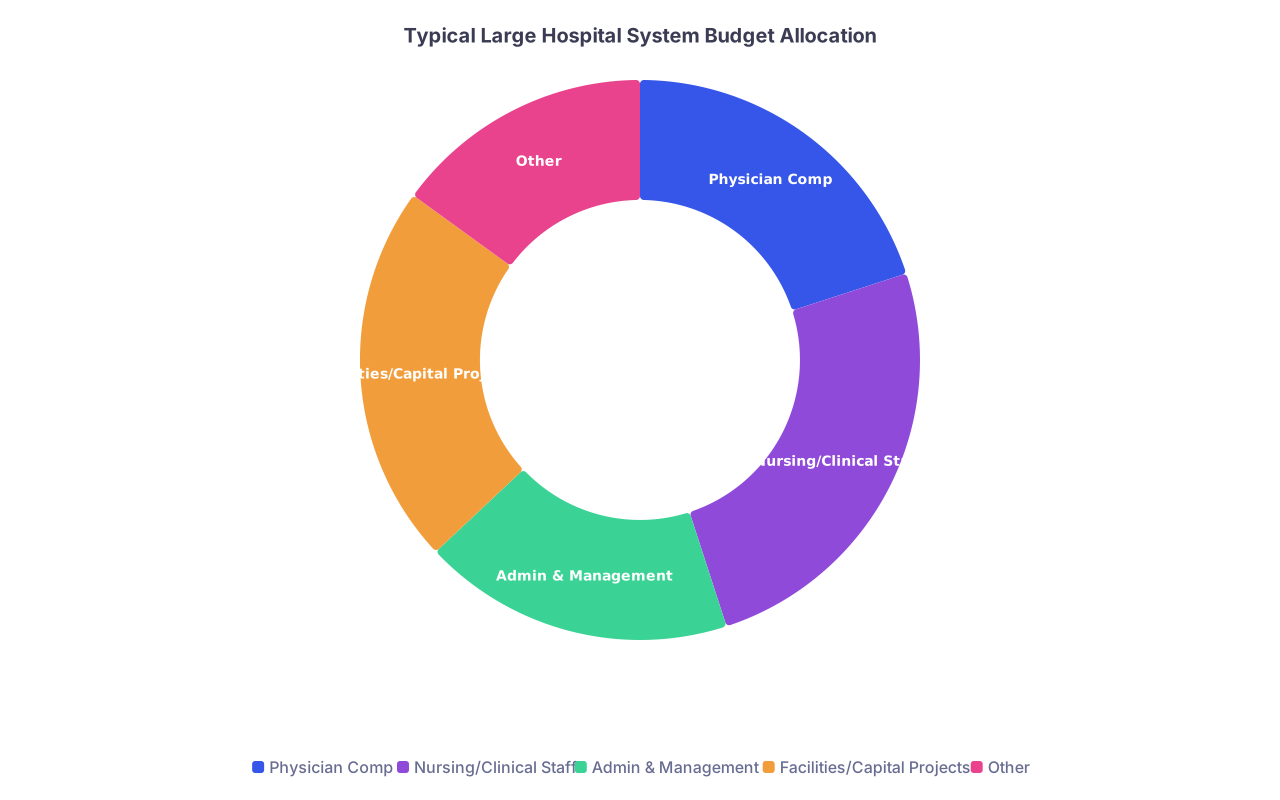
You’ll also hear the quiet refrain: “We just don’t have the budget.” Funny how that never applies to buildings, consultants, and admin layers.
Here’s a simplified snapshot that looks uncomfortably familiar:
| Category | Value |
|---|---|
| Physician Comp | 20 |
| Nursing/Clinical Staff | 25 |
| Admin & Management | 18 |
| Facilities/Capital Projects | 22 |
| Other | 15 |
Is that exact distribution for every system? No. But it’s close enough that CFOs don’t like showing it to line clinicians. When they say “we can’t go above 75th percentile,” what they often mean is “we’d rather not shrink any of these other slices.”
FAQ: What Most Physicians Ask Once They See Behind the Curtain
1. Can I really get a committee to approve an above-75th percentile deal as a new grad?
Yes, but you need genuine leverage: hard-to-fill specialty, underserved market, or a direct competing offer that’s clearly stronger. I’ve seen new interventional cardiologists, GI, heme/onc, and even hospitalists in brutal markets land above-75th packages when the admin’s alternative was losing the service line. You won’t get it by “asking nicely.” You get it by making them afraid of losing you.
2. If my contract has “FMV adjustment” language, should I walk away automatically?
Not automatically. That language is everywhere now. What matters is how they apply it in practice. Ask how often they’ve actually reduced comp for FMV reasons in the last five years and under what circumstances. If they can’t give a straight answer or if multiple physicians tell you their bonuses magically shrank after one good year, treat that as a hard warning.
3. Is private practice really better for avoiding these caps?
Often, yes, but with very different risks. In a well-run private group you’re closer to the actual revenue and overhead, so your upside can be much higher. There’s usually no separate “committee” deciding a theoretical ceiling. But you inherit payer risk, business risk, and partnership politics instead of hospital politics. Some groups quietly cap associate income via buy-in structures and opaque expense allocations. Different flavor of the same problem.
4. What’s the single most valuable thing I can do before negotiating my first job?
Get at least two serious offers in writing and force yourself to be willing to walk from each. That clarity changes how you talk, the questions you ask, and the way recruiters and administrators talk about you behind closed doors. I’ve watched the exact same CV go from “We can’t move above $260k” to “We got special approval for $300k and extra sign-on” once there was a credible alternative on the table.
5. If I’m already stuck in a capped model, how do I fix it?
You need two parallel tracks: internal and external. Internally, document your productivity, your role in key programs, and specific revenue you drive. Time your renegotiation to leadership transitions or contract renewal points. Externally, quietly shop your CV and get real offers. Then go back and say, “I want to stay, but here’s what the market is paying for my role and output. Can you take this to the committee?” If they won’t move, believe them—and leave. Hoping they’ll “do the right thing” keeps you inside their cap indefinitely.
If you strip away the show, compensation committees do three main things that matter to you:
They turn “market data” into a hard ceiling, not a guideline.
They quietly design caps and “policies” that choke your upside while sounding fair and compliant.
They rely on your reluctance to push back and your lack of alternatives to keep you under that ceiling for years.
You will not change that system. But you can learn to see it clearly, position yourself outside its lowest bands, and refuse to be the easy line item they shave to make the budget work.


