

The biggest lie in physician recruiting is not about salary. It is about partnership.
Every year I watch brand‑new attendings sign “partnership track” contracts that were never meant to end in partnership. They were meant to be cheap labor with a carrot on a stick. And yes—people on the inside know it and still say nothing.
Let me walk you through how this game is actually played.
What “Partnership Track” Really Means Behind Closed Doors
Recruiters love the phrase “2‑year partnership track.” Sounds clear. Linear. Almost guaranteed.
In partner meetings, the language is different:
“Let’s see how they do in the market.”
“See if they’re a cultural fit.”
“If the numbers support it.”
Translation: the “track” is conditional, not promised. The expectations are often unwritten. And they are very happy if you never quite make it.
In real life, partnership track usually means four separate things layered together:
- A probationary employee phase where you’re underpaid relative to your production and have very little power.
- A set of informal expectations no one will spell out in your offer letter but everyone will judge you on.
- A buy‑in structure that may or may not make financial sense by the time you get there.
- A gatekeeping culture—i.e., do the senior partners like you enough to share the pie?
Most residents only see point one. They think, “Two or three lean years, then I’m partner.” That’s not how senior partners think.
The unspoken truth: in many groups, the partnership funnel is intentionally narrower than the recruitment funnel.
They will happily hire 3 “potential partners” knowing full well they’re only ever going to offer partnership to 1.
The Numbers They Don’t Show You When They Say “Track”
You’ll never understand partnership until you look at the economics the way a partner does, not the way a resident does.
Here’s the basic money reality:
- As an associate, you’re usually on a salary + bonus structure where the practice keeps the spread between what you produce and what they pay you.
- As a partner, you share in the profits generated by everyone—your work, their work, ancillary services, PE distributions, imaging, ASC, lab, etc.
So ask yourself: why would they be in a rush to convert you from profitable associate to profit‑sharing partner?
They aren’t.
Here’s a scenario I’ve seen more than once:
- You’re offered $275–300k in a community outpatient specialty with “partnership at year 2.”
- You end up producing $800k in collections by year 2 because they dump volume on the new person.
- Overhead (including shared staff, rent, billing, malpractice, etc.) is 50–55%.
Do the math:
$800k collections – 55% overhead = $360k.
They’re paying you $300k all in. They keep the extra $60k margin, plus they keep all the facility fees, imaging center profit, maybe even the in‑office ancillaries.
Now multiply that by 3 associates who never quite make partner.
I’ve literally heard a senior partner say in a closed meeting:
“Honestly, the associates are our best business line. We need one or two on the bubble at all times.”
Recruiters won’t tell you that. Their job is to fill the slot, not expose the structure.
To make this clearer, look at how the “value” of keeping you as a non‑partner compares to bringing you in:
| Scenario | What the Group Gets |
|---|---|
| Non‑partner associate | Keeps margin between your collections and your comp; keeps all equity and ancillary profit |
| New partner | Must share practice profits; dilutes existing partner profit per partner |
| Associate leaves | Short‑term pain; long‑term, can replace with another lower‑paid associate |
| Extend track by 1–2 years | Extra years of margin; delays dilution of partner profit |
Once you see that table in your head, you stop assuming they’re “on your side” about timing.
The Fine Print Tricks: Where the Track Quietly Becomes a Maze
The contract itself is usually where you get misled, but not in the obvious ways.
The recruiter will highlight:
“Two‑year track.”
“Typical partner comp of $500–700k.”
“Buy‑in around 1x your annual salary.”
What they will not highlight is how those promises can be quietly neutered.
Here are the patterns I see over and over:
1. “Partnership eligible” vs “Partnership guaranteed”
That word “eligible” is not an accident. It’s a legal shield.
Contract language will read something like:
“Physician shall be eligible for consideration for partnership after completion of two years of employment, subject to partner vote and practice bylaws.”
You read that as: “Partner after 2 years, assuming I don’t screw up.”
They read that as: “We’ll decide later if we feel like it.”
Huge difference.
2. Bylaws you’re never allowed to see
This one is nasty. Many offers say partnership terms are outlined in “the practice’s operating agreement and bylaws,” which are “available upon request.”
Then when you ask, you get some version of:
“We’ll share that when you’re closer to the decision point. It changes from time to time.”
Red flag.
I’ve seen bylaws that required:
- Supermajority (e.g., 80–90%) partner vote for admission of a new partner.
- Mandatory unanimous vote for any new equity stakeholder.
- Different share classes where founders have voting power you’ll never get.
On paper, there is a path. In practice, it’s close to impossible.
3. Moving goalposts on “productivity” and “citizenship”
This is the subtle one. The criteria for partnership are often vague:
- “Satisfactory productivity”
- “Exemplary professionalism and citizenship”
- “Business needs of the practice at the time”
So they can always say later:
“Your RVUs were fine, but your patient satisfaction scores need to improve.”
or
“We’re in a soft market right now; we need another year of data.”
If they want you, those phrases become flexible in your favor. If they don’t, they become weapons.
How Long Do Tracks Really Take? The Unspoken Timelines
Let’s cut through the fantasy and talk about how long tracks actually run in the wild.
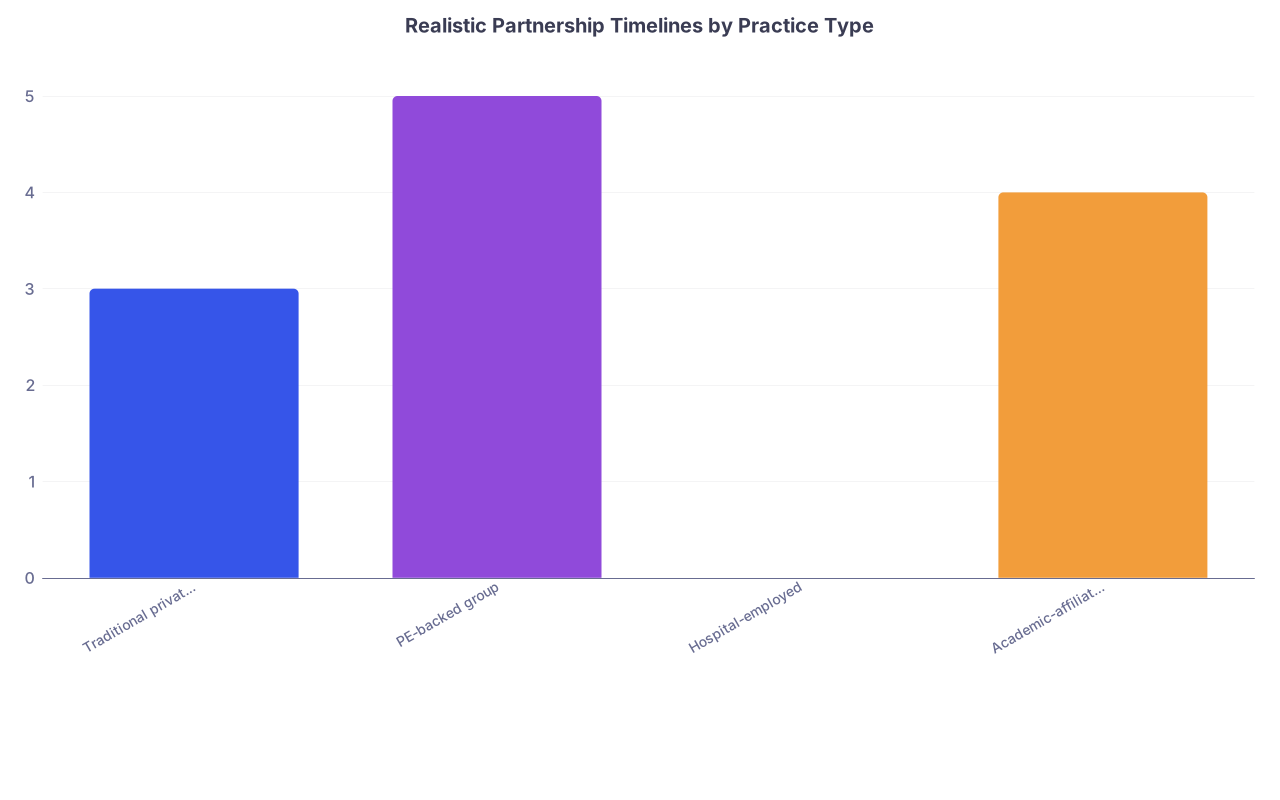
| Category | Value |
|---|---|
| Traditional private group | 3 |
| PE-backed group | 5 |
| Hospital-employed | 0 |
| Academic-affiliated private | 4 |
That’s the reality:
- Traditional independent groups: 2–3 years on paper; 3–5 years in real life for many.
- Private equity‑backed groups: often 4–6+ years, if partnership ever really means true equity.
- Hospital‑employed groups: “partnership” is usually a branding trick; what you really get is seniority, not ownership.
- Academic‑affiliated private practices: variable, often 4+ with a lot of politics.
I’ve seen “2‑year” tracks turn into the following script at the end of year 2:
“Honestly you’re doing great. We usually like to see 3 full years of data before making someone a partner. It’s standard here. We should be ready to talk specifics next year.”
This was never mentioned in recruiting. It was, however, well understood internally.
By the way, here’s the other unspoken number: attrition.
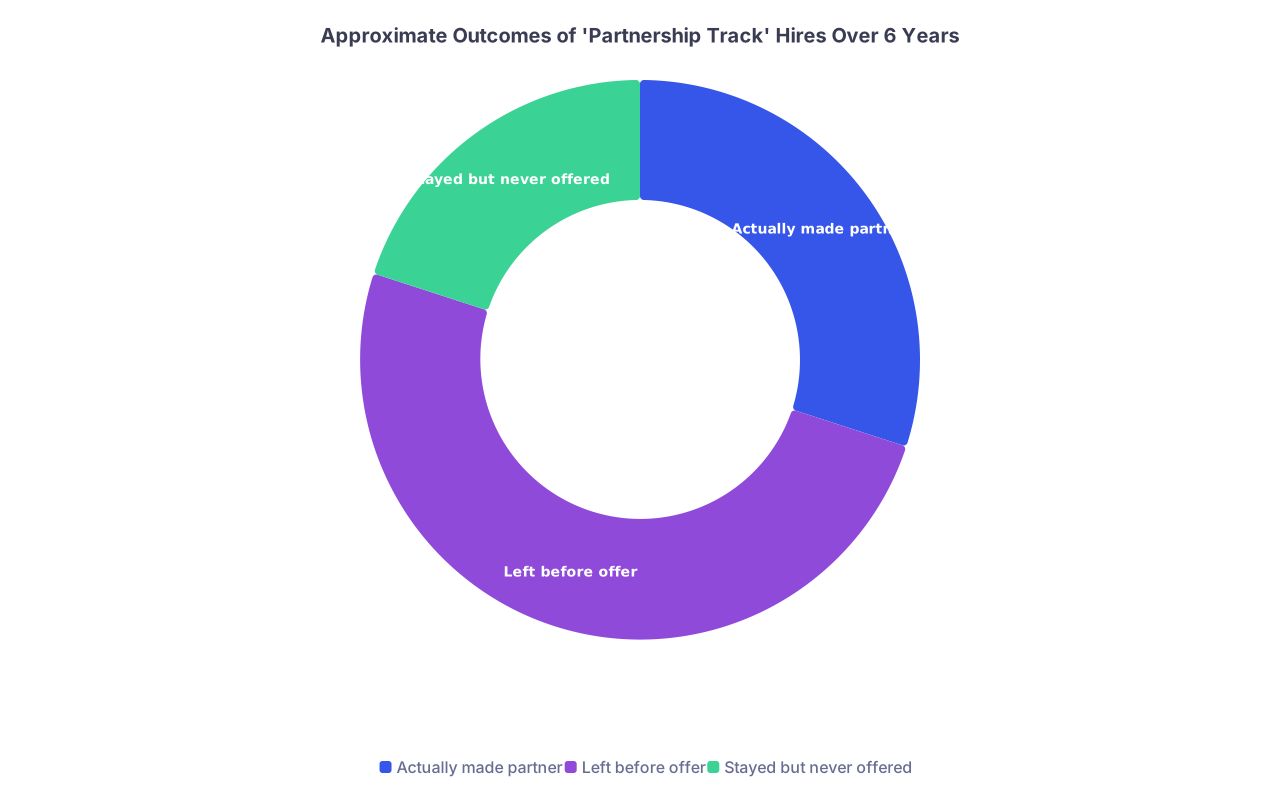
| Category | Value |
|---|---|
| Actually made partner | 30 |
| Left before offer | 50 |
| Stayed but never offered | 20 |
These are rough, of course, but they track reality: it’s quite common that only about a third of “track” hires eventually become true partners. The rest either leave or live forever in associate limbo.
No one shows you that pie chart on interview day.
Cultural Gatekeeping: The Test You Don’t Know You’re Taking
Here’s the part residents underestimate the most: partnership decisions are rarely just about numbers. They’re about comfort.
You’re being evaluated on whether the existing partners want to sit across from you at a table for the next 20 years and split income with you.
Things I’ve heard in partner meetings that killed someone’s partnership chances:
- “He’s technically great, but he’s too independent. Always questioning decisions.”
- “She leaves right at 5. We need people willing to stay and help when it’s busy.”
- “Good doc, but not a culture fit. Patients like him, but he doesn’t ‘get’ our way of doing things.”
Notice what’s missing? RVUs. Collections. Clinical outcomes.
This is not fair. But it is how many groups operate.
The unspoken criteria often include:
- Do you cover undesirable call without complaining too much?
- Do you show up for partner‑type stuff: committee work, meetings, strategy?
- Do you avoid pissing off key staff (office manager, lead MA, head nurse)?
- Do referral sources like you, and do you help grow the business?
- Do you feel like “one of us” to the founding partners?
Your recruiter will say, “They’re looking for a great team player.” That’s the sanitized version.
The real version is: they are looking for someone profitable, predictable, and non‑threatening.
Buy‑In: The Part They Wave Away With “Oh We’ll Work It Out”
If you take nothing else from this, take this: you do not understand the partnership track until you understand the buy‑in.
Everyone loves to talk about partner income. They’re a lot less eager to dissect partner cost.
The classic landmines:
Opaque valuation
The practice is valued by an accountant or consultant “based on industry norms”, and you’re handed a number. Say, $400k buy‑in. No breakdown of goodwill vs tangible assets. No explanation of how that number might change in 2–3 years.Changing valuations right before you’re eligible
I watched one group revalue the practice upward right as their first big wave of associates hit year 3. Buy‑in jumped from ~$300k to ~$550k. Suddenly “We understand if this is a stretch; we can delay another year” started coming out of their mouths.Equity that isn’t really equity
In PE‑backed groups, “partner” might mean:- You can attend partner meetings.
- You can have a small revenue share bump.
- You get phantom equity or incentive units whose payout is speculative and controlled by the sponsor.
It does not automatically mean you own a meaningful slice of the surgery center, imaging center, or management company.
Here’s a simple decision grid you should be forcing yourself to think through:
| Question | Why it Matters |
|---|---|
| How is the practice valued? | Tells you if the number is grounded or arbitrary |
| What exactly am I buying? | Clarifies equity in practice vs ancillaries vs nothing real |
| How was the last partner’s buy‑in structured? | Shows precedent vs “we’ll see later” games |
| Is there a path to more shares later? | Reveals if you can ever reach true senior partner status |
| What happens to my buy‑in if I leave? | Protects you from getting crushed on the way out |
If the recruiter gets vague when you push on any of this, that’s your sign. They either don’t know or don’t want you to know until you’re already emotionally committed.
How Recruiters Soft‑Sell the Risks (And What They’re Thinking)
Put yourself in the recruiter’s shoes for a second. Internal or external, their job is pipeline. They are salespeople, not your fiduciary.
I’ve watched these conversations happen:
Candidate: “How realistic is partnership at 2 years?”
Recruiter: “They’ve had multiple people make it in that timeframe.”
What actually happened: two founding docs named themselves partners at inception, and one associate was made partner in year 4. “Multiple,” technically.
Another common move:
Candidate: “Can I talk to a recent partner about the process?”
Recruiter: “They’re incredibly busy, but I can put you in touch with one of the senior partners. He’s been there 15 years and loves it.”
Of course he does. He’s the one cashing the checks.
Also watch for the safety blanket line:
“If for some reason partnership isn’t the right fit, people are still very happy here as career associates.”
That line is built to calm your fear without addressing the real question: Why wouldn’t it be the right fit? And how often does that actually happen?
I’ve been in debriefs where recruiters say things like:
“Don’t talk too much about the specifics of buy‑in on first pass; it scares them off. Emphasize culture and income potential.”
You think you’re having a transparent grown‑up conversation. They think they’re managing your “concerns” so they can keep you warm in the funnel.
What You Should Actually Be Asking Before You Sign
Let’s talk about how you fight back intelligently.
Not with emotion. With precise, uncomfortable questions.
These are the ones that separate naive from realistic:
“In the last 10 years, how many associates have you hired, and how many became partners? How long did it take each of them?”
Then: “Can I see that in writing or talk to two who made it and two who left?”“Is there any scenario where someone is here more than 4–5 years, full‑time, productive, and cannot become a partner?”
Watch their body language when they answer. If they start telling stories instead of answering the question, they’re dodging.“Can you walk me through, in numbers, what my buy‑in would look like if I were eligible today?”
Don’t let them hide behind “we’ll see later.”“May I review the current operating agreement and bylaws before I sign as an associate?”
If the answer is no, they’re asking you to buy a one‑way ticket without seeing the destination.“Once partner, what percentage of total profit (including ancillaries) do I actually share in?”
I’ve seen practices where new partners got a “profit share” based only on professional fees, while ancillaries were walled off for founding partners.
Here’s how your decision process really looks if you were being honest with yourself:

| Step | Description |
|---|---|
| Step 1 | Offer with partnership track |
| Step 2 | High risk - treat like employee job |
| Step 3 | Assume low chance of partner |
| Step 4 | Partnership may not be worth it |
| Step 5 | Real partnership opportunity |
| Step 6 | Track terms clear and in writing |
| Step 7 | Past track record good |
| Step 8 | Buy in fair and defined |
Most residents skip straight from A to H based on vibes. Do not do that.
Red Flags You’re Being Sold a Mirage
Let me be blunt. If you see these patterns, the “partnership track” is either weak, delayed, or fictional.
- No access to bylaws or operating agreement until “later.”
- Zero or vague answers about how many have actually made partner.
- Recent history of large buy‑out event (PE, hospital purchase) where founding partners cashed out big and now want you to buy in at a high valuation.
- “Junior partner” tier that sounds prestigious but has no real equity or control.
- Strong emphasis on culture and “family” but reluctance to talk about numbers.
One of the most revealing tells? How they talk about people who left.
If they describe every physician who left as “not a good fit,” “had personal issues,” or “wanted a different lifestyle,” that’s a pattern. Good groups will say, “Yes, two people left because we weren’t moving fast enough on partnership then. We changed X, Y, and Z afterwards.” They’ll admit imperfections.
The worst groups blame every departure on the departing doc.
How to Use This Knowledge in Negotiation (Without Burning Bridges)
You’re not going to strong‑arm a partner group into changing its entire structure for you. But you can absolutely change the odds that you’re walking into a sucker’s track.
Here’s how a savvy candidate plays it:
- They treat “partnership track” like a hypothesis, not a promise.
- They push for specifics, in writing, before signing.
- They compare multiple offers on partnership reality, not just starting salary.
And when they negotiate, they focus less on post‑partnership fantasy numbers and more on:
Shortening or clarifying the initial track:
“Can we state explicitly that I will be considered for partnership no later than the end of year 3, with criteria X, Y, Z defined in an addendum?”Getting something if the group punts:
“If, after X years and Y productivity benchmarks, I’m not offered partnership, I’d like an automatic conversion to a pure productivity model at Z% of collections.”Tying vague language down:
Replace “satisfactory productivity” with “minimum of [specific RVU or collections target] averaged over the preceding 12 months.”
Most groups won’t give you everything. But how they respond tells you exactly how seriously to take that “track.”
If they refuse any concrete language, you have your answer: the track exists to recruit, not to promote.
The Perspective You Actually Need
Here’s the uncomfortable truth: some of you will never be partners anywhere. Not because you aren’t good enough, but because the economic and political structure of many modern groups simply doesn’t need more true owners. They need reliable producers.
You are not a failure if you end up in a well‑paid, non‑partner job that supports your life and family. You are only in trouble if you built your entire financial and psychological identity around a partnership promise that was never real.
So here’s how I’d frame it if we were sitting in a call room at 10 pm and you asked me, “How do I know if this track is legit?”:
Assume the partnership pitch is a sales tactic until it survives contact with hard questions, written terms, and past‑track record. Treat the first contract like an audition, not a marriage. And never, ever confuse “eligible” with “inevitable.”
Years from now, you won’t remember the glossy brochure or the recruiter’s enthusiasm. You’ll remember whether you walked into that first job with your eyes open, or whether you let someone else’s story about “track to partnership” write your future for you.


