

Lowball offers are not unfortunate mistakes. They are standard operating procedure.
If you just finished residency or fellowship and got an offer that “seems okay,” there is a very real chance you are being underpaid by tens of thousands of dollars per year. Sometimes six figures. I have seen it repeatedly, especially with first jobs.
You are not stuck with that number.
You are going to renegotiate it. And you are going to do it without burning bridges, getting labeled “difficult,” or losing the opportunity.
This is the playbook.
Step 1: Confirm It’s Actually a Lowball Offer
Before you start scripting emails and rehearsing calls, you need hard numbers. Gut feelings do not win negotiations. Data does.
Here is the minimum data set you should pull before you push back:
MGMA / AAMC / Specialty Society Data
- Ask: “Does your department use MGMA, AMGA, or other benchmarks for compensation?”
- Then get your own:
- If your program or hospital library has MGMA access, use it.
- If not, use:
- AAMC Faculty Salary Report (for academic settings)
- Specialty society salary surveys (e.g., ASA, ACR, ACOG, ACEP)
- Large recruiter reports (Merritt Hawkins, Jackson Physician Search, AMN, Medscape — not perfect, but directional).
Compare Apples to Apples Look at:
- Region
- Setting: academic vs community vs private group
- Years out of training: “newly trained” or “0–2 years”
- Compensation structure: base + bonus, RVU-based, collections, partnership track
Run a Simple Gap Analysis
| Item | Number |
|---|---|
| Offer Base Salary | $220,000 |
| MGMA Median (new IM, region) | $260,000 |
| MGMA 25th Percentile | $240,000 |
| MGMA 75th Percentile | $285,000 |
| Gap from Median | -$40,000 |
If you are below 25th percentile for your region and setting, it is almost always a lowball.
If you are between 25th and 50th, you still have room to negotiate, especially in high-demand fields or locations.
- Look Beyond Base Salary
Lowballing often hides in:
- RVU thresholds that are unrealistic for a new physician
- Weak or nonexistent bonuses
- Long partnership tracks with vague promises
- Small or no signing bonus
- Thin CME, relocation, or loan repayment support
You negotiate on the whole package, not just the base.
Step 2: Decide Your Targets Before You Speak
Walking into negotiation without clear numbers is how physicians get steamrolled.
You need three numbers:
Your Walk-Away Point
- Below this, you decline the offer.
- This is not shared with the employer.
- Example: “If total guaranteed comp is under $250,000, I am out.”
Your Realistic Target
- Based on data (median or slightly above for your profile).
- This is what you will push for.
- Example: “$275,000 base with RVU incentive starting at 4,000 wRVUs.”
Your Ask (Opening Number)
- Slightly above your realistic target to give room to compromise.
- Example: “$290,000 base” if you want to land at $270–275k.
If you cannot define these three numbers, you are not ready to negotiate.
Step 3: Control the Medium – Email First, Then Call
You are going to use email to set the frame and phone/Zoom to close the gap.
Never just call and “wing it.” You will miss key points and you will sound less credible.
Email Template: “Thank You + Request to Discuss”
Subject line options:
- “Offer – Follow-Up and a Few Questions”
- “Offer Details – Discussion Request”
- “Next Steps Regarding Physician Offer”
Body:
Dr. [Recruiter/Chair/Director Last Name],
Thank you again for the offer to join [Group/Hospital/Practice]. I remain genuinely interested in the position and feel that the role is an excellent fit in terms of clinical focus, team culture, and location.
I have reviewed the draft agreement carefully and also compared it with current compensation benchmarks for [specialty] physicians in [region/setting]. There are a few components of the compensation structure I would like to discuss further, particularly the base salary and productivity expectations.
Would you be available for a brief call later this week to review the offer details and see if we can get closer alignment with current market data?
I appreciate your time and look forward to speaking.
Best regards,
[Your Name], MD
This does three things:
- Signals you are serious.
- Signals you have data.
- Signals you are collaborative, not adversarial.
Step 4: Use a Structured Talking Script on the Call
You are not improvising this conversation. You are running a script with room for small variations.
Here is the “spine” of the call.
Part A: Start Collaborative
You open with alignment and appreciation. You do not start by complaining about the money.
Script:
“First, I want to say I really appreciate the offer and the time everyone has spent with me. I am very excited about the role, especially the [specific aspect you genuinely like: strong mentorship, subspecialty clinic, call structure, etc.]. My goal today is to walk through the compensation package and see if we can bring it more in line with current market benchmarks for someone with my training and in this setting.”
Then stop talking. Let them acknowledge.
Part B: Present Your Data Calmly
You are not “arguing.” You are presenting.
Script:
“I did a detailed review of MGMA and [AAMC / specialty society] data for [specialty] in the [region] for physicians early in their careers. For positions similar to this one – [outpatient only / hospital employed / academic with X% clinical, Y% research] – the median base salary for new physicians falls around [$X–$Y], with the 25th percentile still above [$Z].
The current offer lists a base of [$Your Offer], which appears to be closer to or below the 25th percentile for comparable roles.”
Then pause. Let them react. You are not asking yet; you are making sure they see you know the numbers.
Part C: State Your Ask Clearly
Now you go to your target number.
Script:
“Given the current market data and the responsibilities of the role, I would be much more comfortable with a base salary in the range of [$Your Ask]. I think that would better reflect the value of the position and align with benchmarks for new [specialty] physicians in this region.”
Do not fill the silence. Let them respond.
Step 5: Predict and Handle the Standard Pushbacks
You will hear some variation of the same five responses in 90% of negotiations. Have answers ready.
Pushback 1: “This is our standard starting salary”
Translation: “We lowball all the new doctors. Many accept.”
Your response:
“I understand there is a standard starting point. At the same time, compensation norms for [specialty] have moved pretty quickly over the last few years, and many organizations have had to adjust their starting ranges to stay competitive.
Given my training in [fellowship/skills], my planned volume, and the market data I have reviewed, I would need to see the base closer to [$Your Target] to feel comfortable signing.
Is there flexibility to adjust the base, or alternatively to enhance other guaranteed elements of the package to reach that level?”
You are:
- Acknowledging their “policy.”
- Re-centering on data.
- Offering them options (base or other guaranteed comp).
Pushback 2: “But your bonus potential makes up the difference”
Translation: “We want you to subsidize your own salary with unrealistic RVU targets.”
Your response:
“I appreciate that there is upside potential. What I have seen, though, especially for new attendings, is that it often takes 1–2 years to ramp up to full productivity, and relying heavily on bonuses in the first contract can create a lot of financial uncertainty.
For a starting position, I am looking for a stronger guaranteed base in line with the benchmarks we discussed, with bonus and RVU incentives as true upside rather than required to reach median compensation.
We could certainly keep the bonus structure in place, but I would still like to see the base adjusted to [$Your Target].”
If they insist on heavy productivity, you pivot to the RVU terms.
“In that case, I would want to take a closer look at the RVU thresholds and rate to make sure they are realistic for a new physician here.”
We will adjust those in a moment.
Pushback 3: “We are an academic / mission-driven / safety‑net institution”
Translation: “We pay below market and hope the badge makes up the difference.”
Sometimes fair. Often abused.
Your response:
“I completely understand and respect that, and I value the mission, which is part of why I am so interested in this role. That said, even among academic and safety-net institutions, there are still established compensation ranges that reflect the market for [specialty] physicians.
The numbers I have can account for [academic/mission] settings, and the current offer still falls at or below the 25th percentile for early-career physicians. To make this sustainable for me long term, I would need to see the package move closer to [$Your Target].”
Then offer tradeoffs:
“If there is limited flexibility on base salary, we could also discuss enhancing other areas – for example, loan repayment, protected academic time with clear promotion criteria, or a signing bonus to help offset the pay gap in the early years.”
Pushback 4: “If we do this for you, we have to do it for everyone”
Translation: “We have flexibility but want you to cave first.”
Your response:
“I understand the concern about internal equity. At the same time, compensation is usually based on a combination of factors – market conditions, specialty demand, specific skills, and timing. My request is simply to bring this offer in line with current market data for new [specialty] physicians.
I am not asking for anything exotic, just for the package to reflect the reality of the market in [year].”
If they keep hammering this point, that is a red flag about how they handle physicians in general.
Pushback 5: “This is the best we can do”
Now you are at the critical decision point.
Your response:
“I appreciate you looking into it and being straightforward. Let me take the updated numbers, compare them with my other opportunities, and think through whether I can make this work. I am very interested in the position, but I also need to make a financially sustainable decision.
When do you need a final answer from me?”
Then you actually consider walking. Because sometimes “best we can do” is exactly that—and it is not enough.
Step 6: If They Cannot Move Salary, Shift to Other Levers
Sometimes salary really is tight. But that does not mean the negotiation is over. You simply move to other parts of the deal.
Here is a quick list of levers you can pull.
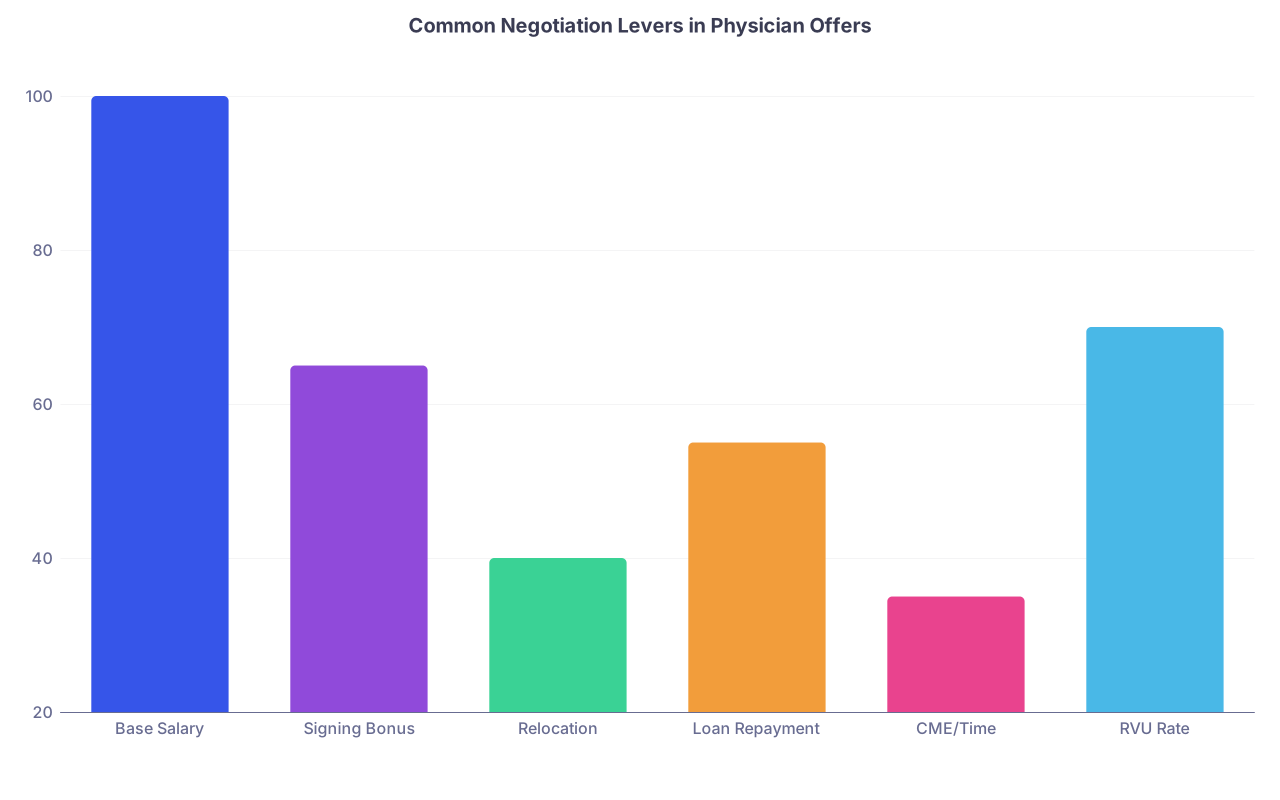
| Category | Value |
|---|---|
| Base Salary | 100 |
| Signing Bonus | 65 |
| Relocation | 40 |
| Loan Repayment | 55 |
| CME/Time | 35 |
| RVU Rate | 70 |
Think in terms of guaranteed value and risk reduction:
- Signing bonus
- Ask for structure: “$25,000 signing bonus, paid on start date, with payback clause only if I leave within 2 years.”
- Loan repayment
- “$20,000 per year for 3 years, paid directly to lender.”
- Relocation
- Convert vague “up to” into guaranteed: “$10,000 relocation stipend, not just reimbursement.”
- CME/Professional funds
- Increase allowance and days: “$5,000 and 5 days; reimbursement for board prep or board fees.”
- Protected time and schedule
- Fewer clinic sessions, reduced call, no double-booking the first 6–12 months. This preserves your sanity.
- Contract length and termination
- Shorten term, reduce tail risk with malpractice coverage (occurrence vs claims-made + tail).
- RVU rate and thresholds
- Lower thresholds for bonuses.
- Higher per-RVU payout.
Script for Shifting to Other Levers
“If the base salary truly cannot move beyond [$X], I would still like to see the total value of the package more closely match market levels. There are a few other areas that could help with that:
- Increasing the signing bonus to [$A]
- Adding structured loan repayment of [$B] per year for [C] years
- Enhancing relocation support to a guaranteed [$D] stipend
If we could adjust those areas, I would feel much more comfortable accepting the offer even if the base stays at [$X].”
You are giving them options to say “yes” without blowing up their official “salary bands.”
Step 7: Fix Bad RVU and Bonus Structures
RVU traps are just as dangerous as low base pay.
Common problems:
- Unrealistically high wRVU thresholds for bonuses.
- Low per‑RVU compensation.
- Short ramp‑up with no protection.
- Hidden productivity expectations that require unsafe volume.
Example: Bad vs Reasonable RVU Terms
| Component | Bad Structure | Reasonable Structure |
|---|---|---|
| Base Salary | $210,000 | $250,000 |
| Annual wRVU Threshold | 7,000 | 4,500 |
| Bonus per RVU above | $35 | $45 |
| Guarantee Period | 6 months | 12–24 months |
| Penalty if below | Base reduction | No clawback in first term |
If your offer looks like the “Bad Structure” column and you are new out of training, you are being set up to subsidize your own income with unsafe productivity.
Script to Renegotiate RVU Terms
“I have also taken a close look at the RVU structure. The current threshold of [X] wRVUs and bonus rate of [$Y] per wRVU are more typical of fully ramped‑up physicians with established panels.
As a new attending, especially in the first 1–2 years, it is challenging to reliably hit those numbers. To make this a more realistic and sustainable structure, I would propose:
- A lower initial threshold of [proposed threshold] wRVUs
- A bonus rate of [$proposed rate] per RVU above that level
- A guarantee that I will not be penalized or have my base reduced in the first [1–2] contract years if I do not hit those numbers, as long as I am meeting reasonable clinical expectations.
That would allow me to focus on building a high‑quality practice without sacrificing financial stability.”
If they will not budge on thresholds or penalties, that is a strong sign to walk.
Step 8: Use Silence and Time to Your Advantage
Most new physicians talk too much in negotiations. They rush to fill silence. They justify. They backpedal.
You are going to do the opposite.
Three practical rules:
- When you state your ask, stop talking. Let them sit with it.
- When they say, “We will have to review this internally,” say,
“I appreciate that. When do you think you will have an update?”
Then stop. - If they send a revised offer, do not reply immediately. Review it overnight. Compare to your targets.
You are signaling that:
- You are not desperate.
- You are deliberate.
- You are interviewing them as much as they are interviewing you.
Step 9: Know When to Walk Away
Some offers cannot be fixed. I have seen:
- Starting salaries 30–40% below regional norms with no flexibility.
- RVU structures that would require patient mills to hit target.
- “Partnership tracks” that are really 5‑year probation periods with no guaranteed buy‑in terms.
- Noncompetes that effectively trap you in a metro area.
Here is a simple decision framework.

| Step | Description |
|---|---|
| Step 1 | Receive Offer |
| Step 2 | Is base near 25th percentile? |
| Step 3 | Try to Raise Base |
| Step 4 | Review Full Package |
| Step 5 | Revised Offer? |
| Step 6 | Consider Walking |
| Step 7 | Are RVUs and Call Reasonable? |
| Step 8 | Negotiate Structure |
| Step 9 | Check Noncompete and Term |
| Step 10 | Improved Terms? |
| Step 11 | Meets Walk-Away Criteria? |
| Step 12 | Accept Offer |
| Step 13 | Decline and Pursue Other Options |
If, after a good‑faith negotiation:
- Base is still far below market
- Total guaranteed value is weak
- RVU/call structure is exploitative
- Noncompete is excessive
You walk. Not “maybe later.” You say:
“After careful consideration, I have decided not to move forward with the offer. I appreciate the time and effort everyone has put into the process, and I wish the team the best in finding the right candidate.”
Then you move on. And you are better off for it.
Step 10: Lock It All in Writing
Verbal promises are worthless. I have watched too many physicians get burned by:
- “We usually pay more once you are here.”
- “We will probably shorten your call.”
- “We can always revisit your salary later.”
If it is not in the contract, it does not exist.
Checklist of what must be written:
- Final base salary and clear bonus/RVU terms
- Duration of any guarantee period
- Signing bonus amount and payback terms (if you leave early)
- Loan repayment amounts and schedule
- Relocation support – stipend vs reimbursement, caps
- CME funds and days
- Call expectations (number of shifts, weekends, nights)
- Noncompete scope (distance, duration, locations)
- Termination terms (without cause notice period, severance if any)
- Any special arrangements you negotiated (reduced panels, protected time, schedule promises)
If they say, “We do not usually put that in the contract,” your response is simple:
“Given how important that piece is to my decision, I would be much more comfortable if we could include it explicitly in the agreement.”
If they absolutely refuse to document it, assume it will not happen.
Putting It All Together: A Condensed Negotiation Script
Here is the core script in compact form. Use this on your first serious call.
- Open with appreciation + alignment
“Thank you for the offer and all the time so far. I am very excited about the role, especially [X]. I would like to review the compensation and structure to see if we can better align it with current market data.”
- Present your data
“Based on MGMA/[AAMC/society] benchmarks for [specialty] in [region/setting], the median starting base is about [$X], with the 25th percentile at [$Y]. The current offer base of [$Offer] looks to be below that range.”
- State your ask
“Given that, and the responsibilities of this role, I would be much more comfortable with a base salary in the range of [$Ask].”
- Handle “standard salary” pushback
“I understand this is the standard starting point. At the same time, compensation norms have shifted, and many organizations have adjusted for recruitment. To make this sustainable, I would need to see the base closer to [$Target], or enhance other guaranteed components to reach that level.”
- Shift to other levers if salary frozen
“If the base truly cannot move beyond [$X], then to keep the total package competitive I would want to improve other pieces – for example, a signing bonus of [$A], loan repayment of [$B] per year for [C] years, and a relocation stipend of [$D].”
- Fix RVU terms if needed
“I would also propose lowering the initial RVU threshold to [N] with a bonus of [$Y] per RVU above that, and no penalties or base reduction in the first [1–2] years while I ramp up.”
- Close with timeline
“Thank you for working through this with me. If you can send an updated draft reflecting these changes, I will review it carefully. When would you expect to have that ready?”
That is your backbone. Edit the language to sound like you. But keep the structure.
Your Next Step – Do This Today
Do not wait until you are on your third job to learn this the hard way.
Today, do one concrete thing:
Open your current or most recent offer, pull regional specialty compensation data, and write down three numbers: your walk‑away point, your realistic target, and your opening ask.
Once those are on paper, draft the exact email you will send to request a compensation discussion. Not tomorrow. Now.


