

The worst time to discover how bad your non-compete is? After your employer flatly refuses to change it.
Step 1: Get Absolutely Clear on What the Non-Compete Actually Does
Most physicians do not fully understand their non-compete the first time they read it. That is not an insult. These clauses are written to be confusing.
You cannot decide what to do until you have four pieces of information nailed down:
- Scope of practice restricted
- Geographic radius
- Duration
- Trigger events (when it applies)
Pull out the contract and answer these questions in writing. Not “I think,” but exact language.
1. Scope: What Exactly Are You Blocked From Doing?
Look for phrases like:
- “practice of medicine”
- “practice of [specialty]”
- “performing professional services substantially similar to those provided to Employer”
- “any clinical services, telemedicine, consulting, administrative, or medical director roles”
You want to know:
- Is it only your specific specialty? (e.g., “non-invasive cardiology” vs “any cardiology”)
- Does it include telehealth?
- Does it include moonlighting, locums, urgent care?
- Does it block you from management / admin roles?
If the clause says “any practice of medicine,” that is broad and aggressive. If it says “clinical practice of outpatient endocrinology,” that is narrower and more survivable.
2. Geography: Where Are You Actually Blocked?
Find the language that starts with “within…” or “in any location where Employer operates…”
Common formulations:
- “within a 10-mile radius of any facility where Physician provided services”
- “within a 25-mile radius of any Employer location”
- “within any county in which Employer maintains an office”
This matters a lot more than you think. The difference between:
- 10 miles from one office
- 25 miles from any current or future office
…can be the difference between you staying in your city or not.
3. Duration: How Long Are You Handcuffed?
Look for phrases like:
- “for a period of twelve (12) months following termination”
- “for two (2) years after cessation of employment for any reason”
Write down:
- Start event (date of termination? last day of work? last day of paid status?)
- End date (12 months? 24 months?)
If you see anything longer than 12–18 months for most physician roles, red flag. Courts often dislike very long periods. That matters later when you assess risk.
4. Trigger Events: When Does It Apply?
This is often buried.
Questions:
- Does it apply if you resign with notice?
- Does it apply if they terminate you without cause?
- Does it apply if they breach the contract (e.g., stop paying you what they promised)?
- Does it apply after expiration of a fixed-term contract without renewal?
Sometimes you will see:
- “This covenant shall apply regardless of the reason for termination.”
- or “Non-compete shall not apply in the event Employer terminates Physician without cause.”
Huge difference. I have seen physicians walk away clean because the non-compete did not apply if they were terminated without cause. I have also seen others stuck because they resigned voluntarily.
Once you have these four mapped out, you actually know what you are fighting about.
Step 2: Reality Check – Is Their “Refusal” Actually Final?
Employers say “We do not change our non-competes” all the time. Sometimes it is true. Often it is posturing.
You need to test if “no” is really “no” or just “not yet.”
Here is how:
Ask targeted, specific questions, not global changes.
Instead of “Can we change the non-compete?” try:- “Does the non-compete still apply if you terminate me without cause?”
- “Is the radius calculated from every location or just my primary clinic?”
- “Would you consider excluding hospitalist moonlighting or telemedicine outside the state?”
Ask what they have done for others.
Literally: “For other physicians you have hired in the last 2 years, have any had modifications to the non-compete?”
They may dodge. Push once: “So, to confirm, every physician signs the exact same non-compete language, with no exceptions?”
If they are lying, they usually get vague. If they are telling the truth, they often say it plainly.Watch who is saying “no.”
- Recruiter? They rarely have authority.
- Practice manager? Limited authority.
- Group president / CEO / in-house counsel? That is closer to a real “no.”
Escalate once, strategically.
You get one meaningful escalation before you start to look like a problem. Use it.
“I understand you try to keep contracts standard. For me to feel comfortable signing, I would like to discuss a few non-compete clarifications directly with [Medical Director/CMO]. Could we set up a 15-minute call to review just that section?”
If the answer after all this is still: “We will not modify it. At all.” Fine. Now you stop trying to change it and start deciding how to operate around it.
Step 3: Quantify the Damage – Use a Simple Decision Map
Before you panic, you need structure. Otherwise this just feels like, “I am trapped” or “I have to move states.” That is rarely the whole truth.
Build a simple map:
- Where you must be (family, spouse’s job, kids in school)
- Where you could be (commutable suburbs, neighboring towns, adjacent states)
- What work you can do outside the non-compete zone
Use three categories:
- Green Zone – Completely outside the radius and restrictions.
- Yellow Zone – Technically inside, but with different employers / roles that might be lower risk.
- Red Zone – Direct conflict with the non-compete.
Quick Tool: Radius vs. Options Table
| Radius | Typical Impact on Options | Common Outcome |
|---|---|---|
| 5 miles | Usually manageable in metros | Stay local, switch groups |
| 10 miles | Tight in mid-sized cities | Some suburbs off-limits |
| 15-20 miles | Major metro constraint | May need to cross metro boundary |
| 25+ miles | Region-level block | Often relocation or telehealth |
| Multi-county | Very aggressive | High litigation risk if violated |
Print a map. Literally. Draw a circle for the radius around your primary practice site(s). Ask:
- Are there other hospitals or practices outside this circle?
- Are there commutable towns outside the circle?
- Is there telemedicine you can do from home that is not covered?
- Is there out-of-state work you can commute to or fly to 2–3 days per week?
You are not deciding yet. You are proving to yourself that it is not binary: “this job or nothing.”
Step 4: Build an Exit Strategy Before You Need It
If the employer will not modify the non-compete, you must assume that if things go bad, you are on your own. That means you do not wait until conflict to plan.
You build an exit strategy while you are still on good terms.
Think of it in three tracks:
- Track A: Stay the full term and leave cleanly
- Track B: Leave early, comply with the non-compete
- Track C: Leave early and challenge the non-compete
You need to know what each one looks like. Not six months from now. Now.
Track A: Stay and Leave Cleanly
Sometimes the best move is simple: put in 2–3 years, gain experience, then leave after the contract term when you have more leverage and fewer strings.
Practical steps:
Know your contract end / renewal terms.
Are you on:- An at-will agreement?
- A 1-year automatically renewing term?
- A 3-year fixed term?
Mark your calendar for:
- Notice deadlines for non-renewal (e.g., “Either party may choose not to renew by giving 90 days’ notice before the end of the term.”)
- Any vesting dates (sign-on bonus forgiveness, relocation claw-back, tail coverage triggers).
Gradually prepare your next move during your final year:
- Quietly network with physicians in adjacent systems or geographies.
- Research which systems are outside your non-compete footprint.
- Start saving aggressively to build a 6–12 month cushion in case of a gap.
If the job is bearable and the pay is good, this is often the least painful option.
Track B: Leave Early, Comply with the Non-Compete
This is where most physicians underestimate the practicalities.
You decide: “I will obey the non-compete.” That means you must:
- Work outside the radius
- For the duration
- Within the scope defined
Real-world options:
- Locums in another city or state
- Telemedicine for out-of-state patients (if allowed)
- Hospitalist / nocturnist work at a hospital outside the radius
- Short-term contracts in rural areas
You must answer two questions:
- Can I make enough money in the compliant zone?
- Can I tolerate the lifestyle hit for 12–24 months?
This is where a simple revenue projection helps.
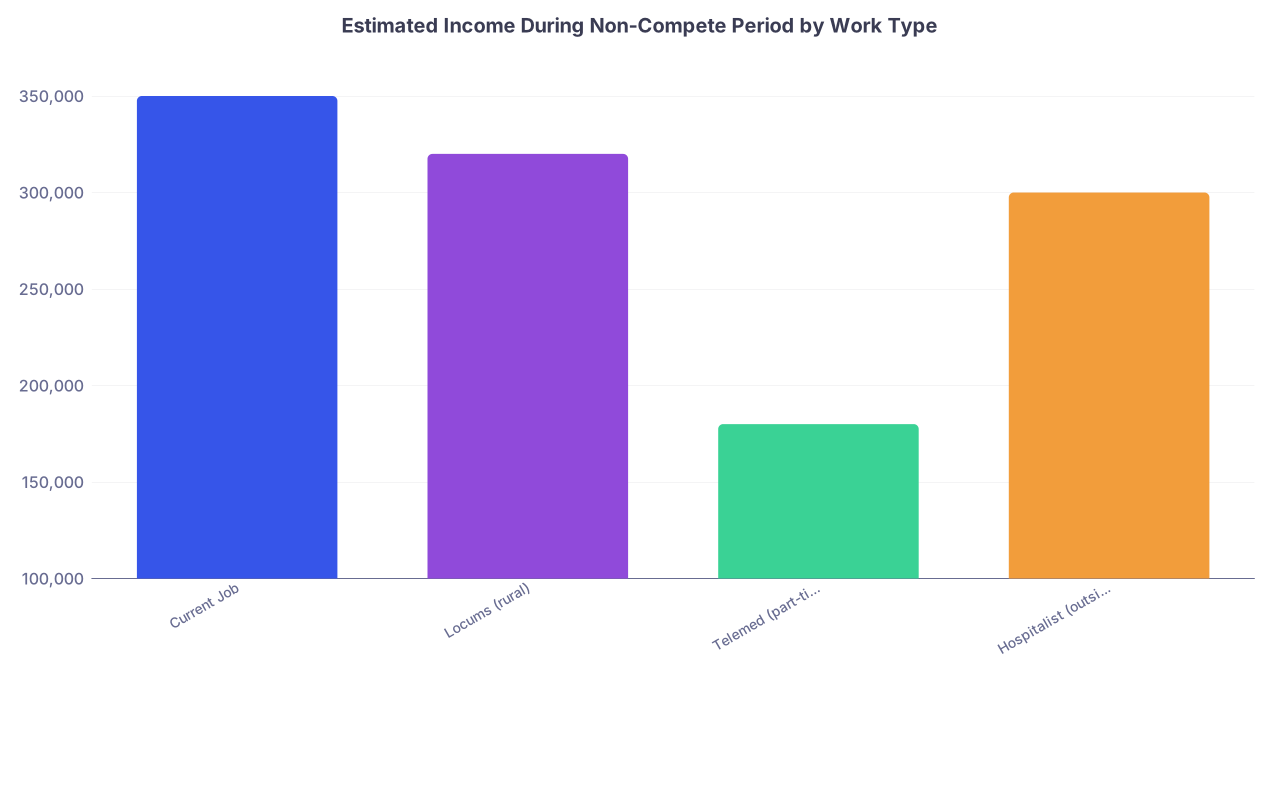
| Category | Value |
|---|---|
| Current Job | 350000 |
| Locums (rural) | 320000 |
| Telemed (part-time) | 180000 |
| Hospitalist (outside radius) | 300000 |
Maybe you go from $350k to $320k for a year doing rural locums. That is a hit, but survivable. If complying would drop you to $120k and you have a family, that is a different picture.
Notice something important: once you prove to yourself that Plan B is survivable, you stop negotiating from fear. That alone changes how you think.
Track C: Leave Early and Challenge the Non-Compete
This is the nuclear option. You do not threaten it casually.
It can work in your favor, but only if:
- The clause is genuinely overbroad or unreasonable.
- State law is physician-friendly or skeptical of non-competes.
- You have legal backing and a war chest.
Typical outcomes when physicians challenge:
- Court narrows the non-compete (smaller radius, shorter duration).
- Court enforces it largely as written.
- Case settles with a buyout or compromise (e.g., you agree not to work at specified direct competitors, but can work elsewhere in the city).
Your goal is not “win at all costs.” Your goal is “reduce risk and time being unemployable.”
Step 5: Use State Law and Enforcement Risk to Your Advantage
The employer’s blanket “no changes” often hides a key fact: their ability to enforce the non-compete varies massively by state.
You do not need to become a lawyer. But you do need to understand your state’s baseline attitude toward non-competes.
Quick Landscape: Physician Non-Competes by State Type
| State Type | Example States | Typical Reality |
|---|---|---|
| Highly Restrictive / Bans | CA, OK, ND, MN (post-2023) | Non-competes largely unenforceable |
| Skeptical / Narrowing | MA, IL, CO, WA | Courts often limit scope/duration |
| Mixed / Case by Case | TX, FL, OH, PA | Enforced if reasonable |
| Employer-Friendly | Some Southern / Midwestern states | Broad clauses often upheld |
You must:
Confirm your state’s rules with a real attorney.
Not a blog post. Not your colleague who “heard from someone.” Pay for at least a one-hour review.Ask your attorney three pointed questions:
- “How likely is this specific clause to be enforced as written?”
- “What have local courts done with similar physician non-competes?”
- “If I left and went to work at [X competitor], what would the realistic risk and outcome be?”
Assume the employer will enforce if:
- They are a large system with in-house counsel.
- They have a history of sending demand letters to departing docs.
- Your specialty is high-revenue (ortho, cardiology, GI).
Sometimes, your attorney will tell you bluntly: “This clause is probably not enforceable as written, and your employer knows it.” That changes how you think.
You might not deliberately violate it. But you might be more willing to accept a narrowed informal understanding:
- “We will not go after you if you avoid working at X and Y direct competitors within 10 miles.”
Is that enforceable in court? Maybe, maybe not. But it can shape a workable truce.
Step 6: Negotiate the Edges Instead of the Core
If the employer refuses to “change the non-compete,” you often still have leverage to negotiate around it.
You do this by shifting away from the label (“non-compete”) and attacking the conditions that make it painful.
Here are levers that are often more negotiable:
1. Trigger Conditions
You can ask to limit when the non-compete applies, rather than its text.
Examples:
- “Non-compete shall not apply if Employer terminates Physician without cause.”
- “Non-compete shall not apply if Physician terminates due to Employer’s material breach.”
- “Non-compete shall not apply after the initial 2-year term is completed.”
These are frequently more palatable to employers because they do not have to edit the core boilerplate, just the triggers.
2. Buyout or Liquidated Damages
If they will not delete it, you can sometimes price it.
Ask directly: “If there were a situation where I needed to work inside the radius, is there a financial buyout option for the non-compete?”
You want language like:
- “Physician may be released from the non-compete upon payment of $X or Y% of annual base salary.”
A clear buyout gives you certainty. That certainty is more important than the number, within reason. You can plan around $50k or $100k. You cannot plan around “we will see you in court.”
3. Narrowed Definition of “Competition”
If they refuse to change radius or duration, you can try to narrow what counts as competition.
Examples:
- Exclude academic or teaching roles (“This shall not apply to full-time academic appointments where clinical practice is incidental.”)
- Exclude urgent care / occupational medicine if you are a subspecialist.
- Exclude telemedicine with no in-person visits.
You are not saying, “Delete the non-compete.” You are saying, “Let us be precise about what it covers.” Employers sometimes agree because it feels less like giving ground.
4. Carve-Outs for Specific Employers
You can negotiate named exceptions. I have seen:
- “This shall not prevent Physician from accepting employment with [University Hospital X] or [VA Hospital Y].”
If there is a system you would jump to in a heartbeat, try to carve it out.
5. Change Other Terms to Reduce the Pain
If they truly will not touch the non-compete, you hit adjacent contract points:
- Shorten the notice period (so you can leave more quickly when you are ready).
- Increase compensation (you are being paid a premium to accept this restriction).
- Shorten the initial term (so you get to an exit point faster).
- Get guaranteed tail coverage (so at least you are not buying malpractice plus obeying a non-compete).
If they demand a strict non-compete and still offer mediocre pay and no tail coverage? That is not “cautious.” That is exploitative. Walk.
Step 7: Protect Yourself From Day One if You Decide to Sign
Let us say you accept reality. They will not change the non-compete. The job is still attractive enough. You sign.
Now your job is to:
- Reduce future dependence on your current employer.
- Keep leverage for a future exit.
- Avoid giving them extra ammunition if things sour.
Here is how you do that.
Build Independent Professional Capital
Do not let your employer own your entire professional identity.
Maintain your own network.
- Stay in contact with residency colleagues.
- Attend local medical society events.
- Know physicians in competing systems by name.
Develop at least one external income option.
Examples:- PRN hospitalist shifts at a facility outside the radius.
- Telemedicine company onboarding (you do not have to use it heavily).
- Consulting, speaking, or academic adjunct roles.
You are not doing this to get rich. You are doing it so that if you leave, you are not starting from zero.
Document Employer Behavior That Might Become “Cause”
If your contract allows termination or non-compete relief for employer breach, you must document.
- Chronic underpayment?
- Withholding RVU reports?
- Cutting staff so you cannot safely see patients?
Keep a contemporaneous record:
- Dates, emails, messages
- Clear descriptions of promises vs. reality
You are not looking to sue. You are building a factual timeline in case you ever need to argue, “They breached first.”
Do Not Secretly Prep a Competing Practice on Their Dime
Easy way to get yourself sued and lose:
- Using employer resources to plan your next clinic.
- Downloading patient lists.
- Telling patients directly where you are going if it violates non-solicit terms.
If you are going to push against the non-compete later, you want clean hands. Let your new employer’s marketing team and publicly available info handle patient awareness.
Step 8: Decide with Eyes Open – Not from Fear
At some point, you need to make a binary decision:
- Accept the job, with non-compete as written or slightly adjusted.
- Walk away, even if everything else looks good.
Use a structured comparison, not vibes.

| Category | Value |
|---|---|
| Compensation | 8 |
| Location/Lifestyle | 9 |
| Non-Compete Risk | 3 |
| Career Growth | 7 |
| Backup Options | 4 |
Ask yourself, out loud if needed:
- If this exact non-compete were never enforced, is this a fantastic job?
- If this non-compete were enforced to the letter and I had to move or work outside the radius for 12–24 months, can I live with that?
If the only way this job makes sense is “they probably won’t enforce it,” you are lying to yourself. Assume they will enforce it. Decide anyway.
And do not underestimate this: the employer that refuses even minor reasonable adjustments often shows you what they are like to work for. That is data.
Key Takeaways
- A “non-negotiable” non-compete does not mean you are powerless. It means you must shift from trying to delete it to planning around it: mapping your options, stress-testing exit strategies, and using state law to your advantage.
- If you sign, you do it consciously: you secure carve-outs where possible, build alternative income and networks from day one, and keep clean documentation in case the relationship breaks down.
- Do not accept a brutal non-compete from a mediocre employer. Either the restrictions are reasonable for what you are getting, or you walk and find an employer that treats your future career like it actually matters.


