

The biggest lie physicians tell themselves about contracts is this: “It is fine, they said they would take care of it.”
That sentence has cost doctors hundreds of thousands of dollars, wrecked careers, and blown up otherwise decent jobs. Verbal promises do not beat written terms. Ever. Not in physician employment. Not in court. Not when the CEO “totally remembers” what was said. You trust the document, or you are gambling your career on someone’s memory and goodwill.
Let me walk you through the landmines so you do not become the cautionary story people whisper about three years from now.
Why Verbal Promises Are Almost Always Worth Zero
There is a simple rule: if it is not in the contract, it does not exist.
You will hear every version of this:
- “We never change that in writing, but we never enforce it.”
- “Legal just keeps the template like that; we will work around it.”
- “Do not worry about the non‑compete; we only use it for partners who leave on bad terms.”
- “Yes, the call schedule is rough now, but we are hiring two more docs next quarter.”
All of that is noise. Courts and hospital systems do not care what a recruiter, CMO, or practice manager “promised you in the hallway.” They care about:
- What is on the signed pages.
- What is in the supporting policies explicitly referenced in those pages.
- What you can prove with documents.
Your memory versus their memory is not a strategy. It is a losing bet.
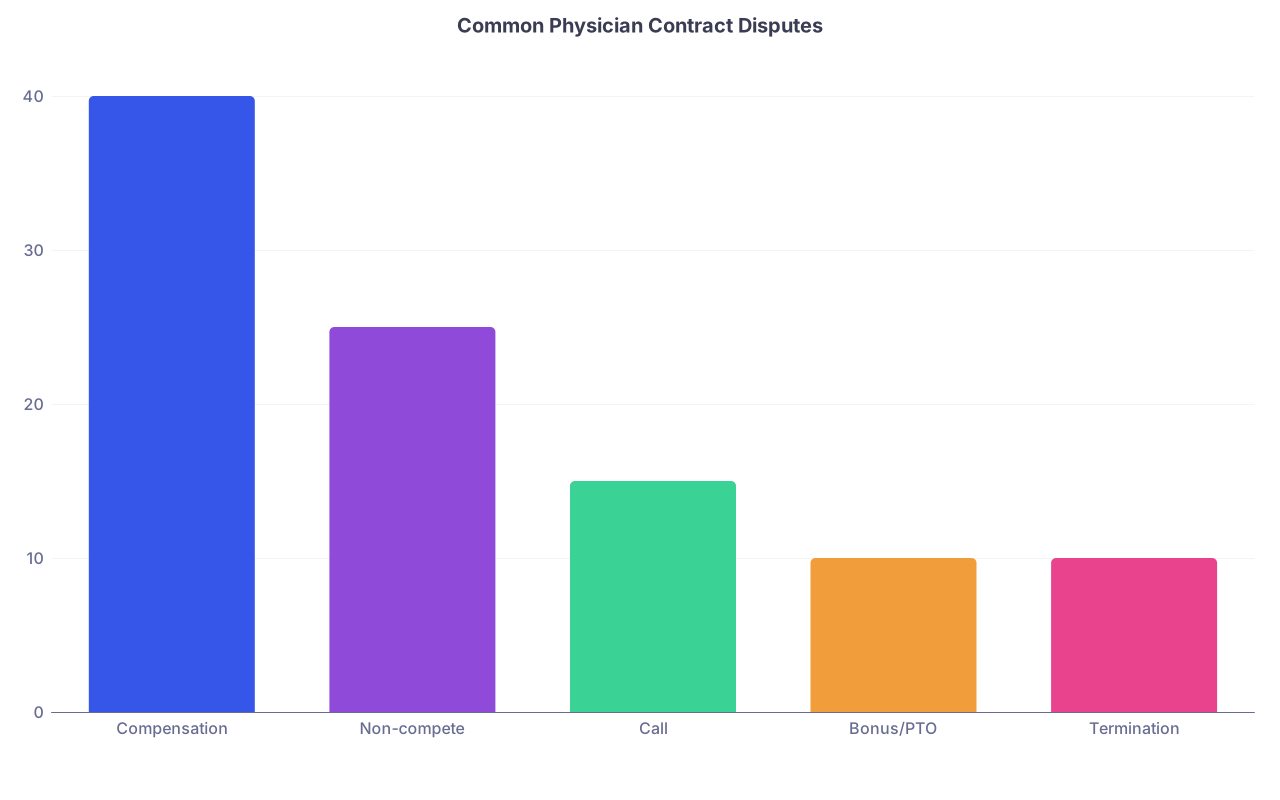
| Category | Value |
|---|---|
| Compensation | 40 |
| Non-compete | 25 |
| Call | 15 |
| Bonus/PTO | 10 |
| Termination | 10 |
The most common disputes I see are not about obscure legal clauses. They are about things the doctor thought were agreed to verbally:
- “Base salary will be adjusted after year one.”
- “You will be 70% outpatient, 30% procedures.”
- “You will not have to take more than 1:5 call.”
- “Partnership track is automatic after two years.”
And then the contract says none of that. Or worse, the opposite.
The Setup: How Smart Physicians Get Talked Into Trusting Words
You are not naïve. You just got worn down. I have watched this play out dozens of times:
- You are tired. Finishing residency or fellowship. Maybe relocating. Exhausted.
- The recruiter is responsive, sending friendly texts at all hours.
- Leadership says all the right things about work‑life balance and “we value our physicians.”
- An offer shows up. Looks pretty good at first glance.
- You ask a few questions. They say, “Yes, we will work with you on that.”
- A revised contract comes back. Half the stuff you discussed is not in there.
- When you push, the tone shifts: “Legal will not change that, but we would never enforce it.”
This is the point where people make the big mistake. They feel like they are being difficult if they keep insisting. They want to be liked. They worry the offer will evaporate. So they swallow their discomfort and sign.
You are not being difficult. You are being responsible with a six‑ or seven‑figure decision that shapes the next 3–5 years of your life.
The Specific Promises That Must Never Stay Verbal
Some things are too critical to leave to “trust.” If any of the following are discussed verbally, they must appear in the written contract or an attached, signed addendum.

1. Compensation structure and “expected earnings”
I have seen this exact phrase in recruiting calls more times than I can count:
“You will easily make $400–450k with our wRVU model. Most of our first‑year docs hit that.”
Then the contract:
- Low guaranteed base.
- High wRVU threshold.
- No protection if referrals disappear or hospital volume changes.
- No written guarantee on ramp‑up support.
If they promise:
- Guaranteed minimum income for X years,
- Stipend for call,
- Extra pay for extra shifts,
- Collections percentage,
- Partnership distributions,
those numbers must be stated clearly. In writing. Otherwise “you should make” turns into “well, it was just an estimate.”
2. Call schedule and shift expectations
Verbal: “We are very protective of our physicians. Nobody takes more than 1:4 call.”
Contract: “Physician agrees to share in equitable call coverage as determined by the group.”
That single sentence has trapped people in 1:2 call “temporarily during growth,” which then lasts three years.
You want:
- Specific maximum call frequency (e.g., not more than 1:4 on average over a quarter).
- How weekday vs weekend call is handled.
- Whether call is home, in‑house, or hybrid.
- Compensation for extra call above the agreed baseline.
- Whether call can be unilaterally changed or requires mutual agreement.
If they say “We never ask people to take more than that,” tell them to put that exact limit in the contract. If they refuse, you have your answer: they plan to exceed it.
3. Non‑compete and post‑employment restrictions
The worst sentence in this entire space is: “We never enforce that.”
Maybe true today. Maybe not when admin leadership changes, the group splits, or the partnership gets ugly.
Typical verbal assurances:
- “We only use the non‑compete for bad actors.”
- “We do not go after people who leave on good terms.”
- “Yes it is 25 miles, but we do not care if you go to the next hospital.”
Then you leave. Suddenly they care a lot.
If they verbally “soften” the non‑compete, the safe path is simple: adjust the language.
- Reduce the radius.
- Shorten the duration.
- Limit it to actual clinic/hospital locations where you work.
- Carve out exceptions (spouse’s job, children’s school, or particular practice you might join).
If they will not put it in writing, you should assume the harshest possible reading of the clause will apply the day you want to leave.
4. Partnership track and ownership promises
This one gets people emotional. And that is dangerous.
You hear: “Everyone becomes a partner at year two. It is just a formality.”
What the contract actually says:
- “Physician may be considered for partnership at the sole discretion of the existing partners.”
- No timeline.
- No stated buy‑in formula.
- No governance rights spelled out anywhere.
You must anchor partnership in writing:
- Criteria and expected timeline for eligibility.
- How buy‑in is calculated (fixed amount, formula, valuation method).
- What partnership actually confers (voting rights, profit share, real assets or just title).
If it is “always how we do it,” then they can have no objection to including at least the framework now.
“But They Promised…”: How Disputes Actually Play Out
Let us talk reality. Once things go sideways, the hospital or group will suddenly rediscover the contract. You might think your emails or memories will rescue you. They probably will not.
| Evidence Type | Practical Strength |
|---|---|
| Signed contract language | Very strong |
| Signed addendum | Very strong |
| Official policy referenced | Strong |
| Emails confirming terms | Moderate |
| Texts / informal notes | Weak |
| Pure verbal recollection | Very weak |
You might get some help if you have emails like: “As we discussed, your call will not exceed 1:4 and non‑compete will not apply if you are non‑renewed.” But even then, if the contract says something different, you are starting from a hole.
The classic disaster scenarios I have seen:
- Physician is promised a certain allocation of OR time; a new hire arrives, allocation is cut, and the contract is silent.
- Employed doc is promised eventual academic title; admin changes and the new chair has no interest in honoring the old promise.
- Primary care doc is promised MA and scribe support “like all our physicians”; budget cuts hit and they work solo at unsustainable panel sizes.
Each time, the answer from leadership is the same: “Your contract does not guarantee that.”
They are not lying. You just trusted air instead of ink.
The Subtle Trap: “Side Letters” and “We’ll Fix It Later”
Sometimes they will try to compromise by sending you a “summary” email or a vague promise to update the contract later.
Red flag phrases:
- “We will revisit this after your first year.”
- “Once you prove yourself, we can adjust that.”
- “Let us get you in the door; we can always amend the agreement later.”
Amendments later require:
- Their motivation.
- Their time.
- Their legal department.
- Their budget.
You have exactly zero control over those. Once you are captive—licensed in that state, kids in school, spouse employed locally—your leverage is gone.
If they genuinely plan to honor something, they can honor it right now on paper. There is no legitimate reason to delay writing down an agreed term unless they want to preserve the option to ignore it.
How To Insist On Written Terms Without Burning Bridges
You do not need to be hostile. You do need to be unambiguous.

| Step | Description |
|---|---|
| Step 1 | Verbal Promise Made |
| Step 2 | Ask to Include in Contract |
| Step 3 | Review W Counsel |
| Step 4 | Ask Why Not |
| Step 5 | Walk Away |
| Step 6 | Added To Draft? |
| Step 7 | Reason Acceptable? |
Use language like:
- “Thank you for clarifying that. Since this is important to me, I will need it reflected in the contract or a signed addendum.”
- “I appreciate the reassurance. My practice is that any key employment term we agree on is put in writing so everyone is protected.”
- “To avoid misunderstandings down the road, let us have legal include that language explicitly.”
If they push back with “You do not trust us?” keep it simple:
“You are running a business; so am I. The written contract protects both of us. I have seen too many colleagues hurt by relying on verbal promises. I do not want that for either of us.”
If that offends them, be very clear about what that tells you about their culture.
The Cost of Getting This Wrong (And Why Walking Away Is Cheaper)
You are afraid of “losing a good offer.” That is natural. But you are not comparing costs honestly.
Here is what you are really choosing between:
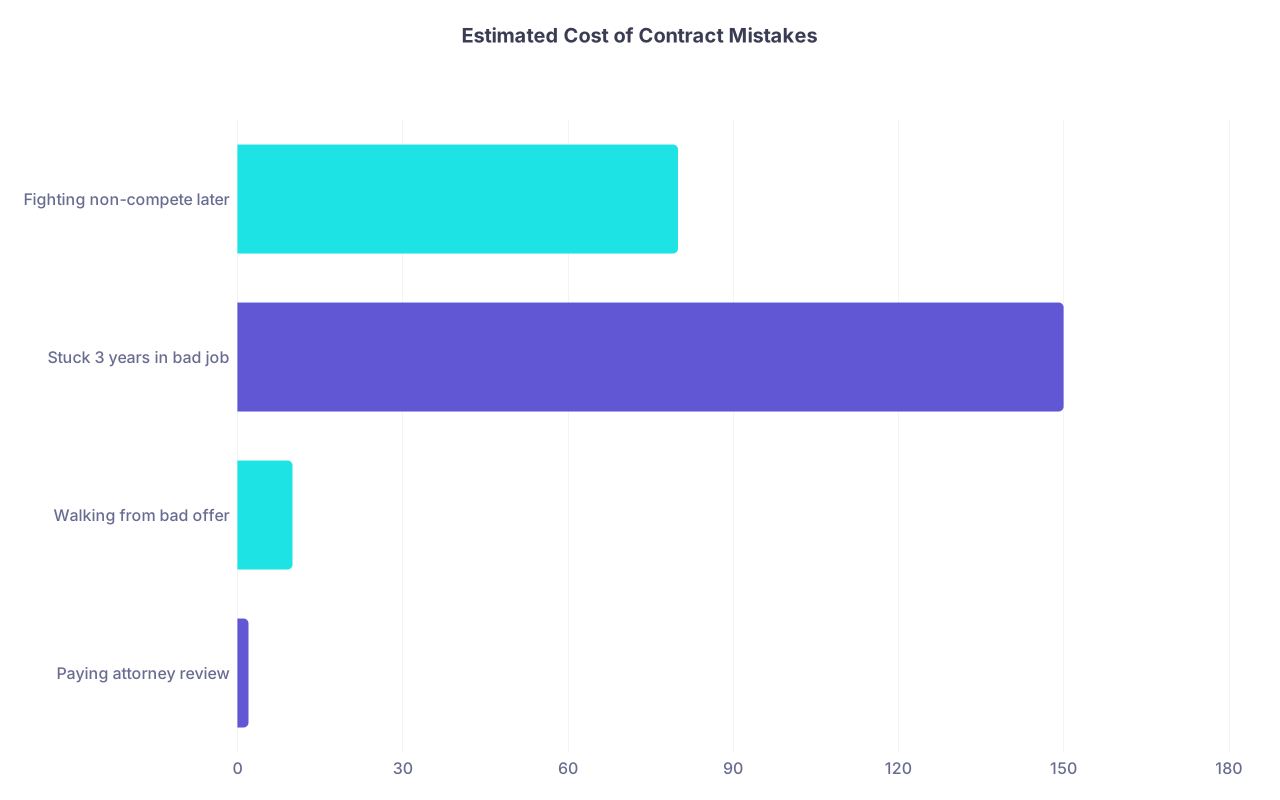
| Category | Value |
|---|---|
| Paying attorney review | 2 |
| Walking from bad offer | 10 |
| Stuck 3 years in bad job | 150 |
| Fighting non-compete later | 80 |
(Values: rough “pain units” not dollars, but you get the idea.)
- Paying a contract attorney: annoying, but finite.
- Walking away from an offer: disappointing, but reversible.
- Being trapped in a job with abusive call, poor support, or lousy pay for three years: that hits your health, your family, your CV, and your future leverage.
- Fighting a non‑compete after the fact: expensive, stressful, unpredictable.
I have never heard a physician say, “I regret walking away from that offer because they refused to write down what they promised.” I have heard dozens say, “I knew I should not have signed this.”
Your gut is usually right. If they refuse to put key promises in writing, do not sign and “hope they are nice.” That is not a strategy. That is wishful thinking.
Practical Checklist: What You Should Never Leave Verbal
Use this as a blunt instrument when you are reviewing offers. If any of the following are material to your decision, they must be written:
- Base salary and length of guarantee.
- Bonus formula and thresholds.
- wRVU/collections targets and conversion factors.
- Maximum call burden and call pay.
- Expected clinical FTE, clinic days, blocked OR time.
- Support staff: MA per physician, scribe availability, APP support.
- Location of primary practice and whether you can be moved.
- Non‑compete radius, duration, and scope.
- Termination without cause notice period and consequences.
- Partnership track: timing, criteria, buy‑in basics.
- Protected time: admin/research/teaching percentages if promised.
If someone tells you, “We cannot put that in writing,” your response should not be to argue. Your response should be to evaluate whether this is an environment worthy of your career.
Because here is the harsh truth: institutions that treat contracts seriously usually honor their words. Institutions that treat contracts as vague guidelines are the ones leaning hard on verbal promises.
FAQs
1. What if the verbal promise came from the department chair, but the contract is controlled by the hospital?
Do not assume internal politics will protect you. Chairs come and go. CMOs rotate. The hospital’s legal department and HR have more staying power than any individual champion. If the chair is truly committed, ask them to push the term into the contract or to sign a separate, formal memorandum on department letterhead that is referenced in the contract. If they “support you” but will not take that basic step, they are not as powerful or committed as they are presenting themselves to be.
2. Can emails or text messages ever save me if the contract conflicts with what I was told?
Occasionally, yes—but do not count on it. Emails confirming specific terms can sometimes support your interpretation if the contract language is vague. But if the contract is clear and contradictory, courts and administrators typically default to the signed agreement. Think of emails and texts as weak backup, not primary protection. Your primary shield is still the written contract and any signed addenda.
3. Is it realistic to expect every verbal assurance to end up in the contract?
No. Minor cultural statements (“we have a collegial atmosphere”) are obviously not contract terms. Focus on anything that affects your money, time, or freedom to practice: compensation, schedule, call, location, non‑compete, partnership, and major responsibilities. If they use concrete numbers or specific obligations in conversation, those belong in writing. Soft, culture‑level comments do not. Learn to separate sales talk from actual terms.
4. What if the employer says their contract is “standard” and cannot be changed?
“Standard” just means “easier for our legal and HR teams.” Many large systems do resist altering the core template, but they still use addenda, offer letters, or supplemental agreements for role‑specific terms. If they refuse absolutely any written modification—even a short addendum summarizing key negotiated points—that is a strong sign they want maximum flexibility at your expense. You will have to decide whether that tradeoff is worth the risk. For most physicians, it is not.
5. How early in the process should I start insisting on written terms?
Earlier than you think. Once they express serious interest and start quoting specific numbers, call burden, or non‑compete “exceptions,” start recording those points in writing—your own email recap is a good start: “To confirm our conversation today, we discussed X, Y, Z.” When you reach the stage of receiving a draft contract, immediately cross‑check it against those written recaps. Anything missing should be raised before you even consider signing. The farther you go without alignment between words and documents, the harder it becomes to fix—and the easier it is for everyone else to claim “miscommunication” later.
In the end, you are not just signing a job offer. You are signing years of your life, your mobility, and your earning power.
Trust people to be human. Trust organizations to protect themselves. Trust contracts to control what actually happens.
And never, ever trust a verbal promise more than the words on the page.


