

You just got the offer you were hoping for. Base salary looks solid, RVUs are fine, PTO is decent. Then you scroll down to “Restrictive Covenants” and see it: a 50‑mile non‑compete for two years, covering every location your new employer might ever open.
Now you’re wondering: Is this normal? Is this enforceable? And more to the point—what is actually reasonable for a physician non‑compete?
Let me cut through the noise and give you real benchmarks, not vague “it depends” answers.
First: The Big Picture On Physician Non-Competes (As of Now)
Non‑competes for physicians are under heavy fire right now. But they’re not dead.
Here’s the current reality you’re negotiating in:
- Some states ban physician non‑competes outright.
- Some limit them heavily (time, distance, scope).
- Many still enforce them, especially for employed physicians in private groups and hospital‑owned practices.
- The new FTC rule trying to ban most non‑competes is tied up in litigation and not reliably in effect for physicians yet. Do not assume it saves you.
So you negotiate based on the law on the ground today, not on wishful thinking.
If you remember nothing else: Reasonable = narrow. Narrow in time, distance, and scope.
Core Benchmarks: What’s “Reasonable” in Plain Numbers
Here are the practical, real‑world benchmarks I use when I review physician contracts.
1. Time: How Long Should a Non-Compete Last?
Common employer ask: 2 years.
Reasonable target: 6–12 months.
Upper limit I’d grudgingly tolerate in many markets: 18 months.
My rule of thumb:
- 6 months: Great. Take it.
- 12 months: Common and usually reasonable, especially in competitive urban/suburban areas.
- 18 months: Negotiable, sometimes acceptable if distance is small and scope is narrow.
- 24 months: Aggressive. Push back hard. At 2 years, it starts looking predatory unless distance and scope are very tight.
If they insist on 2 years, you counter with:
- 1 year max, or
- 18 months with smaller radius and fewer sites covered, and
- Automatic waiver if they terminate you without cause (more on that later).
2. Distance: How Many Miles Is Reasonable?
This is where employers routinely overreach.
Here’s what I consider reasonable by geography:
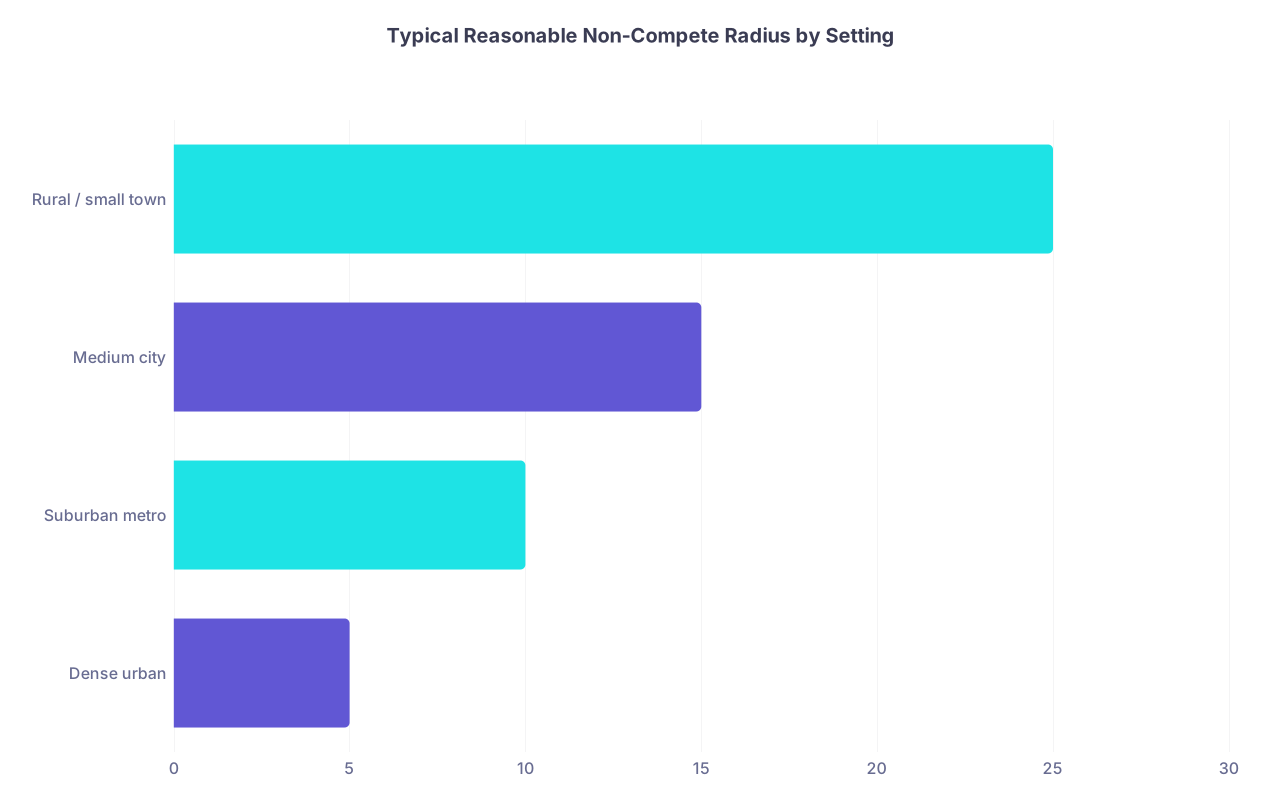
| Category | Value |
|---|---|
| Dense urban | 5 |
| Suburban metro | 10 |
| Medium city | 15 |
| Rural / small town | 25 |
Let’s translate that:
- Dense urban (NYC, Chicago core, Boston, SF):
- Reasonable: 3–5 miles from your primary practice site.
- Anything beyond 10 miles is usually ridiculous; that can wipe out the entire metro.
- Suburban metro:
- Reasonable: 10–15 miles.
- If a 15‑mile radius covers millions of people and multiple hospital systems, push for smaller.
- Medium city / regional center:
- Reasonable: 15–20 miles.
- Rural / small town:
- Reasonable: 20–30 miles around the clinic/hospital where you actually work.
What’s not reasonable?
- State‑wide bans (yes, I’ve seen “no practice anywhere in [State] for 2 years”).
- Multi‑state bans when you only work in one city.
- 50–100‑mile radii that block every major city in the region, especially when you’re not some highly unique subspecialist.
If the contract says “X miles from any current or future practice location,” that’s a red flag. You want:
- X miles from the single primary location where you spend most of your time, OR
- Only from the specific locations where you provided services in the last 6–12 months.
Not “anywhere we might someday open an urgent care.”
3. Geography & Locations: How Many Sites Can They Lock You Out Of?
Reasonable:
- Non‑compete applies only to:
- Your primary worksite, plus
- Any other sites where you worked at least 20–30% of your time in the last 6–12 months.
Unreasonable:
- Every facility in the health system, whether or not you ever set foot there.
- “Any facility owned now or in the future.”
- System‑wide bans when you only cover one clinic and one hospital.
Push for clear language like:
“Non‑competition shall apply only within a radius of X miles from the practice locations where Physician regularly provided clinical services (at least 20% of Physician’s work time) during the final 12 months of employment.”
4. Scope: What Kind of Work Is Restricted?
This gets glossed over. It shouldn’t.
Reasonable scope:
- Limited to your specialty and type of practice.
- Example: “Outpatient general cardiology” if that’s what you do.
- If you’re an interventional cardiologist but the group only had you doing clinic, your non‑compete should not block you from academic cath lab work at the competing hospital.
Unreasonable scope:
- “Any medical services.”
- “Any work for a competitor,” including non‑clinical work (consulting, telemedicine, admin roles).
- Blocking you from unrelated practice types you never did for them—like being banned from telehealth psychiatry because you were employed as an on‑site outpatient psychiatrist.
You want specialty‑specific, role‑specific restrictions.
5. Triggering Events: When Should the Non‑Compete Apply?
This is a big one, and people miss it.
Here’s the standard I like to see:
- Non‑compete applies only if:
- You resign without cause, or
- You’re terminated for cause (real, defined cause, not vague “we feel like it”).
And it should NOT apply if:
- They terminate you without cause.
- They materially breach the contract (e.g., stop paying you, radically cut your schedule/comp).
- The group is sold and your job/schedule/pay are substantially changed.
If an employer wants a broad non‑compete even when they fire you without cause, they’re telling you exactly how little they care about your livelihood.
You push for:
- Explicit carve‑out: “If Employer terminates Physician without cause or Physician terminates for Employer’s material breach, the non‑competition covenant shall not apply.”
How State Law Changes What’s Reasonable
You can’t talk about “reasonable” without talking about where you are. Some states heavily limit or ban physician non‑competes already.
Here’s a snapshot (always double‑check, laws change):
| State | General Trend | Notes |
|---|---|---|
| California | Bans most non-competes | Physician non-competes void |
| Massachusetts | Highly skeptical | Narrow and scrutinized |
| Texas | Allows with limits | Must meet statutory criteria |
| Tennessee | Specialty-based limits | Distance/time caps for MDs/DOs |
| North Dakota | Bans most non-competes | Very restrictive |
| Colorado | Recently tightened rules | Certain physician limits |
If you’re in a ban state and your contract still has a non‑compete, that doesn’t mean you ignore it. It means you:
- Use it as leverage in negotiation (“This won’t hold, so let’s clean it up.”).
- Avoid signing vague or overbroad language that could still be litigated under trade‑secret or non‑solicit theories.
If you’re in a state that enforces non‑competes, you negotiate more aggressively on radius, time, and scope, because this stuff actually sticks.
Practical Negotiation Strategy: How to Push Back Without Blowing the Offer
You do not have to accept the first draft. Every serious employer expects some negotiation—especially on restrictive covenants.
Here’s how to handle it without sounding like a difficult prima donna.
Step 1: Anchor in “Reasonableness,” Not Combat
You frame it as:
“I understand you need some protection. I also need to be able to practice medicine and support my family if this doesn’t work out. Can we narrow this so it’s fair to both sides?”
Then propose concrete changes:
- Time: “Could we reduce this from 24 to 12 months?”
- Distance: “Given the density of this metro area, 5–7 miles from my primary clinic seems more appropriate than 20 miles from all system sites.”
- Locations: “Let’s tie it only to locations where I actually work more than 20% of my time.”
Step 2: Trade If Needed
If they resist, you can trade:
- Agree to slightly longer time if distance shrinks (e.g., 18 months but only 5–7 miles).
- Agree to a modest radius if they limit it to one primary site.
- Accept the non‑solicit (no poaching patients/staff) in exchange for softening the non‑compete.
Reasonable employers will negotiate here. If they flatly refuse all movement, pay attention. That’s diagnostic.
Step 3: Insist On Clear Language Around Termination
Non‑compete should NOT apply if:
- They terminate you without cause.
- They relocate you or radically alter your job in ways you did not agree to.
Get the triggers in writing. “We’d never enforce this” is worthless if it’s not in the contract.
Non-Compete vs Non-Solicit: Don’t Mix Them Up
Companies love to blur these.
- Non‑compete = you can’t work in XYZ area for XYZ time.
- Non‑solicit = you can’t actively recruit patients or staff away from your former employer.
Non‑solicit clauses are usually much more reasonable and more enforceable. I almost always advise physicians to focus their energy on softening the non‑compete first, and only then fine‑tune the non‑solicit (e.g., don’t make it block passive patient transfer or patients following you on their own).
Non‑solicit should not be:
- So broad that you can’t treat any patient who ever touched their system.
- So long that it functionally acts like a non‑compete.
Special Situations: Hospital Systems, Groups, Telemedicine
Different employers, slightly different angles.
Big Hospital / Health System
Common issues:
- System‑wide radius (e.g., 25 miles from every hospital in the network).
- Applying to employed and affiliated sites you never worked at.
Reasonable push:
- Limit to specific entities listed in an exhibit.
- Limit to locations where you personally rendered clinical care.
Private Group Practice
Typical issues:
- Aggressive non‑compete language because they’re afraid you’ll walk out with the panel and compete down the street.
Reasonable middle ground:
- Accept a modest non‑compete (time + radius) if they pay for onboarding/marketing and you’re truly joining their brand.
- Insist on waiver of non‑compete if they sell the group, particularly to private equity, or if your comp model is radically changed.
Telemedicine / Hybrid Work
Non‑competes in telehealth can get absurd.
If your work is remote, then “50 miles from any patient” is nonsense.
You want:
- Limits tied to specific states or platforms, not physical geography.
- Clarity that telemedicine for completely different companies, states, or patient populations is allowed.
Visual: How Restrictive Is Your Clause Compared To Normal?
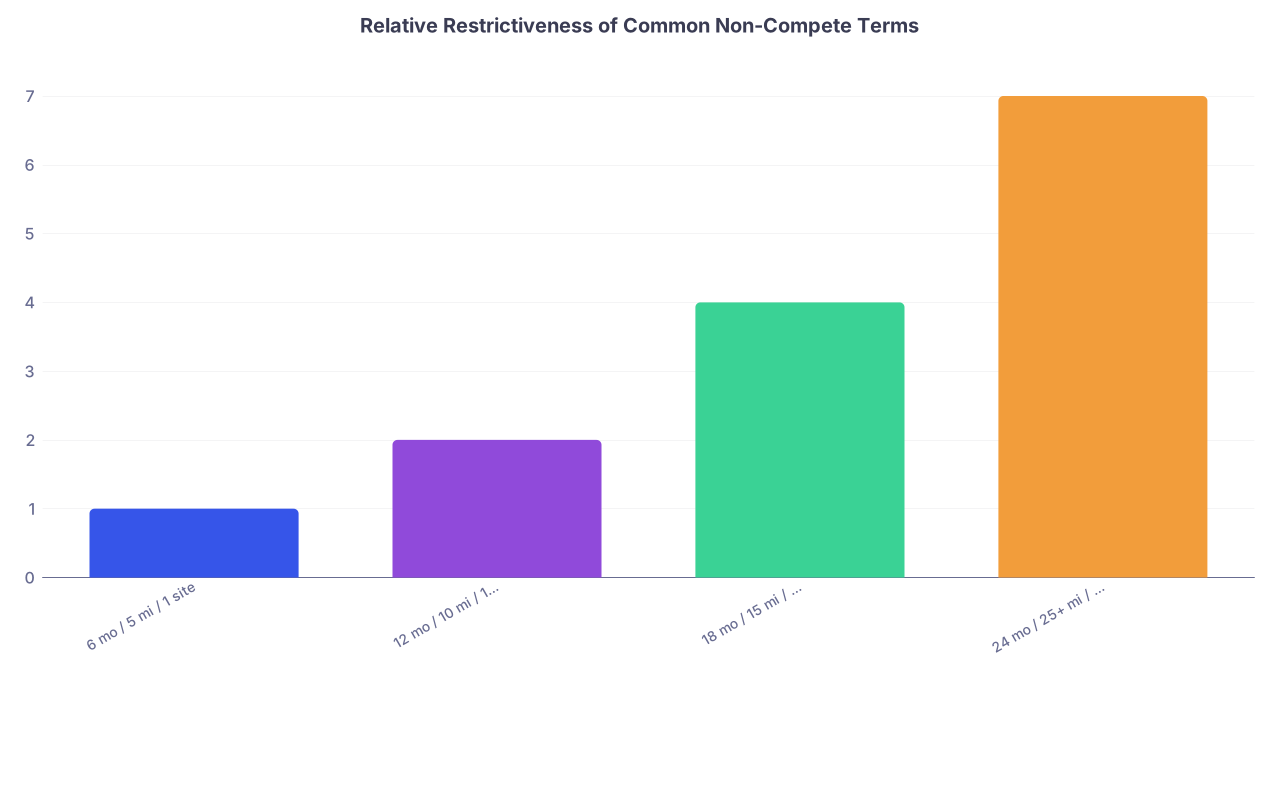
| Category | Value |
|---|---|
| 6 mo / 5 mi / 1 site | 1 |
| 12 mo / 10 mi / 1-2 sites | 2 |
| 18 mo / 15 mi / multi-site | 4 |
| 24 mo / 25+ mi / system-wide | 7 |
Lower numbers = more reasonable; higher = more restrictive. If your clause looks like that last bar, you should be negotiating, hard.
FAQ: Physician Non-Competes
1. Is a 2-year non-compete ever reasonable for a physician?
Occasionally, but not often. Two years might be tolerable if:
- The radius is small (e.g., 5 miles in a big metro).
- It applies only to one or two locations.
- You are highly compensated and the employer made a big investment in you (e.g., significant signing bonus, relocation, heavy marketing).
But a 2‑year, 15–25‑mile, multi‑site non‑compete is overreaching in most circumstances. I’d push strongly for 12 months, with 18 months as a hard upper ceiling only if other terms are very favorable.
2. Is a 50-mile non-compete enforceable?
In some rural areas, maybe. In a city or suburban metro, it’s often excessive. A 50‑mile radius from multiple sites can wipe out an entire region’s job market for you. Even where courts might technically enforce it, it’s a bad idea for you to sign that without serious negotiation.
I would consider 50 miles “reasonable” only if:
- It’s a truly rural, low‑density area, and
- It applies to one hospital/clinic, and
- Time is short (e.g., 6–12 months).
Anything beyond that, I’d treat as aggressively one‑sided.
3. Should I ever rely on “they probably won’t enforce it” and just sign?
No. That’s fantasy‑land behavior. You negotiate as if they will enforce exactly what’s written. Because they might. Or a new administrator might. Or the practice might be sold to a group that absolutely enforces non‑competes.
If they truly don’t care about the non‑compete, they should be willing to narrow or remove it now. “We’d never enforce that” without contract changes is a red flag, not comfort.
4. What’s more important to fight—time, distance, or scope?
Scope first, then distance, then time.
- Scope: If it blocks you from doing any form of your specialty, in any capacity, for anyone, that’s deadly. Narrow that to what you actually do.
- Distance: Shrink the radius, and limit it to specific sites.
- Time: Going from 24 to 12 months is huge. I focus on hitting 12 months or less when possible.
You can sometimes accept 12–18 months if the radius is small and the scope is tightly defined.
5. If my state bans physician non-competes, can I just ignore the clause?
No. You still get it reviewed and still try to get it cleaned up. Courts can enforce related restrictions (non‑solicit, confidentiality, trade secrets), and you don’t want vague language that becomes a litigation playground.
Also, laws change. You do not want to be the test case when the legal environment shifts. Better to have a narrow, clearly drafted clause than a broad, possibly void one that creates risk and confusion.
6. Do I really need a lawyer for this, or can I just negotiate myself?
If the non‑compete is anything beyond a short, narrow local clause, get a physician contract lawyer. Someone who does this all day, in your state. The few hundred to a couple thousand dollars you spend now is cheap compared to:
- Losing an entire metro’s job options for a year or two.
- Paying to move your family because you misread a radius.
- Getting stuck in expensive litigation when you try to leave.
You can absolutely start the negotiation yourself, but have the lawyer mark up the actual language you’re signing.
Key points to walk away with:
- Reasonable = 6–12 months, modest radius, tied to actual worksites and your specific specialty/role.
- Unreasonable = long (18–24+ months), wide (20–50+ miles), system‑wide, and triggered even if they fire you without cause.
- Do not sign a physician contract with a broad non‑compete without slowing down, getting it reviewed, and pushing for narrower, fairer terms.


