
The fantasy that loan repayment programs are “free money” is one of the most expensive myths physicians buy into after residency.
Loan repayment is not a gift. It is a contract structure. And in many cases, it is a very effective way to lock you into a job you would have otherwise left — at a price that quietly favors the employer, not you.
Let’s strip the marketing language and look at what’s actually going on.
The Core Myth: “They’re Paying Off My Loans, So I’m Winning”
You’ve heard this in workrooms:
“They’re offering $100k in loan repayment. I’d be stupid to say no.”
“I know the salary’s a little low, but the loan forgiveness makes up for it.”
This is how people talk right before they sign contracts they later regret.
Here’s the uncomfortable truth: most employer “loan repayment” packages are just disguised compensation with strings attached. If you translated them into plain English, a lot of them would read:
“We’re going to pay you under market for 3–5 years, and if you leave early, we’ll make it financially painful.”
And for many of you, it works. You stay. Not because the job is good, or the schedule is sustainable, or the culture is healthy. You stay because you’re trapped by a vesting schedule and a payback clause.
Before we break down the traps, you need to distinguish three very different beasts that all get lumped under “loan repayment.”
| Type | Who Pays You | Strings Attached |
|---|---|---|
| Federal/National Programs | Government entity | Service commitment, location |
| State / Public Service | State or agency | Location, years of service |
| Employer Loan Repayment | Your employer | Contract terms, clawbacks, noncompete |
Calling all of them “free money” is lazy. Only some are genuinely favorable. Others are golden handcuffs with a nice bow on top.
Follow the Money: How Employer Loan Repayment Actually Works
Let’s say a hospital system offers you:
- Base salary: $240,000
- “Loan repayment”: $25,000 per year for 4 years
- Total “package”: $340,000 in their glossy brochure slides
They tell you, “That’s basically like making $265k a year.”
No, it’s not. And they know it.
If market salary for your specialty and region is $275,000–290,000 without loan repayment, this is what’s happening:
They’re paying you below market in salary and dangling a conditional bonus that only vests if you suffer through multiple years.
You need to do a simple comparison:
- What’s the true market salary for my specialty in this region, without loan repayment?
- If I took the higher salary and used the difference to pay my loans, how would that compare?
I’ve done this math with people sitting across a cafeteria table. Example:
- Job A: $240k + $25k/yr loan repayment x 4 years = $340k “total”
- Job B: $285k, no loan repayment
Difference: $45k per year in salary.
If you take Job B and just auto-pay $30k/year to your loans, you’re still $15k ahead every year, and you’re not contractually locked into anything beyond your standard notice period and maybe a signing bonus clawback.
Not as sexy as “$100k in loan forgiveness,” but financially better and far more flexible.
So why do people still go for Job A? Simple. Psychology. Behavioral economics 101.
- “Loan repayment” sounds targeted and special.
- People hate their loan balance emotionally more than they love extra salary.
- Recruiters lean hard into this language because it works.
You need to be the one in the room who’s immune to the marketing. Convert every loan repayment offer into “equivalent annual compensation,” then compare to true regional market pay.
The Real Handcuffs: Clawbacks, Vesting, and Noncompetes
Loan repayment programs aren’t just about money coming in. The real story is in the money that can go back out if you leave.
Here’s where the hidden shackles usually live:
1. Payback if You Leave Early
Most employer repayment programs are structured as either:
- An annual lump sum that vests only if you complete the year, or
- An upfront “forgivable loan” that is gradually forgiven each year
Both are fine — until you want out.
Common clause I see:
- Employer pays you $100,000 as a “loan repayment” or “forgivable promissory note”
- You owe $20,000 back for each year you do not complete of a five-year term
Translation: leave after 2 years and you may owe $60,000, plus interest. You’re already tired, maybe burned out, maybe dealing with toxic leadership — and now you’re staring at a massive check to buy your freedom.
People stay. Not because it’s smart. Because it’s less painful than writing that check.
2. Noncompete + Repayment = Double Trap
Standalone noncompetes are bad enough. But pair a noncompete with loan repayment clawbacks and you’ve created a pretty effective cage.
Common setup:
- 20–30 mile noncompete for 1–2 years
- Loan repayment or forgivable loan with payback if you leave before X years
So to leave and stay in your city, you might have to:
- Pay back tens of thousands (sometimes over $100k), and
- Move your entire life or commute ridiculous distances to stay in practice
That “$100k in loan repayment” doesn’t look so generous when it effectively gives the employer leverage over your zip code, schedule, and negotiating power for half a decade.
3. Tax Surprise
One more fun detail: most employer loan repayment is taxable income to you.
So that $25k “loan repayment” may actually net you something like $15k–18k after federal, state, and payroll taxes. But your payback clause, if you leave early, is often on the gross amount.
You pay tax when it comes in. You repay the full principal if you leave. You do not automatically get that tax back. You might recoup some later via a deduction, but you’re carrying the pain upfront.
Again, this is not free money. It is a tax-inefficient, employer-controlled compensation vehicle.
Federal and State Programs: When It Is Actually Worth It
Now let’s be fair. Not all loan repayment is a trap. Some programs are legitimately good trades — especially if you already want to work in those settings.
Think:
- National Health Service Corps (NHSC)
- Indian Health Service (IHS)
- Many state-level loan repayment or rural health incentives
- True Public Service Loan Forgiveness (PSLF) via 501(c)(3) or government employers
The key distinction:
These programs are typically not your employer reaching into your contract to control you. They are external programs with relatively transparent rules.
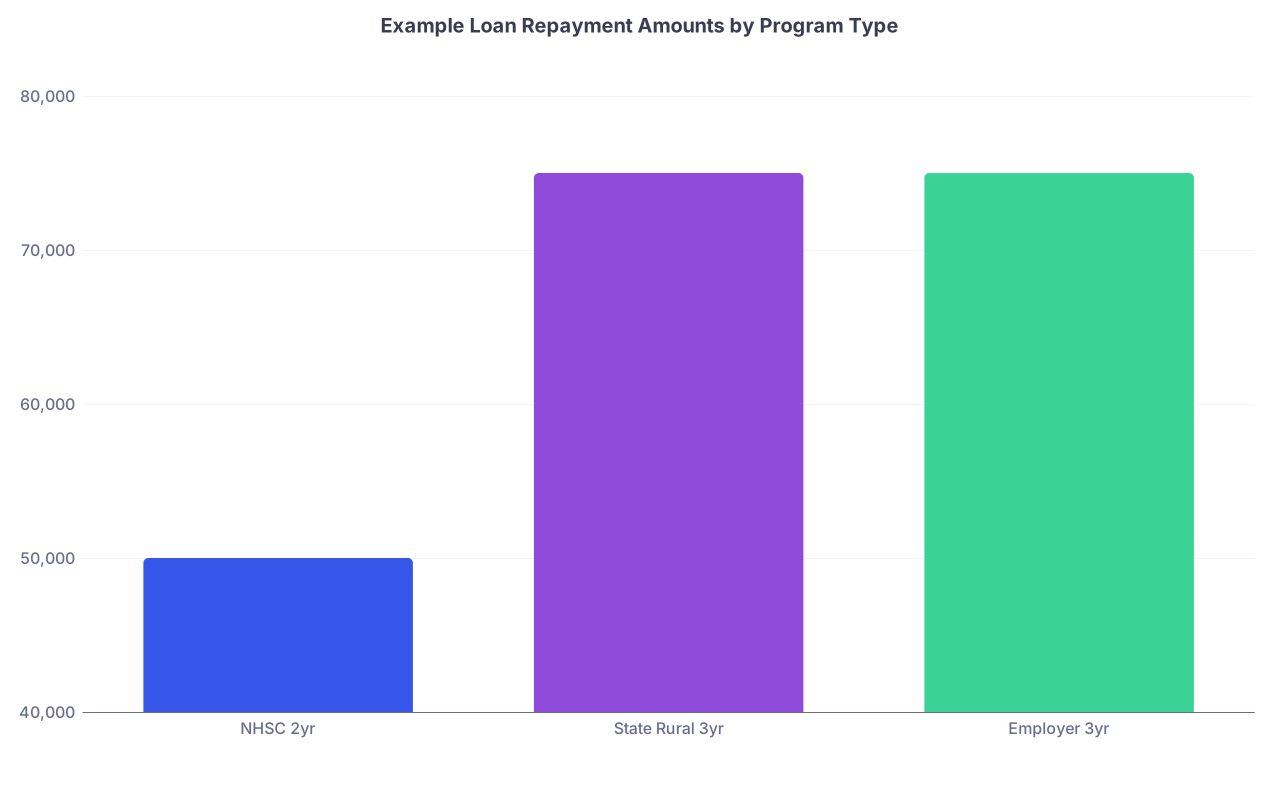
| Category | Value |
|---|---|
| NHSC 2yr | 50000 |
| State Rural 3yr | 75000 |
| Employer 3yr | 75000 |
Notice something? The dollar figures aren’t wildly different. The difference is in who holds the leash.
- With NHSC or state programs, if your job turns toxic, you may transfer sites or finish the commitment and leave. Your employer isn’t usually clawing back the money.
- With PSLF, the benefit is about where you work (nonprofit/government) and staying in the system, not about staying with one specific employer.
The tradeoff with these programs is almost always about:
- Location (rural, underserved, specific communities)
- Practice environment (FQHC, VA, public hospital)
- Pay that might be somewhat lower, but still reasonably market-aligned
Those can be excellent deals if they match your values and lifestyle. The key difference is choice. You usually have more mobility within that ecosystem.
The Negotiation Reality: You Can Often Convert “Loan Repayment” to Salary
Here’s one of those things recruiters don’t advertise: in many settings, the “loan repayment” bucket is flexible.
I’ve seen this play out more than once:
Physician: “I don’t really need loan repayment, but I care about base salary. Can we roll that into my base instead?”
Employer: “We don’t typically do that…”
[Two weeks later]
Employer: “We talked to leadership. We can move part/all of it into salary.”
Why does this matter?
Because straight salary:
- Is simpler
- Has no clawback beyond standard sign-on terms
- Often increases your retirement contributions (because they’re a % of salary)
- Doesn’t create weird tax/repayment games
If they insist the loan repayment must stay structured that way, ask why.
If their answer is “tax efficiency” or “how our internal buckets are set up,” fine — but then the terms need to be clean:
- Yearly payments, not big front-loaded promissory notes
- No retroactive clawback if terminated without cause
- Clear vesting (e.g., year 1 payment is fully yours after you complete year 1)
If instead you see:
- 5-year forgiveness schedule
- Repayment on termination “for any reason”
- Noncompete that covers huge territory
That’s not a benefit. That’s control dressed as generosity.
A Simple Framework: When Loan Repayment Is a Tool vs a Trap
You do not need a finance degree. You just need a checklist and some discipline.
Ask yourself:
If I stripped out “loan repayment,” is this job competitive on salary, schedule, and culture?
If not, they’re using loan repayment to compensate for something. Usually a red flag.Could I replicate or beat the financial benefit by taking a higher salary elsewhere and sending extra to my loans myself?
Very often yes, especially in competitive specialties.What happens if I leave at 12, 24, 36 months?
You want that answer in numbers in writing — not vague language.Who is actually paying the money?
- If it’s a federal/state/PSLF-type arrangement → usually cleaner.
- If it’s directly from the employer with heavy strings → extra scrutiny.
Can I negotiate structure?
If they won’t budge on any term, that tells you how they view physicians: as replaceable labor, not as long-term partners.
One Example, Side by Side
Let’s put a simple comparison in front of you.
| Feature | Job A (High Salary) | Job B (Loan Repayment) |
|---|---|---|
| Base Salary | $290,000 | $245,000 |
| Loan Repayment | $0 | $25,000/year x 4 |
| Noncompete | 10 miles / 1 year | 25 miles / 2 years |
| Clawback if Leave Year 2 | Signing bonus only | ~$50,000 |
On paper, Job B recruiter will say, “Total comp over 4 years: $245k x 4 + $25k x 4 = $1,080,000. That’s basically the same as Job A at $290k.”
Except:
- You pay tax on loan repayment.
- Your retirement match (say 5%) is better on higher salary.
- Your flexibility to leave Job B is financially punished.
Run the math: Job A with aggressive self-directed loan payments often leaves you richer and freer.
Hidden Upside: You Don’t Actually Need Employer Help to Kill Your Loans
One last myth: “Without a loan repayment program, I’ll drown in debt.”
That’s rarely true for attending physicians who live like a human adult, not like a TikTok influencer, for the first few years.
If you’re making $260k–300k and keep your fixed costs under control, you can:
- Throw $30–60k per year at loans
- Knock out six figures of principal in just a few years
- Maintain full job mobility the entire time
Not dependent on anyone’s vesting schedule. No “if you leave early, you owe us” games. Just you, your paycheck, and straightforward amortization.
Ironically, I’ve watched several early attendings in “no loan repayment” jobs pay off loans faster than colleagues who were “waiting for forgiveness” under complex employer-designed programs — and stuck in miserable jobs because of it.
Two Places Loan Repayment Actually Shines
To be fair, there are scenarios where structured loan repayment is legitimately smart:
You already want the job, even without it.
You love the group, location, schedule, and culture. The loan repayment is just extra gravy. The terms are reasonable, clawbacks modest, and salary still in market range. Fine. Take it.You’re trading location for life.
Rural/underserved, lower cost of living, and you’re saying, “I’ll do 3–4 years, wipe out my loans, stockpile cash, then decide what’s next.”
If the job isn’t toxic and the numbers are real, this can be a very rational move.
Notice the pattern: in both cases, your primary reason for taking the job is the job itself, not the loan perk. That’s the line most people cross without realizing it.
The Bottom Line
Loan repayment programs are not magic. They are just compensation with conditions.
Three key points:
- Treat every loan repayment dollar as conditional salary. Run the numbers against a clean, higher-salary offer and see who actually pays more.
- The danger is not the perk; it is the strings. Clawbacks, long forgiveness schedules, and noncompetes are the real “handcuffs” — not the debt you walked in with.
- The best deals are either external (federal/state/PSLF) or attached to jobs you’d gladly take without them. If the only reason you’re signing is “they’re paying my loans,” you’re probably the one getting owned.
Negotiate like a grown professional, not like a desperate debtor. Your future self — the one who wants the option to walk away — will thank you.