

You’re sitting at your kitchen table at 10:30 p.m. One browser tab: the offer letter from a large hospital system. Another tab: your spouse’s email with “We’d like to talk next steps” from a completely different city. Your recruiter is nudging you: “We really need an answer by Friday.” Your spouse’s potential employer is moving slower than a prior auth.
You both know the truth: if your spouse cannot land a viable job in the same area, this offer is dead. But you also know something else: if you tip your hand too early, you might scare off the employer or give up leverage.
This is the dual‑career trap. And if you handle it passively, you lose.
Let’s walk through how to make your spouse’s job a feature of your negotiation, not an afterthought.
Step 1: Get Clear on Your Actual Constraints Before You Talk
Before you say one word to a recruiter about your spouse, you and your spouse need a brutally honest conversation.
You’re deciding three things:
- Is this a “must be together” situation or “we can do distance for a while”?
- How far are you willing to commute or live apart?
- What counts as a “good enough” job for your spouse?
Do this on paper. Not in your head.
- Draw a circle around the potential job site: what’s an acceptable commute radius for each of you? 30 minutes? 60?
- Write down your spouse’s minimums: salary range, schedule frequency, academic vs. community, leadership needs, visa needs if relevant (this one breaks people if ignored).
- Rank priorities: money, schedule, call burden, academic title, kids’ schools, proximity to family. Be honest. I’ve watched couples implode because one partner quietly cared more about being near grandparents than the other realized.
Then define your non‑negotiables as a couple, like:
- “We will not live in separate states.”
- “Spouse must have a job signed within 3 months of my start date.”
- “If spouse only finds per‑diem or low‑pay work here, we are not moving.”
This is your internal contract. You don’t show it to anyone. But every negotiation move you make has to align with it.
Step 2: Decide When to Reveal the Dual‑Career Issue
You have three basic timing options:
| Timing | Pros | Cons |
|---|---|---|
| Very Early | Honest, can leverage support | Risk of being screened out |
| After Initial Fit | Some leverage, low surprise | Less time for spouse search |
| At Offer Stage | Max leverage, but high risk | Can feel like a surprise ask |
Here’s how I suggest thinking about it:
- If you’re in a rural or less competitive area where they’re desperate for your specialty, you can afford to mention your spouse early. They often have to recruit whole families.
- If you’re in a hyper‑competitive urban market or a prestige academic center where they have a stack of CVs, I usually wait until:
- You’ve had at least one visit,
- They’ve shown clear interest,
- You’re moving toward an offer.
At that point, your value is clearer. They’ve invested time in you. It’s harder for them to walk away over “complication.”
A simple script for that moment:
“I’m very interested in this position and could see myself here long‑term. There’s one key factor I want to be transparent about: my spouse is also in [field/industry/specialty] and our ability to relocate realistically depends on there being good options for them in this area. Is that something your institution or network ever helps with?”
You’re not saying, “I will not accept without a guaranteed job for my spouse.” You’re saying, “This is a real factor; can you help?”
Most decent systems at least have a playbook for this. Let them show their hand.
Step 3: Map Out What Kind of Help You Actually Need
“Dual‑career friendly” can mean anything from “We’ll make some intros” to “We’ll create a funded position for your spouse.” Don’t assume; define.
Typical categories:
- Introductions only
- They email chairs or hiring managers in your spouse’s field.
- They put words like “star recruit,” “priority candidate,” “strong preference for co‑location” into those emails.
- Shared institutional hire
- Both of you get offers from the same health system or university.
- Sometimes one FTE is entirely new, created to land you.
- Network support
- They leverage community practices, referrals, or partner hospitals to find openings for your spouse.
- Financial bridge
- They cannot guarantee a job for your spouse, but they can:
- Increase your base salary,
- Provide a signing bonus,
- Cover relocation more generously,
- Offer a temporary stipend or academic title to your spouse.
- They cannot guarantee a job for your spouse, but they can:
You decide what bucket you realistically need.
If your spouse is also a physician in a needed specialty (say, psychiatry, rheumatology, anesthesia), the odds of a true dual hire go up. If your spouse is in a saturated specialty (derm in a big city) or a niche academic field with limited positions, “introductions + financial cushion” might be more realistic.
Step 4: Make the Employer Do Some Work for You
This is where you stop acting like an isolated job seeker and start treating the institution like a system.
Be explicit about what help you want, but stay reasonable.
Examples of clear, specific asks:
- “Would you be willing to introduce my spouse to the chair of [X] at your main hospital and at your affiliate across town?”
- “Do you have a dual‑career coordinator or HR partner who helps spouses in academic roles?”
- “Is there an internal or external job list for physicians in your network that my spouse can tap into?”
- “Is there flexibility on my start date so that we can align it with my spouse’s hiring timeline?”
If they say:
“We don’t really do anything formal for spouses.”
That tells you something important about this place’s culture. I’ve watched more than one young physician ignore that red flag and later eat the consequences when their spouse could not find work for a year.
On the other hand, if they respond with:
“We can copy our recruitment director and chair of [spouse’s specialty] and set up calls next week.”
You’re dealing with a system that understands reality.
Step 5: Translate Dual‑Career Reality Into Contract Language
Most people stop at conversations. That’s a mistake. What protects your family is what’s on paper.
Here are concrete ways to make the contract dual‑career friendly.
1. Start date flexibility
Instead of:
Start date: July 1, 2026.
Ask for:
Start date: Between July 1 and November 1, 2026, specific date to be mutually agreed upon no later than March 1, 2026.
That window buys your spouse time to secure something and lets you adjust if their offer is delayed.
2. Relocation and temporary housing
Push the relocation benefits to reflect the dual‑career complexity. For example:
- Higher moving allowance,
- Temporary housing support for 3–6 months,
- Travel reimbursement for additional house‑hunting trips (both of you).
You can justify it directly:
“Because my spouse is also job searching in the area, we’ll likely need extra trips and a longer overlap. Can we increase the relocation stipend from $10,000 to $18,000 and include one additional house‑hunting trip for both of us?”
3. Shorter or staged commitment
If your spouse’s situation is uncertain, you should not chain yourself to a five‑year contract with a nuclear noncompete.
Options to negotiate:
- Shorter initial term (e.g., 2–3 years instead of 5).
- A more reasonable noncompete radius/duration.
- Or explicitly no noncompete if you must stay in the area but change employers.
You will not always get this, but it is absolutely rational to tie it to the dual‑career piece:
“Given that our long‑term location depends on my spouse’s opportunities, I’m not comfortable with a 3‑year, 50‑mile noncompete. Could we reduce the radius to 15 miles and the duration to 1 year, or consider removing it?”
4. Tailored bonus/forgiveness schedules
A lot of places try to lock you with:
- Huge signing bonus,
- Tuition/loan assistance,
- Forgivable recruitment loans with multi‑year claw backs.
You need those structured so that if the dual‑career situation blows up, you’re not financially trapped.
Ask:
- That the bonus or loan forgiveness be front‑loaded (more forgiven in early years).
- That repayment be prorated monthly or quarterly, not “all or nothing” if you leave 1 day too soon.
- For clarity that if they terminate you without cause, payback is waived.
You can phrase this as:
“Because our staying here is linked to whether my spouse can secure a stable position, I’d like the forgiveness schedule to be monthly over 3 years rather than a lump forgiveness at year 3. That way, if we have to relocate for my spouse’s job, we’re not penalized disproportionately.”
Step 6: If Your Spouse Is Also in Medicine – Play It Right
Two‑physician couples are their own beast. Systems love them when the math works, but sometimes administrators get weirdly territorial.
If you’re both physicians:
- Decide if you want the same employer or just the same city.
- Same employer: easier call schedules, shared benefits, more leverage, but higher risk if administration goes toxic.
- Different employers: diversification of risk, potentially better combined negotiation power, but trickier scheduling.
- Use joint leverage smartly. Not like a threat.
Example of what not to say:
“We’re a package deal; if you don’t hire both of us, we’re not coming.”
That sounds like a hostage note.
Better:
“We’re both very interested in this region and would love to be in the same health system if possible. Here’s my spouse’s CV. Would you be open to a conversation about potential roles for both of us?”
If they’re serious, they’ll move quickly. I’ve seen systems create an extra hospitalist FTE or carve out an academic educator role in two weeks when they really wanted Candidate A and their Cardiology spouse.
And get this part in writing if there’s any promise of a future slot for your spouse. Email is fine, but the clearest form is a short letter or addendum:
“The employer agrees to consider in good faith the creation of a faculty position in [spouse’s specialty] within the Department of X for Dr. [Spouse] during the first 18 months of employment, subject to budget approval and mutual agreement on duties.”
This is not a guarantee. But now you have something to point to when leadership turns over (and it will).
Step 7: If Your Spouse Is Not in Medicine – Use the Institution’s Ecosystem
If your spouse is in another field—academia, tech, education, finance—you need to think beyond your department.
Ask:
- Is there a university affiliated with the hospital?
- Any major employers or corporate partners the hospital has formal relationships with?
- Does the city/region have a dual‑career program (common in big university towns)?
These systems often have an “Executive relocation” or “Dual Career” office that literally exists to help trailing spouses find work. But they do not advertise it loudly.
Your script:
“My spouse works in [X]. Does your institution have any dual‑career support or contacts at local employers they could connect with?”
Get actual names. Actual emails. Then push gently:
“Would you be willing to send an introductory email on our behalf?”
That warm intro email from “Vice Dean of Clinical Affairs” to the Google site lead or local university provost will do more than 50 cold applications.
Step 8: Use Timelines as a Negotiation Tool, Not a Panic Trigger
Here’s what usually happens:
- You get an offer with a 7–10 day “exploding” deadline.
- Your spouse’s search is behind, because you were waiting to see if you liked this job.
- Everyone feels urgency. Bad decisions get made.
Do not accept artificial panic if you can help it. Instead, convert timeline chaos into clear milestones.
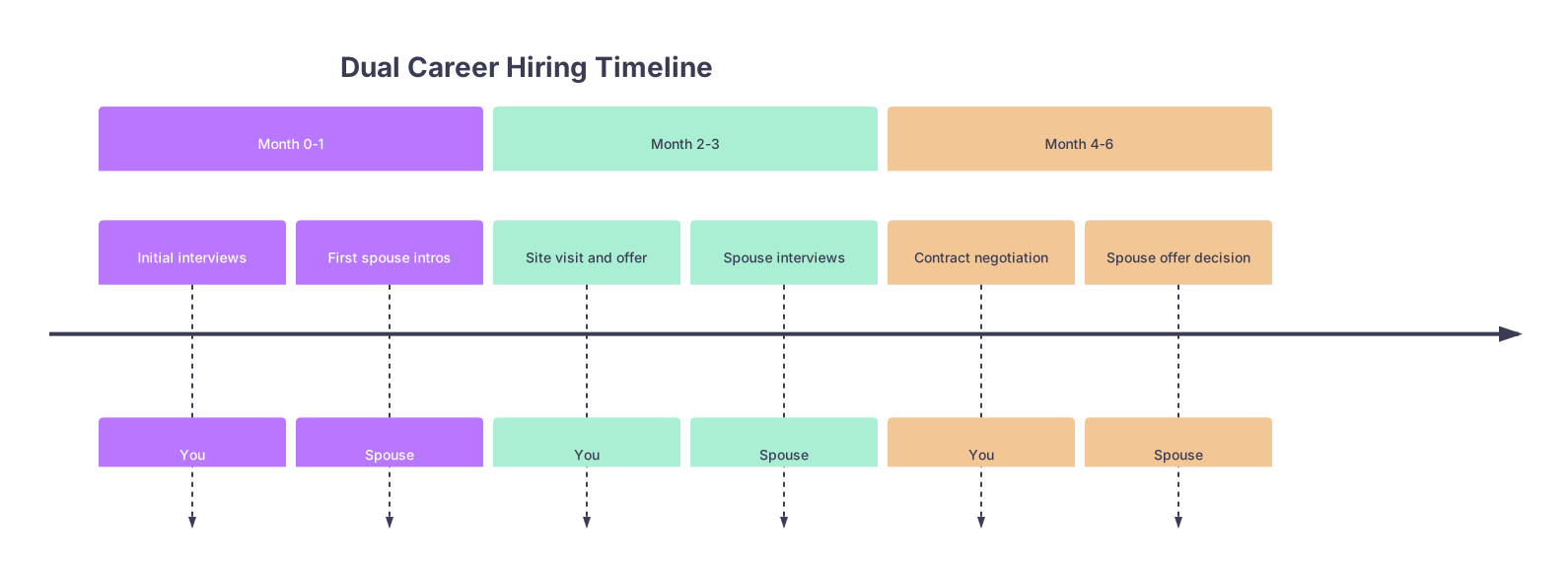
| Period | Event |
|---|---|
| Month 0-1 - Initial interviews | You |
| Month 0-1 - First spouse intros | Spouse |
| Month 2-3 - Site visit and offer | You |
| Month 2-3 - Spouse interviews | Spouse |
| Month 4-6 - Contract negotiation | You |
| Month 4-6 - Spouse offer decision | Spouse |
When you receive an offer, respond quickly but do not rush to sign:
“Thank you for the offer. I’m excited about this role. Because my spouse is also in the process of interviewing locally, I’ll need about 3 weeks to finalize our family decision. Can we set [date] as a target for my response?”
Half the time, they say yes. When they do not, that tells you something about their style. Many will compromise on a “short extension” if you show engagement (asking clarifying questions, scheduling a follow‑up call, involving a lawyer).
Step 9: Get a Contract Lawyer Who Actually Understands Dual‑Career Issues
This is not the moment for your uncle who “does some contracts.” You want someone who:
- Reviews physician contracts weekly,
- Has seen two‑physician and spouse‑job scenarios,
- Understands the noncompete mess in your state.
You’re not asking them to find you a spouse job. You’re asking them to:
- Protect you if your spouse’s job falls through,
- Keep you out of noncompete jail if you later need to switch employers in the same city,
- Structure bonuses/forgiveness so you’re not trapped.
Hand them the actual situation:
“My spouse needs to find a job in this region too. There’s a real chance we might have to leave in 2–3 years if that does not work. Review this contract as if that happens. What are the landmines?”
If they wave off noncompetes or repayment clauses with “You’ll probably be fine,” get someone else.
Step 10: Know When to Walk Away (And Actually Do It)
The hardest part. You get a nice offer. The salary is good. The colleagues seem fine. And:
- They offer zero meaningful help to your spouse,
- The noncompete makes it impossible to just “switch groups across town,”
- There’s no significant dual‑career support anywhere in the city.
You do not “figure it out later.” You walk.
I’ve watched this play out both ways:
- Couple A ignored the writing on the wall. Three years later, spouse still under‑employed, resentment sky‑high, physician stuck in a group they hate because of a 50‑mile noncompete and a $90k unforgiven signing bonus.
- Couple B ripped off the Band‑Aid. Turned down a prestigious academic center that would not even send two emails for the spouse. Landed at a mid‑sized city where the system created a part‑time role for the spouse and gave them both leverage. Five years later, they are thriving.
Saying no to a shiny job that fails your internal “family contract” is not weakness. It’s discipline.
A Quick Reality Check: This Is a Long Game, Not a Single Offer
Here’s the mental model I want you to keep:
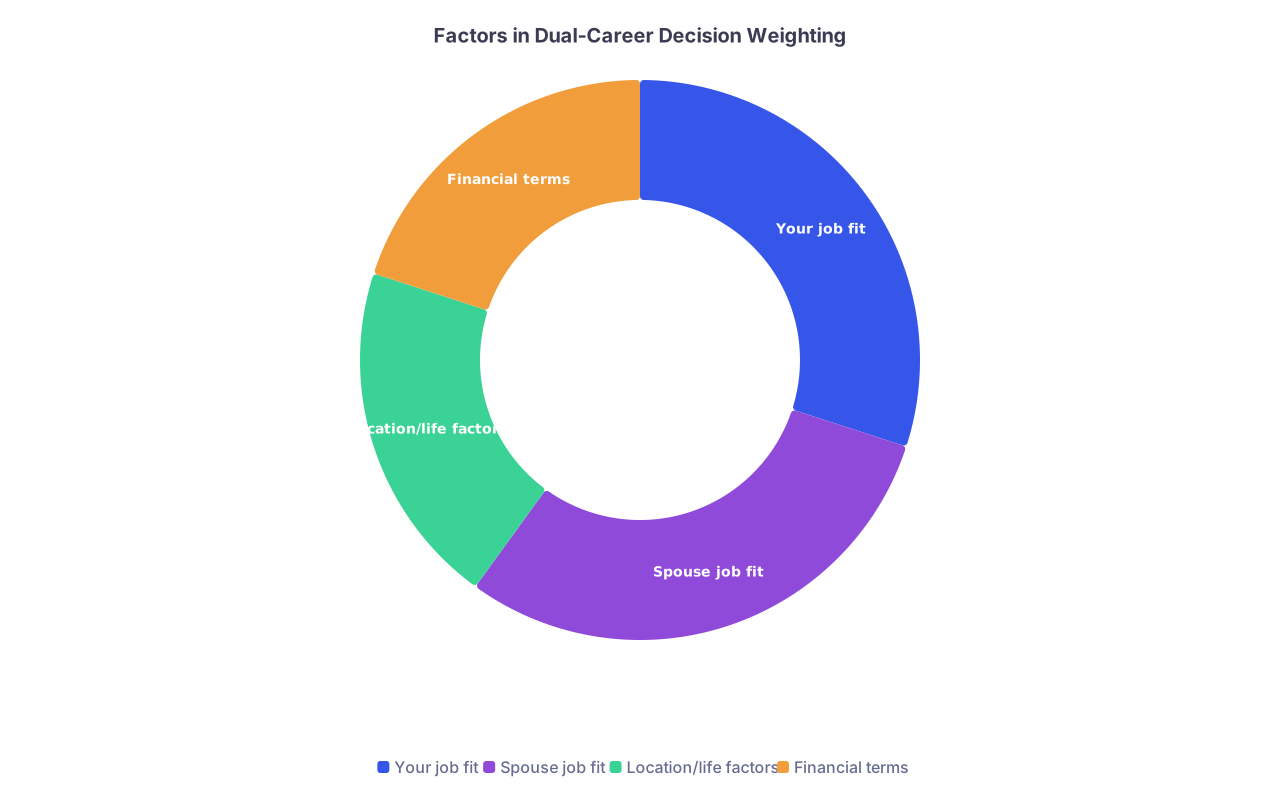
| Category | Value |
|---|---|
| Your job fit | 30 |
| Spouse job fit | 30 |
| Location/life factors | 20 |
| Financial terms | 20 |
You’re not just taking “a job.” You’re choosing:
- A regional labor market for both of you,
- A network of potential employers over the next decade,
- A set of schools, friends, support systems, and yes, exit doors.
When your spouse’s job matters—and it does for almost everyone—you treat the contract as a family document, not an individual trophy.
You slow down when recruiters push speed. You press for written terms when administrators give “verbal assurances.” You hard‑wire flexibility into the contract so that if the spouse situation shifts, you have options besides misery or financial ruin.
Once you’ve done that—once you’ve asked the right questions, pushed for the right protections, and aligned the offer with your internal family deal—you’ll be in a much stronger position to say yes without that sick feeling in your stomach.
From here, the next chapters are different: learning how to actually live in the new job, renegotiate once you’ve proven yourself, and build a career that doesn’t chew up your family life on the way. But those are their own situations.
Right now, your task is simpler and harder: use this offer, and your spouse’s reality, to build a contract that works for both of you. Then sign it with your eyes open—together.


