
The biggest mistake physicians make with MGMA data is treating it like a single number instead of a distribution.
If you walk into a negotiation saying “I want the MGMA median,” you have already lost most of your leverage. The data show a far better way to use MGMA: as a multi‑dimensional benchmark, tied tightly to your personal productivity and your local market.
Let me walk you through how to do this like a data analyst, not a desperate job seeker.
1. What MGMA Data Actually Is (and What It Is Not)
MGMA compensation data is not magic. It is a large but imperfect survey.
Here is what it usually includes, by specialty:
- Total compensation (often including base + bonus + call + some benefits)
- Work RVUs (wRVUs)
- Compensation per wRVU
- Collections, net revenue
- Practice ownership type (hospital, academic, private, etc.)
- Geographic region, and sometimes practice setting (urban, rural)
From a data standpoint, MGMA gives you a distribution: 10th, 25th, 50th, 75th, 90th percentiles. The power is not “the median” – the power is the relationship between your expected work and those percentiles.
Typical structure (simplified):
| Metric | 25th %ile | 50th %ile | 75th %ile |
|---|---|---|---|
| Total Comp ($) | 230,000 | 260,000 | 300,000 |
| Annual wRVUs | 3,800 | 4,300 | 4,900 |
| Comp per wRVU ($/wRVU) | 55 | 60 | 66 |
If your offer is $260,000 with an expectation of 5,000 wRVUs, the math is brutal:
- Comp per wRVU offered = 260,000 / 5,000 = $52/wRVU
- MGMA median comp per wRVU = $60
- You are being priced at well below the 25th percentile rate for above‑median work.
That is how you use MGMA data. Not “median pay is X,” but “my effective rate is misaligned with national benchmarks given the expected work.”
MGMA is not:
- A guarantee of what you “should” earn
- Perfectly representative of your exact local micro‑market
- A substitute for understanding your own RVU targets and schedule
It is a reference distribution. You are arguing fit and alignment, not entitlement.
2. The Numbers That Actually Move Negotiations
Compensation is multi‑variable. MGMA lets you compare across variables, but only if you calculate the right things.
The three ratios that matter most:
- Total comp vs. MGMA comp percentile
- Expected wRVUs vs. MGMA wRVU percentile
- Implied $/wRVU vs. MGMA $/wRVU percentile
If your comp percentile is lower than your wRVU percentile, you have immediate, objective leverage.
Let’s anchor this with a simple visual model.
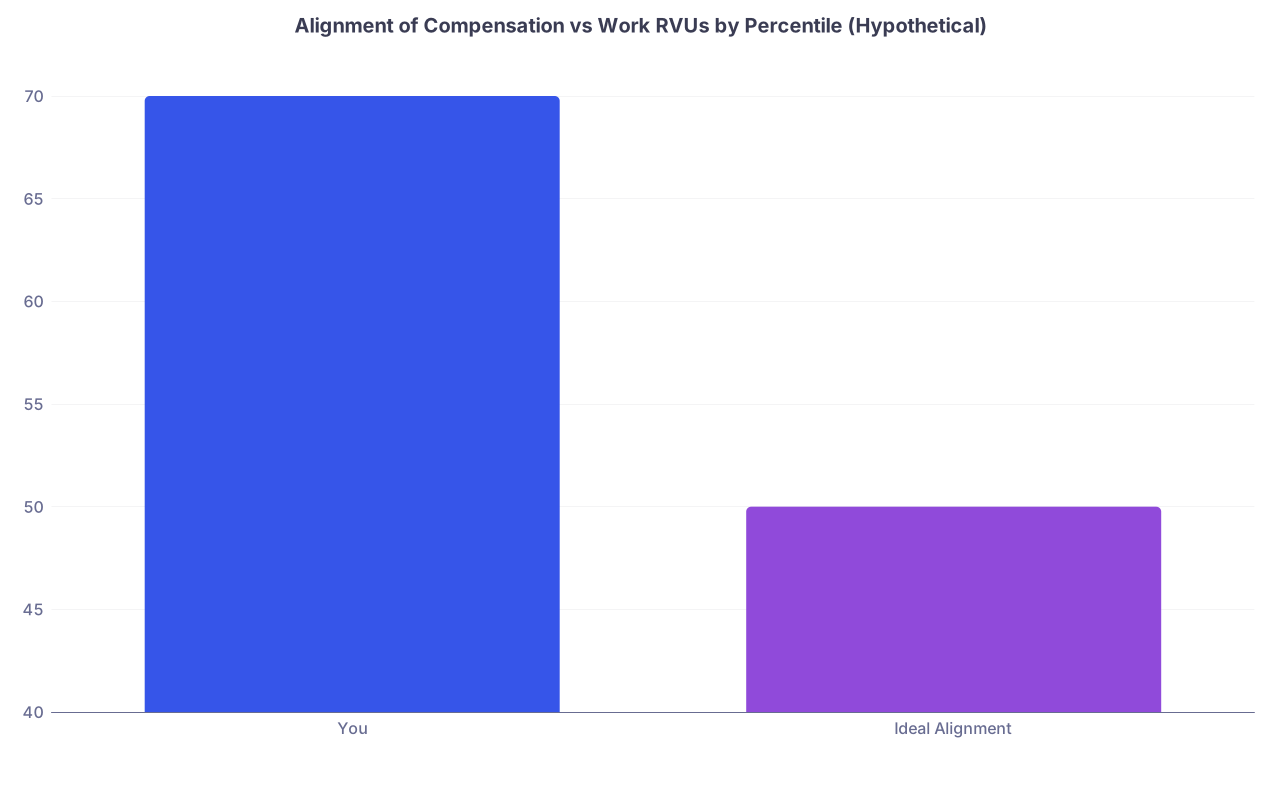
| Category | Value |
|---|---|
| You | 70 |
| Ideal Alignment | 50 |
Interpretation (behind the chart):
- Your expected wRVUs are at ~70th percentile
- Your comp offer is at ~50th percentile
The gap is your negotiation story.
A more realistic data comparison looks like this:
Suppose MGMA for your specialty (hypothetical numbers):
- 25th percentile: 220k comp, 7,000 wRVUs, $31/wRVU
- 50th percentile: 260k comp, 8,000 wRVUs, $32.50/wRVU
- 75th percentile: 320k comp, 9,000 wRVUs, $35.50/wRVU
Your offer:
- Base salary: 250k
- Productivity bonus starts after 8,500 wRVUs
- No clear per‑wRVU bonus rate disclosed
If the job’s volume estimates suggest you will be around 9,000 wRVUs:
- Effective base-only rate = 250,000 / 9,000 = $27.78/wRVU
- MGMA median = $32.50
- MGMA 75th = $35.50
You can reasonably argue for:
- Higher base, or
- Lower wRVU target before bonus triggers, or
- Higher $/wRVU bonus rate above threshold, or
- Some combination of the three
You are not saying “pay me 320k because MGMA 75th is 320k.” You are saying:
“My effective rate per unit of work is significantly below MGMA norms for this volume. Let us adjust one or more of the levers so that the compensation structure aligns better with national benchmarks for this level of productivity.”
That is the language of data, not emotion.
3. Step‑by‑Step: How to Benchmark Your Offer Against MGMA
Treat your contract like a dataset. You have inputs (hours, call, wRVUs) and outputs (pay, benefits, time off). You need to normalize.
Step 1: Extract the Quantitative Assumptions
From the job description and contract draft, pull:
- Expected clinic or shift volume (patients/day or shifts/month)
- Stated or implied wRVU target
- Base salary
- Productivity formula (threshold + per‑RVU rate)
- Call expectations (in‑house vs beeper, frequency)
- Sign‑on, relocation, loan repayment (one‑time vs recurring)
If they say “most physicians here generate around 8,000–9,000 wRVUs,” write that down. That number matters far more than a vague “busy practice” comment.
Step 2: Convert the Offer into Comparable Metrics
You want at least three comparison metrics:
- Base + likely bonus = “expected total comp”
- Expected RVUs (or a conservative range, e.g., 7,500–8,500)
- Implied $/wRVU
Example:
- Base = 240k
- Bonus = $40/wRVU above 6,000 wRVUs
- Internal data or recruiter says average faculty do ~8,000 wRVUs
Then:
- Expected bonus = (8,000 – 6,000) × 40 = 2,000 × 40 = 80,000
- Expected total comp = 240k + 80k = 320k
- Implied rate = 320,000 / 8,000 = $40/wRVU
Now you can benchmark.
Step 3: Align with MGMA Percentiles
You need the MGMA table for your specific specialty, region, and practice type if possible (hospital employed vs private practice). Often you will only have national data; use that and frame it as such.
Let us say MGMA shows, for your specialty, nationally:
- 50th percentile: 300k, 7,500 wRVUs, $40/wRVU
- 75th percentile: 350k, 8,500 wRVUs, $41.50/wRVU
Your expected comp and RVUs:
- 320k at 8,000 wRVUs, $40/wRVU
Here, you are roughly:
- Compensation between median and 75th
- Productivity between median and 75th
- Rate per wRVU = exactly median
That is reasonably aligned. Negotiation here is about fine‑tuning (call pay, non‑clinical time, sign‑on) rather than “this is a bad deal.” The data does not support an aggressive “I am underpaid” claim.
Now run a more problematic scenario.
Offer B:
- Base: 230k
- Bonus: $35/wRVU above 7,000
- Expected volume: 8,500 wRVUs
Expected total comp:
- Bonus = (8,500 – 7,000) × 35 = 1,500 × 35 = 52,500
- Expected total comp ≈ 282,500
- Implied rate = 282,500 / 8,500 ≈ $33.23/wRVU
Against the same MGMA:
- MGMA median rate = $40/wRVU
- MGMA median comp = 300k at 7,500 wRVUs
You are doing more work than median (8,500 vs 7,500) for:
- Less money (282.5k vs 300k)
- Lower rate ($33.23 vs $40)
That is not “slightly off.” That is structurally misaligned.
Your ask could be any of:
- Increase base to ~260k, keep same bonus formula
- Increase bonus rate to at least $42–$45/wRVU above 7,000
- Lower threshold to 6,000–6,500 wRVUs
But your argument is straightforward: “Based on MGMA data, this compensation structure under‑indexes both total compensation and compensation per wRVU relative to expected productivity.”
4. Regional, Practice Type, and Non‑Clinical Adjustments
Raw MGMA numbers can mislead you if you ignore context. The data show substantial spread by:
- Region (Midwest vs West vs Northeast vs South)
- Urban vs rural
- Academic vs private vs hospital employed
- Ownership track vs pure employed
You should never be quoting a single national “median” without clarifying what slice you are using.
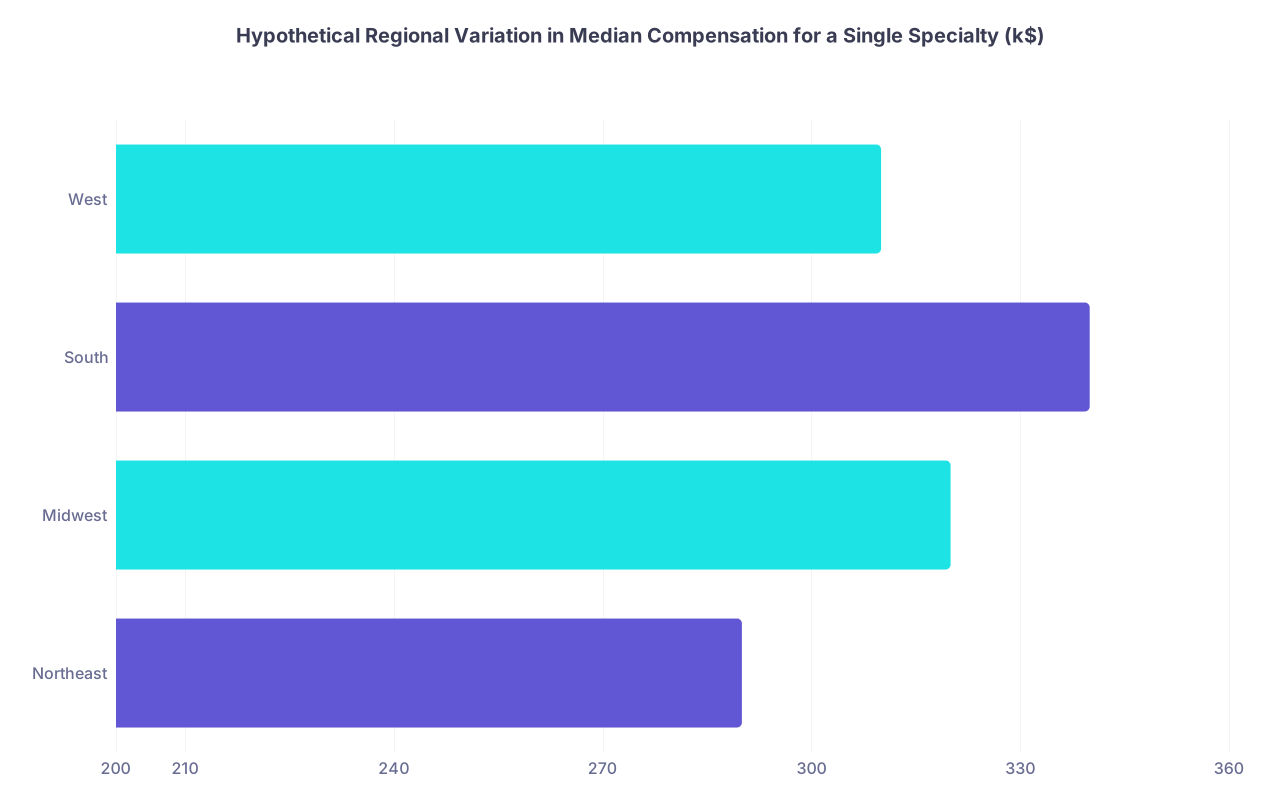
| Category | Value |
|---|---|
| Northeast | 290 |
| Midwest | 320 |
| South | 340 |
| West | 310 |
That kind of spread is typical. If you are looking at a rural Midwestern job and waving a Northeast urban academic MGMA median, you will sound naïve.
Adjust your interpretation like this:
- If you are going rural, the comp percentile should skew higher because they are buying your willingness to be in that geography. I get suspicious when a rural job pays at or below national median despite high volume.
- If you are going academic or heavily non‑clinical (admin, teaching, research), the comp percentile may justifiably be lower—but the RVU expectations must also be lower. High volume + “but this is academic so pay is lower” is textbook exploitation.
Time allocation matters. If you are 0.7 clinical / 0.3 admin, do not compare your salary to 1.0 FTE clinicians. Normalize:
- Take MGMA clinical full‑time benchmark (say 350k at 1.0 FTE)
- 0.7 clinical equivalent ≈ 0.7 × 350k = 245k clinical portion
- Then add an admin stipend (which might be under MGMA leadership/medical director benchmarks)
If someone tells you, “Our full‑time physicians make about 350k, you will do 0.7 clinical plus admin for 260k total,” ask explicitly:
“How much of this 260k is for the clinical portion versus the administrative responsibilities, and how does that compare to MGMA clinical and leadership benchmarks?”
You are separating out the components so each can be benchmarked properly.
5. Framing Your Ask Using MGMA Without Sounding Entitled
You want to sound like you have done your homework, not like you read a Reddit thread saying “Always ask for 75th percentile.”
Good framing:
- Start with alignment, not accusation.
- Use specific numbers.
- Tie your productivity and schedule to the benchmarks.
Here is a clean structure:
- Acknowledge you have reviewed MGMA data for [specialty], [region/practice type if available].
- State where the offer sits roughly on that distribution for total comp and for $/wRVU.
- State the expected productivity percentile (based on their own volume estimates or clear RVU targets).
- Point out any mismatch: “Productivity closer to 75th, compensation closer to 25th–50th.”
- Offer specific options that fix the misalignment.
Example language you can adapt:
“I reviewed MGMA data for [specialty] in [region]. Median compensation is approximately [X], with median wRVUs around [Y], which works out to about [$Z] per wRVU. Based on our discussions, the expectation here is about [your wRVU estimate] wRVUs annually, which is closer to the [NN]th percentile in MGMA, but the current compensation package places me near the [MM]th percentile in both total compensation and compensation per wRVU.
I would like to adjust either the base salary, the wRVU threshold, or the per‑RVU bonus rate so that the overall structure is better aligned with MGMA benchmarks for the level of productivity you are describing.”
That is hard to dismiss as “unreasonable.” It is quantitative, specific, and anchored to external data.
6. Guardrails and Red Flags in MGMA‑Based Negotiations
There are several predictable games employers play when you bring up MGMA.
Game 1: “Our Market Is Different”
Sometimes this is true. Sometimes it is an excuse.
Your response should be half curiosity, half audit:
- “Can you share any internal data on what your current physicians are earning and producing? Even ranges would be helpful, so I can make sure we are aligned with both MGMA and your internal benchmarks.”
If they are paying everyone below MGMA 25th with above‑median expectations, “our market is different” is code for “we underpay and get away with it.”
Game 2: “We Pay Below Median but You Will Make It Up in Volume”
Translate that into math instantly. High volume at low rate is not “making it up.” It is just working more for cheap.
Run the numbers explicitly:
- “If I hit 9,000 wRVUs, that will be roughly X% above MGMA median productivity, but the effective rate would still be about [$A/wRVU], which is significantly below MGMA median for compensation per RVU.”
Screenshot that math on a single page. If they do not come up meaningfully, they are relying on you not doing the arithmetic.
Game 3: “We Use a Different Survey”
Sometimes you will hear about SullivanCotter, AMGA, or proprietary health‑system data. That is fine. The tactic is the same: your productivity percentile should roughly match your pay percentile.
Ask to see at least:
- The median and 75th percentile compensation and wRVUs for your specialty
- How their internal comp plan is structured relative to those numbers
You are not married to MGMA as a brand. You are married to the logic of alignment between output and pay.
7. Putting It All Together: A Negotiation Script with Data
Let me stitch all of this into a concise, realistic exchange. Assume you are a general cardiologist, community hospital, Midwest, fresh out of fellowship.
MGMA (hypothetical numbers, cardiology):
- Median comp: 520k, 9,000 wRVUs, $57.8/wRVU
- 75th comp: 600k, 10,500 wRVUs, $57.1/wRVU
Offer:
- Base: 475k
- Bonus: $50/wRVU above 8,500
- Recruiter states most cardiologists there are at 10,000–11,000 wRVUs
Your internal math:
- If you hit 10,500 wRVUs (around 75th percentile productivity):
- Bonus = (10,500 – 8,500) × 50 = 2,000 × 50 = 100,000
- Total = 575k
- Rate = 575,000 / 10,500 ≈ $54.76/wRVU
Relative to MGMA:
- Comp 575k at 10,500 RVUs vs MGMA 600k at 10,500
- Rate $54.76 vs MGMA ~$57.1
Not a disaster. But slightly under benchmark despite high output.
Your negotiation:
“I appreciate the offer and the transparency around volume. Based on our discussions, it sounds like a realistic wRVU range is around 10,000 to 11,000 annually, which places productivity in the upper MGMA ranges.
Looking at MGMA data for cardiology in the Midwest, median comp is about 520k at around 9,000 RVUs, and the 75th percentile is about 600k at 10,500 RVUs. The current structure, if I reach 10,500 RVUs, lands me around 575k total, or about $55 per RVU, which is modestly below the MGMA rate at that productivity level.
To bring the plan more in line with MGMA for the level of work you are describing, I would like to either:
- Increase the base to 500k with the current bonus structure, or
- Raise the bonus rate above 8,500 RVUs from $50 to $60 per RVU.
Either of those options would put the total compensation closer to MGMA benchmarks at the expected productivity, which feels more balanced for both sides.”
You are not asking for fantasy numbers. You are asking for alignment. If they say no to everything, they are telling you they want high‑percentile work at low‑percentile pay. Then it is not a negotiation problem. It is a job‑selection problem.

| Step | Description |
|---|---|
| Step 1 | Receive Offer |
| Step 2 | Extract Work and Comp Details |
| Step 3 | Calculate Expected RVUs and Total Comp |
| Step 4 | Compare to MGMA Percentiles |
| Step 5 | Negotiate Fine Points |
| Step 6 | Prepare Data Based Ask |
| Step 7 | Present Options to Adjust Base or RVU Terms |
| Step 8 | Sign Improved Contract |
| Step 9 | Reassess Fit and Consider Other Offers |
| Step 10 | Comp and Work Aligned? |
| Step 11 | Employer Adjusts? |

8. Quick Reality Check: When MGMA Is Less Helpful
There are scenarios where MGMA is a blunt tool:
- Highly niche subspecialties with low survey counts
- Start‑up models (direct primary care, telemedicine heavy)
- Very small private practices with unusual partnership economics
In those cases, you still use the same logic—alignment of work and pay—but you lean more on:
- Internal comparables (what are other partners or associates making)
- Revenue/expense data for the practice
- Break‑even and upside scenarios (what happens in years 2–3)
The biggest error is using MGMA as a rigid demand in a context where the model is intentionally non‑standard. Smart negotiators know when to say, “MGMA is only a partial reference here; let us look at the actual revenue model.”
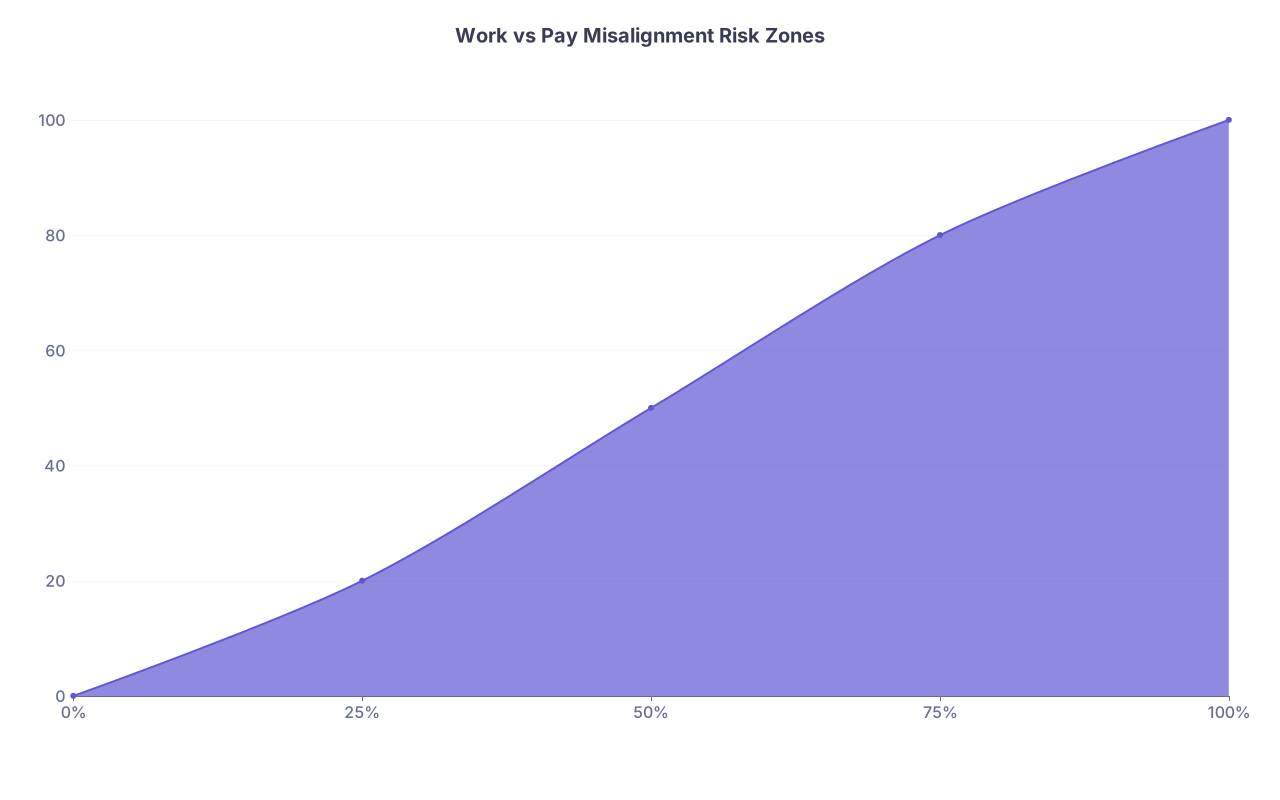
| Category | Value |
|---|---|
| 0% | 0 |
| 25% | 20 |
| 50% | 50 |
| 75% | 80 |
| 100% | 100 |
Think of that area chart as a mental model: the farther your productivity percentile outruns your pay percentile, the more risk you are accepting that will never be fixed later. Most systems do not magically “correct” low initial offers. They anchor to them.

FAQ (Exactly 3 Questions)
1. What if I do not have direct access to the full MGMA report?
Use what you can get: partial tables from recruiters, summaries from your specialty society, program leadership, or colleagues who have access. Many residents and fellows get MGMA data through their GME office or department admin. Even approximate medians and 75th percentiles are enough to build a reasoned argument. Focus on ratios (your $/wRVU vs MGMA $/wRVU) rather than obsessing over exact dollar values.
2. How high above MGMA median is realistic to ask for as a new attending?
The data show that new grads rarely start above the 75th percentile unless they are in extremely undesirable locations or very high‑demand subspecialties. A reasonable target: compensation structure that lands you between the 50th and 75th percentile for total comp if your expected productivity is also between the 50th and 75th percentile. If your productivity expectations are near 75th–90th percentile, asking to be paid at least 60th–75th percentile is not aggressive—it is rational.
3. Should I ever accept below‑median compensation?
Yes, if and only if the “cost” is balanced by concrete value elsewhere: substantially lower RVU expectations, excellent schedule, strong mentorship, clear path to partnership or leadership with upside, or a location you personally prioritize. But run the math. If your productivity is at or above MGMA median and your pay is stuck at 25th–30th percentile with no credible path upward, that is not a trade‑off. It is a subsidy you are providing to the employer.
Key points:
- MGMA is a benchmark distribution, not a single “right” number—use it to align your pay percentile with your productivity percentile.
- Convert every offer into RVUs, total expected comp, and $/wRVU, then compare those to MGMA by region and practice type.
- Frame your negotiation as a request for alignment with objective data, not a demand for a specific percentile “because MGMA says so.”