

The data shows a blunt truth: most physicians have no idea what their call pay is worth in their market—and hospitals exploit that ignorance.
You are trading nights, weekends, and holidays for what is often a vague “stipend” or “part of your overall comp.” That is not analysis. That is charity. Let’s turn it into math.
This is not about feelings. It is about benchmarking your call pay against regional norms and walking into negotiations with hard numbers, not hopeful guesses.
1. The Call Pay Landscape: Real Numbers, Not Myths
Every time someone tells me, “Call is just part of being a doctor,” I hear: “We did not bother to quantify the value of your time.” Hospitals track everything from case mix index to left‑without‑being‑seen percentages. The idea that they “cannot” quantify call is fiction. They simply benefit when you do not.
National survey data (MGMA, SullivanCotter, AMGA, and multiple health system internal reports I have seen) converge on a few patterns:
Call pay varies massively by:
- Region (Northeast vs South vs West, etc.)
- Specialty (procedural vs cognitive)
- Call type (home vs in‑house, primary vs backup)
- Employed vs independent model
The spread can easily exceed 2–3× between low and high regions for very similar workloads.
Younger physicians and new grads are disproportionately underpaid for call because they accept “standard” terms without questioning the benchmark.
Let me quantify some realistic example ranges. These are illustrative, but anchored in real survey ballparks for community/non‑academic settings for hospital‑based and procedural specialties (anesthesiology, general surgery, cardiology, hospitalist, OB/GYN) with primary call responsibilities.
| Region | Low Range ($/24h) | Typical Range ($/24h) | High Range ($/24h) |
|---|---|---|---|
| Northeast | 500 | 700–1,000 | 1,200+ |
| Midwest | 400 | 600–900 | 1,100+ |
| South | 300 | 500–800 | 1,000+ |
| West | 450 | 700–1,000 | 1,300+ |
Those numbers are for paid call. Many physicians are getting $0 outside wRVUs for equally burdensome call. That is how you know you are subsidizing the system.
To visualize the regional gaps:
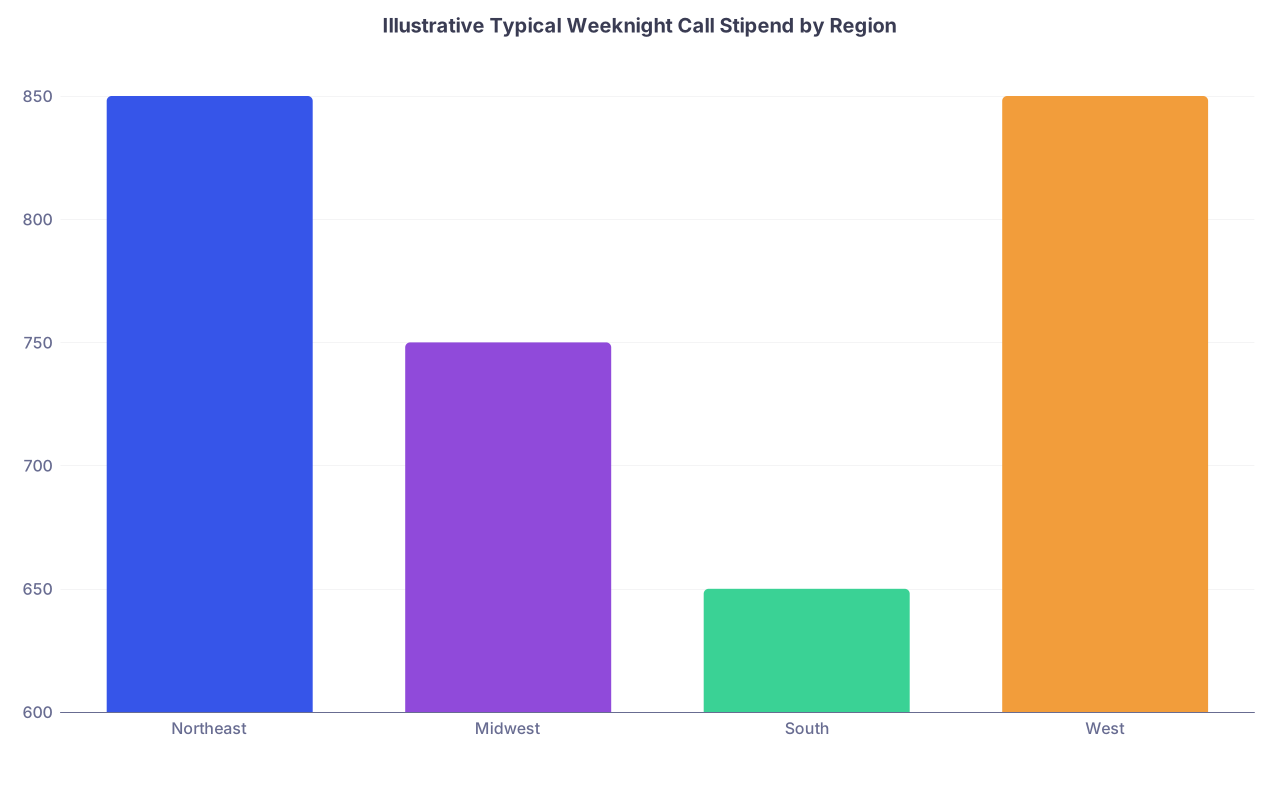
| Category | Value |
|---|---|
| Northeast | 850 |
| Midwest | 750 |
| South | 650 |
| West | 850 |
If your “stipend” is $250 for a 24‑hour weekend call in the Northeast, you are not just a little under market. You are donating labor.
2. Regional Differences: Why Your Zip Code Dictates Your Night Value
Region is not just geography. It is supply-demand, payer mix, malpractice environment, and local culture baked into dollars.
Northeast
High demand, dense populations, significant academic presence, often higher baseline comp and higher call pay. Often:
- More complex tertiary care centers.
- Higher cost of living.
- More subspecialization, so call pools can actually be thinner than you think.
A typical pattern I see in the Northeast for hospital‑based procedural call:
- Weeknight primary call: $700–1,200 per 24 hours.
- Weekend/holiday 24h call: $1,000–2,000.
- Home call that routinely becomes in‑house: paid as if in‑house (or should be).
South
Paradoxical region. Often physician‑friendly states, lower cost of living, but also a strong “it’s part of the job” culture.
Patterns:
- Many hospital-employed groups with no explicit call pay—call is bundled into base RVU target.
- Where call is paid, stipends might run $300–800 per 24h, even when volume is high.
- Independent groups sometimes do much better, billing professional fees plus call stipends from the facility.
Midwest
Quietly competitive. Not as flashy as the coasts, but plenty of rural and semi‑rural coverage gaps.
Patterns:
- For smaller towns with 1–3 physicians covering entire service lines, call stipends can spike to attract coverage.
- Typical $600–900 per 24h for procedural primary call is not unusual in community hospitals.
- Backup call may be unpaid or minimally paid unless coverage is tight.
West
Highly variable. California metro vs rural Mountain West are two different planets.
- Urban West Coast: higher total comp, but also high expectations for “teamwork” and “shared responsibility” instead of explicit call pay.
- Rural West: some of the highest stipends, especially where there are only a few specialists in a 100‑mile radius.
You get the idea. Region sets your baseline, but specialty and structure decide whether you are above or below that line.
3. Call Type: Home vs In‑House, Backup vs Primary
The ugliest mistake I see in contracts: one flat call rate regardless of intensity. That is mathematically irrational.
You must differentiate:
- In‑house call (physically present in hospital or mandated proximity).
- Home call with frequent call‑ins.
- Home call with rare call‑ins.
- Primary call vs backup or second call.
- Post‑call time protections (or lack thereof).
Let’s assign plausible tiers (again, broadly consistent with survey medians across regions for non‑academic environments):
| Call Type | Relative Value Index* |
|---|---|
| In‑house, busy | 1.0 (baseline) |
| In‑house, moderate | 0.8 |
| Home call, frequent call‑ins | 0.7 |
| Home call, occasional call‑ins | 0.4 |
| Home call, rare disruptions | 0.2 |
| Backup / second call (true backup) | 0.2–0.3 |
*Index is relative to a busy in‑house 24h call being “1.0.”
If your market pays $1,000 for a busy in‑house 24‑hour call, a “fair” home call rate with frequent call‑ins might land around $600–800. Backup call with truly rare call‑ins might reasonably be $200–300. That is a rational scaling.
Instead, many employers do the reverse: they compress everything to a single lowball number like $250 “per call” and let you eat the variability.
4. Are You Underpaid? Work It Out in Numbers
Let’s actually compute it. You should evaluate call pay on at least three axes:
- Effective hourly rate.
- Effective per‑case or per‑encounter value.
- Proportion of your total comp that call represents versus effort.
Step 1: Compute Your Effective Hourly Call Rate
You need:
- Stipend per call (S)
- Average length of call in hours (H) – usually 24 for weekend/weekday coverage.
- Average active work hours during call (A) – actual being in the hospital or actively working (charting, procedures, telehealth, etc.).
You then have two numbers:
- Nominal hourly rate: S/H
- Active work hourly rate: S/A
Example:
You are in the Midwest, general surgeon, weekend 24‑hour home call, stipend $500. On typical weekends you:
- Get called in 3 times.
- Each call‑in + documentation = ~2 hours.
- Plus phone calls and care coordination: ~2 additional hours.
Total active work ≈ 8 hours.
Nominal rate = $500 / 24 = $20.83/hour
Active work rate = $500 / 8 = $62.50/hour
If you are making $500k/year for roughly 55 hr/week (clinic + OR) ≈ 2,860 hours/year, your base effective hourly rate is around $175/hour before benefits.
You are selling your nights and weekends at $62.50/hour active or $20.83/hour nominal. The data says that is irrational unless you like being on call.
Step 2: Adjust for Regional Market
Now compare your stipend to regional benchmarks. Here is a simplified illustrative comparison for 24‑hour weekend primary call for procedural specialties:
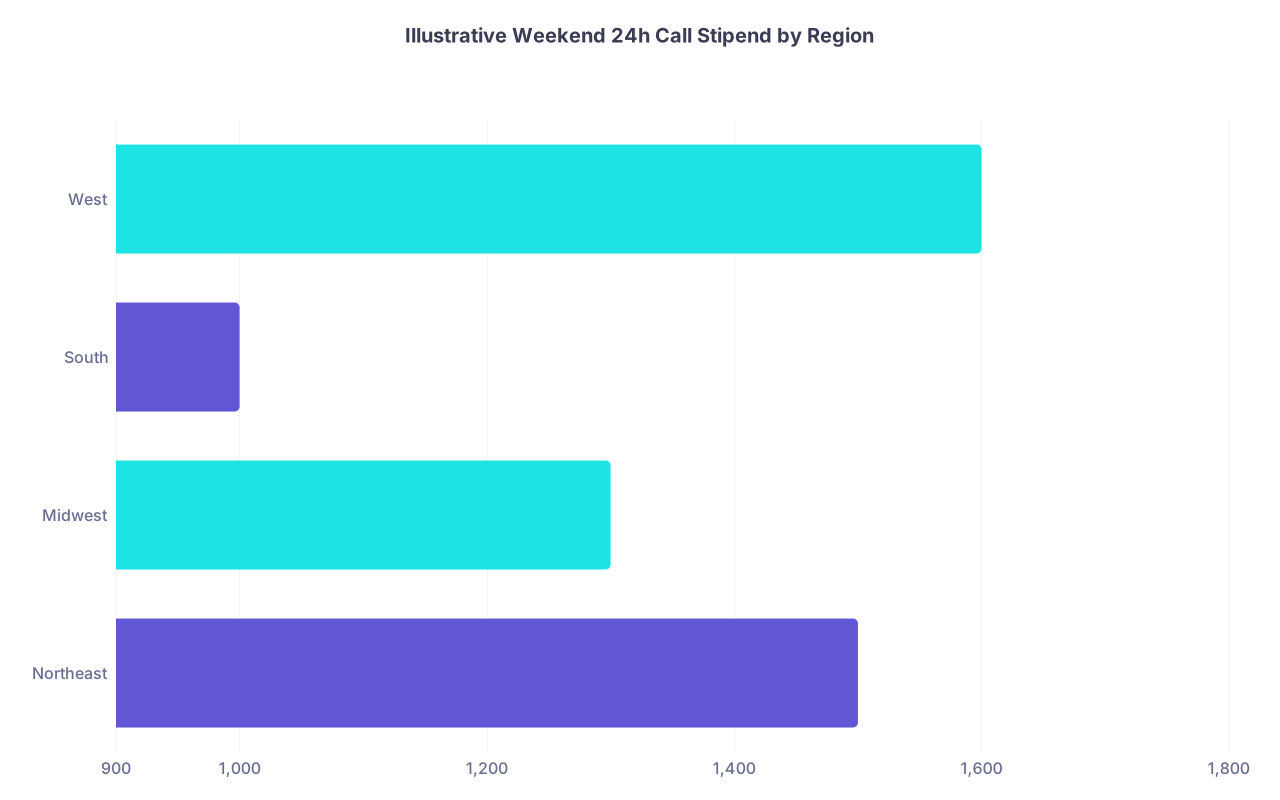
| Category | Value |
|---|---|
| Northeast | 1500 |
| Midwest | 1300 |
| South | 1000 |
| West | 1600 |
If you are in the Midwest making $500 per weekend 24h call while regional normative stipends cluster around $1,000–1,300, the gap is explicit:
- You are at 38–50% of peers’ call pay for similar coverage.
This is not a subtle underpayment. It is a structural discount on your nights.
Step 3: Quantify Annual Impact
Let’s say:
- You take 1 weekday call per week and 1 weekend call per month.
- Your call stipend is $300/weekday and $500/weekend.
- 52 weekdays + 12 weekends = 64 call days.
Annual call stipend income:
- Weekdays: 52 × 300 = $15,600
- Weekends: 12 × 500 = $6,000
- Total = $21,600
Compare to a more competitive structure in your region:
- $700/weekday and $1,500/weekend:
- Weekdays: 52 × 700 = $36,400
- Weekends: 12 × 1,500 = $18,000
- Total = $54,400
Annual underpayment for call alone ≈ $32,800.
Over a 5‑year contract term, that is $164,000. Before compounding, before inflation. That is how “call is part of the job” quietly deletes a down payment on a house.
5. Internal Equity: The Silent Benchmark You Are Probably Ignoring
Region is only half of the equation. The most powerful comparison in negotiations is rarely national—it is internal.
The data you care about:
- What do your partners earn for call?
- What do other service lines in the same hospital earn for call (anesthesiology, cardiology, OB, trauma surgery)?
- How is backup call paid for others vs you?
Hospitals hate sharing this data. Fine. You build it yourself.
You ask directly. You ask multiple people. You ask the specialist who complains about everything; sometimes that person is the most precise historian of wrongs.
Once you have even a partial picture, you can convert that to a structured comparison:
| Service Line | Call Type | Stipend ($/24h) |
|---|---|---|
| General Surgery | Primary weekend | 500 |
| OB/GYN | Primary weekend | 1,200 |
| Cardiology | Primary weekend | 1,000 |
| Anesthesia | In‑house 24h | 1,400 |
| Hospitalist | Night shift (12h) | 1,000 |
If you are the general surgeon in that table, you do not need an MGMA subscription to know you are mispriced. You need a spine and data.
6. How to Use These Numbers in Negotiation
There are only three levers that matter once you realize you are underpaid for call:
- Call frequency
- Call pay per event
- Total compensation offset elsewhere (salary, bonus, RVU rates)
The cleanest solution is almost always: pay more per call. The second‑best is: less call. The worst is: “We will ‘consider’ adjusting your RVU bonus structure.”
Here is how I structure this when advising physicians.
Step 1: Present the Data, Not Emotion
You want something like:
- Regional external benchmarks (MGMA/SullivanCotter/AMGA reports, or even credible recruiter ranges).
- Internal benchmarks across service lines.
- Your effective hourly rate compared to your usual hourly value.
You frame it as:
- “Current weekday call: $300/24h. Comparable market data for this region and specialty: $600–900/24h.”
- “Current weekend call: $500/24h. Comparable: $1,000–1,500/24h.”
- “Annual difference at current call volume: approximately $30,000–35,000 below market.”
No whining. Just numbers.
Step 2: Propose a Tiered Structure
Flat rates are lazy compensation design. You propose structure.
For example:
- Weeknight home call: $600/24h
- Weekend home call: $1,200/24h
- Holiday call: 1.5× weekend rate
- Backup call: 0.3× primary rate unless physically called in (then same rate as primary)
That structure has logic. It scales with intensity and sacrifice (weekends/holidays), and it is directly benchmarkable.
Step 3: Quantify the Incremental Cost to Them
Most administrators will fixate on the line item: “This will increase call costs.” Good. Make it explicit and manageable.
Say you are asking to move from:
- $300 → $600 for weeknights (52 calls/year)
- $500 → $1,200 for weekends (12 calls/year)
Incremental annual cost:
- Weeknights: (600–300) × 52 = $15,600
- Weekends: (1,200–500) × 12 = $8,400
- Total = $24,000
You then tie that to:
- Your retention (cost of replacing a surgeon/OB/anesthesiologist is easily $250k–500k in recruitment, lost revenue, and ramp‑up).
- Coverage stability (the cost of locums can be $2,000–4,000 per 24‑hour call).
Suddenly $24,000/year is not a “big” number. It is a discount on not having to scramble for locums.
7. “But I Get RVUs for Call…” – Do the Math Anyway
This is the other favorite tactic: “Your call is compensated through the RVUs you bill.”
Sometimes that is actually true and fair. Often, it is not.
You evaluate it like this:
- Average RVUs generated per 24‑hour call (over a year, not one lucky weekend).
- Conversion factor ($/RVU for you).
- Compare the net to what a stipend would be.
Example:
- Average: 10 RVUs per 24h of weekend call.
- Your RVU rate: $50/RVU.
- Compensation attributable to call: 10 × $50 = $500/24h.
Now compare that to market:
- Region typical: $1,000–1,500/24h for similar volume.
- Your effective “call pay” via RVUs: $500.
You then have a clean argument:
- “If we are treating RVUs as call compensation, the current structure pays approximately half of typical regional rates for equivalent weekend coverage. We can either (a) increase my RVU rate for call‑generated work or (b) add a stipend to align total call compensation with market benchmarks.”
You are not rejecting the RVU argument. You are quantifying it and showing the delta.
8. Night and Weekend Work: The Fatigue Discount No One Mentions
Call is not just hours. It damages the rest of your week.
You should think about:
- Post‑call productivity loss (clinic no‑shows, slower OR days, decision fatigue).
- Burnout risk (measurable in turnover and error rates, by the way).
- Impact on your “day” earning capacity.
One practical way I have seen physicians quantify this:
- Track 3–6 months of your own data:
- wRVUs on post‑call clinic days vs non‑post‑call days.
- Average OR case numbers post‑call vs non‑post‑call.
- Compute the drop.
If you find your post‑call days produce, say, 20% fewer RVUs on average, you can embed that in your argument:
- “Call not only adds work, it depresses productivity the following day. At my current wRVU rate and volume, each post‑call day costs roughly $X in lost RVU generation. A higher call stipend partially offsets that structural loss.”
You are tying call pay to total economic impact, not just “extra” hours.
9. Simple Visual Model: When Are You Clearly Underpaid?
To summarize the patterns I see over and over, you are very likely underpaid for call if:
- You receive $0 stipend and call‑generated RVUs are modest.
- Your 24h weekend call stipend is under $500 anywhere but the very lowest‑pay markets.
- Your effective active-work hourly rate during call is <50% of your baseline hourly earning rate.
- Your regional peers in same specialty are >30–40% above you in call pay.
A quick mental model using boxes and ranges:
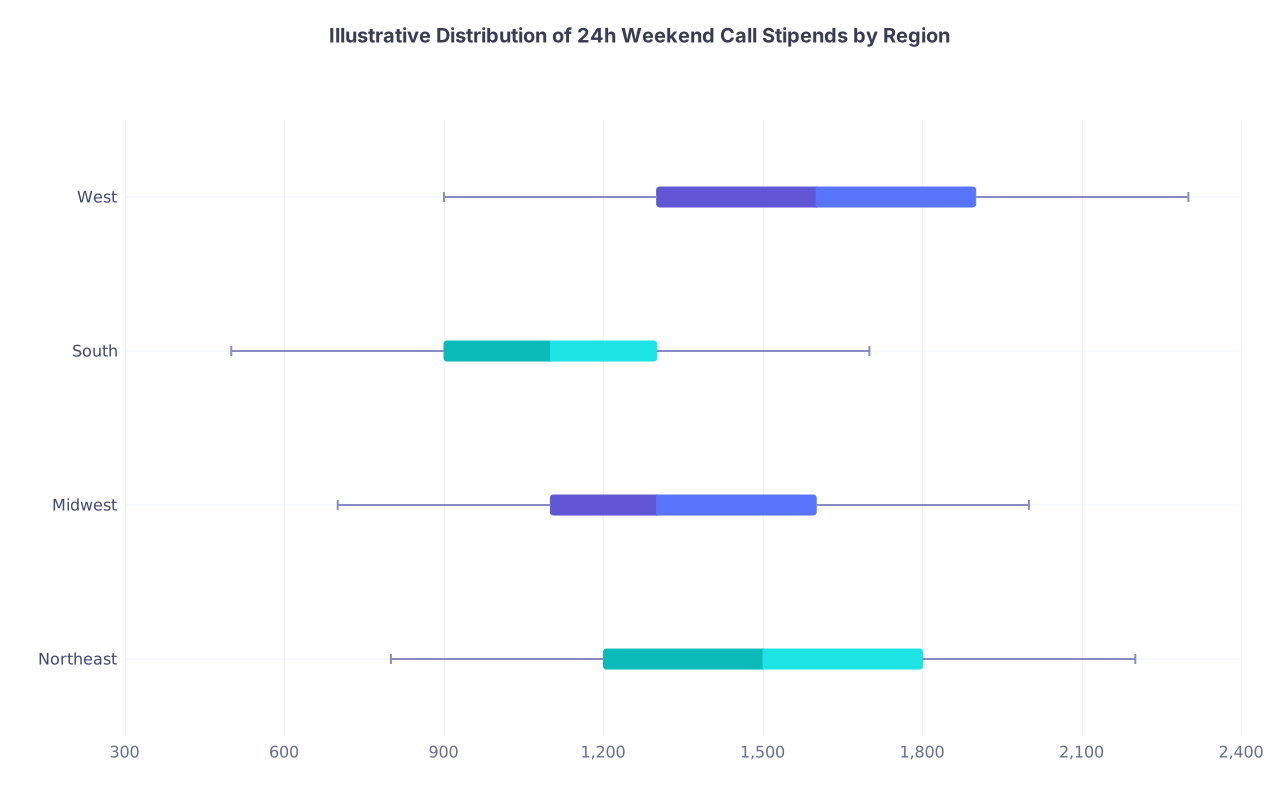
| Category | Min | Q1 | Median | Q3 | Max |
|---|---|---|---|---|---|
| Northeast | 800 | 1200 | 1500 | 1800 | 2200 |
| Midwest | 700 | 1100 | 1300 | 1600 | 2000 |
| South | 500 | 900 | 1100 | 1300 | 1700 |
| West | 900 | 1300 | 1600 | 1900 | 2300 |
If your stipend is sitting near the left tail of these ranges for your region and specialty, that is underpayment. Not “possibly.” Mathematically.
FAQ (Exactly 5 Questions)
1. Where do I get reliable regional call pay data without paying for MGMA or SullivanCotter?
You piece it together. Use multiple sources: recruiters will often share ranges for competitive call packages in your specialty; colleagues in neighboring systems; subspecialty society surveys; state medical association data; and yes, even anonymous physician forums where people post real numbers. None is perfect alone. Together they give you a usable range. You do not need a precise median; you need to know if you are at 40% of your peers or 90%.
2. My employer says “nobody else here gets call stipends.” Does that end the conversation?
No. That line usually means “we have not had to pay for this yet.” You counter with external market data and the cost of replacement/locums. You can propose a phased‑in structure (e.g., start with weekend/holiday stipends only, then expand). System‑wide precedent is a political constraint, not a mathematical impossibility. Administration creates new pay structures all the time when recruitment becomes painful enough.
3. How do I factor in call when comparing two job offers in different regions?
Convert everything to an annualized, all‑in number. For each offer, compute: base salary + expected bonus + call stipends + realistic call RVU income. Then subtract an imputed “fatigue discount” if one job has substantially more or harsher call (for example, mentally subtract $20–30k from an offer with brutal Q2 in‑house call). Region matters, but the math on your total compensation for your actual schedule matters more.
4. Is it ever reasonable to accept $0 explicit call pay?
Yes—but only when either call volume is extremely low and genuinely light, or your overall comp is clearly above market and explicitly described as including call. For instance, if you are being paid at the 90th+ percentile for your specialty and region while doing average call, the premium may already be baked in. Most of the time, though, $0 call pay means you are subsidizing the system with nights and weekends they did not even try to price.
5. What if my group partners seem content with low call pay—does that mean I should just accept it?
No. Contentment is not a benchmark. Sometimes they joined years ago when volumes were lower. Sometimes they value stability more than money. Sometimes they never ran the numbers. Your leverage is greatest when you tie your ask to recruitment, retention, and coverage reliability, not “fairness.” You can push for change professionally: “Given current call volume and market data, we are underpricing our coverage. I want to work on a structure that supports recruitment and keeps this sustainable.” You are not just asking for yourself; you are correcting a mispriced service.
Core message, distilled:
- Benchmark your call pay against regional and internal data; if you are below by 30–50%, you are underwriting the hospital.
- Convert call to hard numbers—hourly rates, annual totals, and RVU equivalents—then negotiate with explicit, structured proposals.
- Nights and weekends are not a vague professional duty. They are billable coverage services. Price them like one.


