

Most new attendings sign productivity contracts they do not actually understand. The data shows that misunderstanding the pay model is the fastest way to leave six figures on the table.
You wanted numbers. Let us get into numbers.
1. The Three Compensation Engines: Base, Productivity, and Risk
Strip away the legalese and 40-page PDFs. Almost every physician contract for post-residency jobs is built from three levers:
- Guaranteed base (salary or draw)
- Productivity pay (usually wRVUs, sometimes collections)
- Risk modifiers (bonuses, penalties, non‑compete, call, benefits)
The fight is not “salary vs productivity.” The real question is: how much of your total compensation is at risk, and on what metric?
To see how this plays out, look at typical structures across specialties.
| Specialty | Typical Model | % Income at Risk (Productivity) | Variability Risk |
|---|---|---|---|
| Family Med (outpt) | Base + wRVU bonus | 20–35% | Medium |
| Hospitalist | Base + shift/census | 10–25% | Low–Medium |
| General Surgery | Low base + strong wRVU | 30–50% | High |
| Orthopedics | Draw + collections | 40–70% | Very High |
| Dermatology | Base + collections | 30–60% | High |
The higher that “% at risk” column goes, the more your income can swing year to year. Up or down.
The critical mistake: residents obsess over the base number and ignore the productivity engine that actually drives their paycheck once they are one or two years in.
2. RVU vs Collections vs Straight Salary: What the Data Shows
The data across large MGMA, AMGA, and SullivanCotter datasets is consistent: salary-only models cap upside but protect floor; productivity-heavy models widen the spread.
Let me translate that into something you can feel in your bank account.
2.1 Straight / Mostly Salary
Common for: academic medicine, hospital-employed primary care, pediatrics, some hospitalist gigs.
Typical pattern:
- Year 1–2: Fixed salary with small quality bonus (5–10% of comp)
- Year 3+: Either continues as salary, or converts to base + modest productivity
The data: variability is low. You might see ±5–10% year to year driven by small bonuses or admin FTE shifts.
You will not double your income without changing jobs or roles.
2.2 RVU-Based Models
Common for: multi-specialty groups, hospital-employed IM subspecialties, general surgery, cardiology, GI.
Mechanics:
- You are paid per work RVU (wRVU) at a negotiated dollar rate, often with a base tied to a target volume.
- Example: $270,000 base for 6,000 wRVUs, plus $50 per wRVU above 6,000.
Two variables control your income:
- Your wRVU volume
- Your wRVU conversion factor ($/wRVU)
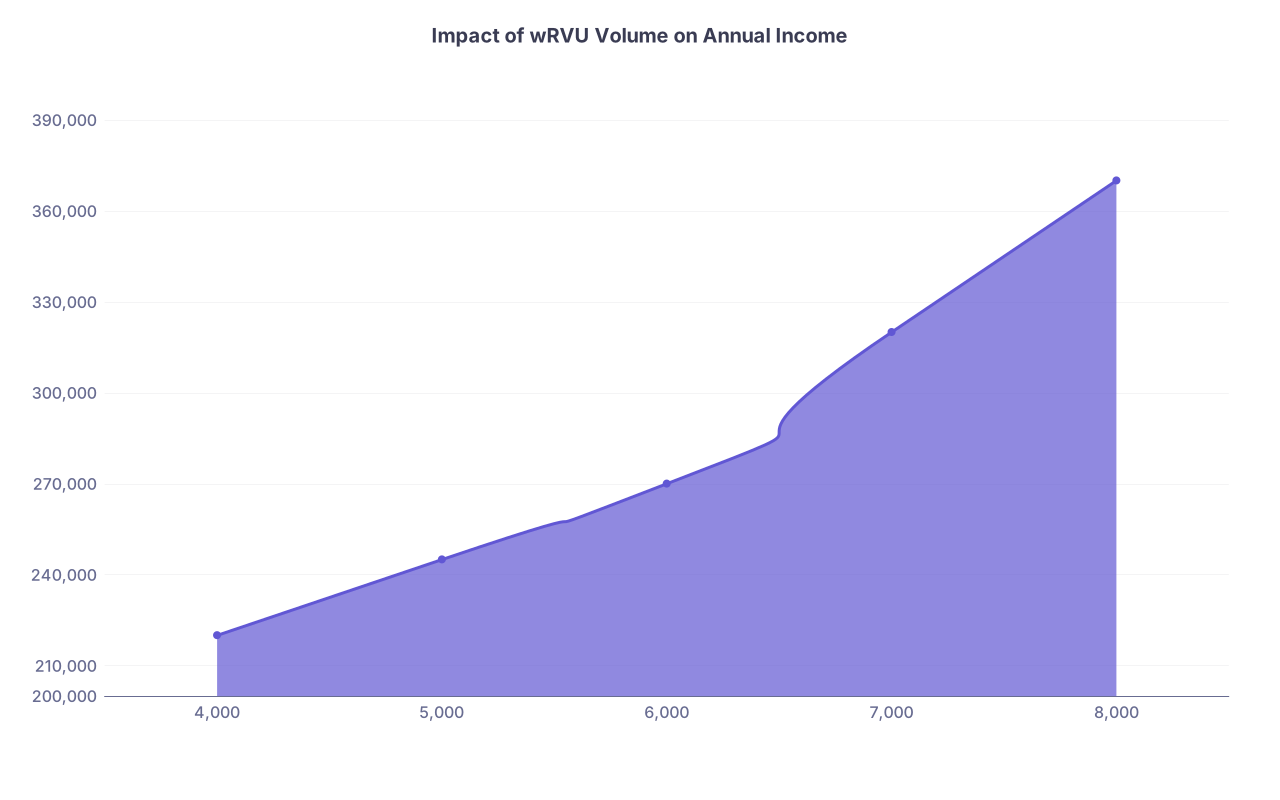
| Category | Value |
|---|---|
| 4,000 | 220000 |
| 5,000 | 245000 |
| 6,000 | 270000 |
| 7,000 | 320000 |
| 8,000 | 370000 |
In a typical hospital-employed internal medicine clinic model:
- Low producer (4,000 wRVUs): maybe $220–240k
- Median producer (6,000 wRVUs): ~$270–300k
- High producer (8,000+ wRVUs): $350–400k+
Same contract. Same employer.
Different throughput, different coding, different support staff → $150k spread.
2.3 Collections-Based Models
Common for: private practice surgical subspecialties (ortho, ENT, plastics), some derm, some GI, anesthesia groups.
Mechanics:
- You receive a percentage of your net collections (not charges).
- Typical range: 35–50% of collections for nonsurgical, 40–60% for procedural and surgical fields once you are a partner.
- Often preceded by a 1–3 year “guarantee + draw” period.
Collections models embed two risk factors: your volume and your payer mix.
A blunt example from an orthopedic practice:
- Surgeon A: 80% commercial, 20% Medicare → collections $1.4M → at 45%: $630k
- Surgeon B: 40% Medicaid, 40% Medicare, 20% commercial → collections $800k → at 45%: $360k
Same procedures. Same work. Different zip code and referrer base. $270k difference.
3. Income Variability by Specialty: Actual Ranges, Not Fairy Tales
If you care about productivity vs salary, you are really asking: “How much can my income swing?” and “What is realistic upside?”
Let us organize this by specialties and typical post-residency models.
3.1 Outpatient Primary Care (FM, IM, Peds)
Most new grads in these fields land in hospital-employed or large group settings.
Typical structures:
- Year 1–2: Base salary $220–260k (FM/IM), $190–230k (Peds), small quality bonus ($10–20k max)
- Year 3+: Base plus wRVU production or panel-based bonuses
Observed ranges in the wild for full-time outpatient FM/IM:
- Low: $210–230k (under-producing, mostly salary/academic)
- Median private/hospital-employed: $260–300k
- High producers with strong wRVU rates and efficient clinics: $325–375k+
The data shows true upside here is ~1.3–1.5x the base, not 2–3x.
Your variability band is maybe $80–120k in private/hospital-employed settings.
Where people get burned:
- wRVU target set at 5,500; historical clinic volume only supports 4,500
- Poor MA/scribe support → you physically cannot hit the numbers
- wRVU rate is under-market ($38 instead of $50) so extra work is underpaid
The math:
If your contract is $240k base for 5,500 wRVUs at $40 per wRVU above target:
- If you only hit 4,500 wRVUs (due to poor support): you still get $240k, but you are on a PIP or at risk of non-renewal.
- If you hit 7,000 wRVUs: 1,500 excess x $40 = $60k → $300k total.
Change the rate to $55/wRVU and the same work becomes $82,500 extra → $322,500 total.
That $15/wRVU difference is not small. On 7,000 wRVUs, it is $105,000 per year.
3.2 Hospitalists
Hospitalist income looks simpler but carries hidden productivity components (shifts, census, nocturnist differentials).
Common models:
- 7-on/7-off, 182 shifts per year
- Base pay tied to shift count, with bonuses for higher census, admissions, nights
Typical ranges in community settings:
- Salary-style: $260–290k for day docs, $320–360k for nocturnists
- Productivity components can add $20–80k depending on census and extra shifts
Income variability tends to be lower than surgical fields. You are looking at ±10–20% between low and high producers in the same group.
The real “productivity” difference: those who pick up extra shifts can push from $280k to $350k+. Risk here is more burnout than financial.
4. Surgical and Procedural Specialties: Where Variability Explodes
This is where the stakes jump. Productivity-heavy models in surgery and procedures can triple income—for the right person in the right environment. Or they can trap you below MGMA median if the OR, clinic access, or referral streams are not there.
4.1 General Surgery
Let us compare two new general surgeons.
Surgeon A: Hospital-employed, RVU model
- Base: $400k for 8,000 wRVUs
- Rate: $60 per wRVU over 8,000
Surgeon B: Private group, collections after 2-year guarantee
- Year 1–2: $425k guarantee, then moves to 45% of collections
- Typical mature collections: $1.2–1.6M
Income trajectories:
Surgeon A (steady RVU producer ~8,000–9,000): $400–460k
Surgeon A (high volume, 11,000 RVUs): $400k + 3,000 x $60 = $580k
Surgeon B (weak referrer base, collections only $800k): 0.45 x 800k = $360k
Surgeon B (built strong niche, collections $1.6M): 0.45 x 1.6M = $720k
Same training level. Same specialty.
Low: $360k. High: $720k. Spread: $360k.
That spread does not come from negotiation skill alone. It comes from matching the productivity model to a reliable pipeline of cases.
4.2 Orthopedics, GI, Cards, Derm – The High-Variance Group
For these, the data from compensation reports and real groups shows a consistent pattern:
- Early hospital-employed years: “safety” base, often $400–600k depending on field
- Later partner/production years: massive range, usually 2–3x between 25th and 90th percentiles
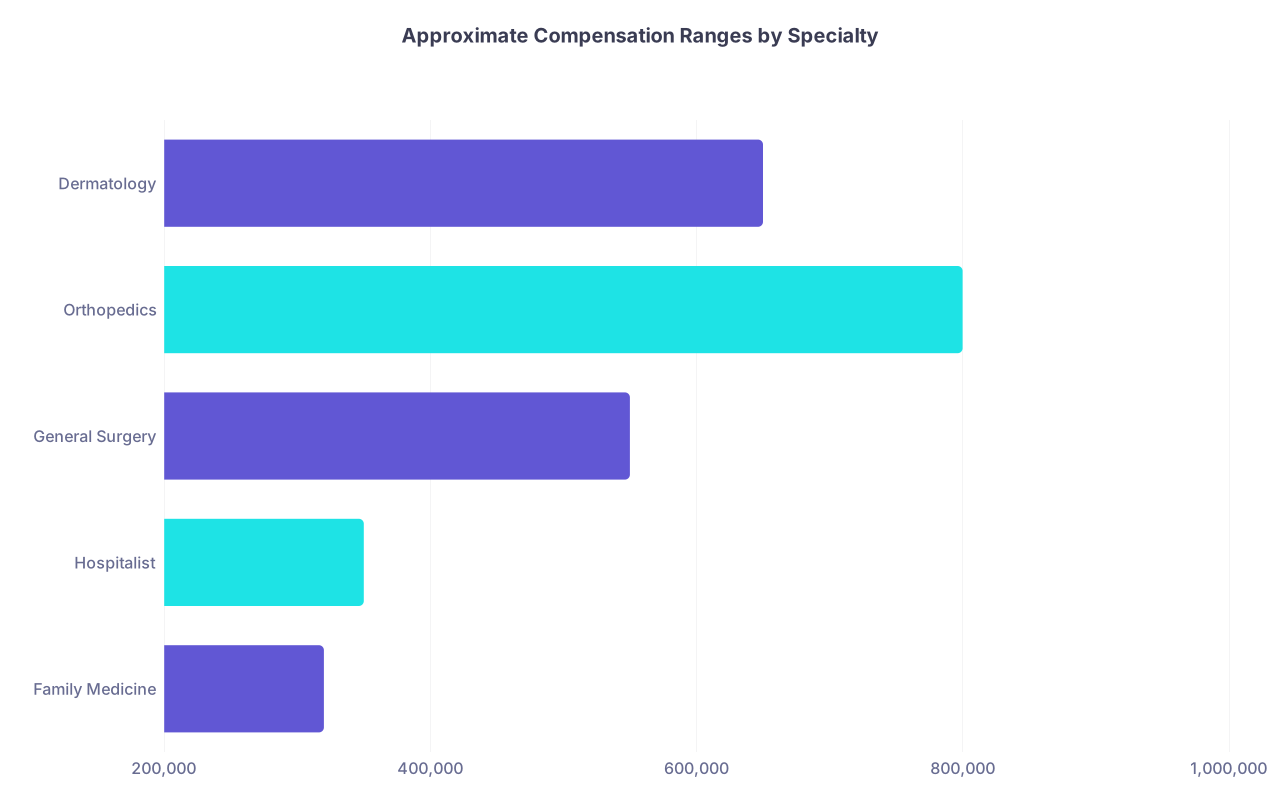
| Category | Value |
|---|---|
| Family Medicine | 320000 |
| Hospitalist | 350000 |
| General Surgery | 550000 |
| Orthopedics | 800000 |
| Dermatology | 650000 |
Those bars hide real volatility. Short version:
- Ortho: starting guarantees $450–650k; mature production can be $500k on the low side to $1.2–1.5M+ on the high side.
- GI: starting $450–600k; mature production ~$550k–$1.0M+.
- Cards (invasive/interventional): $500–700k early; $600k–$1.1M+ later.
- Derm: $350–500k early; medical derm typically $400–700k, procedural/cosmetic mix can exceed $1M.
The difference is rarely “work ethic” alone. It is case mix, payer mix, facility control, and the design of the productivity model (RVU vs collections vs hybrid).
5. How Productivity vs Salary Actually Changes Your Risk Profile
Income variability is not just “upside potential.” It is also downside exposure.
Here is how the models stack up on volatility.
| Model Type | Typical Variability Year to Year | Who Bears Most Risk |
|---|---|---|
| Straight Salary | ±5–10% | Employer |
| Salary + Small Bonus | ±10–20% | Shared, but mostly employer |
| RVU with Base | ±20–40% | Physician (volume risk) |
| RVU, Low Base | ±30–60% | Mostly physician |
| Collections-Based | ±40–80%+ | Physician (volume + payer mix) |
If you are risk-averse, pure salary is mathematically safer. But if you are entering a high-demand specialty, in a growing market, with strong institutional support, avoid overly rigid salary caps. They flatten your income curve exactly when you could have captured your peak earning years.
6. How to Quantify a Productivity Offer (Instead of Guessing)
Most residents read productivity language once, nod, and move on. That is how you get trapped in “we expected 7,000 wRVUs” conversations three months into your first job.
You need a simple, data-driven checklist.
6.1 Reverse-Engineer the Contract
For any offer with productivity:
Identify:
- Target wRVUs or expected collections
- Dollar rate per wRVU or percent of collections
- Base salary guarantee and duration
Build a 3-scenario model: conservative, expected, aggressive.
Example: Hospital-employed cardiology offer
- Base: $525k
- Target: 9,000 wRVUs
- Rate above target: $70 per wRVU
Ask: “What is realistic?” Then plug:
- Conservative: 7,500 wRVUs
- Expected: 9,000 wRVUs
- Aggressive: 11,000 wRVUs
Income math:
- 7,500 wRVUs → below target, still $525k, but risk of “underperformance” label
- 9,000 wRVUs → $525k (if base assumed to cover target with no extra)
- 11,000 wRVUs → 2,000 x $70 = $140k bonus → $665k total
Now compare that against MGMA/AMGA benchmarks for invasive cards in that region. If their “aggressive” scenario only gets you to national median, you are underpaid.
6.2 Pressure-Test the Assumptions
You cannot just multiply. You have to ask the ugly logistics questions.
- How many clinic days per week?
- How many OR/cath lab blocks? Protected? Or can anesthesia/hospital take them?
- Average clinic volume for current docs? (You want actual numbers: “Dr. X sees 18–20 per half day, codes mostly 99214.”)
- No-show rates? New:follow-up mix?
- Payer mix: % Medicare / Medicaid / commercial / self-pay.
I have sat in on negotiations where administration swore “You will easily hit 7,000 wRVUs.” Then an older partner quietly added, “Our clinic scheduler caps us at 16 patients per day because of room limits.” That one sentence just cut 20–30% off realistic production.
7. Specialty-Specific Traps in Productivity and Salary Models
Some patterns repeat so often they are basically clichés.
7.1 Primary Care Trap: “High Panel, Low Support”
- High-wRVU target with below-average MA/scribe support and long refill/inbox burden.
- Salary looks fine, but effective hourly rate plummets. Productivity ceiling also drops because time is sunk into uncompensated work.
You negotiate either better support or lower wRVU expectations. Ideally both.
7.2 Hospitalist Trap: “Extra Shifts are Optional (Until They Are Not)”
- Base income assumes 15 shifts per month. Realistically you end up doing 18–20 because of staffing gaps.
- Many contracts pay same per-shift regardless of census. You end up subsidizing the hospital when volume spikes.
Data play: demand a higher marginal rate for extra shifts beyond your base FTE. If your base rate is $1,900/shift, push for $2,300–2,500 for extras.
7.3 Surgeon Trap: “Partnership Buy-In without Transparency”
- Early guarantee seems generous. Then your income drops when you convert to collections share, because overhead is higher than you realized, or referrers keep cases at other hospitals.
- Or you are offered “50% of collections after expenses” with zero clear accounting of what “expenses” include.
You need to see at least 3 years of anonymized partner-level income and expense statements. If they cannot or will not show those, your risk profile just doubled.
8. How to Decide: Which Model Fits Your Risk and Your Specialty
Let us be blunt. Personality and life stage matter.
If you are:
- Highly efficient, comfortable with volume, and in a procedural/surgical specialty in a growing area → lean into productivity, but only with infrastructure proof.
- Risk-averse, early in career, with loans and no savings, in a cognitive field → accept more salary, but negotiate fair productivity terms for later years.
Here is a simple orientation:
| Profile | Preferred Model Emphasis |
|---|---|
| New grad, high debt, non-procedural | Higher base, modest productivity |
| New grad, procedural, strong market | Balanced base + strong productivity |
| Mid-career, family obligations | Stable base, capped productivity |
| Late-career, niche high-demand | Production-heavy, low base |
You can absolutely renegotiate as your risk tolerance changes. Contracts are not destinies. They are 2–3 year bets you make with your employer.
Make the bet with your eyes open and your spreadsheet loaded.
9. Key Takeaways: How Not to Get Blindsided
Let me condense the data into a few hard truths:
- Most real income variation in attending life comes from productivity design, not the initial base number.
- The same RVU or collections model can generate a 2–3x spread depending on volume, payer mix, and support. Your contract language must assume realistic numbers, not sales pitches.
- Specialties with procedures and surgery have the widest variability. That is opportunity if you are in the right environment, disaster if OR time and referrals are constrained.
- You should always model three scenarios—conservative, expected, aggressive—before signing. If “expected” still pays below national medians for your specialty and region, walk or negotiate.
FAQ (Exactly 5 Questions)
1. How do I know if my wRVU rate is competitive for my specialty?
Compare your offer to current MGMA or AMGA data for your specialty and region. Ask explicitly: “What percent of median is this $/wRVU based on?” For primary care, you often see $45–60/wRVU; for many IM subspecialties and surgical fields, $60–90+ is more typical. If your conversion factor is at the 25th percentile while your wRVU target is at the 75th, that imbalance is a red flag.
2. Is a high base salary always worse than a lower base with strong productivity?
Not always. For a risk-averse new grad in a saturated market, a higher base may be rational. The problem is locking into a high base with minimal productivity upside in a high-demand procedural field where you could reasonably produce at the 75th percentile or higher. In that scenario, the high base becomes a ceiling instead of a floor. You want alignment between your realistic volume and the ability of the model to reward it.
3. How many years should a guaranteed salary last before switching to productivity?
Most common: 1–3 years. Shorter guarantees (1 year) place more risk on you but may open up stronger production upside earlier. Two years is a reasonable middle ground for fields where ramp-up is slower (cardiology, GI, surgery). If the group insists on a short guarantee and immediate productivity, make sure there is data that the practice can support near-target volumes from day one.
4. Are collection-based models always better than RVU-based models in private practice?
No. Collections models carry payer mix risk and billing efficiency risk. If you are in a high-Medicaid region or the group has weak billing, a pure collections model can underpay you relative to your actual work. RVU models, when fairly set, can buffer some payer mix fluctuations because they pay on work done, not cash collected. The “better” model is the one whose assumptions (payer mix, overhead, volume) are transparent and realistic.
5. What is the single most important question to ask about a productivity-heavy offer?
“Show me, in writing, what the current physicians in this exact role produced and earned over the last 2–3 years.” That data ties the sales pitch to reality. If they cannot show anonymized numbers, or if actual physician incomes cluster well below the theoretical upside they are dangling in front of you, you have your answer: the risk is on you, not them.


