

The biggest mistake new attendings make is simple: they negotiate salary and ignore benefits. The data shows that error is easily worth $50,000–$150,000 per year in lost value.
You cannot negotiate a physician contract intelligently until you can convert every major benefit—CME, retirement, health, disability, malpractice, time off—into a dollar number. Once you do, a “$260,000 offer” might quietly become a $320,000 package, or a “$300,000 offer” might shrink to the equivalent of $240,000.
Let’s quantify this properly.
1. Why You Must Monetize Benefits (Not Just Glance at Them)
You are entering a market where:
- Median first-year attending salaries in many fields differ by $20,000–$40,000 across offers.
- But the swing in total compensation from benefits alone commonly exceeds $75,000.
That is not an exaggeration. Here is what I have seen in actual offer comparisons for general internal medicine, hospitalist, and non-interventional cardiology roles:
| Component | Offer A (Hospital) | Offer B (Private Group) |
|---|---|---|
| Base Salary | $260,000 | $300,000 |
| Retirement Contribution | $26,000 (10%) | $0 |
| Health Subsidy | $18,000 | $6,000 |
| CME + Licensure | $6,000 | $2,000 |
| Disability + Life | $4,000 | $0 |
| Effective Total Value | $314,000 | $308,000 |
If you only look at salary, Offer B “wins” by $40,000. Once you actually value benefits, Offer A comes out ahead.
The point: your brain will anchor on salary unless you actively fight it with numbers. You need a spreadsheet mentality here.
To do this well, you translate each benefit into an annual dollar value, then adjust for tax treatment and time value when relevant.
2. Retirement Plans: The Quiet Six-Figure Swing
Retirement contributions are where a naïve negotiation costs you the most over a career. A lot of new attendings look only at percentage. Wrong metric. You care about:
- Employer contribution rate (match plus non-elective).
- Contribution limits by plan type.
- Vesting schedule.
- Investment options and fees (secondary, but they add up).
Step 1: Recognize plan types and caps
Current IRS limits (2024; adjust as they change):
- Employee 401(k)/403(b) elective deferrals: $23,000 (under 50).
- Total employer + employee cap (defined contribution, e.g., 401(k), 403(b)): $69,000.
- 457(b) employee deferrals (if available): extra $23,000.
So a large non-profit system with 403(b) + 457(b) and a generous employer contribution can legitimately put $30,000–$50,000+ per year into tax-advantaged accounts for you.
Step 2: Compute annual employer dollar value
Example: Hospital-employed cardiologist
- Base salary: $350,000
- 403(b) match: 100% of first 4% of salary + 50% of next 4%
- Non-elective contribution: 3% of salary regardless of employee contribution
Employer contribution formula if you contribute at least 8%:
- Match = 4% + 2% = 6% of salary
- Non-elective = 3% of salary
- Total employer = 9% of $350,000 = $31,500 per year
Now compare that to a private group with a simple 401(k) but no employer match.
- Employer retirement benefit: $0
That is a $31,500 per year gap, purely in employer money.
Step 3: Compound it—lifetime impact
Plug that into a simple future value estimate:
Assumptions:
- Extra employer contribution: $30,000 per year
- Investment growth: 5% real (around 7–8% nominal minus inflation)
- Time horizon: 25 years
Future value ≈ $30,000 × [((1.05^25 − 1) / 0.05)]
(1.05^25 ≈ 3.39; minus 1 = 2.39; divided by 0.05 ≈ 47.8)
≈ $30,000 × 47.8 ≈ $1.43 million in today’s dollars
One employer having a “9% contribution” vs “0%” is not a rounding error. It is a seven-figure difference.
This is why a $20,000 lower salary can still be the better deal if the retirement plan is much stronger.
3. Health Insurance: Subsidy, Risk, and Hidden Compensation
Most new attendings glance at the premium and move on. Not nearly enough. You must value:
- Employer premium subsidy (annual, pre-tax).
- Plan design (deductible, max out-of-pocket).
- Risk shift onto you (especially for family plans).
- HSA contributions if in a high-deductible plan.
Step 1: Calculate employer annual subsidy
Example: Family coverage
Plan A (large system):
Total annual premium: $26,000
Employee portion: $6,000
Employer subsidy: $20,000Plan B (small group):
Total annual premium: $24,000
Employee portion: $14,000
Employer subsidy: $10,000
Difference in employer value: $10,000 per year.
That is recurring and effectively pre-tax. At a 35% combined marginal tax rate, that $10,000 subsidy is worth roughly $15,000 in pre-tax salary.
Step 2: Incorporate out-of-pocket risk
Compare max out-of-pocket (MOOP):
- Plan A: MOOP family = $6,000
- Plan B: MOOP family = $14,000
Worst-case year (bad pregnancy, kid with asthma, surgery):
- Total cost to you under Plan A: $6,000
- Total cost under Plan B: $14,000
- Annual risk difference: up to $8,000
You do not need a probability model for interview season, but qualitatively: a plan with lower employee premium and lower MOOP is unambiguously higher value. Put a conservative expected value on the risk difference (say $2,000–$3,000 per year).
Step 3: Add HSA contributions if relevant
If an employer contributes to an HSA:
- Employer HSA contribution: $3,000 per year
- Triple tax advantage (pre-tax in, tax-free growth, tax-free qualified withdrawals)
That $3,000 is almost dollar-for-dollar like extra compensation, but tax-advantaged.
Combine subsidy, risk, and HSA, and you easily see $10,000–$20,000 annual variance in health benefit value across offers.
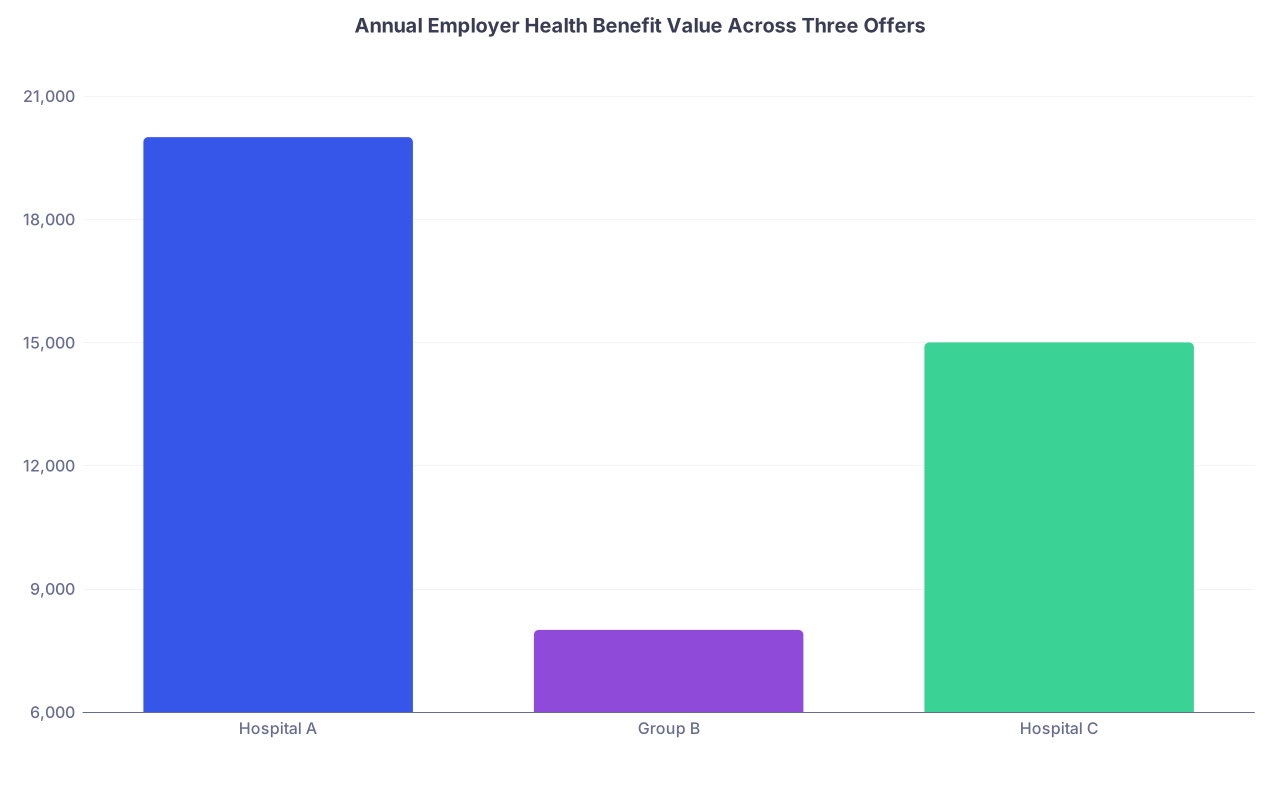
| Category | Value |
|---|---|
| Hospital A | 20000 |
| Group B | 8000 |
| Hospital C | 15000 |
4. CME, Licensure, and Professional Expenses: Small Line Items, Big Leverage
CME funds get dismissed as “a few thousand dollars.” That is sloppy thinking. Fold in all the associated costs:
- CME allowance (course fees).
- Travel and lodging for conferences.
- Board exam and recertification fees.
- State licenses, DEA, hospital dues, specialty society dues.
Example: Realistic annual professional cost
For a typical specialist:
- CME courses/meetings: $3,000–$4,000
- Travel/hotel for 1–2 conferences: $2,000–$3,000
- State license(s): $300–$800 (depending on number of states)
- DEA registration (averaged annually): ~$150–$200
- Board exam amortized (if spreading over several years): $400–$600
- Society dues: $300–$600
You are very quickly in the $6,000–$8,000 per year range.
If Offer A gives:
- CME fund: $5,000
- Licensure, DEA, boards, dues: fully covered
And Offer B gives:
- CME fund: $2,000
- “Other expenses typically borne by physician”
You are looking at a net difference of roughly $4,000–$6,000 per year in post-tax spending. To replace that with salary at a 35–40% marginal tax rate, you need $6,000–$10,000 more base.
In negotiation, it is often easier to move CME/professional expense buckets by a few thousand dollars than to move base salary by $15,000. High ROI negotiation target.
5. Disability, Life, and Malpractice: Low-Probability, High-Value
These are the boring lines that end up mattering a lot when something goes wrong. But even in normal years, they have hard cash value.
Disability insurance
Strong offers often include:
- Group long-term disability (LTD) at 60–66% of income.
- Premiums paid by employer (or structured so benefits are tax-free).
Approximate annual cost if you had to buy equivalent individual coverage as a new attending:
- 60% income replacement on $300,000 income
- Ballpark individual policy cost: 2–4% of covered salary
- That is $6,000–$12,000 per year in premium equivalent.
Employer-paid group LTD is less robust than a good individual own-occupation policy, but if it is free to you, value that benefit at several thousand dollars per year minimum. Any employer who does not offer LTD is effectively asking you to fund this entirely yourself.
Life insurance
Typical group life:
- 1–2x annual salary (sometimes more), premiums paid by employer.
- The individual term equivalent for a 30-something physician:
- $1 million 20-year term: roughly $500–$900 per year.
If an employer is providing 1–2x salary in group life, the value is in that range annually.
Malpractice coverage structure
Two questions matter:
- Is it claims-made or occurrence?
- Who pays tail if you leave?
Rough annual cost benchmarks for malpractice in a moderate-risk specialty:
- Occurrence policy: employer premium $18,000–$30,000 per year.
- Claims-made: initial premium lower, rising over 3–5 years; tail often 1.5–2x the mature annual premium.
Tail coverage in a hospitalist or general surgery position: easily $30,000–$80,000.
If Offer A: employer covers tail on termination (not for cause)
and Offer B: tail is physician’s responsibility
You are effectively accepting a contingent liability equal to low five figures for each potential move.
You can discount that to an annualized expected value. Example:
- Expected tenure: 5 years
- Tail cost if you leave: $60,000
- Annualized cost: ~$12,000 per year in risk exposure.
It is not as clean as a salary line item, but if you are comparing a job that covers tail vs one that does not, that difference is real and material.
6. PTO, Call, and “Unpaid Time”: Valuing Your Time, Not Just Their Money
Now to the most abused concept: time off. A “7 on / 7 off” job with no PTO sounds fantastic until you price your time.
First, compute your effective hourly rate.
Example: Standard clinic job
- Base salary: $260,000
- Work weeks: 48 (4 weeks vacation)
- Work hours per week (real, not contract fantasy): 50 hours
- Annual hours: 48 × 50 = 2,400
- Effective hourly rate: $260,000 / 2,400 ≈ $108/hour
If another offer:
- Base salary: $280,000
- Work weeks: 50 (2 weeks vacation, less CME time)
- Hours/week: 55 (heavier template plus call burden)
- Annual hours: 50 × 55 = 2,750
- Effective hourly rate: $280,000 / 2,750 ≈ $102/hour
Everyone says Offer B is higher paying. It is not. You are earning less per hour and burning out faster.
PTO as cash equivalent
Use that hourly rate to monetize PTO.
From Offer A above:
- Hourly: $108
- 4 weeks PTO = 4 × 50 = 200 hours
- PTO value in salary equivalent: 200 × $108 ≈ $21,600
So a job with 4 weeks PTO vs 2 weeks PTO has an embedded $10,000+ value difference at this salary level. More at higher incomes.
Now layer call:
- Inpatient call: how many nights per month? How many are in-house?
- Weekend call: post-call days protected or not?
- Call pay: is there dedicated compensation or is it “expected”?
You can build a simple model:
- Estimate extra hours/month from call (be honest; ask current physicians).
- Multiply by your effective hourly rate.
- Compare jobs on “all-in” time.
I have seen “$300,000” community cardiology jobs where, after valuing call and unpaid admin, the effective rate came in under $90/hour vs a “$260,000” job at $120+/hour. Very different life.
7. Putting It All Together: A Simple Total Compensation Model
At this point you have many moving parts. You need structure. Build or mentally use a total compensation table.
| Category | What to Include |
|---|---|
| Cash Compensation | Base, RVU/productivity, call stipends |
| Retirement | Employer contributions, profit-sharing |
| Health & Insurance | Health, HSA, dental, vision, LTD, life |
| Professional Support | CME, licenses, boards, dues |
| Malpractice | Premium structure, tail responsibility |
| Time Value | PTO, holidays, schedule intensity |
Translate each category into an annual dollar number.
Here is a realistic comparison. Two jobs, same specialty, same region.
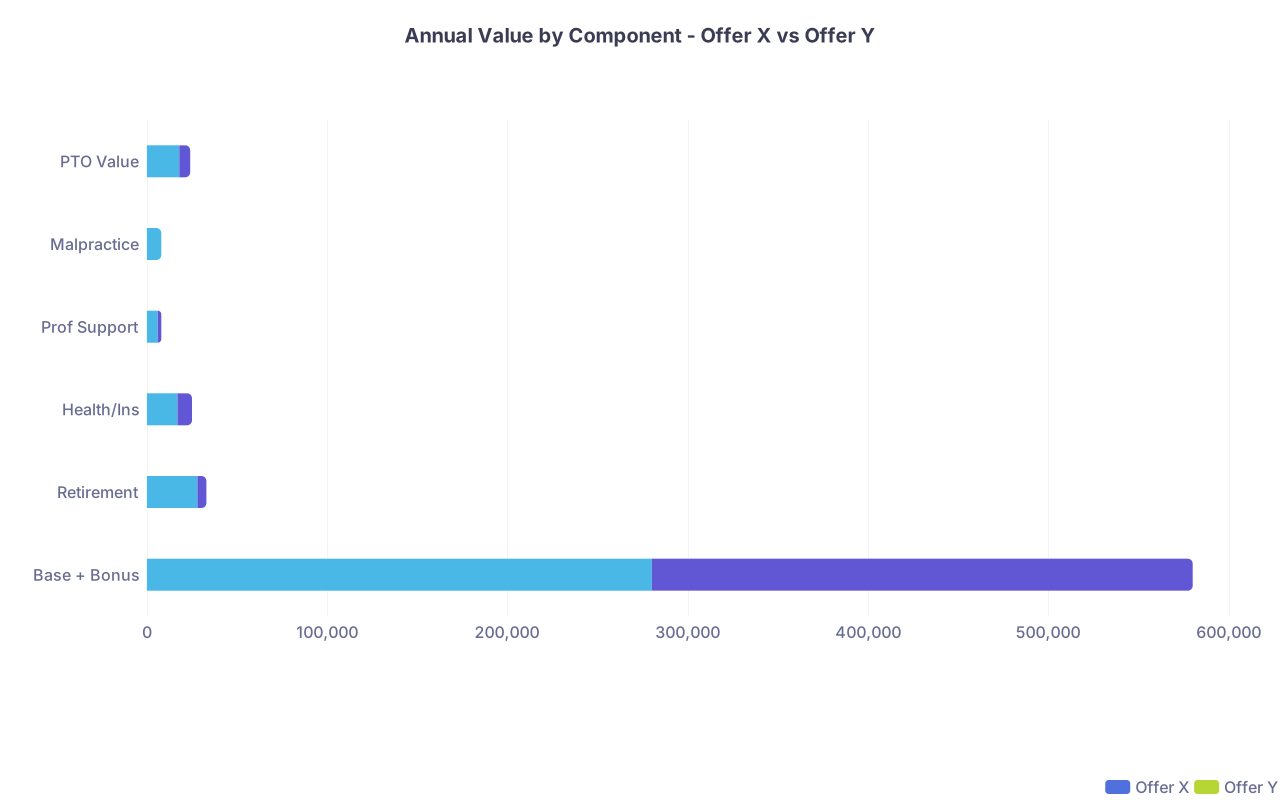
| Category | Offer X | Offer Y |
|---|---|---|
| Base + Bonus | 280000 | 300000 |
| Retirement | 28000 | 5000 |
| Health/Ins | 17000 | 8000 |
| Prof Support | 6000 | 2000 |
| Malpractice | 8000 | 0 |
| PTO Value | 18000 | 6000 |
Now sum:
Offer X
- Base + bonus: $280,000
- Retirement: $28,000
- Health & insurance (net value): $17,000
- Professional: $6,000
- Malpractice (tail covered, annualized value): $8,000
- PTO incremental value (vs 2 weeks): $18,000
- Total effective: $357,000
Offer Y
- Base + bonus: $300,000
- Retirement: $5,000
- Health & insurance: $8,000
- Professional: $2,000
- Malpractice: $0 (you pay tail)
- PTO incremental: $6,000
- Total effective: $321,000
On salary alone, Y looks better. Once you monetize benefits, X is ahead by ~$36,000 per year plus future retirement compounding.
And that is before counting lifestyle differences from fewer hours or lighter call.
8. How to Use These Numbers in Negotiation
Knowing the value is only useful if you use it strategically.
You do not walk in and say “Your retirement plan is worth $31,500 per year so I demand X.” You use the valuation to:
- Decide which levers matter most to you.
- Identify “cheap” concessions for the employer that are high value to you.
- Avoid being blinded by base salary games.
Target high-ROI negotiation points
Some examples:
CME and professional expenses
Moving CME from $3,000 to $6,000 and adding licensure/DEA coverage might cost them $3,000–$5,000. That saves you the same amount post-tax every year. Easy ask.Tail coverage clause
Negotiating shared tail or employer-paid tail after certain tenure might be a one-time $40,000–$60,000 swing. Employers know this and often have room on structure, especially for hard-to-recruit specialties.PTO or schedule tweak
Moving from 3 to 4 weeks off, or adjusting clinic template to reduce uncompensated hours, shifts your effective hourly rate significantly without a direct salary tag.Retirement match percentage
An extra 1–2% match on a $300,000 salary is $3,000–$6,000 per year. Over a decade, easily mid-five figures in contributions before growth.
You anchor your negotiation around “total package alignment,” not a single number on page 1.
9. A Simple Decision Flow You Can Actually Use
To keep this practical, here is the mental process I push new attendings through.

| Step | Description |
|---|---|
| Step 1 | Receive Offer |
| Step 2 | List All Compensation Elements |
| Step 3 | Convert Each Benefit To Annual Dollars |
| Step 4 | Estimate Annual Hours and Call |
| Step 5 | Compute Effective Hourly Rate |
| Step 6 | Compare Total Value Across Offers |
| Step 7 | Identify High ROI Negotiation Targets |
| Step 8 | Decide Accept or Decline |
| Step 9 | Negotiate Package |
| Step 10 | Sign or Walk |
| Step 11 | Gap vs Market and Priorities |
This is not theory. It is basically the process top-tier physician contract attorneys and financial planners use, just compacted so you can do a first pass yourself.
10. Final Numbers That Actually Matter
The contract conversation feels emotional. Recruiters talk in vague terms: “strong benefits,” “competitive package,” “good work–life balance.” Ignore the adjectives. Force everything into three numeric outputs:
- Annual total compensation value (all benefits monetized).
- Effective hourly rate (total value divided by realistic hours).
- Long-term wealth impact (especially from retirement and big liabilities like tail).
Once you have those, decisions get much cleaner.
You will start seeing patterns:
- Academic or large systems: often lower base, higher retirement/benefits, stronger health, better malpractice protection.
- Small private groups: higher base, weaker formal benefits, more individual risk.
- PE-backed or aggressively RVU-based shops: high top-line potential, but benefits and risk protections are often stripped down.
You decide which mix you prefer. But you do it with your eyes open, spreadsheet in hand.
Key takeaways:
- Salary is usually only 75–85% of your real compensation; retirement, health, malpractice, and time off fill the rest of the pie, and the swing between offers is easily $50,000+ per year.
- You must convert every benefit—CME, retirement, health, disability, malpractice, PTO—into dollar terms, then compare offers on total annual value and effective hourly rate, not headline salary.
- The highest negotiating leverage often lies in benefits and risk allocation (retirement match, CME, tail coverage, schedule), where modest contract changes create five- and six-figure lifetime differences at relatively low cost to the employer.


