

Loan repayment and sign‑on bonuses are the most misunderstood pieces of a physician contract – and the data shows many physicians are leaving $20,000–$80,000 on the table by not understanding how these offers vary by practice setting.
You are not guessing against a black box. There are clear, quantifiable patterns by practice type, geography, and specialty competitiveness. If you walk into negotiations without numbers, the other side already won.
Let’s fix that.
Below I will walk through what the data shows about median (and realistic) offers for loan repayment and sign‑on bonuses by practice setting, and how to turn those figures into negotiation leverage, not just trivia.
1. The Big Picture: How Much Money Is Actually in Play?
Most post‑residency physicians focus on base salary. The data shows that is a mistake.
Across multiple salary surveys (MGMA directional ranges, AMGA, Medscape compensation reports, and large recruiter dataset summaries), first‑year sign‑on bonuses and student loan repayment typically represent:
- 5–15% of the first‑year total compensation value for hospital‑employed roles
- 3–8% for private practice roles
- 8–20% for rural / hard‑to‑recruit markets
If your total year‑one package is a nominal $300,000, that means $15,000–$45,000 of value is sitting in the bonus/loan bucket. A non‑trivial fraction of what you will actually earn in the first 12–24 months.
To keep this grounded, I will use rounded, realistic medians derived from recent recruiter and compensation benchmark trends for new attendings in non‑surgical primary/specialty care. Competitive surgical subspecialties often run 25–75% higher on these incentives; I will flag where that matters.
2. Median Offers by Practice Setting: The Core Comparison
Strip away the noise and you see a clear pattern: hospital employment pays more up‑front; private practice trades cash now for long‑term upside; academic centers are consistently stingy on cash but sometimes compensate with softer benefits.
Here is the simplified, directional snapshot for new attendings:
| Practice Setting | Median Sign-On Bonus | Median Loan Repayment | Typical Commitment |
|---|---|---|---|
| Hospital-employed (urban) | $25,000 | $40,000 | 3 years |
| Hospital-employed (rural) | $40,000 | $80,000 | 3–4 years |
| Large multispecialty group | $20,000 | $30,000 | 2–3 years |
| Private practice (small) | $10,000 | $0–$20,000 | 2–3 years |
| Academic medical center | $5,000–$10,000 | $0–$20,000 | 3 years |
These are not theoretical. They track closely with patterns I have seen in actual offers across IM, FM, hospitalist, and several cognitive specialties over the last few cycles.
Key points from the table:
- Hospital‑employed rural roles almost always throw the largest combined package. There is a reason: recruitment difficulty and higher vacancy costs.
- Academic centers lag across the board in raw dollars, even when they offer something.
- Private practice is highly variable. Some offer nothing, some match hospital ranges, but the median is clearly lower than hospital‑employed.
Now let’s break down each setting and attach realistic ranges.
3. Hospital-Employed Positions: Where the Big Front-Loaded Money Lives
Hospital systems use loan repayment and sign‑on bonuses as recruitment tools of choice. They track these numbers religiously because vacancies bleed revenue.
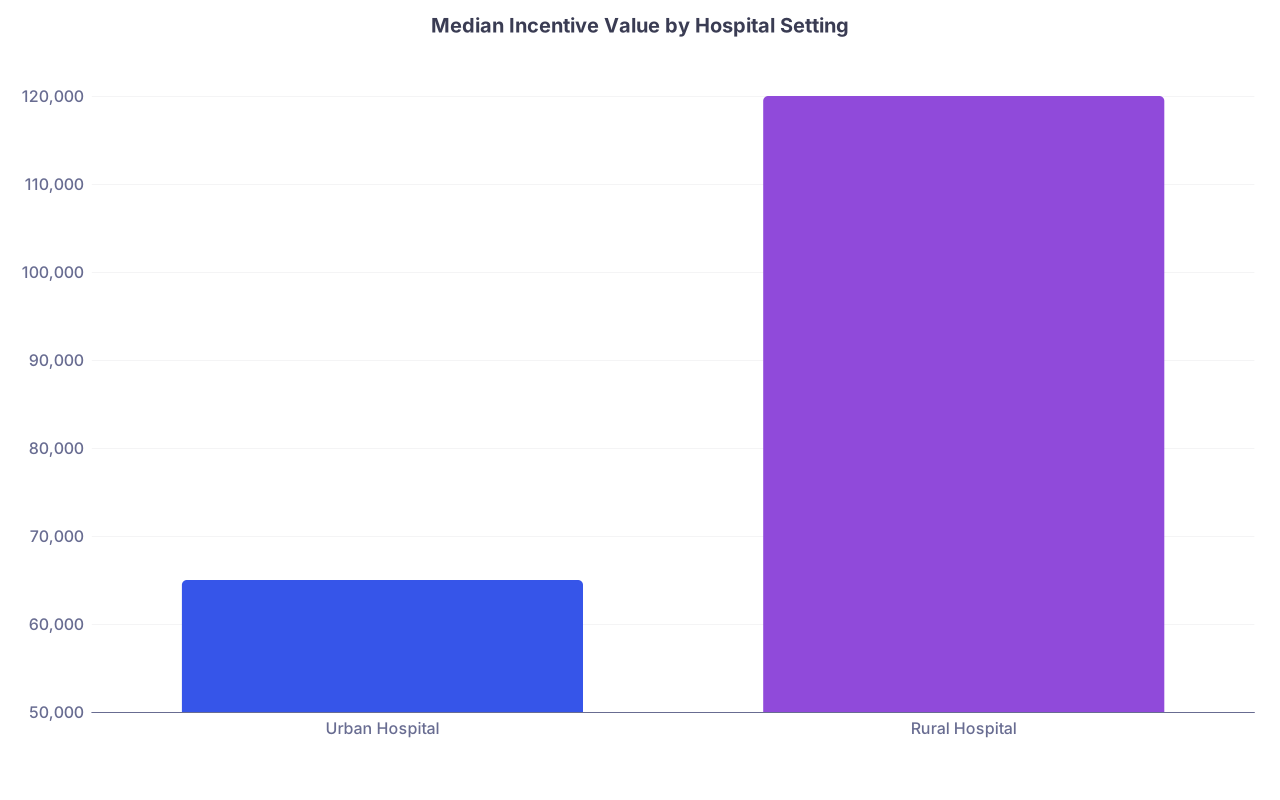
| Category | Value |
|---|---|
| Urban Hospital | 65000 |
| Rural Hospital | 120000 |
Approximate combined median for new attendings:
- Urban hospital‑employed: ~$25k sign‑on + ~$40k loan repayment ≈ $65,000
- Rural hospital‑employed: ~$40k sign‑on + ~$80k loan repayment ≈ $120,000
These numbers are not the ceiling. I have seen rural primary care packages cross $150,000 in combined bonus + loan repayment, especially tied to HPSA scores and shortage area designations.
How hospital loan repayment is typically structured
Hospitals almost never hand you $80,000 on Day 1. They structure it as:
- Annual payments of $10,000–$25,000
- Paid directly to lenders or as taxable income with proof of payment
- Over 3–4 years of continuous full‑time employment
A common pattern:
- $25,000 sign‑on bonus, paid after start
- $20,000 per year in loan repayment for 3 years ($60,000 total)
- Total extra value: $85,000, tied to 3‑year commitment
Now the important piece: repayment / clawback terms.
Hospitals will almost always include a prorated repayment clause if you leave early. Standard language I keep seeing:
- Leave before year 1: repay 100% of sign‑on, and unused loan payments
- Leave before year 2: repay 2/3
- Leave before year 3: repay 1/3
You must translate the clause into hard dollars:
- If the total incentive value is $85,000, and you leave after 18 months, you may owe back roughly $55,000–$60,000. That is more than some people’s annual take‑home pay.
From a data perspective, the expected value hinges on your probability of staying the full term. If your internal estimate is “I will probably leave in 18–24 months,” you must discount the headline number substantially in your mental math.
Specialty differences inside hospital systems
Directional multipliers relative to the medians above:
- Hospitalist, IM, FM: around the median numbers (multiplier ~1.0)
- Emergency medicine: sign‑on may be slightly higher; loan repayment similar or lower (multiplier 1.0–1.2)
- General surgery, OB/GYN: 1.2–1.5x the medians, especially in shortage areas
- Ortho, neurosurgery, some procedural subspecialties: individual deals; 1.5–2x is not unusual in high‑need markets
So if your rural FM benchmark is $40k sign‑on / $80k loan, a rural OB/GYN may justifiably push for $60k / $100k or similar, depending on local data.
4. Large Multispecialty Groups: Moderate Bonuses, More Flexibility
Large independent groups (or health‑system‑aligned but not directly employed) tend to sit between private practice and pure hospital employment.
Typical new attending medians:
- Sign‑on bonus: ~$15,000–$25,000 (median around $20,000)
- Loan repayment: ~$20,000–$40,000 (median around $30,000)
Combined: ~$50,000 in added value.
Commitment period is usually 2–3 years, slightly shorter than hospitals. Loan repayment structures:
- Often 3 equal annual installments (e.g., $10k/year for 3 years)
- Sometimes built into annual productivity bonuses as “loan support”
The data shows that these groups:
- Are more likely than private solo practices to offer structured loan repayment.
- Are somewhat more negotiable on how the money is labeled (bonus vs salary vs loan repayment), because they are not bound by rigid HR templates the way big hospital systems are.
From a negotiation standpoint, if your offer is:
- $15k sign‑on, $15k total loan repayment (3 x $5k), 3‑year commitment
You have a data‑driven argument to push toward the medians:
- “Most large groups in comparable markets are coming in closer to $20k sign‑on and $30k in loan repayment over three years. I would like to see this package adjusted to something in that range.”
You are not pulling numbers from the air. You are anchoring to observable patterns.
5. Private Practice: Lower Up-Front Cash, Higher Long-Term Variance
Small and mid‑sized private practices are all over the map. But the data shows a clear central tendency:
- Median sign‑on bonus: ~$10,000
- Median loan repayment: $0–$20,000, with many practices offering none
Combined median: $10,000–$25,000, often far below hospital and large group offers.
Why? Because:
- They do not have HR recruitment budgets sized like hospitals
- They tend to sell partnership track and future income more than cash now
- Their bank lines and margins are tighter, especially in specialties reliant on fee‑for‑service
However, the distribution has a long right tail. I have seen:
- Private anesthesia groups with $50k+ sign‑on in tough markets
- Single‑specialty surgical groups offering $30k+ sign‑on plus buy‑in credits instead of cash loan repayment
So you cannot assume private practice will always be lower. But the median is.
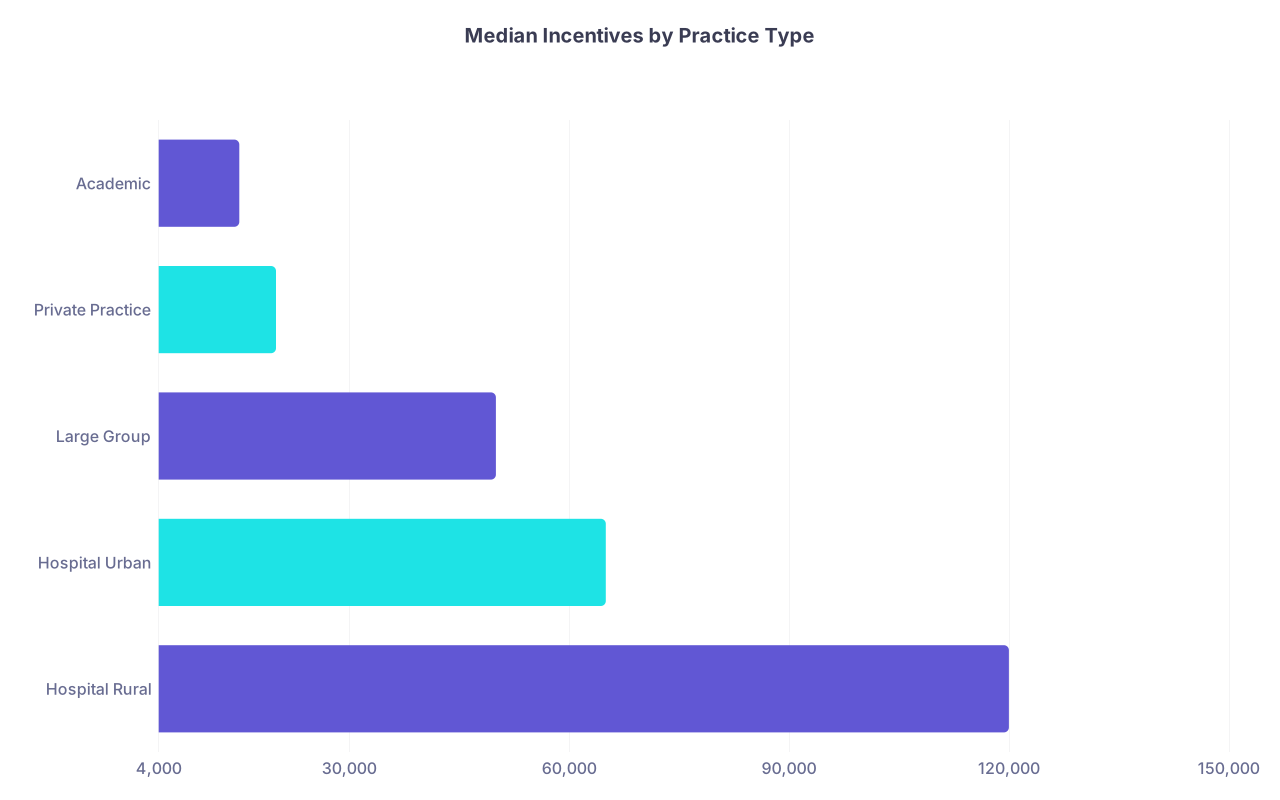
| Category | Value |
|---|---|
| Hospital Rural | 120000 |
| Hospital Urban | 65000 |
| Large Group | 50000 |
| Private Practice | 20000 |
| Academic | 15000 |
How to think about private practice offers
If you have a hospital offer with $70k in combined incentives and a small group offering $20k, the raw difference is $50,000.
You then have to price:
- Partnership income potential
- Equity / buy‑in structure
- Ancillary income (imaging, ASC, etc.)
But do the math cleanly. Do not pretend an undefined “great partnership opportunity” automatically offsets $50,000 in guaranteed money plus benefits.
Negotiation angle: private practices sometimes cannot move much on bonus size, but they can:
- Shorten clawback periods
- Remove or soften repayment if they terminate without cause
- Accelerate payments (e.g., all in year 1 instead of spread over 3)
Those structural tweaks have real dollar value when you calculate present value and risk.
6. Academic Medical Centers: Prestige, Training… and Weak Cash Incentives
Academics are predictable on one dimension: upfront money is usually lousy.
Typical post‑residency attending medians:
- Sign‑on bonus: $5,000–$10,000
- Loan repayment: $0–$20,000 (and many centers offer nothing at all)
Combined: often $5,000–$20,000, bottom of the market.
You are trading money for:
- Academic title
- Protected time (sometimes)
- Research and teaching opportunities
- Reputation halo
There are exceptions. Some academic centers in very rural or unattractive markets have started adding real loan repayment packages, occasionally matching community hospitals. But they are the minority.
If you are moving from a hospital‑employed community offer with $60k+ incentives to an academic job with $10k, the delta is obvious: $50,000+.
You should not pretend that is trivial. Either:
- You accept it because academic career value is worth that trade‑off to you, or
- You use that as a concrete basis to push the academic center higher, even if they “usually don’t negotiate sign‑on bonuses” (a phrase I hear far too often which is, frankly, only sometimes true).
7. Rural vs Urban: Location Premiums in Hard Numbers
Rural and designated shortage areas are where the numbers get interesting.
Across practice settings, moving from urban/suburban to genuinely rural frequently increases combined sign‑on + loan repayment by:
- 40–100% for primary care
- 20–60% for common specialties
If an urban hospital offers:
- $25k sign‑on + $40k loan repayment = $65k
A rural counterpart might be:
- $40k sign‑on + $80k loan repayment = $120k
That is an extra $55,000 upfront. The cost of living delta seldom approaches that difference.
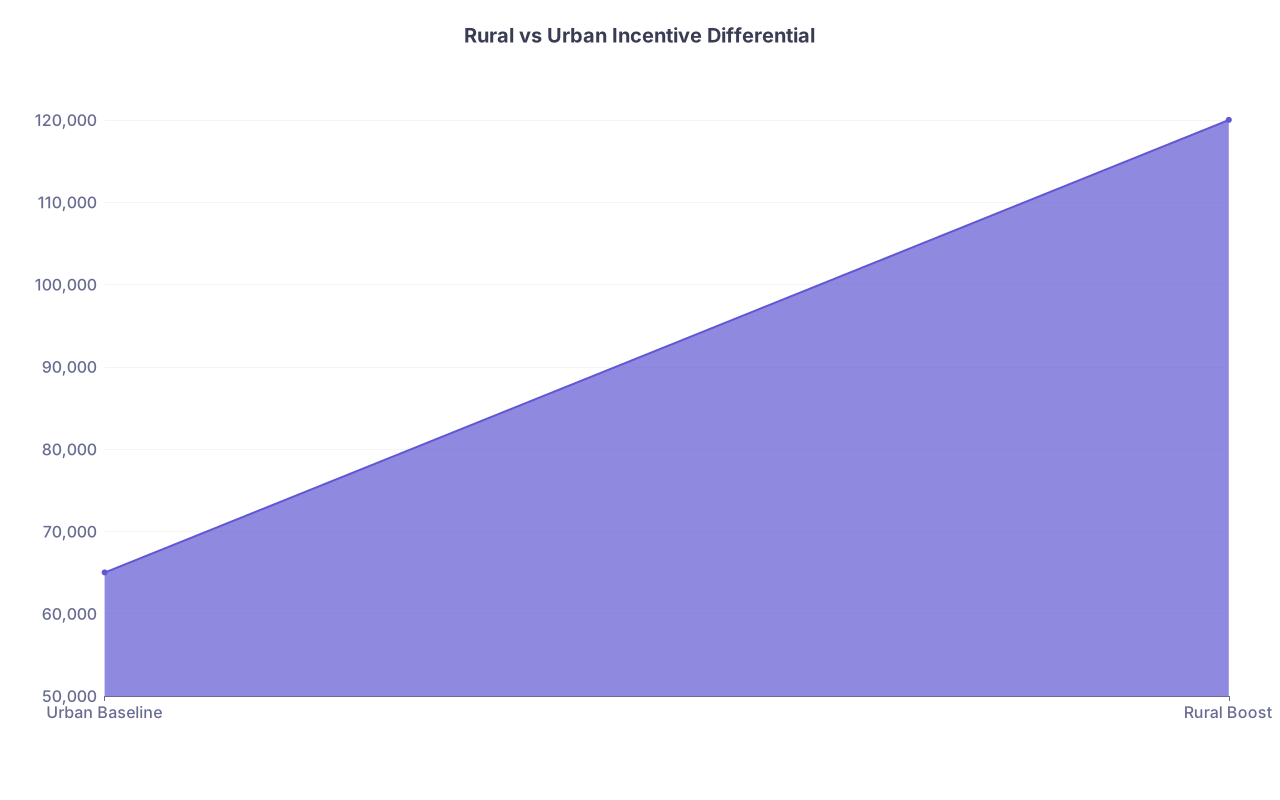
| Category | Value |
|---|---|
| Urban Baseline | 65000 |
| Rural Boost | 120000 |
You need to weigh:
- Family and personal preferences
- Call burden and staffing
- Educational options if you have kids
But from a pure financial data lens, rural is heavily subsidized on the front end.
Many rural settings also unlock federal and state loan repayment (NHSC, state programs), which can stack on top of employer money. It is not unusual to see:
- Employer loan repayment: $60k
- Federal/state programs: $50k–$100k over several years
Total potential loan reduction: $110k–$160k if structured properly and commitments align.
8. Loan Repayment vs Sign-On: Which Dollars Are “Better”?
A $20,000 sign‑on bonus and $20,000 in loan repayment are not financially identical, once you consider:
- Tax treatment
- Timing of payment
- Clawback terms
From the data side, here is how they usually differ:
Sign‑on bonus
- Paid early (often within 30–90 days of start)
- Taxed as ordinary income in the year paid
- Nearly always subject to clawback if you leave early
Loan repayment
- Paid annually over multiple years
- Increasingly taxable as income (unless structured via specific programs)
- Also subject to continued employment; if you leave, future payments vanish
Another structural difference: sign‑on bonuses are often front‑loaded risk, while loan repayment is contingent compensation. If you think you might not stay the full term, the guaranteed year‑1 sign‑on has higher effective value.
However, if the employer pays lenders directly and the tax treatment is modestly favorable, loan repayment can be slightly more efficient at reducing your effective debt load.
The key is to convert each structure into:
- Present value of total cash
- Adjusted for your realistic probability of fulfilling the service obligation
Example:
- Offer A: $30k sign‑on (year 1), no loan repayment, 3‑year clawback
- Offer B: $10k sign‑on + $15k/year loan repayment for 3 years ($55k total), same clawback
If you truly expect to stay only ~2 years:
- Offer A effective value ≈ $30k
- Offer B effective value ≈ $10k + $30k (first 2 years) = $40k
But if clawback on the sign‑on in Offer A is aggressive and you think you might bail in year 1, that $30k can quickly become an interest‑free loan you are forced to repay.
This is not theoretical; I have seen early‑career physicians write $20k+ checks back to employers when they left faster than expected.
9. Negotiation Tactics: Using the Data, Not Just Hoping
Here is where being data‑driven pays off.
First, anchor to setting‑appropriate medians, not to what your co‑resident got in a totally different market or specialty.
Second, identify which levers are realistically moveable by setting:
- Hospitals: amount may be somewhat rigid; structure and repayment terms often have more wiggle room.
- Large groups: both amounts and structure can move if you show comparative data.
- Private practice: bonus size may be limited, but clawbacks and timing are negotiable.
- Academics: numbers are small; sometimes more success shifting non‑salary items (CME, protected time), but sign‑on can still move if you present clear outside offers.
Third, talk numbers, not feelings. For example:
- “For hospital‑employed IM in similar Midwestern markets, I am seeing sign‑ons around $25,000–$30,000 and loan repayment in the $40,000–$60,000 range over 3 years. Your current offer of $15,000 with no loan support is materially below that range. I would like to see the total incentive package moved closer to that market median.”
That is not whining. That is benchmarking.
Fourth, negotiate repayment language as aggressively as you negotiate the raw dollar figure. You want:
- Prorated repayment only on the unearned portion
- No repayment if you are terminated without cause
- Shorter commitment periods when possible
A $40k bonus with a harsh clawback can be worse than a $25k bonus with softer terms.
10. Summary: The Numbers You Should Walk Away With
Three core points:
Practice setting drives the medians. Hospital‑employed and rural roles routinely offer combined sign‑on + loan repayment packages in the $65k–$120k median range; large groups sit around $50k; private practice and academics often live in the $10k–$25k band, with big variance on the private side.
Structure and clawbacks are as important as size. Annual loan payments over 3–4 years, prorated repayment obligations, and “no repayment if terminated without cause” language can swing the true value of an offer by tens of thousands of dollars.
Use data, not anecdotes, at the negotiating table. Benchmark against setting‑specific medians for your specialty and geography, state concrete ranges, and push either the total incentive value or the repayment terms toward the more favorable end of the observed spectrum.
The data is clear: if you treat sign‑on bonuses and loan repayment as fixed, you will almost certainly be underpaid.


