

The first thing experienced physicians look for in your contract is the thing most new grads barely glance at: where the traps are, not where the money is.
Let me walk you through how your future colleagues actually read a contract when you hand it to them and say, “Does this look okay?” Because they don’t start with salary. Administrators want you to start with salary. That’s the distraction. The real story is buried in the terms that make it hard for you to leave, hard for you to say no, and very easy for them to replace you.
This is what your future colleagues really notice first when they see your contract.
1. The Non-Compete: “Can You Walk Away or Are You Trapped?”
Every seasoned attending I know flips to one of two sections first: restrictive covenants / non-compete, and termination. If those are bad, the rest barely matters.
Here’s the internal dialogue of your future colleague skimming your PDF:
“Okay, what’s the radius? How long? Is this even workable in real life or are they basically handcuffing this person to the building?”
They’re looking for three things right away:
- How big is the geographic restriction?
- How long does it last?
- Does it apply if the employer terminates you without cause?
A 5–10 mile non-compete in a dense urban area? That’s functionally a career ban. In Manhattan or Boston, 5 miles is half the market. Someone with experience sees that and thinks: they’re trying to own this person’s patient base, not just protect a practice.
A 30–50 mile non-compete in a rural area? That can mean uprooting your entire life if you leave. Your colleague knows exactly what that feels like because chances are they watched someone in their group move their kids’ schools because they missed one line in the contract.
What really raises eyebrows is when the non-compete still applies if:
- They terminate you without cause
- They downsize your department
- They merge or sell the practice and you do not like the new owner
That’s when a more senior physician says something like, “So they can fire you on Friday and still block you from working in town on Monday? No.”

Here’s the part hardly anyone tells you: a lot of non-competes are written overly broad on purpose, even in states where enforcement is shaky. The hospital’s goal is not always to win in court. The goal is to scare you into compliance and make it painful and expensive to test the clause.
Your future colleagues know which employers “send letters” when people leave and which ones don’t bother. They’ve heard, “We don’t aggressively enforce it… but legal says we still need it in there.” Translation: “We absolutely will enforce it if it benefits us.”
They scan that section and think: if you sign this and then hate the job, can you practice anywhere near your spouse’s job, your kids’ school, your aging parents? Or will you be on a plane every week for locums because you can’t work within 30 miles?
That’s their first real test of whether this is a fair deal or a trap.
2. Termination and “Without Cause”: Who Actually Has Power?
The second place they flip to is termination. Not compensation. Not vacation. Termination.
They’re asking: Who holds the eject button?
Here’s what they’re scanning for:
- Notice period for termination without cause
- Whether termination “without cause” is mutual or one-sided
- Any “for cause” language that’s vague enough to weaponize
A standard setup: either side can terminate without cause with 60–90 days’ notice. That’s fine. It’s when they see something like:
- Employer: can terminate you without cause with 30 days’ notice
- Physician: must give 180 days’ notice or pay liquidated damages
That’s when a senior physician leans back and says, “So they can drop you in a month, but you have to work half a year to leave? No way.”
The other red flag is vague “for cause” language. Your future colleague looks for weasel words like:
- “Failure to maintain satisfactory productivity levels as determined by Employer”
- “Conduct detrimental to the reputation of the practice”
- “Failure to comply with policies and procedures”
Too broad. Too subjective. They’ve seen “for cause” invoked because someone pushed back on RVU targets or refused to take on yet another unassigned call slot. On paper, it looks like “professionalism.” In reality, it was “you didn’t behave like a doormat.”

| Category | Value |
|---|---|
| 30 days | 15 |
| 60 days | 40 |
| 90 days | 30 |
| 120+ days | 15 |
The subtle thing your colleagues check: does the non-compete still apply if they terminate you without cause or even for “restructuring,” “reorganization,” or “loss of contract”?
Because that’s the cruelty you don’t see coming as a new grad:
- Hospital loses the contract with your group
- Group folds or is acquired
- You’re “released”
- You still cannot work in the area for 12–24 months
Your experienced colleague spots that in ten seconds. And they know what it means in the real world: you’ll be the one scrambling for a job two states away while your spouse stares at you across the kitchen table asking how this was possible.
3. Compensation Model: “Are They Using You to Subsidize the System?”
Only after those landmines do most sharp attendings look at pay. Not because money doesn’t matter. Because an unsafe cage with gold bars is still a cage.
But when they do look at compensation, they ignore the big, impressive first number and go straight to the mechanics.
Is it:
- Straight salary?
- Salary + RVU bonus?
- Pure RVU?
- Hybrid with collections percentage?
And then the key question: based on whose assumptions?
They’re not impressed by “$350k–$500k potential.” They’ve been inside enough meetings with CFOs to know those top numbers are usually based on:
- Unrealistic patient volumes
- Call coverage that burns people out
- RVU tiers designed so only 1–2 people per group hit the top bracket
If you show a savvy colleague an offer with:
- Base: $260k
- RVU bonus after 5,000 RVUs
- Paid at, say, $45/RVU
The first thing they’ll ask is: “What are the actual RVU numbers for current docs there?” And here’s the real insider part: the group almost never gives those numbers upfront. Your colleagues know that. They also know that when a system is proud of compensation, they show you those distributions immediately.
| Model Type | Contract Target RVUs | What Colleagues Actually See |
|---|---|---|
| Academic IM | 4,500 | 3,000–3,800 |
| Community IM | 5,500 | 4,500–5,200 |
| Hospitalist 7on7off | 5,000 | 4,000–4,800 |
| EM (busy site) | 6,000 | 5,000–5,800 |
| Surgical subspecialty | 7,000 | 5,500–6,500 |
Then they look for the clause that quietly devastates young physicians: changes to compensation “at the sole discretion of Employer,” often with a meaningless notice period.
That’s how people get lured by:
Year 1: great base + sign-on + loan repayment
Year 2: “System-wide compensation restructuring due to market conditions”
Year 3: “Here’s your new RVU-heavy plan. Good luck.”
Your colleagues are reading that section and thinking: “Can the rules be changed out from under you once you’ve built a life here and your kids love their school?” If the answer is yes, the nice starting base means a lot less.
4. Call, Coverage, and “Other Duties as Assigned”
The next thing your future colleagues look for is the thing administrators always undersell: call and coverage obligations.
This is where deception is rarely outright; it’s almost always omission.
Look at how it’s worded:
- “Physician will participate in equitable call”
- “Physician will share in group call responsibilities as determined by Employer”
- “Physician agrees to provide hospital coverage as scheduled”
That vague language makes every veteran physician nervous, because they’ve watched “equitable” morph into “you’re the youngest, you cover more.”
They want to know:
- How often are you on call, really?
- Is call in-house or from home?
- Is call paid? (Stipend? RVU credit? Nothing?)
- Are you covering only your group or all unassigned patients?
Your colleagues don’t trust the recruiter’s “Oh, call isn’t that bad.” They want actual numbers. How many nights a month? How many weekends? Any backup call? Any mandatory cross-coverage when people are on vacation?
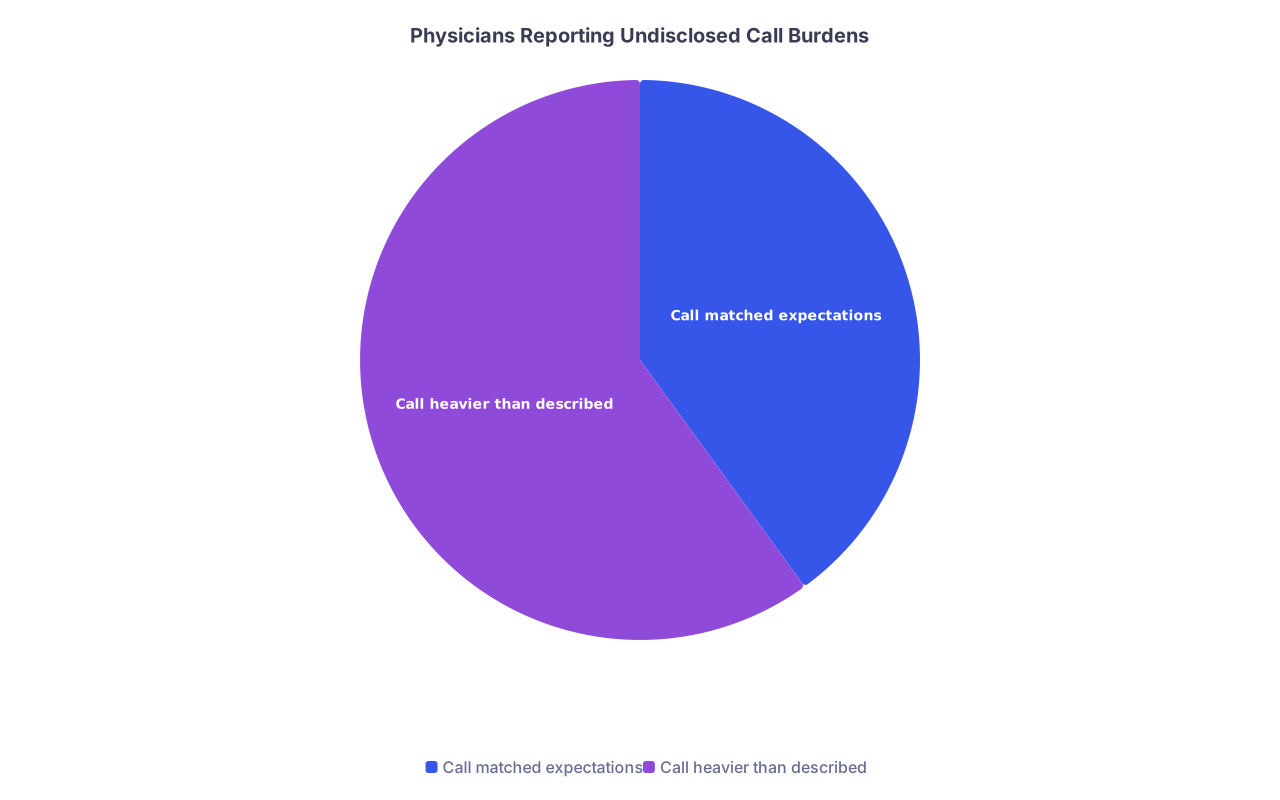
| Category | Value |
|---|---|
| Call matched expectations | 40 |
| Call heavier than described | 60 |
The insider truth: call gets “front-loaded” to new hires all the time. Contracts almost never say that explicitly. But buried in the language is: schedule “as determined by Employer” without any objective standard.
A really sharp colleague pays attention to one more detail: is there language tying your bonus or RVUs to work that includes call, nights, weekends? Or are they pretending those hours don’t exist when they build your target?
Because if your RVU target is built around a 1.0 FTE clinic schedule plus an ugly call schedule, your life is going to be miserable. You’ll either miss your RVU target or you’ll hit it and burn out. Your colleagues have seen both.
5. Tail Coverage and Malpractice: Who Pays When You Leave?
If you want to see a room of experienced physicians roll their eyes in unison, mention “claims-made malpractice without tail included” in a new-grad contract.
Every single one of them has watched someone walk away from a job with a giant tail coverage bill they didn’t anticipate.
The line your colleagues go hunting for:
- Is malpractice occurrence-based or claims-made?
- If claims-made, who pays for tail coverage?
- Is there any vesting schedule where tail is covered after X years of service?
Most new grads barely linger on this. It feels abstract. You’re thinking about starting work, not leaving. Your older colleagues are thinking about your exit from day one, because that’s where employers hide the costs.
Typical scenario that raises eyebrows:
- Claims-made policy
- You’re responsible for tail if you leave within the first 3 years
- Tail could cost 150–250% of the annual premium
So on a $20k annual premium, you might suddenly owe $30–50k just to walk away clean. I’ve seen people stay in toxic jobs an extra year purely because they couldn’t eat the tail.

The ones who’ve been around longer also check for any link between tail and cause of termination. Because some contracts are written so:
- If they terminate you without cause after X years, they’ll pay tail
- But if you leave voluntarily, you’re still on the hook
That sounds fair on first glance until you realize “without cause” termination is often used sparingly, while people leave voluntarily all the time when the job shifts, leadership changes, or compensation is “restructured.”
Your colleagues don’t just see a malpractice clause. They see how handcuffed you’ll feel when it’s time to go.
6. Autonomy, Schedule, and “Other Places You May Work”
Another thing that jumps out to seasoned physicians is any line that lets the employer move you around like a chess piece.
The language is usually bland:
- “Physician will provide services at such locations as reasonably designated by Employer”
- “Physician agrees to provide services at additional clinic sites as required”
What your colleagues read: they can bounce you between clinics, hospitals, or even cities inside the system whenever it suits them.
They ask:
- Are your primary practice locations clearly listed?
- Is there any limit on additional locations (e.g., within X miles)?
- Can they assign you to a low-resource, high-volume satellite because someone quit?
This matters. A lot. Because the internal hospital conversation when they’re drafting that language is not “How do we help Dr. Newhire build a sustainable practice?” It’s “How do we build flexibility so we can plug holes in coverage without renegotiating every contract?”
Then they look at schedule language:
- Is your FTE defined?
- Any cap on clinic sessions per week?
- Any specific protected administrative or academic time actually spelled out in hours?
If it just says “Physician shall work full-time,” your seasoned colleague knows what that turns into over time: a creeping shift into more sessions, more add-ons, more meetings, more committees… with nothing in writing you can point to.
You’d be surprised how often academic time “softly disappears” unless it’s explicitly written as “0.2 FTE protected time” or “1 day per week.” Your future colleagues have watched colleagues lose half their academic time with a new chair and no contract language to defend it.
7. Partnership Tracks, Equity, and “We Take Care of Our Own”
In private groups, the first thing your future colleagues look at isn’t the shiny “partnership in 2–3 years!” promise. They want the fine print about how you actually get there.
They’re looking for:
- Is the partnership track time-based or discretionary?
- Is there a clear buy-in formula?
- Are rights and obligations of partners actually defined?
Vague language like “Physician may be considered for partnership at the discretion of existing partners” with no objective criteria is a neon warning sign to anyone who’s watched this before.
I’ve seen groups string people along for 5–6 years with, “Next year, we think you’ll be ready,” while milking them at the associate compensation level. Usually the associate is asking, “Does this seem fair?” while the more senior colleague is sitting there thinking: they like your revenue, not your vote.

| Category | Value |
|---|---|
| Partnership on time | 45 |
| Delayed 1-2 years | 35 |
| Never materialized | 20 |
Your colleagues also check if there’s any clause saying your partner status or buy-in can be “modified at the sole discretion of the group” or tied to opaque peer evaluations.
And here’s the internal secret from the partner meetings you’ll never see:
- Some groups intentionally keep the partner class small to keep profits high
- Bringing you in as a “partner-track” associate is a hedge against volume and call, not always a true intent to expand partnership
- If the group is uncertain about the market or impending hospital negotiations, they keep your “track” fuzzy and flexible—on purpose
An experienced doc sees that in two minutes. They’re not just reading the words; they’re thinking about incentives. Who benefits from keeping you non-partner? Follow that, and the contract language suddenly makes sense.
8. The Stuff You Think Is Small That Actually Screams “Culture”
Here’s the part that never shows up in residency “contract review” sessions but your colleagues always notice: the little clauses that reveal how the organization really thinks about physicians.
They look for:
- CME money and days – Is it token ($1–2k, 3 days) or serious?
- Support for boards, licenses, DEA – Is any of it covered?
- Relocation and sign-on – Any repayment if you leave early, on what schedule?
- “Professionalism” language – Is it vague, moralizing, and easily weaponized?
Small but telling example: a system that nickel-and-dimes you on CME, licensure, and board fees is rarely generous anywhere else. That’s not about the $2k; it’s about whether they see you as a professional or a cost center.
Another one: repayment clauses for sign-on and relocation. Your colleagues know those are retention tools disguised as gifts. They look very closely at:
- Is it pro-rated or all-or-nothing if you leave before 2–3 years?
- Does it still apply if they terminate you without cause?
I’ve seen contracts where someone was terminated after a service-line change and still hit with a $20k+ repayment because the language didn’t carve out employer-initiated terminations. That’s not an accident. Finance approved that contract.

Then there’s the “social media” or “reputation” clauses that are getting more common. Your senior colleagues are already wary of anything like:
- “Physician shall not engage in conduct that could bring disrepute to Employer as determined by Employer”
They’ve watched those become tools to silence people who speak up about staffing, safety, or systemic issues.
9. What Experienced Colleagues Really Think But Rarely Say Straight
When your future colleagues see your contract, they’re not just line-editing. They are mentally running through these questions:
- If this goes badly, how hard is it for you to leave?
- If the hospital system “restructures,” how exposed are you?
- Are you being paid market rate for this call, this RVU target, this tail risk, and this non-compete?
- Does anything in writing match what the recruiter promised?
Let me be blunt: when a contract is truly fair, people do not need to hide the ball. The more vague the language, the more it usually favors the employer. Your colleagues know that from years of watching contracts weaponized.
They’re looking first at:
- Non-compete
- Termination
- Malpractice/tail
- Compensation mechanics (not headline numbers)
- Call and schedule control
They know if those are bad, the “$40k sign-on bonus” is lipstick on a pig.
And the unspoken thing you can feel but no one says out loud: they’re also gauging whether you’re willing to walk away. Because nothing undermines a negotiation faster than a physician who has already emotionally committed to a city or a group and is just looking for someone to bless a bad deal.
3 Things to Remember
Your colleagues don’t start with the salary; they start with the trap doors. Non-compete, termination, and tail coverage tell them more about your future than the base number.
Vague, discretionary language is never vague by accident. “As determined by Employer” almost always means “we’ll decide later, in our favor.”
A contract isn’t just about how you start the job – it’s about how you can leave. That’s what the veterans see instantly when they skim those pages, and that’s what you need to train yourself to see, too.


