

Two months before finishing fellowship, a friend of mine sat in her car outside a medical office building, crying over a PDF on her phone. Her first attending offer looked “great” on paper… until she hit the non-compete clause: 25 miles, 2 years, from every clinic location the group owned. She zoomed in and out on the screen like that would somehow make the radius smaller.
You might be in the same place. Contract in hand. Everyone telling you, “Just sign, this is standard.” And you’re thinking: “What if I hate this job? What if my partner’s job changes? What if this non-compete screws me for years?”
You’re not irrational. You’re just the only one in the room actually thinking about future-you.
First: Can a Non-Compete Actually Wreck Your Career?
Short answer: it can absolutely wreck your next 1–3 years if you ignore it. It’s much less likely to destroy your entire career.
Here’s the part nobody says out loud: hospitals and large groups don’t put these clauses in just to be decorative. They’re there because they sometimes enforce them. I’ve watched:
- A hospitalist who had to drive 70 minutes each way for a year because of a 25-mile non-compete around a mid-sized city.
- A PCP who had to move her kids’ schools because her “tiny” group owned clinics and an ASC in three surrounding towns she didn’t even know about when she signed.
- An anesthesiologist who got a cease-and-desist letter two weeks into a new job across town. He ended up paying a mid-five-figure settlement just to stay.
So yes, worst-case scenarios are real. But they’re not equally likely everywhere.
What usually happens is more boring and more fixable than your 3 a.m. fear spiral:
- You hate your first job or it changes under you (leadership, call burden, compensation model).
- You want to leave in 1–3 years.
- You realize your non-compete makes the “obvious” next move complicated.
- You either:
- Work somewhere slightly farther than you wanted for a bit, or
- Negotiate your way out, or
- Take a short-term “gap” option (locums, telemed, part-time) until the clock runs.
Annoying? Yes. Career-ending? No.
The danger is when you sign something truly awful without realizing it’s awful.
How Often Are Physician Non-Competes Actually Enforced?
Let’s put some structure to the anxiety.
Non-compete enforceability depends heavily on where you practice and how the clause is written. States vary a lot.
| State Type | Typical Reality for Physicians |
|---|---|
| Ban / very limited (e.g., CA, MA for some hospital docs, ND, OK, MN) | Non-competes often unenforceable or severely limited |
| Hostile but narrowing (e.g., CO, IL, WA) | Newer statutes restricting scope, duration, or income thresholds |
| Middle-ground (e.g., NY, PA, OH) | Enforced if “reasonable” in scope and time |
| Very friendly to employers (e.g., TX, FL, GA) | Non-competes often enforceable if drafted decently |
And then there’s the federal noise. You’ve probably heard about the FTC trying to ban non-competes. Two things about that:
- It’s in legal limbo and heavily contested.
- Even if it survives, healthcare often gets “special treatment” and carve-outs.
So no, you can’t bank on “Oh, they’ll all be illegal soon.” That’s fantasy planning.
But here’s where your worst-case brain needs a check:
Most groups don’t want the PR nightmare, legal expense, and relationship damage of dragging a doctor through court if there’s a clean compromise. I’ve seen far more:
- Quiet waivers
- Buy-outs
- Shortened restrictions
- “Fine, just don’t go to X direct competitor” verbal understandings (and then a clean written release)
…than scorched-earth lawsuits.
The bigger risks are:
- You sign something unreasonably broad.
- You make a lateral move that directly threatens them financially.
- You leave badly (burn bridges, trash them to patients, recruit staff away aggressively).
Do those three together in a state that likes non-competes and yes, they may come down hard.
What Makes a Non-Compete Truly Dangerous?
There are “annoying but survivable” non-competes and “what the hell is this” non-competes.
Here’s what I look at when someone sends me theirs in a panic:
1. The Radius + What It’s Measured From
A 10–15 mile radius around one primary location in a big metro? Often workable.
But red flags:
- Measured from every clinic, ASC, hospital, outreach location, satellite.
- Radius that effectively wipes out an entire metro or region (e.g., 30+ miles in a rural area, 20+ in a smaller city).
Scenario: You sign with a large multi-specialty group in Columbus. The contract says “25 miles from any practice location.” They have 14 sites. That’s basically the entire city and a ring around it. Now your partner gets their dream job in Columbus…and you’re looking at driving 60–90 minutes one way or moving. That’s the kind of thing that does blow up your life for a bit.
2. Duration
I start to get genuinely nervous when I see:
- 2+ years non-compete duration
- Plus “tail” time tacked on after termination notice periods
One year is irritating but usually survivable. Two years, especially with a big radius, is where your personal life starts taking the hit.
3. Scope of Practice
Good: limited to your specific specialty or even sub-specialty and type of work.
Scary:
- “Any practice of medicine”
- “Any clinical services for which you are licensed”
- Or something vague like “competing medical services”
Because then they can argue that even side-gigs, telemedicine, or urgent care counts as “competition.”
4. Termination Conditions
The nightmare version:
- Non-compete applies no matter who ends the relationship, and
- Non-compete applies even if they terminate you without cause.
So they can fire you for any non-protected reason…and still freeze you out of the market. That’s the kind of clause I tell people to push back on very hard.
How Likely Is It to Block Your Future Moves, Really?
Here’s the part you’re probably replaying in your head:
“What if I sign this, then:
- I burn out.
- The job changes.
- My spouse needs to move.
- My parents get sick.
And then I’m trapped or unemployed?”
So let’s talk actual probability like adults.
Most people:
- Stay ~2–5 years in their first job.
- Don’t stay forever.
- Do, at some point, want to move closer to family or change practice setting.
Your non-compete meaningfully affects you ONLY if:
- You want to stay in the same geographic area,
- In the same immediate timeframe (no 6–12 month gap you can fill with other work),
- In a clinical role that could be argued as direct competition, and
- The employer is both willing and able to enforce it.
If you’re in a major city with tons of systems, some independent groups, and telehealth options, plus reasonable radius/duration? It might cramp your ideal options but not destroy them.
If you’re in a small-to-mid town where your group/hospital owns pretty much everything and your partner’s career is locked to that city? Your non-compete risk is way higher. That’s where I’ve seen actual life-upheaval.
Let me be very blunt:
Non-competes are least likely to ruin your future if you:
- Are open to moving cities/states within a year or two if a job goes bad.
- Are okay doing locums, telemed, or non-clinical work for 6–12 months if needed.
- Negotiate reasonable terms up front instead of just signing and hoping.
They’re most likely to wreck things (at least temporarily) if:
- You’re geographically locked (spouse job, kids, family, visa issues).
- You sign something huge (25+ miles, 2 years, multiple sites).
- You have no backup plan and everything rides on staying put.
What You Can (And Should) Push Back On Before You Sign
You’re not powerless here, even though it feels like it.
Most new grads I talk to feel like they’ll “blow the offer” if they ask for anything. Reality: programs and groups expect some negotiation. The worst they usually do is say “no” or “we can’t change that piece.”
Here are the non-compete edits that actually move the needle in real life:
Limit the locations it’s tied to.
- Ask for it to apply only to your primary worksite, or at most 1–2 clearly listed addresses.
- Get those addresses spelled out in the contract. Not “any current or future site.”
Shrink the radius.
- In a dense city, 5–10 miles is plenty for “protecting” a practice.
- In rural areas, 15–20 might be realistic. More than that? Push back.
Shorten the time.
- Push toward 12 months. Anything longer, you at least try to get reduced.
Tie it to cause.
- Ask that the non-compete does not apply if:
- They terminate you without cause, or
- You terminate for good cause (like material breach, unpaid comp, call bait-and-switch).
- Ask that the non-compete does not apply if:
Clarify the scope.
- Narrow it to your specific specialty and work type.
- Example: “outpatient adult endocrinology” instead of “any practice of medicine.”
And yes, sometimes they say no or give you some “we do this for everyone” line. That doesn’t mean you’ve screwed up by asking. It means you now have real data to decide if this is worth accepting.
Your Exit Plan: Assuming It Does Go Bad
Let’s indulge the full catastrophizing scenario for a minute. You sign. Two years in, you’re miserable, and the non-compete is ugly.
What do people actually do?

| Step | Description |
|---|---|
| Step 1 | Hate current job |
| Step 2 | Review contract and non-compete |
| Step 3 | Talk to health care lawyer |
| Step 4 | Seek waiver or modify terms |
| Step 5 | Search jobs in new region |
| Step 6 | Negotiate release or buyout |
| Step 7 | Locums, telemed, or temporary job |
| Step 8 | New job no non-compete risk |
| Step 9 | Wait out non-compete |
| Step 10 | Start new local job |
| Step 11 | Stay in city? |
| Step 12 | Employer flexible? |
Common real-world paths I’ve seen:
Negotiate a release.
“I’m willing to leave quietly, give plenty of notice, help transition, and not recruit your staff. In return, I want a written waiver of the non-compete for X job.”
You’d be surprised how often that works if you’re calm and professional.Accept a suboptimal but temporary commute.
Take a job 40–60 minutes away for a year. Not fun, but it’s finite.Do locums/telemed/other for 6–12 months.
Many people overestimate how impossible this is. Yes, it’s disruptive. No, it doesn’t end your career.Move markets completely.
If you’re single or relatively flexible, sometimes the simplest move is to switch cities for a year or longer.
You’re not deciding the rest of your life with one signature. You’re deciding how painful a worst-case exit might be in the first few years.
Quick Reality Check vs. Your Fears
Let’s contrast what your brain is probably saying vs. what actually tends to happen.

| Category | Value |
|---|---|
| Total career ruined | 5 |
| Forced to leave medicine | 3 |
| Temporary commute/move | 55 |
| Short-term gap work | 20 |
| Smooth waiver/negotiation | 35 |
That “total career ruined” scenario? It’s the rare one.
What’s common: inconvenience, some financial hit, some family logistics. Hard? Yes. Permanent damage? No.
The big mistake isn’t “signing a non-compete.” It’s signing:
- A vague, broad, long, multi-location non-compete
- In a state that enforces them
- When you’re geographically locked
- Without even trying to narrow it
That’s when your future self wants to time-travel back and shake you.
How to Keep Your Sanity While You Decide
If you’re already lying awake obsessing over one clause, here’s how I’d triage your anxiety into action:
- Get a physician contract lawyer in your state. Not your uncle’s real estate lawyer. Someone who reads these every week.
- Make them explain your worst-case scenario in plain English. “If everything goes wrong and they enforce this, what realistically happens to me?”
- Compare that to your real life: partner’s job, kids, visa, family, housing.
- Decide:
- Can I live with this risk?
- If not, what do I need changed to sleep at night?
You’re not asking for a unicorn, you’re asking not to sign a landmine you don’t understand.
And yes, sometimes the answer is: “Walk away from this offer. They won’t budge and it’s too risky for your situation.” That hurts in the moment. It prevents much worse pain later.

FAQs (The Stuff You’re Probably Still Worried About)
1. Could a non-compete actually stop me from practicing medicine at all?
Almost never. Courts know you need to work. They’re more likely to limit where and in what capacity you can practice, not ban you from medicine. Worst realistic case: you temporarily have to work farther away, in a different setting (e.g., hospital-only instead of clinic), or in a non-competing role (telemed outside the area, admin work, locums elsewhere) until it expires.
2. What if I sign and later decide I want to stay in the same city—am I screwed?
Not automatically. This is where nuance matters. Many people negotiate partial releases (“you can work for Hospital B but not Clinic X”), or they take a job just outside the radius for a year. You might have fewer options than you’d like in that exact metro, but “fewer options” is very different from “no options.” A lot of the pain can be reduced with a calm exit strategy and a decent lawyer.
3. Can I just ignore the non-compete because I’ve heard they’re ‘not enforceable’?
That’s how people end up with injunctions and frantic emails. Some states are hostile to non-competes, sure, but many still enforce “reasonable” ones. Employers also know that the threat of enforcement often scares doctors away without any case ever going to trial. Don’t assume you’re in the clear because of something someone said on Reddit. Get an actual legal opinion in your state before you bet your career on “probably fine.”
4. Will a future employer back out if they see I have a non-compete?
Sometimes, yes—if they think hiring you will trigger a legal mess. But smart employers expect non-competes and will often:
- Ask to see the clause
- Have their legal team assess risk
- Time your start date around the restriction, or
- Help negotiate with your old employer for a waiver
Your job is to be transparent early, not drop it on them at the credentialing stage.
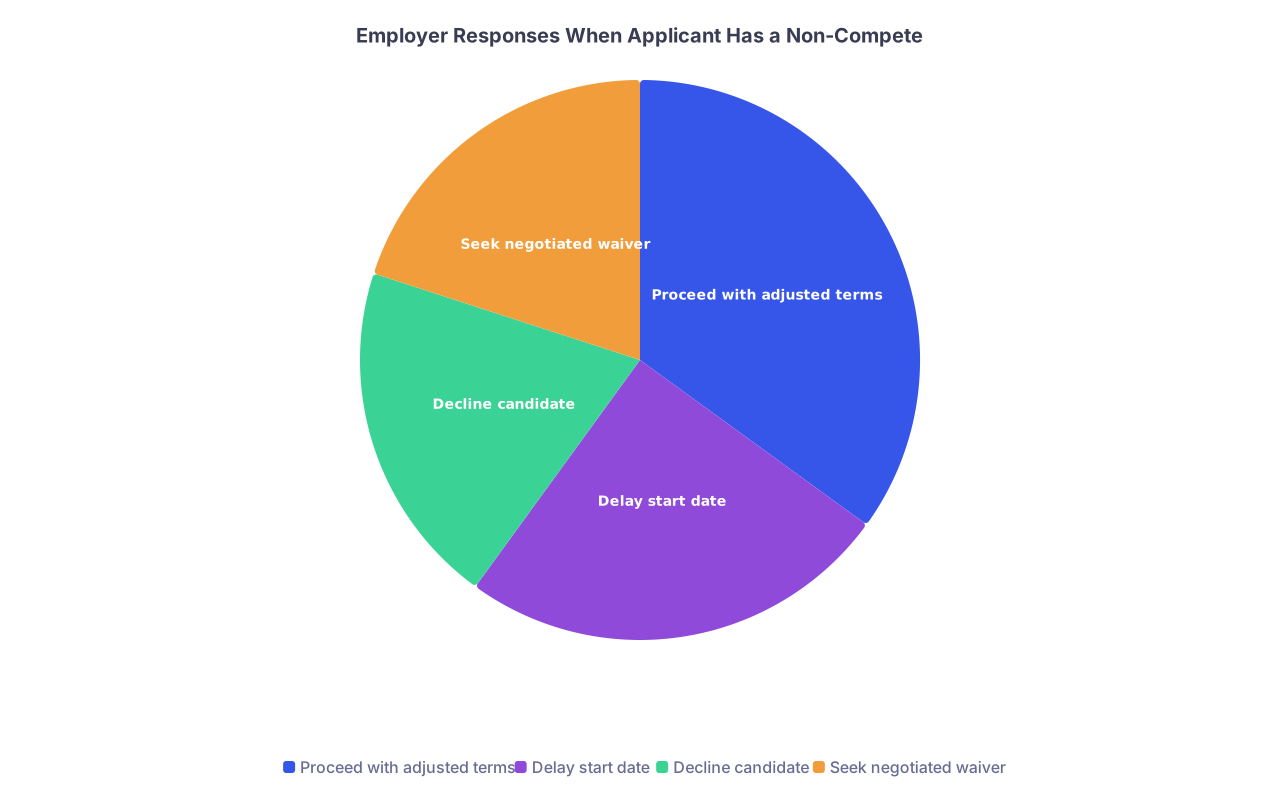
| Category | Value |
|---|---|
| Proceed with adjusted terms | 35 |
| Delay start date | 25 |
| Decline candidate | 20 |
| Seek negotiated waiver | 20 |
5. Is it ever worth turning down a good job offer just because of the non-compete?
Yes. I’ve told people flat out: “If you’re locked to this city because of kids, spouse, or visa, this non-compete is a time bomb.” A fantastic salary doesn’t fix being legally boxed out of your own town if it goes bad. If the non-compete is huge (multiple locations, big radius, long duration) and they won’t budge, walking away can be the most rational, self-protective move you make.
6. How do I know if my non-compete is ‘reasonable’ or a disaster?
Gut check: if you read it and your immediate thought is “This basically wipes out my entire city/region for 2 years,” that’s a problem. Specifically look at:
- Radius (in your actual geography—pull up a map)
- Duration (aim for 12 months)
- Locations (one or two named sites vs “any current or future site”)
- Scope (your specific specialty vs anything you’re licensed to do)
Then have a health care contract lawyer tell you, in one sentence, “On a scale of 1–10, how screwed am I if I want to leave in 2 years but stay here?” If the answer feels like an 8–10 and you’re geographically stuck, you treat that as a serious red flag, not background noise.
Years from now, you won’t remember every clause you argued over or which lawyer redlined which sentence. You’ll remember whether you protected your future self when everyone else told you to “just sign, it’s standard.”


