

Yes, they can change your salary after you start — but only in very specific ways your contract usually already quietly allows.
Let’s rip the band‑aid off. That fear you have — that they’ll hire you at $280k and then six months later say “We’re cutting you to $210k, take it or leave it” — is not completely insane. I’ve seen versions of that happen.
But I’ve also seen a lot of new attendings panic over salary changes that were actually allowed, predictable, and not a sign of “we’re about to screw you.”
You’re not crazy to be anxious. You just need to know what your contract actually lets them do.
The brutal truth: your contract almost never guarantees your salary forever
Everyone tells you, “Read the contract.” But nobody explains the one key reality:
Your first‑attending contract usually protects how they can change your pay, not that they won’t.
Most physician offers bake in pay changes from day one. It’s just hidden in:
- RVU-based compensation language
- “Productivity adjustments”
- “Compensation plans subject to change”
- “Compensation may be modified at employer’s discretion with X days’ notice”
So when you ask, “Can they change my salary after I start?” the real question is:
“Have I already signed something that lets them change my salary, and on what terms?”
Let me walk through the main ways salary actually changes in real life — and which ones should make you nervous.
Four common ways your salary gets changed (that you probably already agreed to)
1. The classic: the guarantee expires and you drop to base + productivity
This is the one that freaks people out the most, but it’s actually the most standard.
You’ll see something like:
“Year 1: Guaranteed salary of $260,000.
Year 2: Base salary of $180,000 plus $45 per wRVU in excess of 4,500 wRVUs annually.”
So of course what happens?
You get six months into Year 2, and your paycheck is smaller. You panic. You think they “changed your salary.”
They didn’t. The contract did.
That “guarantee” was basically a training‑wheels year. It was always scheduled to disappear. This is especially common in:
- Primary care
- Hospital employed IM/FM
- Some surgical subspecialties in big systems
If your offer letter says “Year 1: $X” and then nothing about years 2–3, that’s actually worse. That vague “Compensation to be adjusted in future years based on productivity and system policies” line? That’s their legal permission slip.
The key question:
Is your salary change:
- A pre‑defined transition from guarantee → productivity (normal, expected, still painful), or
- A surprise mid‑contract change that wasn’t clearly spelled out (red flag)?
2. RVU / productivity changes that are technically “formula,” but feel like a pay cut
Here’s where it gets sneaky.
Your contract says you’re paid:
“$50 per wRVU, using the current CMS Physician Fee Schedule. Employer may adjust compensation methodology based on changes in payer mix, reimbursement, or system policy.”
Sounds fine when you’re just trying to match as a PGY‑3.
Then one day:
- They raise the wRVU threshold (you now need more RVUs to get the same bonus)
- Or they cut the per-RVU rate
- Or they move procedures into lower-paying codes
- Or the hospital “aligns” with new benchmarks and your comp plan gets “updated”
So your base technically stays the same, but the realistic total pay drops.
Did they “change your salary”? Strictly speaking, they might say “we just adjusted the compensation plan.” Practically? Yeah, your take‑home pay went down.
And the scary part: many contracts explicitly let them do this unilaterally, as long as they:
- Apply it to everyone in your group
- Give X days’ written notice (60–90 is common)
- Don’t reduce below some floor (if you were lucky enough to negotiate one)
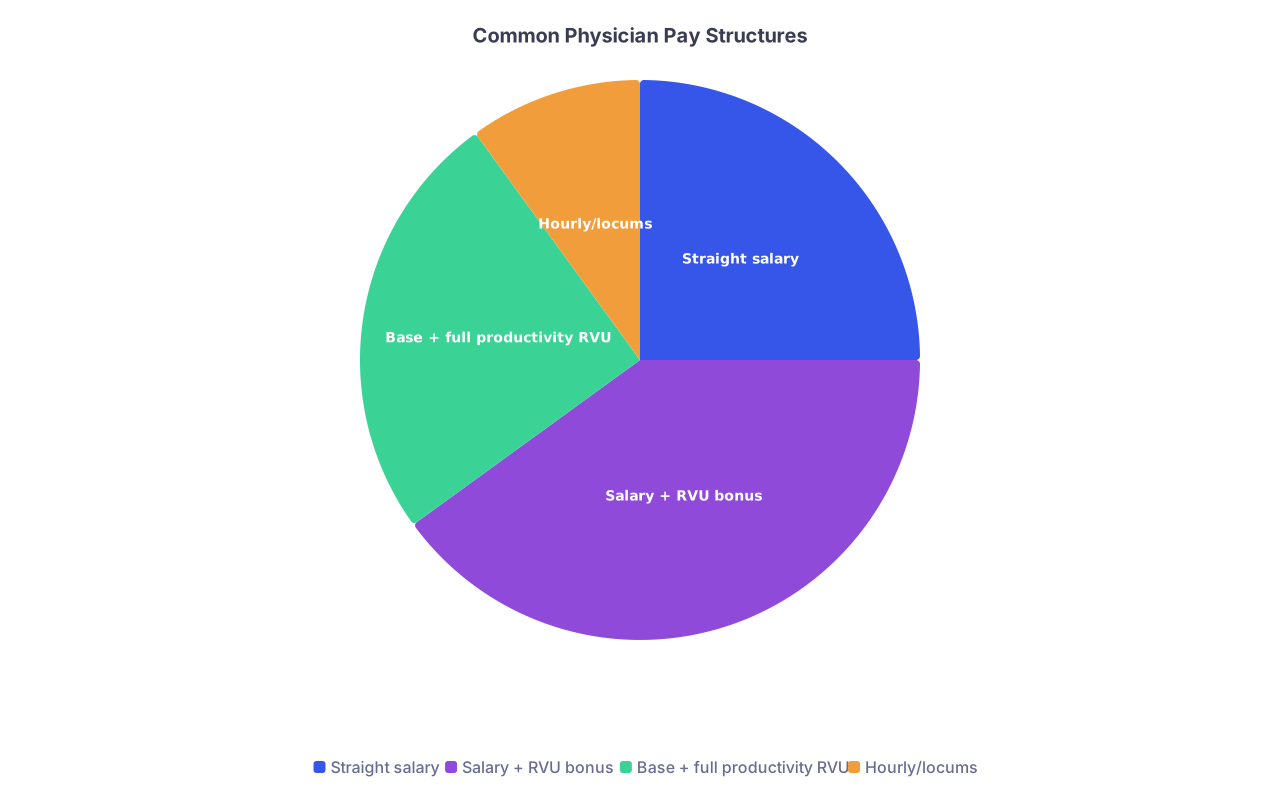
| Category | Value |
|---|---|
| Straight salary | 25 |
| Salary + RVU bonus | 40 |
| Base + full productivity RVU | 25 |
| Hourly/locums | 10 |
Once you’ve signed something like that, it’s less “Can they change my salary?” and more “When the hospital changes the comp plan, I’m coming along for the ride whether I like it or not.”
3. “System-wide” changes and “financial hardship” clauses
This is the doomsday line people skip because they’re tired by page 11:
“Employer reserves the right to modify compensation on a non‑discriminatory basis in the event of financial hardship, reimbursement reductions, or organizational restructuring.”
Translation: If the hospital’s losing money, they can cut pay across the board and claim it’s not targeting you.
I’ve seen this during:
- Major system mergers
- COVID surges when elective cases stopped
- Sudden payer contract losses
The worst version is broad and vague:
“Employer may modify compensation from time to time at its discretion…”
The less‑bad version has guardrails:
“Employer may reduce compensation by up to 5–10% with 60 days’ notice in the event of documented system‑wide financial hardship.”
So yes — sometimes they can absolutely say, “We’re cutting everyone’s salary 10% for the next year.” And your contract might allow it with very little recourse besides quitting.
But that’s the other piece: their right to change your pay usually travels with your right to walk away.
Most of these contracts are at‑will or have a “without cause” termination right with 60–90 days’ notice. Which means:
They can change your pay.
You can say, “Nope” and leave.
The hard part is that you’ve got a mortgage and loans and maybe kids and you can’t just vanish in 90 days.
4. Sneaky “salary change” through call, panel, and schedule manipulation
Sometimes they don’t even touch the number on your contract.
They just change:
- Call burden
- Clinic hours
- OR block time
- Advanced practice provider support
- How new patients are assigned
- Which payer mix you get
And suddenly you’re “the late clinic person” or “the one who covers Medicaid heavy clinics” or “the doc who loses OR time to the big name surgeon.”
On paper, your salary formula is unchanged. In fact, admin will happily tell you, “Your RVU rate is the same!”
But your ability to earn that salary? Quietly sabotaged.
That’s not technically a “salary change” clause. It’s a workload / assignment / admin power problem. But from your perspective, it feels exactly the same: less money than you were led to expect.
When changing your salary is not okay under most contracts
Let’s talk about the stuff that should make you very suspicious.
If your contract says:
- “Base salary: $260,000 per year”
- No language about “subject to change”
- No explicit comp plan modification clause
- No at-will employment (rare in private practice, but can happen)
- No “system-wide” or “financial hardship” adjustment language
And eight months in they say:
“We’ve decided to lower all new doctors to $220,000. This will apply to you starting next month.”
That’s usually not okay.
They’re trying to retroactively rewrite a fixed term. You might have:
- Breach of contract arguments
- Leverage to negotiate
- At minimum, strong reasons to get a lawyer involved quickly
Same if they try to:
- Cut just your pay and not others, with no documented performance issues
- Tie your salary to new metrics no one else in your specialty is using
- Change your pay in a way that seems retaliatory (e.g., after you reported a safety or compliance concern)
Is it worth suing? That’s a separate nightmare. But at least now we’re in the territory of “this is not standard / normal / contractually clean,” not “you just didn’t read the comp plan.”
How to read your contract right now for salary change landmines
Take a breath. Grab your contract. You’re looking for a few specific sections:
| Section Heading | What To Look For |
|---|---|
| Compensation | Base vs RVU, guarantees, rates |
| Term and Termination | At-will, without-cause notice |
| Employer Policies/Comp Plan | Right to change methodology |
| Financial Hardship/Force Majeure | System-wide reduction language |
| Duties and Scheduling | Ability to change clinic/call |
You want to underline (literally, with a pen) words and phrases like:
- “Subject to change”
- “Employer reserves the right”
- “From time to time”
- “In its sole discretion”
- “System policies and procedures”
- “Compensation plan may be modified”
- “Benchmarks / fair market value / MGMA”
Then ask yourself:
- Does my contract clearly say my base salary is fixed for the whole term?
- Or does it explicitly give them flexibility to “adjust” comp midstream?
- Are there any caps or limits to how much they can reduce (percentage, floor, etc.)?
- How much notice are they required to give me before a change takes effect?
If you can’t tell after one read, that’s not you being dumb. That’s the contract being intentionally vague. Which is its own kind of answer.
Worst-case scenarios vs what actually happens most of the time
Your brain is probably doing this:
- “They’ll slash my pay in half once I’m trapped and my kids are in school.”
- “I’ll be stuck because no one else will hire me.”
- “I’ll have to choose between tolerating the abuse or uprooting my life.”
Let me ground this with what I’ve actually seen with brand-new attendings:
Most common “salary changes” in years 1–3:
- Transition from guarantee → productivity (you knew this, but it still hurts)
- RVU thresholds raised a bit after a system comp review
- Call stipends slightly adjusted
- Modest across-the-board 5–10% reductions in big hospital crises
- Bonus formulas tweaked, typically not in your favor but not catastrophic
Less common, but real:
- Sudden “alignment” to a different compensation tier that effectively cuts total comp 10–20%
- Private group partners deciding they “overpaid” associates and unilaterally changing the distribution
- New CEO/CFO who wants to “standardize” comp across specialties and tanks previously strong packages
Rare, but nightmare‑level:
- 30%+ unexpected cuts mid‑contract without a clear cause
- Targeted compensation changes after you spoke up about something
- Major reduction in base with vague future “productivity upside” that never materializes
The ugly truth: they can change stuff more easily than you want them to. But they almost never go full‑nuclear right away, because turnover and bad reputation hurts them too.
Your leverage isn’t zero. It’s just not as strong as a brand‑new recruit with no baggage and no complaints.
What you can actually do if they change your salary after you start
Here’s the part your 3 a.m. brain wants to know: If they lower your salary, are you just stuck?
Not automatically.
You have a few levers, none of them perfect:
Check the contract against what they’re doing
Are they acting within the written terms, or outside them?
If they’re outside, that’s your power. You don’t open with threats, but you do calmly reference the agreement you both signed.Ask for the “system‑wide” proof
If they claim, “We’re doing this for everyone,” you can ask for:- Written policy change
- Confirmation it applies to your whole cohort
They may not show you numbers, but even asking can slow down unilateral nonsense.
Quietly talk to a healthcare attorney
Not your cousin who does divorces. Someone who reads physician contracts all day.
Sometimes one strongly worded letter that says, “This appears to violate Section X of Dr. Smith’s agreement” gets them to “clarify” or soften the change.Use your notice period as leverage
If your contract says either side can terminate without cause with 90 days’ notice, then you can absolutely say:
“This change will force me to look at other opportunities. I want to stay, but I also need compensation that aligns with the original understanding.”Start quietly window‑shopping
The best actual power you have in medicine is still your ability to walk and get hired somewhere else. You may not want to move. But having real options changes your posture from desperation to negotiation.
How to protect yourself before you sign (for next time)
I know, you might already be locked in. But I’m going to say this anyway so you don’t repeat the cycle in your next job.
In future contracts, push for:
- Clear statement: “Base salary of $X per year during the initial term shall not be reduced except by mutual written agreement.”
- Limits on system‑wide reductions: caps like “no more than 5–10%” and “not more than once per 12‑month period.”
- Notice requirements: “Any changes to the compensation plan require 90 days’ written notice.”
- Defined productivity terms: exact RVU rates, thresholds, and how/when they can be changed.
- Tethered termination: if they materially change compensation, you get the right to terminate on shorter notice.
They might push back. That’s fine. At least then you know you’re joining a place that wants wide open flexibility to cut your pay whenever they want. You can decide if that’s a risk you’re willing to take, not a surprise you discover later.

| Step | Description |
|---|---|
| Step 1 | Hear about salary change |
| Step 2 | Check contract language |
| Step 3 | Assess impact and options |
| Step 4 | Consult physician contract attorney |
| Step 5 | Stay and quietly explore jobs |
| Step 6 | Use notice clause and plan exit |
| Step 7 | Negotiate or challenge change |
| Step 8 | Allowed by contract |
| Step 9 | Can you tolerate it short term |
The part you probably need to hear
You’re not naive for worrying about this. You’re not paranoid. You’re seeing what’s happening in healthcare — consolidation, margin obsession, physician burnout — and wondering if you’re just a line item.
Here’s my take, after watching this play out more than once:
- Most employers won’t gut your salary out of nowhere. It’s bad business.
- Many employers will gradually squeeze around the edges — RVUs, bonuses, expectations — because they know new attendings are scared to leave.
- The contract you sign matters more than you want to believe when you’re exhausted and just want a job.
You are allowed to say, “I’m not okay with vague comp language.”
You are allowed to walk away from an offer that gives them all the power.
You are allowed, even as a new attending, to expect clarity and fairness.
And if you’re already stuck in a contract that gives them too much freedom?
Your job for the next 6–12 months is to:
- Learn exactly what you signed
- Keep your CV sharp
- Build relationships in your specialty
- And quietly position yourself so this job is a choice, not a prison
Because the only real antidote to “They can change my salary any time” is “I can leave any time and they know it.”


