

It’s July 1st (or it will be soon). You’re about to start your first attending job. Everyone around you is saying “Congrats!” and “You made it!” and all you can think is:
What if I hate it?
What if they work me into the ground?
What if I burn out in 6 months and I’m trapped for 3 years?
You’re not thinking about the signing bonus or the moving stipend. You’re staring at the words “term,” “non-compete,” “repayment,” and quietly panicking:
“If this job breaks me, do I have any way out that doesn’t destroy my career or my finances?”
Let’s talk about that. Because you’re right to worry. And also, you have more control than you think—if you get the right stuff into your contract before you sign.
The core fear: “What if I want to leave and they won’t let me?”
Here’s the nightmare version that lives rent-free in your head:
You start the job. The culture is toxic. RVU expectations are ridiculous. Admin shrugs at unsafe staffing. You’re scheduled “1:4 call” that magically becomes “1:3 plus random extra weekends.” Six months in, you’re grinding your teeth at night, your hair’s falling out, and you’ve Googled “non-compete physician how screwed am I” at 2 a.m.
But your contract is three years.
The non-compete is 50 miles.
There’s a massive signing bonus clawback if you leave early.
So you stay. You burn out. You start questioning medicine entirely.
That’s the fear.
The whole point of negotiating exit-friendly clauses is to turn “I’m trapped” into “I have options, and I can use them if this becomes unsustainable.”
Here’s the blunt truth:
Your first attending job is very often not your forever job. Systems change, leadership changes, you change. The mistake isn’t leaving. The mistake is signing a contract that makes leaving catastrophic.
So yes, it’s smart—even essential—to look at every clause through the lens of:
“If this job goes bad, how cleanly can I get out?”
The big four: clauses that decide how stuck you are
There are four main buckets that determine your exit options:
- Term and termination (how long you’re “locked in” and how you can leave)
- Non-compete / restrictive covenants (where you can work next)
- Repayment obligations (what you owe if you leave)
- Compensation structure (how painful it is to stay while you plan your exit)
We’ll walk through each, with specific “burnout” scenarios.
1. Term and termination: your emergency exit door
The “term” section is sneaky. It looks boring. It’s not. It’s the part that decides if you have a lever to pull when things go sideways.
You’re looking for one magical phrase: “termination without cause” (sometimes called “no cause termination”).
What that means in normal-people language:
You can resign for any reason (burnout, moving, your spouse’s job, you just hate it) by giving written notice X days in advance.
Typical notice periods are:
| Notice Period | How Common | Comment |
|---|---|---|
| 60 days | Fair | Manageable exit |
| 90 days | Very Common | Often acceptable |
| 120 days | Aggressive | Try to shorten |
| 180 days | Red flag | Hard to leave |
If your contract does not have a no-cause termination clause? You’re functionally locked in unless:
- They breach the contract (hard to prove)
- They agree to let you out (good luck if they’re short-staffed)
- You walk away and risk getting sued (nuclear option)
If you’re someone who’s already anxious about burnout, this clause is non-negotiable. I’m not being dramatic. I’ve watched people stuck in jobs that were destroying them mentally because they literally had no clean way out.
What you want:
A clause that looks roughly like:
“Physician may terminate this Agreement without cause upon ninety (90) days’ prior written notice to Employer.”
Then you try to negotiate:
- 90 days instead of 120–180
- No “only effective on the last day of a month/quarter” nonsense
- No penalties tied just to using no-cause termination
Burnout scenario:
You’re seven months in. Productivity ramp-up is unrealistic, clinic support is a mess, leadership is gaslighting your concerns. You’re not in danger of losing your license, but you’re crying in your car between patients.
If you have no-cause termination at 90 days, you can:
- Quietly start looking for a new job
- Give notice when you have something else lined up
- Survive three more months while planning your exit
If you don’t have that clause? You’re begging them to “let you out early,” and they’re reminding you of “your commitment to the community.”

| Step | Description |
|---|---|
| Step 1 | Job Becomes Unsustainable |
| Step 2 | Give 90 day notice |
| Step 3 | Search for new job while employed |
| Step 4 | Transition out with limited damage |
| Step 5 | Ask employer to release you |
| Step 6 | Leave but lose leverage |
| Step 7 | Stay burned out or risk legal fight |
| Step 8 | No cause termination in contract |
| Step 9 | Employer agrees |
If your draft doesn’t include no-cause termination, that is a genuine red flag. Not “slightly concerning.” Red.
2. Non-compete: will leaving mean moving your entire life?
This is the other clause that keeps people up at night.
You’re imagining: you finally find the courage to quit, and then you realize you can’t work within 50 miles for two years. Your partner works locally. Your kids are in school. Your support system is there. So either you:
- Move your whole life
- Or take a massive pay cut commuting to a distant job
- Or leave clinical work entirely for a while
Yeah, that’s nightmare fuel.
You need to nail down three things:
- Radius
- Duration
- Scope (what kind of work is restricted)

| Category | Value |
|---|---|
| 0 months | 15 |
| 6 months | 25 |
| 12 months | 45 |
| 24 months | 15 |
Friendly-ish terms look like:
- 5–15 miles in urban/suburban areas (maybe 20–30 in rural)
- 6–12 months
- Limited to your specialty and to locations you actually worked at
Terrible terms look like:
- 30–50+ miles around every clinic/hospital in the system
- 18–24 months
- Vague scope like “any medical practice that competes with employer”
Remember: you’re not just negotiating for “happy you.” You’re negotiating for “6-months-in-and-depressed you” who might need to bail with as little collateral damage as possible.
Things that genuinely help if you burn out:
- Tying the non-compete only to specific sites you actually worked
- Carving out hospitalist/ER/telemed if you’re outpatient primary care (or vice versa)
- Getting non-compete fully removed if they terminate you without cause
- Narrowing radius based on your home address, not every corporate location
Worst-case scenario you’re trying to avoid:
You’re a general internist in a mid-sized city. You burn out, give notice. Non-compete says:
- 30 miles from any clinic owned by the health system
- 24 months
- Applies to “any practice of internal medicine”
You realize that 30-mile circle basically covers your entire metro area. You now have to choose:
- Move
- Work urgent care 90 minutes away
- Or go non-clinical and pray financially
This is why you push on this before signing, even if it feels uncomfortable.
3. Money traps: signing bonuses, relocation, loan repayment
This is the part that makes people feel literally trapped even when they technically can leave.
You’re fried. You want out. Then you do the math:
“If I leave before 2 years, I owe back $40k of signing bonus, $15k relocation, and lose $50k of loan repayment.”
And your brain goes, “I can’t afford to quit.”
The contract language you want to dissect like a path slide:
- Signing bonus repayment schedule
- Relocation repayment schedule
- Loan repayment (who gets paid, how, and what happens if you leave)
- Any “forgivable loan” structure
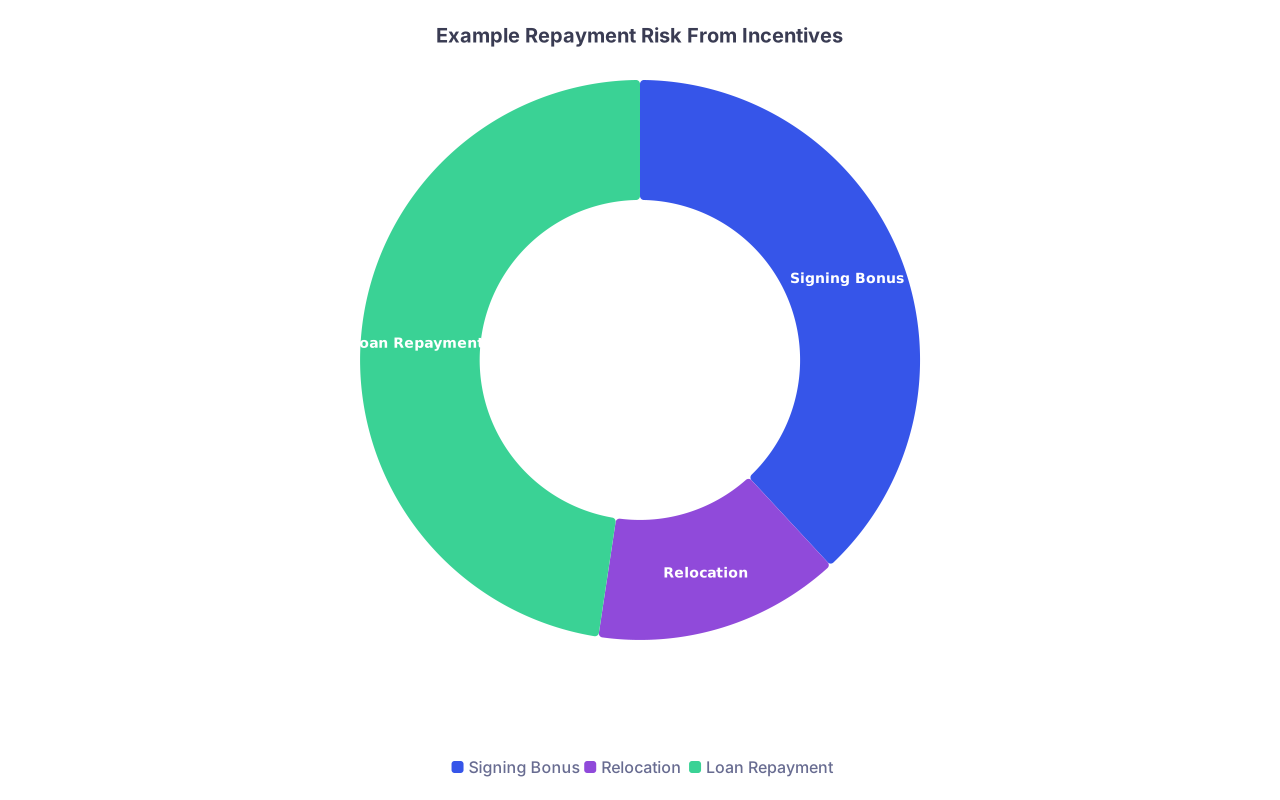
| Category | Value |
|---|---|
| Signing Bonus | 40000 |
| Relocation | 15000 |
| Loan Repayment | 50000 |
Best-case structure (from a burnout-exit standpoint):
- Bonuses/relocation forgiven pro rata over time
- Example: 3-year commitment, 1/36th forgiven each month
- No lump-sum penalties beyond the unearned portion
- Repayment waived if they terminate you without cause or materially breach the contract
Red flags:
- “If Physician terminates Agreement for any reason before 3 years, Physician will repay 100% of the signing bonus.” (No proration)
- Relocation must be fully repaid if you leave within 2 years—even if you’ve given them 23 months of your life
- Loan repayment treated as a “loan” you personally owe if you leave, rather than money they paid directly to your lender with clear forgiveness terms
Burnout reality:
People push themselves well past healthy limits because they feel financially handcuffed. I’ve watched folks stay in objectively toxic jobs because they were scared of a $30k clawback, while burning out so badly they ended up cutting back to 0.6 FTE later anyway.
Sometimes, paying back some money to save your health is absolutely worth it. But it’s a lot easier to make that call if:
- The amount is smaller
- It’s prorated
- There are carve-outs where you’re not on the hook
Negotiate the numbers when you still have leverage, not when you’re crying in a parking lot.
4. Compensation structure that fuels burnout (and how to spot it early)
This isn’t exactly an “exit clause,” but it affects how fast you get to the exit point.
Comp systems that are especially brutal for new attendings:
- Pure RVU with unrealistic ramp-up
- High base that converts to mostly productivity after 1 year
- Opaque “productivity targets” tied to continued employment

From a burnout angle, here’s what you want baked into your contract:
- Clear, written RVU targets
- Guaranteed base compensation for at least 1–2 years that’s not clawed back
- No surprise “productivity review” that lets them cut your pay drastically after a year
Because if they under-resource you, don’t market you, then blame you for not hitting RVUs and cut your pay, guess what? You’re not just burned out. You’re burned out and underpaid.
That’s when people start moonlighting, stacking shifts, overbooking, and the spiral accelerates.
Clauses that can soften the landing if things go bad
There are a few quieter things that don’t scream “EXIT” but can help a lot if you need to pull back or pivot rather than nuke the job entirely.
Part-time / FTE flexibility
Sometimes you don’t actually want to quit medicine or even the job. You just can’t keep doing 1.0 FTE.
If you can get any written language that acknowledges the possibility of reduced FTE, that gives you space later to say:
“Per Section X, we agreed we could discuss adjustment of FTE based on mutual agreement.”
Is it guaranteed? No. But it beats having nothing.
Call expectations in writing
Verbal promises like “call is light” and “usually 1:5” are worthless if they’re not in the contract.
You want:
- Frequency of call
- Whether it’s in-house vs home
- Any caps on extra call you can be “voluntold” into
Because when you’re burning out, call is usually gasoline on the fire. Having something in writing gives you a leg to stand on when you push back.
How to mentally approach the contract: assume you might leave
Here’s the mindset shift that actually calms the anxiety rather than feeds it:
Don’t treat this contract like a marriage vow.
Treat it like a lease.
You hope you’ll love the apartment and want to renew for years. But you still:
- Check the early termination penalties
- Look at what happens if the building changes hands
- Think about noise, commute, neighborhood
Same thing here. Assume there’s a non-trivial chance you’ll leave within 1–3 years. Not because you’re flaky. Because healthcare is chaotic and systems change faster than your contract term.
So when you read each section, silently add:
“If I’m burned out, moving, or unhappy, how painful does this clause make it to leave?”
If the answer keeps being “very,” you either negotiate, or you walk.

Tiny but powerful: get someone to fight for you
No, you’re not “bothering” anyone by getting the contract reviewed. You’re not ungrateful. You’re an exhausted graduating resident trying not to get legally pinned to the wall.
People who are actually useful here:
- Physician-focused contract attorneys in your state
- Senior physicians who’ve negotiated multiple contracts and are willing to be blunt
- Sometimes specialty societies with sample contracts or red-flag lists

You’re not overreacting because you’re thinking about burnout clauses. The people who get burned the worst are usually the ones who thought:
“It’ll be fine. I’ll just work hard and be a team player.”
And then find out “team player” means “we own you.”
Quick comparison: exit-friendly vs. exit-hostile contracts
| Feature | Exit-Friendly | Exit-Hostile |
|---|---|---|
| No-cause termination | Yes, 60–90 days | No, or 180+ days |
| Non-compete radius | 5–15 miles, limited sites | 30–50+ miles, system-wide |
| Non-compete duration | 6–12 months | 18–24 months |
| Signing bonus repayment | Prorated monthly/annually | All-or-nothing within term |
| Relocation repayment | Prorated, short window | Full repayment 2–3 years |
| Loan repayment | Clear forgiveness, limited risk | Structured as personal debt |
| Call expectations | Defined in writing | Vague or “as assigned” |

FAQs
1. Is it “unprofessional” or a bad sign to ask for changes to my first contract?
No. And if a group treats basic questions or reasonable edits like an insult, that’s actually data. Good employers expect some negotiation. They may not give you everything, but they shouldn’t make you feel guilty or “disloyal” for asking. You’re signing a legal agreement that affects your career, your finances, and your mental health. Wanting it to not be a trap is the bare minimum.
2. What if I’ve already signed and I’m just now realizing my contract is awful?
You’re not doomed, but you do need to be strategic. Have a contract attorney review what you signed and explain, in plain terms, your worst-case exposure: non-compete scope, repayment amounts, realistic risk if you breach. Sometimes the fear is bigger than the actual risk. Sometimes it’s truly bad. Either way, knowing the exact parameters gives you power: you can plan a timeline, save money if repayments are likely, look for jobs outside the non-compete radius, or negotiate a mutual separation if the employer is also unhappy.
3. Is it ever worth staying in a burning-you-out job just to finish the bonus/repayment period?
Sometimes, yes. But that decision should be conscious, not automatic. Do the math with a clear head: “If I stay 6 more months, I save $20k in repayments. What’s the cost to my health, relationships, and future career if I keep grinding at this level?” I’ve seen physicians destroy their love for medicine over amounts of money that were completely fixable over a few years with a better job. Money matters. But so does not breaking yourself.
4. If I leave my first job early, will that permanently stain my record?
Not if you’re thoughtful about it. People leave first jobs all the time. Recruiters see it constantly. What matters is how you leave and what story it tells. “I realized the culture and expectations weren’t a fit, I fulfilled my notice period professionally, and I’ve been looking for a practice that aligns better with X/Y/Z” is fine. Disaster is walking out mid-call block, ghosting, or getting into a lawsuit. Protect your professionalism even when you’re miserable. Future employers care much more about your references and how you explain the transition than the simple fact that you left early.
You’re not supposed to sign your first attending contract like you’re handcuffed to a sinking ship. You’re allowed to build escape hatches. You’re allowed to say, “If this turns out to be bad for me, I want a way to leave without nuking my life.”
Years from now, you probably won’t remember the exact RVU conversion rate or how long the notice period was. You’ll remember whether you felt trapped—or whether you’d given yourself enough exits to walk away when you needed to.


