
Academic physician contracts are not inherently safer than private practice or employed community jobs. That belief sticks around mostly because people repeat it, not because it holds up under scrutiny.
If you’re a new attending coming out of residency, you’ve probably heard some variation of this:
“Go academic if you want stability. Private and corporate jobs are risky. Academics is where you go for security.”
That sounds reassuring. It is also, very often, wrong.
Let’s pull this apart.
The Myth: “Academic = Job Security, Community = Risk”
Here’s the usual story residents tell each other in workrooms at 2 a.m.:
- Academic jobs have “real” contracts and multi-year terms
- Universities don’t fire people; they just “reassign” them
- Promotions and tenure protect you
- Even if the pay is lower, the security makes up for it
I’ve seen people turn down significantly better community or large-group offers because of one phrase: “I just want something secure, so I’m going academic.”
Reality: academic contracts are often less protective than the better-written private or hospital-employed agreements. The security you think you’re getting frequently lives in your head, not in the contract.
You’re not safer just because the logo on your badge belongs to a university.
What the Data and Real-World Trends Actually Show
No, there isn’t a neat RCT of “Academic vs Community Job Security,” but the macro picture is very clear if you look at how physicians are actually being employed.
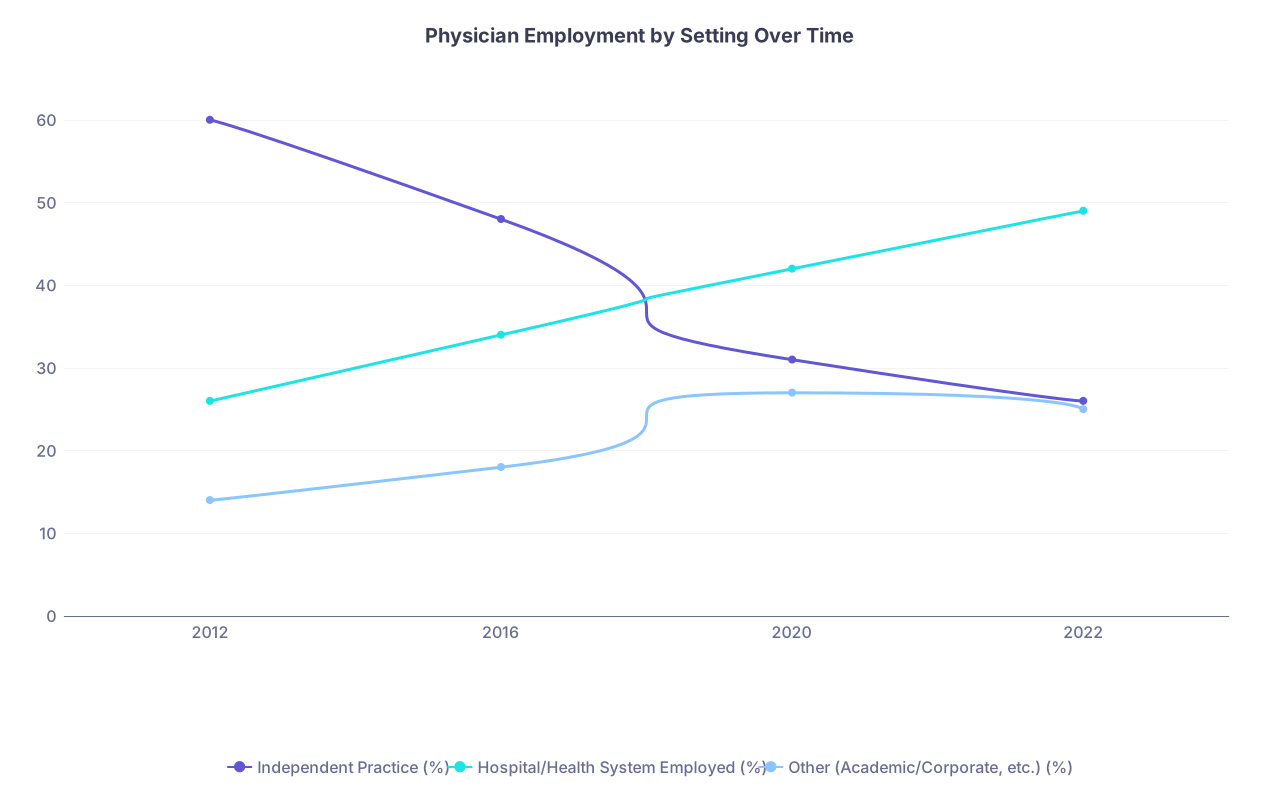
| Category | Independent Practice (%) | Hospital/Health System Employed (%) | Other (Academic/Corporate, etc.) (%) |
|---|---|---|---|
| 2012 | 60 | 26 | 14 |
| 2016 | 48 | 34 | 18 |
| 2020 | 31 | 42 | 27 |
| 2022 | 26 | 49 | 25 |
The AMA, AAMC, and multiple workforce surveys converge on a few realities:
- Most physicians now work for large employers (health systems, corporate groups, large academic centers).
- All of these entities—academic or not—use similar contract tools: RVU targets, non-renewals, “without cause” termination, productivity-based bonuses.
- Academic centers are under just as much financial pressure as community hospitals. Sometimes more. Their response isn’t magical; it’s the same: cut costs, cut FTEs, shift clinical load.
The important point: the type of employer is a poor proxy for security. The actual contract language and the financial health of that department or service line matter far more.
Reality Check #1: Your Academic Contract Probably Has At-Will or “Without Cause” Termination
The biggest myth is that academic jobs are “locked in” for the contract term.
Pull up a random academic offer letter or full contract from a major university (I’ve seen them from big-name places—think top-20 medical schools). You’ll see cheerful phrases like:
- “Initial term: 3 years”
- “This appointment is renewable annually”
Looks stable on the surface. Then you scroll.
In the termination section you’ll often find one of two things:
- At-will employment spelled out in legalese.
- “Without cause” termination by either party with 60–180 days’ notice.
If your contract says the institution can terminate “without cause” on 90 days’ notice, that three-year term is marketing, not protection. They can cut you off well before the end of the “term” and still be perfectly compliant with the contract.
Compare that to a decent community or hospital-employed contract that:
- Has the same “without cause” clause, but
- Offers a signing bonus, relocation, and possibly a guarantee period with clear expectations
- Sometimes includes severance (yes, this exists) or at least a longer notice window (180 days)
Security is not “3-year term” written on the first page. Security is how easy it is for them to get rid of you, and how painful it is for you when they do.
Reality Check #2: Tenure Is Rare, and Clinical Tenure Is Not What You Think
A shocking number of residents still think “tenure” means “I can’t be fired.” Maybe that was kind of true in the 1970s for certain basic science faculty. It is not your reality as a new clinical assistant professor.
In modern academic medicine:
- True tenure-track positions are shrinking
- Many clinical physicians are hired as “clinical track,” “educator track,” or “fixed-term” faculty
- Those tracks usually do not confer classic tenure protections
Even where tenure exists, it typically protects academic freedom and certain due-process rights, not clinical FTE or your exact job configuration. Your department can:
- Reduce your clinical time
- Reassign you to less desirable sites
- Decrease administrative roles
- Let a “temporary” salary-support supplement expire
- Not renew a secondary appointment that mattered to your income
And they can do a lot of this without technically firing you or “violating tenure.”
If your entire security plan is “I’ll just get tenure,” you’re solving a problem with a tool that probably won’t be handed to you, and wouldn’t work the way you think if it was.
Reality Check #3: Academic Revenue Pressures Are Brutal—and They Hit Clinicians First
The romanticized idea is: academics = mission-driven; community = money-driven. That sounds nice. It’s also nonsense.
Academic medical centers:
- Carry huge fixed costs (research infrastructure, trainees, compliance, under-reimbursed complex care)
- Depend heavily on clinical revenue from faculty to subsidize research and education
- Are competing in the same market as large private and corporate groups that are often more efficient operationally
So when margins get squeezed, what happens? They lean on the only flexible part: employed clinicians.
You see:
- Increased RVU targets, often mid-contract
- Less protected academic time than promised (“We need everyone to pick up more clinical sessions for the next 12–18 months…”)
- Frozen promotions or raises
- Quiet non-renewals of 1-year appointments
- “Restructuring” of service lines, which is a polite word for “your secure job just changed a lot”
In a smaller private group, the “pressure” is more obvious because partners feel it directly and talk about it openly. In academics, the pressure is there too; it just shows up filtered through committees and “strategic planning” language.
Not more secure. Just more bureaucratic.
Reality Check #4: The Hidden Risk—You’re Expendable if Your Niche Isn’t Profitable
Academic physicians love the phrase “niche.” “I’m being recruited to build a niche program in XYZ.”
Translation: they’re gambling that you can create a revenue stream or prestige halo that justifies your salary.
If that bets fails? You become a cost center. And cost centers get “restructured.”
Common scenarios I’ve watched up close:
- A young specialist is hired to build a program (e.g., cardio-oncology, complex airways, transgender surgery). After 2–3 years, referrals are weaker than hoped or reimbursement is worse than modeled. Suddenly the contract is “not renewed.”
- Hospital/medical school joint funding for a certain service line dries up. Hospital stops supporting part of the FTE; department can’t or won’t backfill. Job quietly disappears or morphs into something the physician didn’t sign up for.
- Grant or philanthropy that supported protected time ends. Department says, “We need you to increase clinical effort to 1.0 FTE.” Your “academic” role shrinks to hobby status.
None of these stories are rare. They’re baked into the current academic business model.
Contrast that with a large hospital-employed group that makes money every single day on bread-and-butter medicine—hospitalists, general cardiology, primary care, anesthesia. Is that system capable of ugly behavior? Sure. But in many cases, the service line you’re in is structurally more secure than a fragile academic niche.
Reality Check #5: Benefits and “Prestige” Aren’t a Shield
You’ll hear: “I know the salary is lower, but you get better benefits and stability in academics.” Sometimes. Sometimes not.
Here’s what actually varies, and not always in the direction you think:
| Feature | Academic Center | Community/Hospital Employed |
|---|---|---|
| Base Salary | Lower to mid-range | Often higher |
| RVU Pressure | High and rising | High, but sometimes clearer |
| Without-Cause Term? | Very common (60–180 days) | Very common (60–180 days) |
| Tenure Protection | Rare for clinicians | Not applicable |
| Non-Compete | Sometimes looser | Often tighter but negotiable |
| CME/Academic Perks | Better on average | Variable, sometimes limited |
The biggest “benefit” academics trade on is prestige: name-brand institution, teaching residents, publishing. Those are great if you value them. They do not stop a department chair from cutting your FTE or declining to renew your annual appointment.
I’ve seen physicians accept a significantly weaker legal contract (shorter notice, fuzzier duties, vague RVU expectations) just to have a big academic logo on the letterhead. That’s fine as a conscious tradeoff.
It is not fine if you’re telling yourself a story that “academic = more secure” while your actual contract is thin.
Reality Check #6: What Actually Makes a Contract More “Secure”
Security is not where you work. Security is:
- How hard it is for them to terminate you
- How much runway you have if they do
- How portable your career is if you have to leave
So when you compare offers—academic or not—you should be looking at things like:
- Length and clarity of “without cause” notice (90 vs 180 days is a big deal)
- Explicit severance (rare, but you can sometimes negotiate something for early non-renewal)
- How your role is funded (all clinical margin vs specific grants vs joint operating funds)
- How specific your duties and support are: protected time, clinic space, staff, call expectations
- Non-compete terms and how badly they trap you geographically
A high-prestige academic job with:
- 90-day without-cause
- 1-year renewable term
- Vague language about “duties as assigned”
- No clarity on how your 0.2 “research” FTE is actually funded
…might be less secure in practice than a community job with:
- 180-day without-cause
- Clear RVU or session expectations
- Stable, profitable service line
- Negotiated relocation clawbacks that phase out, and maybe even a modest severance
Add one more uncomfortable truth: mobility is its own form of security.
If your non-compete and academic subspecialization lock you to one institution or one tiny geographic area, you are less secure, not more.
Reality Check #7: How to Stop Chasing the “Security” Mirage
You do not fix this by deciding “academics bad, community good.” That’s just flipping one simplistic myth for another.
You fix it by:
- Reading the termination and funding parts of the contract like a hawk. Ignore the fluff in the preamble about “mission” and “excellence.”
- Asking very direct questions:
- “Where does my salary come from—what percent is clinical margin vs department vs grants vs hospital support?”
- “What happens if the hospital no longer funds this position?”
- “How many people in the last five years have had their contracts non-renewed or FTE reduced for financial reasons?”
- Modeling the downside:
- If you got 90 days’ notice tomorrow, how bad would it be?
- Could you work nearby or are you boxed in by a non-compete or academic niche?
- Stop equating ‘prestigious and complex’ with ‘safe.’ Tertiary/quaternary centers are often first in line for reimbursement cuts and political drama. They are not safety blankets.

| Step | Description |
|---|---|
| Step 1 | Job Offer Received |
| Step 2 | Read Termination Clause |
| Step 3 | More secure on paper |
| Step 4 | Check notice length |
| Step 5 | Better runway |
| Step 6 | High risk if non renewed |
| Step 7 | Review funding sources |
| Step 8 | Relatively more secure |
| Step 9 | Financially fragile role |
| Step 10 | Without cause allowed |
| Step 11 | Notice 180 days or more |
| Step 12 | Funding stable and diversified |
Notice what’s not in that diagram: “Is this academic or community?” Because that’s not the main variable.
The Bottom Line
Strip away the marketing and nostalgia, and the story is simple:
Academic contracts are not inherently more secure. Most have the same “without cause” escape hatch as community and corporate jobs. Tenure rarely protects modern clinical faculty the way young physicians imagine.
Real security comes from structure, not branding. Notice periods, funding stability, clarity of duties, and your ability to leave and work elsewhere matter far more than whether the employer is a university.
If you want security, negotiate and plan for the downside. Stop telling yourself “academics are safe” and start reading what happens if the department decides you’re too expensive, your niche isn’t profitable, or the hospital pulls funding.
You can choose academics for good reasons—teaching, research, mission. Just do not confuse those with protection. Your contract, not the institution’s reputation, is what stands between you and a surprise termination email.
And a lot of academic contracts are flimsier than you think.