
The belief that a big down payment automatically makes a real estate deal “safe” is one of the most expensive mistakes physicians keep repeating.
You are not immune because your income is high. In fact, your high income makes this mistake more likely.
You get pitched a “can’t lose” deal:
“Just put 40–50% down, you’ll crush the mortgage, build equity fast, and in 10–15 years it will be worth a fortune.”
I have watched too many attendings sign on to that pitch, park six figures of cash in a property, and then spend the next decade subsidizing it out of their call pay.
Let’s dismantle this properly.
The Dangerous Illusion: “Big Down Payment = Safety”
Here is the mental trap:
High-income physician. Busy. Risk-averse. Hates the idea of losing principal.
So you do what feels “conservative”: you throw a huge down payment at a property to keep the loan small. You accept that cash flow is low or even slightly negative because “I can afford it” and “it will appreciate.”
This is not conservative. This is reckless in a white coat.
You are making at least four errors at once:
- Confusing lower leverage with low risk.
- Ignoring cash flow as a risk management tool.
- Treating your clinical income as a permanent subsidy.
- Underestimating how fragile your tolerance becomes when life changes.
I keep seeing versions of the same story:
- EM doc in his late 30s buys a $900k short-term rental with 40% down because the pro forma shows breakeven after “projected” occupancy. Then COVID travel collapses. He bleeds $3–4k/month for 18 months, right as his group cuts shifts.
- OB/GYN couple buys a $1.2M “future retirement home” in a hot coastal market, 50% down, rents it long-term for a “small” negative cash flow of $800/month. Five years later they want to cut back clinically. That house payment suddenly feels like a ball and chain.
They thought the big down payment made the deal safer. It did not.
Why Low or Negative Cash Flow Is a Red Flag, Not a Rounding Error
Let me be blunt: if your investment property does not stand on its own two legs financially, it is not an investment. It is a liability dressed up as a wealth strategy.
Cash flow is not a “bonus.” Cash flow is your margin of safety.
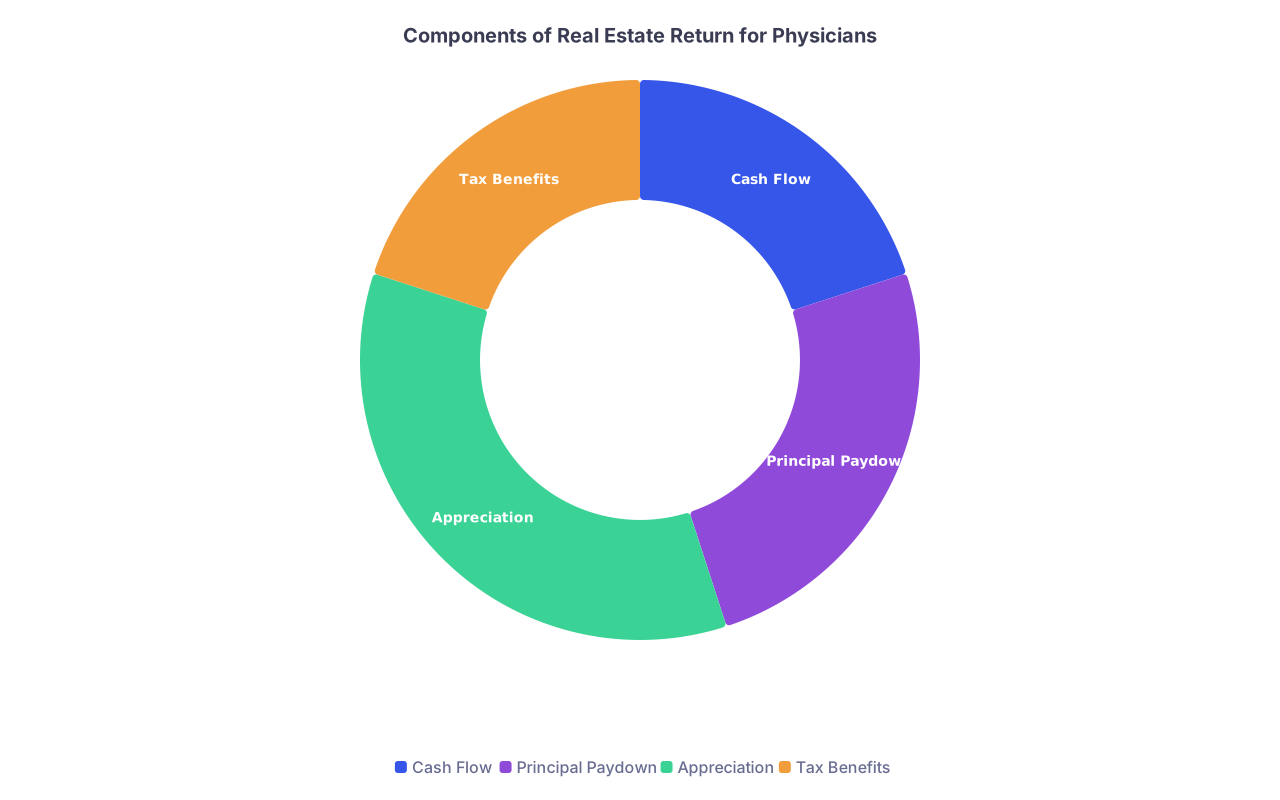
| Category | Value |
|---|---|
| Cash Flow | 20 |
| Principal Paydown | 25 |
| Appreciation | 35 |
| Tax Benefits | 20 |
There are four main components to your return in rental real estate:
- Cash flow (rent minus all expenses)
- Principal paydown
- Appreciation
- Tax benefits (depreciation, deductions)
Physicians routinely overpay for 3 and 4 (appreciation and tax perks) and sniff at 1 (cash flow) like it is optional.
Big mistake.
Because here is what happens when you accept low or negative cash flow:
- Every vacancy hurts twice. Once in lost rent, again in out-of-pocket carry costs.
- Every unexpected repair is a personal check.
- Every shift you drop at work is shadowed by, “But can I still cover the property?”
- Your ability to hold through a downturn depends on your job, not the asset.
An actual “conservative” investment is one that can survive shocks without you constantly feeding it.
Low cash flow is not conservative. It is dependency.
How the Big Down Payment Trap Specifically Targets Physicians
You are targeted because you:
- Have high W-2 income.
- Have limited time.
- Are anxious about “losing money” in stocks after watching your 401(k) swing.
- Like the tangibility of real estate.
- Carry student loan trauma and want something that feels “stable.”
So you get:
- Residential realtor: “You can afford this. Plus, you will build equity like crazy.”
- Mortgage broker: “With 30–40% down your payment is so low. Banks love buyers like you.”
- Buddy in the doctors’ lounge: “My rental is basically paying for itself; plus write-offs.”
Nobody is talking about true cash flow. Nobody is stress-testing the numbers.
Physicians often accept deals that a basic small landlord with a W-2 of $70k would laugh at. That landlord knows what a furnace bill feels like. You have not felt it yet.
That ignorance is not a flex. It is risk.
The Numbers You Keep Getting Wrong
Let’s be specific. Here is where most physician calculations go off the rails:
- Using mortgage + taxes + insurance as “the expenses.”
- Believing a simple “rent – (PITI) = profit” back-of-the-envelope.
- Ignoring reserves.
- Ignoring capital expenditures (roof, HVAC, water heater, exterior).
- Using unrealistic vacancy rates.
- Accepting rosy appreciation projections as if they are guaranteed.
The property is only safe if it survives reality, not a spreadsheet fantasy.
| Item | Physician Pro Forma | Reality on a Decent Rental |
|---|---|---|
| Vacancy | 3% | 5–8% |
| Maintenance | 3% of rent | 8–12% of rent |
| Capital Expenditures | 0–3% of rent | 8–12% of rent |
| Property Management | Ignored or 5% | 8–10% |
| Reserves | None | 3–6 months expenses |
You think:
“Rent is $4,000. Mortgage, taxes, insurance are $3,200. So I cash flow $800/month. Great.”
Reality:
- 8% property management = $320
- 8% maintenance = $320
- 8% capital expenditures (CapEx) = $320
- 5% vacancy average = $200 “lost” monthly
Now your true economic cash flow is:
$4,000 – $3,200 – $320 – $320 – $320 – $200 = -$360/month
That “nice cash flowing property” is actually costing you $4,300 per year. And that is before anything big breaks.
You insulated the bank with your down payment. You did not insulate yourself.
Why A Big Down Payment Often Makes The Return Worse
Let’s say you have $300,000 to deploy.
Option A:
You buy a $900,000 single rental with 33% down. It cash flows near zero after realistic expenses.
Option B:
You buy three $300,000 rentals with 25% down each. Each one modestly cash flows.
Ignoring transaction costs for the moment, where is the risk lower?
Not in the big single deal.
One expensive property with thin cash flow is fragile. If the high-income tenant leaves, or the local employer shuts down, or an HOA slaps a massive assessment, you hurt badly.
Three smaller properties, with adequate cash flow, spread across different submarkets, each with real reserves, are far more robust.
Here is the part physicians hate hearing:
Sometimes the best move is to put less down, keep a conservative loan, demand real cash flow, and hold more cash reserves. More leverage, but lower fragility.
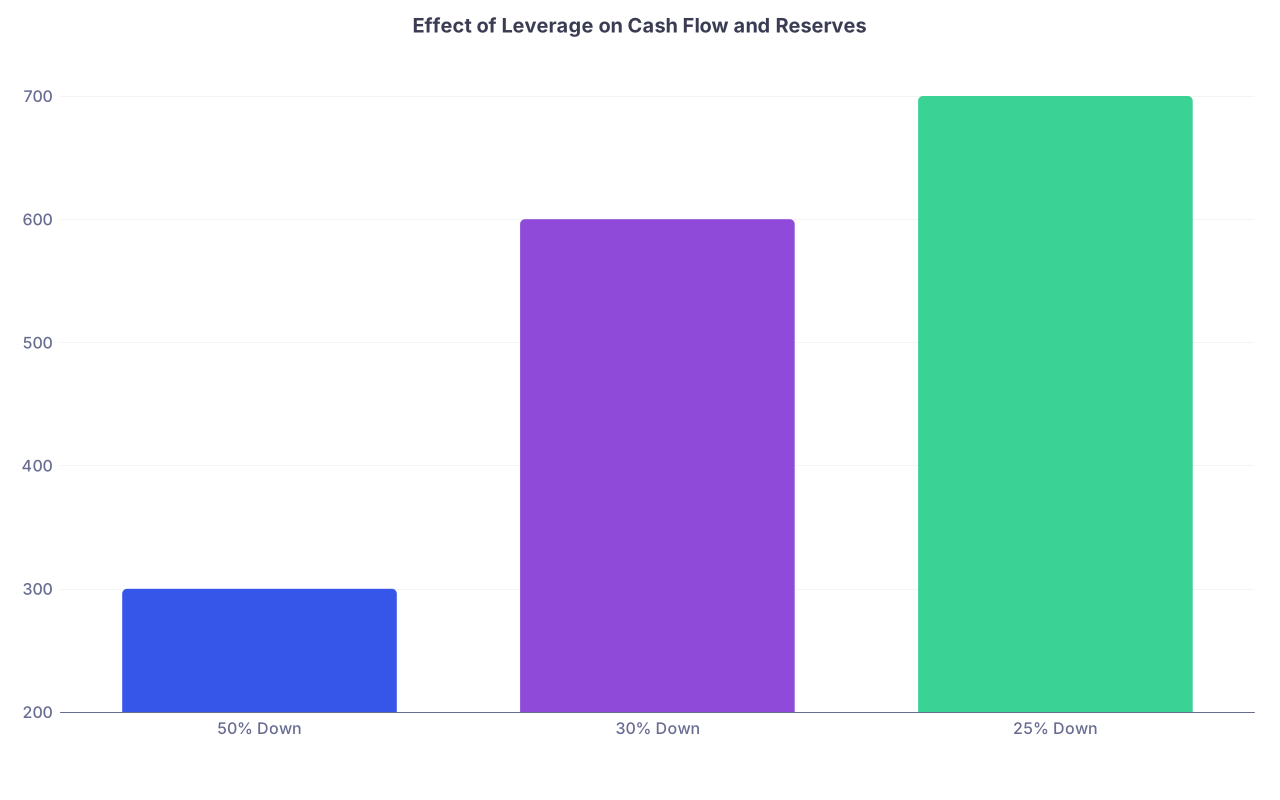
| Category | Value |
|---|---|
| 50% Down | 300 |
| 30% Down | 600 |
| 25% Down | 700 |
That kind of structure lets the properties work, instead of your paycheck working overtime.
Legal and Liability Angles You Are Ignoring
This is the “financial and legal aspects” bucket where many physicians are quietly unprepared.
1. Ownership structure laziness
The pattern:
- Title in personal name.
- No LLC.
- No umbrella policy.
- No separation between rental finances and personal finances.
Then you put a massive down payment in, which means you have a huge chunk of exposed equity sitting in a property with tenants, contractors, handymen, guests, and delivery drivers moving through it.
You built a big target.
You do not need 14 shell companies, but you should not:
- Hold multiple rentals in your personal name with large equity and high net worth.
- Skip umbrella insurance because “I have malpractice.”
This is a legal and asset protection failure layered on top of a cash flow failure.
2. Partnering without protections
Another classic physician mistake:
- Two colleagues buy an “investment” together.
- Both throw in big down payment money.
- Operating agreement is an afterthought or a template stolen from the internet.
- No clear rules on capital calls, exits, buyouts, or responsibility splits.
Then cash flow is weak. Repairs pop up. Someone wants out. Divorce, illness, job change.
Now your big down payment is trapped in a property and in a partnership fight.
Good operating agreements assume the cash flow might suck at times. They define:
- Who is required to put in extra cash (if anyone).
- What happens if one partner refuses.
- How to handle forced sales or buyouts.
- Priority of return of capital vs. profit splits.
Do not skip this because “we are friends.” That is delusional.
3. Tax “savings” that do not save a bad deal
Too many docs justify low cash flow properties with:
- “I get to take depreciation.”
- “I am working toward Real Estate Professional Status (REPS) to offset income.”
- “The cost segregation study will make up for it.”
Tax benefits can amplify a good deal. They can not rescue a weak one.
You are trading real dollars today (writing checks every month) for maybe-tax-savings that depend on complex qualifiers, your spouse’s work status, and future law changes.
If the core economics are bad, the tax tail should not wag that dog.
A Simple Framework To Avoid The Big-Down-Payment, Low-Cash-Flow Trap
You do not need a PhD in real estate finance. You just need to stop accepting deals that only “work” because you are willing to subsidize them with physician income.
Here is a saner framework.
1. Demand truth in underwriting
Before you buy:
- Model at least 5–8% vacancy.
- Set aside 8–12% of rent for maintenance.
- Set aside 8–12% of rent for capital expenditures.
- Include full management costs (even if you plan to self-manage).
- Include realistic insurance that reflects your net worth and lawsuit exposure.
If the property is still meaningfully cash-flow positive after all that, it is worth considering.
If it is negative, ask yourself why you are buying it. “Because I like the area” is not investing.
2. Build real reserves, not wishful thinking
If you are going to own rentals, you should plan on:
- 3–6 months of property expenses in reserves per property at a minimum, or
- A dedicated, well-funded reserve account for the whole portfolio.
Your big down payment is not a reserve. It is sunk equity. You cannot quickly or cheaply access it when the water heater explodes.
3. Align loan structure with reality, not ego
Physicians love 15-year notes because “I want it paid off faster.”
I get it. Student loan trauma again.
But a 15-year note on a thin cash flow property can turn a marginal deal into a terrible one. Sometimes the truly safer move is:
- A 25- or 30-year amortization.
- Fixed rate.
- Solid reserves.
- Positive cash flow.
You can always pay extra principal when the deal is good and you are flush. What you cannot do is retroactively lower a payment during a downturn.
Timeline Of How This Mistake Usually Unfolds
You might recognize yourself somewhere in this sequence.
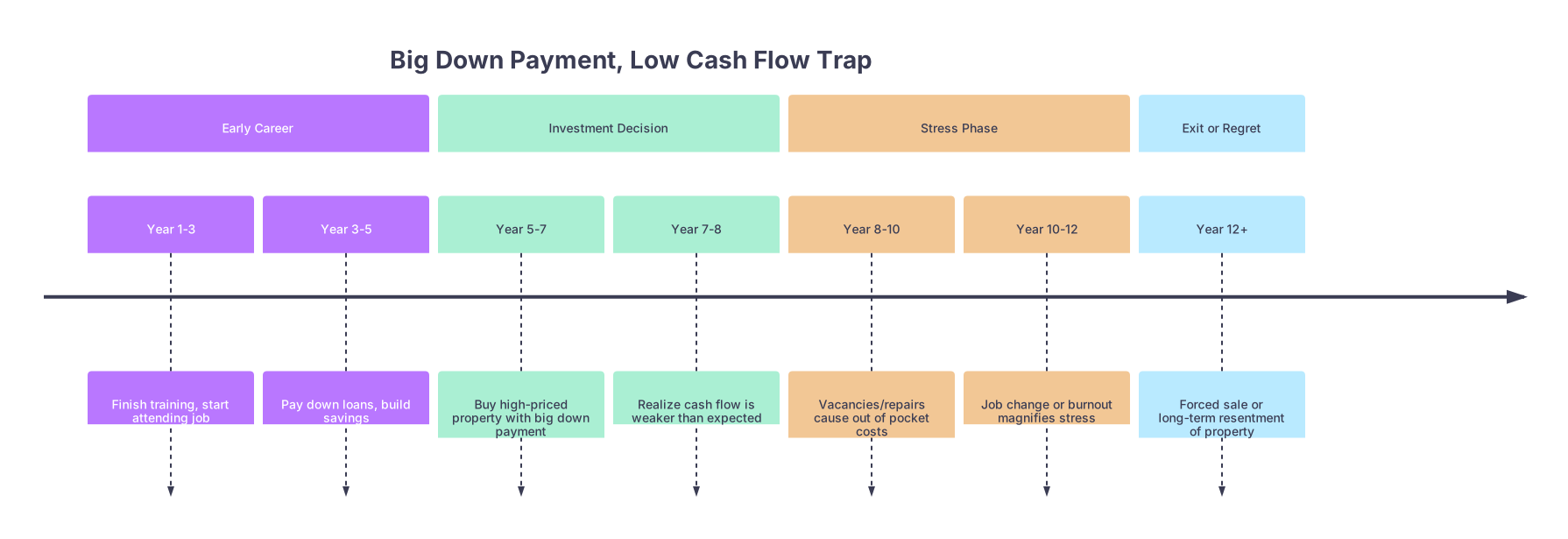
| Period | Event |
|---|---|
| Early Career - Year 1-3 | Finish training, start attending job |
| Early Career - Year 3-5 | Pay down loans, build savings |
| Investment Decision - Year 5-7 | Buy high-priced property with big down payment |
| Investment Decision - Year 7-8 | Realize cash flow is weaker than expected |
| Stress Phase - Year 8-10 | Vacancies/repairs cause out of pocket costs |
| Stress Phase - Year 10-12 | Job change or burnout magnifies stress |
| Exit or Regret - Year 12+ | Forced sale or long-term resentment of property |
The problem is not always that physicians “lose” money on these deals. Many of them hold for 10–15 years, sell with some appreciation, and walk away with a modest gain.
The real cost?
- Years of anxiety.
- Lost liquidity.
- Opportunity cost of capital that could have gone into better assets.
- Handcuffed career decisions (“I cannot cut back, we have to cover the rental.”)
That is the part rarely discussed in the closing statements.
Red Flags You Should Treat As Deal-Killers
Here is a short list. If you see two or three of these together, walk.
- Property only breaks even or is negative cash flow after realistic expenses.
- You are told, “Don’t worry about management costs, you can just self-manage.”
- Appreciation is the main justification. “This area is going to explode.”
- You are “stretching” to make the down payment.
- Your reserves will be bare or nonexistent after closing.
- You are relying heavily on tax benefits to justify the purchase.
- The seller’s numbers ignore repairs, CapEx, and realistic vacancies.
- Your spouse is already uneasy and you are hand-waving the concerns away.
This is your money and your night call sanity. You do not owe anyone a yes.
Frequently Asked Questions
1. Is it ever reasonable for a physician to accept breakeven or slightly negative cash flow?
It can be, but only under strict conditions most physicians do not meet. You should have:
- Very strong, diversified income streams.
- Deep reserves, well beyond 6 months of expenses.
- A clear, realistic plan for why this specific asset is worth the risk (for example, assembling parcels for a development with known demand, not “it’s by a nice coffee shop”).
Even then, I would treat it as a speculative play, not a core retirement strategy. If you are early in your investing journey, you have no business normalizing negative cash flow.
2. Should I just avoid real estate altogether and stick with index funds?
You do not need real estate to become wealthy as a physician. Broad market index funds plus a high savings rate will get you there. Real estate is an optional tool, not a requirement.
But if you choose to use it, you must respect it as a business. That means underwriting conservatively, demanding real cash flow, and not using your MD as a backstop for sloppy deals. If you are not willing to do that work or learn those basics, then yes, you are probably better off avoiding direct real estate and using REITs or staying with funds.
3. How much cash flow should I target per property?
Rules of thumb like “$200–300 per door” can be misleading because markets and price points vary. A more useful way to think: after all realistic expenses, including management, maintenance, CapEx, and vacancy, you want a clear, positive cash flow that feels meaningful relative to your down payment and risk.
If you are tying up $200,000 to earn $150/month in true cash flow, that is a terrible return and not worth the hassle or risk. You are better off keeping that money liquid, paying debt, or investing in broader markets.
4. Does forming an LLC fix the risk if I put a big down payment in?
An LLC helps with liability compartmentalization, but it does not fix bad economics. You can still end up feeding a negative cash flow property inside an LLC with your personal money. You can still watch your big equity position get eroded by forced sales or price drops.
Think of an LLC and insurance as seat belts and airbags. Useful. Necessary in many cases. But they do not make it safe to drive off a cliff. The underlying investment must still be sound.
5. I already made this mistake. What should I do now?
First, get honest numbers. Re-underwrite the property with:
- Realistic vacancy, maintenance, CapEx, and management.
- A clear reserve plan.
- Different scenarios (rent drop, interest rate changes if you are adjustable, etc.).
Then decide:
- If you can raise rents or cut legit costs to make it truly cash-flow positive.
- If a refinance (longer term, fixed rate) can stabilize things.
- If selling and redeploying capital into better-structured investments is the cleaner move, even if it hurts your ego.
Do not stay in a bad structure for another decade just because you once thought it was “conservative.” Pride is an expensive asset class.
Two things to remember:
- A big down payment does not make a bad deal good. It just makes a bad deal slower to fail and harder to unwind.
- If the property cannot support itself without your physician paycheck, you did not buy an investment. You bought a dependent.
Protect your cash. Protect your future time. Let the numbers, not the sales pitch, decide what is “safe.”