
Only 7–10% of net lease physicians ever touch ground leases or build‑to‑suit deals—yet those who do often end up owning the dirtiest‑looking K‑1s and the cleanest balance sheets.
Let me break down why.
Most physician “real estate investing” is vanilla: you buy a condo office, maybe a small MOB, or you invest passively in a syndication. Fine. But ground leases and build‑to‑suit structures are where sophisticated family offices, institutional capital, and a small handful of physicians quietly operate while everyone else fights over 5% cap triple‑net urgent care deals on LoopNet.
You asked for niche. This is niche.
Ground Leases 101 for Physicians: You Own the Dirt, They Own the Box
Start with the core distinction. In a traditional purchase, you own land + building. With a ground lease, you own the land and lease it long‑term (often 40–99 years) to a tenant who pays to build and own the improvements during the lease term. At the end of the lease, in most properly drafted ground leases, you get the building too. For free.
So your return profile is not “rent + someday I sell the building.” It is:
- Land rent cash flow
- Plus reversionary ownership of all improvements at lease expiration (or earlier if there are buyout/termination triggers)
For a physician, the first reaction is usually: “Why would any tenant agree to this?” Three reasons:
- They want balance sheet flexibility and do not want to tie up capital in land.
- They want to keep a specific location but avoid a big up‑front capital outlay.
- Their shareholders or REIT structure prefers a lower capital base with operational control.
Think of large hospital systems, dialysis operators, national imaging chains, or dental platforms backed by private equity. They care about operations more than land banking.
What a Ground Lease Looks Like in Practice
You might see a term like:
- Initial term: 50 years
- Renewal options: 2–3 options of 10 years each
- Starting ground rent: 6–8% of appraised land value (sometimes structured as a flat dollar per SF of land)
- Escalations: 2–3% annually or CPI‑based with floors/caps
- Taxes/insurance/maintenance: Usually triple‑net to the ground lessee
You, as the physician landowner, are effectively a bondholder with inflation protection. But there are teeth. Ground leases are not simple; they are sophisticated documents, and many are written to favor institutions, not an individual doctor trying to “figure it out on the side.”
The Financial Logic: Why Ground Is a Different Animal
I will be blunt: if you treat a ground lease like a normal NNN lease, you will overpay or sign something dangerous.
Two fundamental differences:
- You are valuing land rent, not building rent.
- Your residual value is heavily shaped by the legal language around reversion, condemnation, casualty, and lender rights.
Cap Rates, IRR, and Why Institutional Money Loves These
Ground leases usually trade at lower cap rates than fee‑simple leased buildings with the same tenant credit. Example:
| Asset Type | Typical Cap Rate Range |
|---|---|
| Credit MOB fee-simple NNN | 5.25% - 6.25% |
| Credit tenant ground lease (healthcare) | 4.00% - 5.00% |
| Non-credit, private group MOB NNN | 6.25% - 7.50% |
| Non-credit ground lease | 5.00% - 6.50% |
Why would anyone accept a 4.5% cap on ground rent? Because:
- The income stream is extremely secure if the tenant is strong and heavily invested in improvements they do not own the land under.
- You are senior in the capital stack in a practical sense: if the tenant defaults, you typically gain the building or the right to re‑tenant with a building already there.
- Your downside is protected by land value plus building reversion.
For a physician investor with a 20–30 year horizon, the IRR story can be deceptive if you only look at cash‑on‑cash. A stable 4.5% yield can look boring. But factor in:
- Annual escalations (2–3% compounded is not trivial over 30–40 years).
- Eventual building reversion at near‑zero basis.
That is where the magic happens. The discounting math starts to favor you strongly in later years.
Physician Use Case: Practice + Land Split
Here is a scenario I have seen more than once:
- A cardiology group buys a parcel near a growing hospital campus.
- They set up an LLC that owns only the land.
- They sign a ground lease from that land LLC to a separate LLC that will build and own the cardiology building.
Result:
- The operating practice pays rent to the building entity.
- The building entity pays ground rent to the land entity.
- Senior partners hold larger interests in the land entity (longer‑duration, lower‑risk), while junior partners or practice‑level investors participate more in the building/operations side.
This is essentially “institutional structuring” for a physician group.
Legal Structure: The Clauses That Make or Break a Ground Lease
This is where most doctors get burned. They look at:
- Term
- Rent
- Escalations
…and ignore the legal machinery that controls all the downside scenarios. Your attorney must have actual ground lease experience. Not “I do closings” experience.
Key legal axes:
1. Reversion and End‑of‑Term Provisions
You want: Automatic reversion of improvements at lease expiration without additional payment.
The tenant will try to negotiate:
- Purchase option for the land at a pre‑agreed formula price.
- Renewal rights so generous that the marketability of your reversion is diluted.
- Provisions that create implicit pressure on you to extend or sell cheap near expiration.
If the lease allows the tenant to buy the land at some “fair market value” determined by appraisers, you may lose the upside of capturing both land and building value. The drafting details determine whose appraiser frame dominates.
2. Casualty and Condemnation
When the building burns down or the state takes part of the property for a road widening, who gets paid, and who has to rebuild?
The bare‑bones questions:
- Are the tenant’s insurance proceeds required to be used to rebuild the improvements?
- If the site becomes unusable, does the ground lease terminate, or is rent still owed?
- What if there is a partial taking—does rent adjust? Does either party have termination rights?
For a physician owner, your risk is ending up with a hole in the ground and a terminated lease with little or no recourse. Ground leases can be written to shift much of that risk back onto the tenant. Many tenants will fight this. That is negotiation.
3. Financing and Subordination
Most ground tenants will want to finance their improvements. Their lender will demand certain protections:
- Non‑disturbance: If the tenant defaults on its loan, the ground lease survives, and the lender (or foreclosure buyer) can step into the tenant’s shoes.
- Cure rights: Lender gets the right to cure tenant defaults under the ground lease.
- Subordination: In some structures, the fee interest (your land) is subordinated to the leasehold lender.
Let me be very clear: As a physician landowner, you almost never want your fee interest subordinated to a leasehold mortgage. That is how you end up, in a worst‑case scenario, with a lender ahead of you and the risk of losing some or all of the property.
The safer structure:
- Fee interest remains senior.
- Ground lease is recorded.
- Tenant can mortgage only its leasehold interest, with lender rights carefully spelled out but without subordinating your land.
Build‑to‑Suit Deals: When You Provide the Box, Not Just the Dirt
Ground leases are dirt‑only plays. Build‑to‑suit (BTS) is different: you either own land already or acquire it, then you pay to develop a building tailored to a specific tenant’s specs, usually under a long‑term net lease.
In a physician context, I see two main models:
- You are the tenant (practice or ASC) and engage a developer to do a BTS for you.
- You are the landlord‑investor and sign a BTS lease with a healthcare tenant.
Both can work well if you understand the economics and legal exposures.
Build‑to‑Suit as Physician-Tenant: “We Want a Custom ASC”
Say your surgical group wants a 15,000 SF ASC with specific OR specs, imaging, mechanical, etc. You partner with a developer:
- Developer finds site, designs building, arranges construction and financing.
- You sign a long‑term NNN lease (10–20 years) at a rent that covers developer’s yield‑on‑cost plus risk premium.
This is not “free building.” You are paying for it in rent, exactly like paying a car payment that includes principal and profit. But you:
- Avoid development risk and project management headaches.
- Lock in a customized facility.
- Can sometimes negotiate purchase options later (developer flips to you or to a REIT).
The trap: physicians focusing only on the monthly rent number and ignoring:
- Personal guarantees hidden in the lease or side agreements.
- Cost overrun clauses that find their way back into rent.
- Inadequate assignment/subletting rights if your group changes structure or sells to a PE‑backed platform.
Build‑to‑Suit as Physician Landlord-Investor
This is rarer but powerful.
You (or a small physician syndicate) act as the capital partner. Typical structure:
- You put up equity (20–40% of project cost).
- A construction lender provides the rest.
- Tenant commits to a 10–20 year NNN lease with pre‑agreed rent reflecting a target yield on total cost (say 7–8% unlevered).
After construction:
- Debt converts to permanent financing or is refinanced.
- You now own completed building plus land, with stable signed tenant, often at a higher yield than you would get buying a fully stabilized MOB on the market.
This is how some physicians quietly end up owning 30–50,000 SF outpatient campuses that later sell to healthcare REITs at a premium.
But again—development risk. Cost overruns, delayed CO, tenant change orders, municipal approvals. Any one of these can eat your return if not properly contracted.
Comparing Ground Leases vs Build‑to‑Suit vs Straight Fee-Simple Purchase
You want to know where these tools fit in your portfolio, not just what they are. Here is the clean comparison.
| Feature | Ground Lease (Own Land) | Build-to-Suit (Landlord) | Fee-Simple Purchase (Stabilized) |
|---|---|---|---|
| Capital Intensity | Low (land only) | High (land + construction) | Medium-High (full building cost) |
| Development Risk | Low to moderate | High | Low |
| Initial Yield | Lower | Higher | Moderate |
| Long-Term Upside | Very high (reversion) | High (rent growth + cap rate) | Moderate |
| Complexity (Legal/Struct) | High | High | Moderate |
| Suitability for New Docs | Usually poor | Poor to moderate | Better |
If you are very early in your career, fee‑simple small assets or passive investments make more sense. Ground leases and BTS should come later, when:
- You have a stable income base.
- You can tolerate multi‑year horizons with limited liquidity.
- You can hire specialized legal and development professionals without flinching at their hourly rates.
Risk Profile: What Can Actually Go Wrong?
People romanticize these structures because institutions use them. Institutions also have entire legal departments and risk teams. You do not.
Let’s be explicit about the real risks.
Ground Lease Risks for Physician Owners
Bad Tenant Credit
Owning land under a local imaging group with shaky finances is not the same as owning land under a large health system. If the group fails, will another operator step into their shoes and pay comparable ground rent? Maybe. Maybe not.Over-Leveraged Tenant Improvements
If tenant’s lender steps in, you need to know exactly what rights that lender has. If the lender can tear down or remove improvements on default, your “free building at the end” fantasy may be less real.Poorly Drafted Reversion Language
I have seen leases where reversion is theoretically there but so riddled with conditions, appraisal fights, and purchase options that the landowner’s leverage is neutered.Inflation/CPI Traps
CPI‑based escalations with caps might feel safe, but long‑term, if inflation runs high and your caps are low, your real rent shrinks. Physicians rarely model 30–50 years of inflation scenarios. Your institutional counterparty does.
Build‑to‑Suit Risks for Physician Landlords
Cost Overruns and Schedule Delays
If you sign a fixed‑rent lease and your construction ends up 20% over budget, your yield is permanently impaired. Lump sum, GMP (guaranteed maximum price) construction contracts with good contingencies are non‑negotiable.Tenant Backing Out or Renegotiating
LOIs are non‑binding. If the tenant bails before final lease execution and financing, you are left with a half‑baked project. Pre‑lease conditions and security deposits matter.Exit Liquidity Misconceptions
Physicians assume, “I will just sell to a REIT at 5.5% cap.” Maybe. But if your lease is quirky, your tenant credit is thin, or your location is tertiary, that exit can be 7–8% cap instead. That crushes your IRR.
Practical Deal Mechanics: How These Deals Actually Get Done
Let’s ground this in the concrete steps of a typical physician‑involved transaction.

| Step | Description |
|---|---|
| Step 1 | Identify Site or Tenant |
| Step 2 | Feasibility and Pro Forma |
| Step 3 | Letter of Intent Terms |
| Step 4 | Legal Drafting of Ground or BTS Lease |
| Step 5 | Financing and Approvals |
| Step 6 | Construction or Tenant Build |
| Step 7 | Stabilization and Operations |
| Step 8 | Refinance or Sale Decision |
Notice where complexity lives: C through E.
For a Ground Lease Deal
Step 1 – Site and Tenant: Either you already own land (common if your practice bought excess land years ago) or a tenant approaches you with a request to ground lease a portion of it. Alternatively, you intentionally buy land in a strategic corridor near medical demand, expecting to ground lease it later.
Step 2 – Framework Economics: You and tenant agree on land value, desired yield (ground rent), and escalation structure. A simple back‑of‑the‑envelope:
Land worth $1.2M x 6.5% yield = $78,000/year base ground rent, plus escalations.Step 3 – Lease Drafting: Long, nasty documents. You want your attorney to focus obsessively on:
Reversion, default, subordination, casualty, condemnation, assignment, and lender consents.Step 4 – Tenant Financing and Construction: Tenant secures leasehold financing, builds their facility. Your role: minimal, except for approvals outlined in the lease (plans, use, signage).
Step 5 – Stabilized Income: Once open, you receive ground rent like clockwork. For you, this is low‑touch. For the tenant, it is their operating headquarters / facility.
For a Build‑to‑Suit as Physician Landlord
Step 1 – Tenant Commitment: You do not start without a signed or near‑final lease. Pre‑leases to at least 60–70% of NRA if multi‑tenant. For single‑tenant medical, you want a near‑binding deal before closing on land.
Step 2 – Financing Stack: Usually:
20–35% equity from you and partners, 65–80% construction loan. Lender will underwrite to stabilized DSCR, tenant credit, and lease terms.Step 3 – Fixed Price Construction Contract: You negotiate a GMP contract with a reputable GC experienced in medical projects (ASC, MOB, or whatever is relevant). Medical builds are not generic retail shells.
Step 4 – Implementation and Change Orders: Tenant will request changes. Your lease needs cost pass‑through provisions or rent‑adjustment mechanisms for significant tenant‑driven scope changes.
Step 5 – Post‑CO Refinance or Hold: Many physician investors refinance into long‑term debt once the building stabilizes, pull some equity out, then either hold for income or package for sale.
Specific Physician Scenarios: Where These Shine (and Where They Do Not)
Scenario 1: Senior Physician Group with Excess Land
A long‑established ortho group owns 8 acres; their building uses only 4. A regional rehab operator wants 2 acres for a custom facility.
Play: You structure a 50‑year ground lease on 2 acres:
- Rehab operator builds and finances their building.
- You keep fee ownership.
- Ground rent becomes a second stable income stream in your retirement, with your group’s real estate entity holding long‑term upside.
This is almost textbook. Low development risk, high strategic control.
Scenario 2: Younger Group Wants a Flagship ASC But Lacks Capital
They find a land parcel and talk to a developer for a build‑to‑suit.
Good version:
- Developer funds land + construction.
- Group signs 15‑year NNN lease with reasonable base rent tied to 7–8% yield on total cost, plus options.
- Limited or no personal guarantees beyond initial years or limited amount.
- Purchase option structured at a fair multiple of rent or appraised value after year 7–10.
Bad version:
- Inflated “turnkey” cost per SF with little transparency.
- Personal guarantees for full lease term.
- No meaningful purchase option or break rights.
- Weak assignment rights that make a future sale to PE or health system painful.
You do not want the bad version.
Scenario 3: High-Earning Specialist with Cash and Real Estate Curiosity
A radiologist with several small rental properties starts looking at ground leases under national kidney dialysis clinics, urgent cares, or free‑standing EDs.
Correct progression:
First, invest passively in a high‑quality, well‑structured ground lease through a reputable sponsor. Read the documents, talk to counsel, learn the structure.
Later, consider direct ownership of a single‑tenant ground lease asset with:
- Strong tenant credit
- Clear reversion provisions
- No fee subordination
- Conservative leverage (or none at all)
Jumping straight to “let me originate a complex ground lease myself with a private operator” is how people learn expensive lessons.
A Quick Look at How Returns Can Stack Over Time
To keep it concrete, imagine:
- Land bought today for $1,000,000.
- Ground lease at 6% initial yield = $60,000/year, 2.5% annual bumps.
- Year 30, building and land are valued at, say, $6,000,000 combined (not crazy if rent and market keep pace with inflation).
If you never sold and just collected rent, your cash IRR might look modest. But when you include the end reversion value (either through sale or refinance after reversion), the blended IRR can easily exceed 10–12% annually over a long horizon—on an asset that functioned like a low‑volatility bond for three decades.
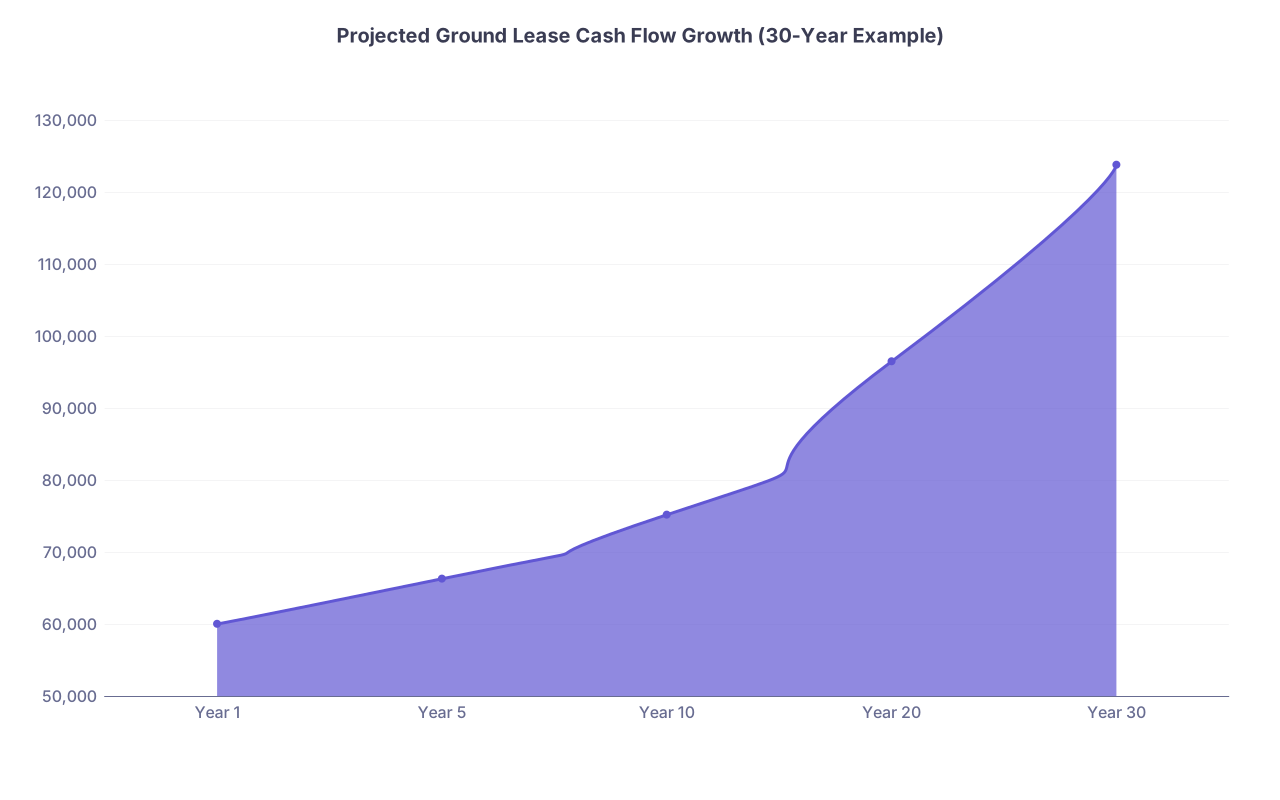
| Category | Value |
|---|---|
| Year 1 | 60000 |
| Year 5 | 66274 |
| Year 10 | 75161 |
| Year 20 | 96462 |
| Year 30 | 123763 |
That chart is only the rent line. It ignores the terminal building+land value you capture at the end. That asymmetry is why institutions love this game.
Common Mistakes I See Physicians Make in These Deals
Let me just list a few because they repeat:
Signing Ground or BTS Lease Docs Based Only on LOI Understanding
“But the LOI said…” means nothing when the 80‑page lease says something else. If a term matters, it must be in the lease with precise language. Period.Underestimating They Are the Smallest Player at the Table
Your counterparty might be a multibillion‑dollar health system, a PE platform, or a REIT. Their documents are refined by dozens of prior deals. You cannot “wing it” with a generalist attorney or a casual review.Ignoring Assignment and Change of Control Provisions
For physicians planning to sell their practice later, restrictive assignment language in a BTS lease can torpedo deal value. A buyer will discount heavily if assignment is at landlord’s sole discretion or subject to silly conditions.Mispricing Risk on Non-Credit Tenants
A private, three‑doctor LLC signing a 20‑year ground or BTS lease is credit risk, not a bond. That needs premium yield, tighter guarantees, and stricter covenants. Too many physician landlords accept “institutional” cap rates on “mom‑and‑pop” tenants.No Exit Strategy Modeled Upfront
Are you holding to term? Selling in year 10? Refinancing? The answer shapes leverage, amortization, and structure. Deal decisions in year 1 should match your likely exit windows.
When These Niche Plays Actually Make Sense for You
To be blunt, most physicians do not need ground leases or build‑to‑suit plays to do well. You can build solid wealth with boring fee‑simple properties or good private funds.
Ground and BTS start to make sense when:
- Your practice or investment entity already owns or can assemble strategic land in a strong medical corridor.
- You have >$1–2M that you can tie up in illiquid, medium‑to‑long duration real estate risk without “needing it back” soon.
- You are willing to pay for specialized counsel and, occasionally, a development consultant to keep you from making novice mistakes.
- You think in 10–30‑year blocks, not 2–3 years.
For many mid‑career and senior physicians, that is actually the right time horizon. You may not want another side gig seeing patients at age 70, but you will not complain about indexed ground rent checks on land that a hospital system is essentially never leaving.
Core Takeaways
- Ground leases and build‑to‑suit deals are not “advanced NNN.” They are different instruments with their own legal and financial logic.
- Your upside lives in the fine print: reversion rights, financing structure, casualty/condemnation, and assignment—get those wrong and you donate value to your counterparty.
- For the right physician, at the right career stage, with the right specialists at the table, these niche plays can quietly outperform the overcrowded “buy a small MOB at 6% cap” strategy—without requiring you to become a full‑time developer.