
Only 17% of physicians in medical office buildings can accurately explain what their CAM “reconciliation” line item actually covers.
That is a problem. Because in a triple-net (NNN) lease, CAM and pass-throughs are where your profitability quietly bleeds out.
Let me break this down specifically for you as a physician who either:
- leases space from a landlord, or
- owns a building and leases to others (or plans to).
This is not generic real estate advice. This is medical-office, physician-tenant, physician-landlord specific. Where triple-net structure, CAM, and pass-throughs interact with compliance, build-out, and reimbursement reality.
Triple-Net 101 For Physicians: What You Are Really Signing Up For
A “triple-net” lease means you pay:
- Base rent (the number brokers love to quote).
- Plus your share of:
- Property taxes
- Property insurance
- Common Area Maintenance (CAM)
In practice, for medical office:
- Many leases are described as NNN, but are actually “modified NNN” or “absolute NNN-lite.” The label means nothing; the definitions and exhibits control.
- Your true occupancy cost is Base Rent + NNN + add-ons quietly sitting elsewhere in the lease.
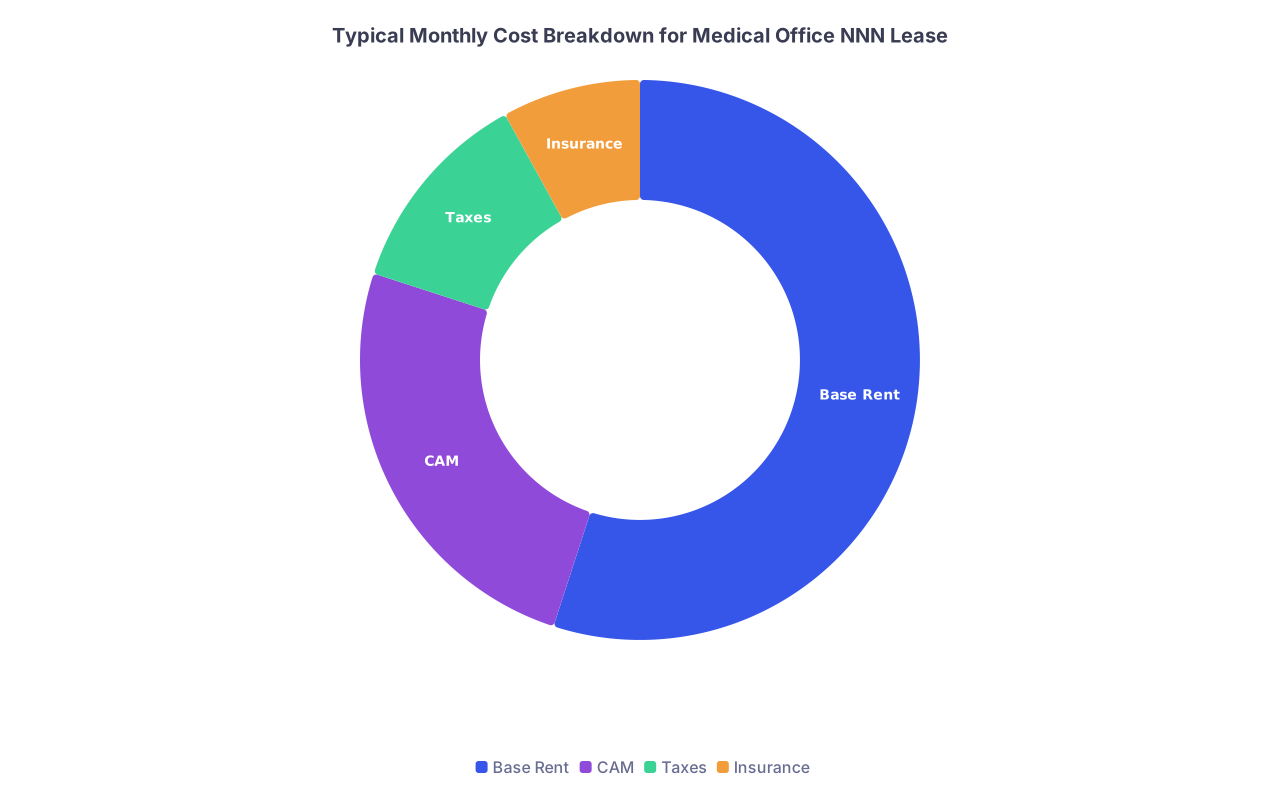
| Category | Value |
|---|---|
| Base Rent | 55 |
| CAM | 25 |
| Taxes | 12 |
| Insurance | 8 |
What most physicians miss:
The real fight is rarely over the base rent. It is over what flows into the CAM and “Operating Expenses” bucket for the next 10–15 years.
CAM Charges: Where the Landlord Makes It Or You Bleed
CAM = Common Area Maintenance.
In medical office properties, this often includes:
- Exterior and interior common area cleaning
- Landscaping, snow removal
- Parking lot maintenance and repair
- Lobby, hallways, common restroom upkeep
- Security, access systems
- Management fees and sometimes asset management fees
Here is where it gets tricky: how “Operating Expenses” and CAM are defined.
A sloppy definition in your lease can drag all of this into your bill:
- Capital expenditures (new roof, parking lot replacement)
- Leasing commissions
- Landlord’s legal fees (including fighting with other tenants)
- Landlord’s corporate overhead
- Costs to cure landlord violations
- Marketing and tenant attraction costs
The Two Sentences That Matter More Than Your Rent
You will usually see something like:
“Tenant shall pay its Proportionate Share of Operating Expenses, including all costs of operating, maintaining, repairing, managing, and securing the Project…”
And then some vague, overbroad list.
You want:
- A precise definition of what is INCLUDED.
- A precise definition of what is EXCLUDED.
If you do not have an exclusion list, you are accepting an uncapped credit card with the landlord swiping.
I have seen leases where:
- A physician group paid for the landlord’s litigation costs against a completely unrelated tenant, buried in CAM.
- Tenants funded the entire parking lot replacement via CAM “maintenance” instead of capital reserve.
Operating Expense Exclusions You Should Demand
You want a detailed exclusion section. At minimum, you push to exclude:
- Landlord’s capital expenditures (with a narrow exception addressed below)
- Depreciation, amortization
- Leasing commissions and marketing
- Landlord’s corporate overhead and salaries (beyond on-site property management at reasonable levels)
- Costs to remediate pre-existing environmental contamination
- Costs of landlord’s financing (interest, principal, loan fees)
- Costs related to other tenants’ defaults or disputes
- Insurance deductibles above a reasonable threshold
If your lawyer hands back a redline without a robust exclusion list, you are underrepresented.
Pass-Throughs: What The Landlord Pushes Onto Your Ledger
Triple-net = pass-through culture. Anything “building-related” tends to be pushed toward the tenants.
You will see variations of:
“Real Estate Taxes” – sounds straightforward, but watch for:
- Special assessments
- Impact fees
- Penalties or interest from landlord’s late payment
“Insurance” – again, watch for:
- Earthquake / terrorism riders in non-critical zones
- Landlord’s self-insured retention games
- Unreasonable deductibles being pushed as operating expenses
“Capital Improvements” – this is the big one.
Capital Improvements – The Silent Time Bomb
Many “modern” leases allow pass-through of capital expenditures if they:
- Reduce operating expenses, or
- Are required by law, or
- Are “to maintain the building in a comparable class” (vague, dangerous language)
Then they “amortize” the cost over the useful life and charge you your proportionate share of that yearly amortization.
If not drafted tightly, this clause lets a landlord:
- Upgrade to more expensive LED systems, “efficient” chillers, “green” roofs
- Claim “cost savings” and amortize the entire capital upgrade across tenants
- While you may or may not ever see the promised operating savings
What you want:
- Capital improvements only pass through if:
- Specifically required by new laws enacted after lease signing, and
- Amortized over the IRS useful life, and
- With savings calculation transparent, offsetting any cost where applicable.
This is a fight. It is worth it. On a 15-year lease, the difference can be mid-six-figures.
How CAM Is Allocated: Physicians Almost Always Misread This
Your CAM share is typically:
Your Premises Sq Ft / Total Rentable Sq Ft
But there are landmines:
“Rentable” vs “Usable”
- Rentable includes your space plus a fraction of common areas.
- If the building has large common areas, your effective rent per usable square foot is higher than you think.
“Gross Up” provisions
- If the building is partially vacant, landlords often “gross up” variable expenses to a hypothetical 90–100% occupancy to avoid under-recovery.
- Gross up itself is not evil. But abused, it becomes a pricing weapon.
Medical vs non-medical tenants
- If you have higher parking load or extended hours, landlords might try to justify a higher CAM share.
- Or slip language allowing different allocation methods over time.
| Issue | What Physicians Assume | What Actually Happens |
|---|---|---|
| Useable vs rentable sf | Paying on exam room size | Paying on load factor inflated rentable |
| Gross-up of expenses | Only for utilities | Applied broadly, raises CAM per foot |
| Vacant space impact | Vacant = lower CAM | Gross-up keeps CAM artificially high |
You must understand:
- The exact denominator used (total rentable area, occupied area, or “deemed” occupied)
- Whether landlord can reallocate CAM at its “reasonable discretion” (terrible phrase for tenants)
CAM Reconciliations: The Annual Surprise That Should Not Be A Surprise
Every year, landlord estimates your CAM for the upcoming year, bills monthly, then “reconciles” at year-end. If actual expenses are higher, you get a bill. If lower, you might get a small credit.
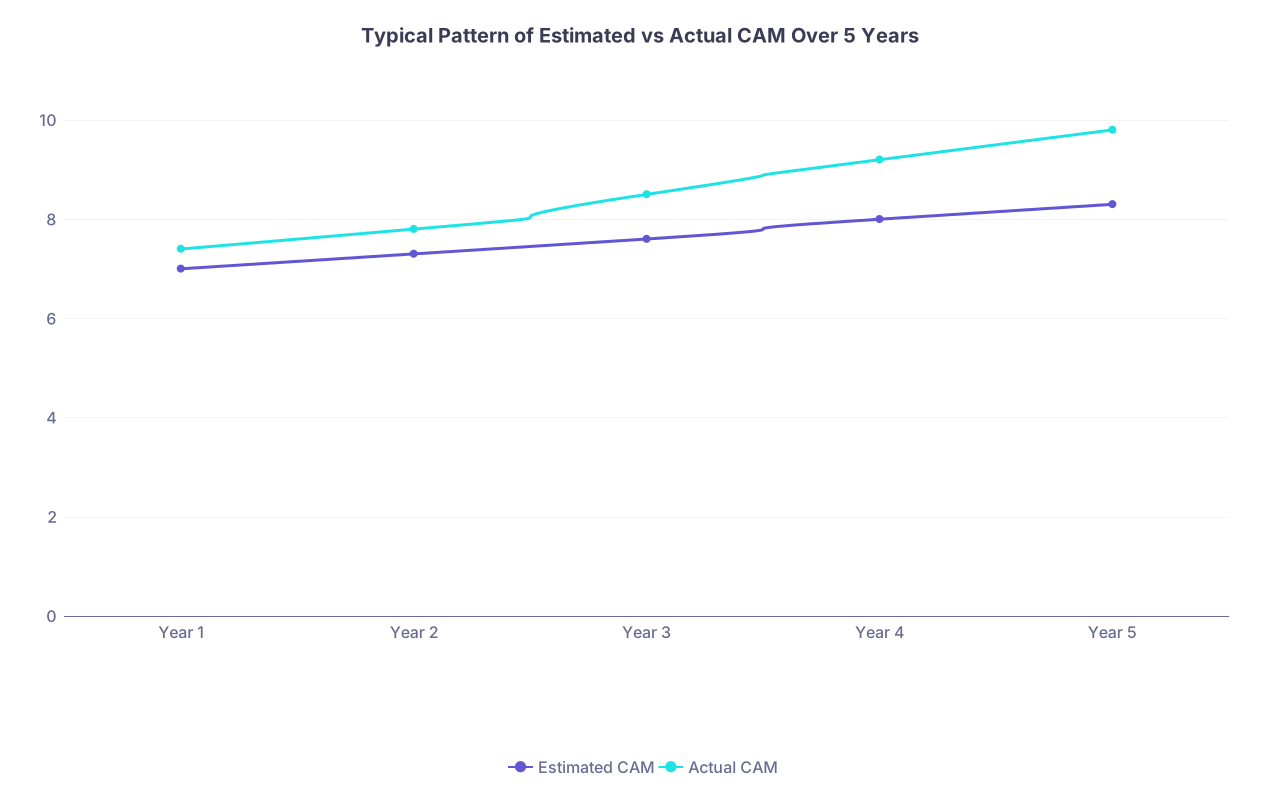
| Category | Estimated CAM | Actual CAM |
|---|---|---|
| Year 1 | 7 | 7.4 |
| Year 2 | 7.3 | 7.8 |
| Year 3 | 7.6 | 8.5 |
| Year 4 | 8 | 9.2 |
| Year 5 | 8.3 | 9.8 |
Notice the pattern: estimates almost always lag reality. On purpose or because of inertia, the effect for you is the same.
Your protections should include:
An explicit right to audit CAM and Operating Expenses:
- Reasonable conditions (e.g., within 6–12 months of statement, during business hours, by CPA or consultant, etc.)
- If overcharge > X% (commonly 3–5%), landlord pays for the audit.
A requirement that reconciliation be delivered by a specific date:
- If landlord blows the deadline, its right to collect additional CAM for that year is waived.
- Landlords will fight this. Ask for it anyway. At least get some time limit language.
Transparent supporting detail:
- Line-item breakdown of each category, not a one-page summary.
- Ability to review invoices, tax bills, insurance policies on request.
I have seen multi-physician practices recover six figures in wrongful overcharges by performing a single audit in year 7 of a long lease.
Expense Stops, Caps, and Indexing: Advanced Physician Protection Tools
If you are a strong tenant (or the building is struggling), you have leverage to reshape risk.
Expense Stops
Landlord pays up to a fixed amount of operating expenses per square foot. You pay increases above that.
You will see:
“Landlord shall be responsible for Operating Expenses up to an amount equal to $X per rentable square foot per year, Tenant shall pay Tenant’s Proportionate Share of any excess…”
Or:
“Base Year” structure – where Year 1 operating expenses set the baseline, and you only pay increases over that year.
This is common in office, less so in true NNN retail, but can be negotiated in medical.
Risk: Landlord inflates the “base year” with non-recurring or artificial costs (loaded with one-time items) so your “increases” look small while actual costs stay high. You need clean base year language that excludes extraordinary items.
Caps on CAM Increases
You can push for:
- A cap on controllable operating expense increases (e.g., no more than 4–5% per year, compounded).
- “Controllable” excludes taxes and insurance, but everything else gets capped.
Mandatory detail:
- The cap must apply on a cumulative basis, not just line-by-line, or the landlord will reclassify expenses across categories to sidestep the cap.
Tying Increases to an Index
Less common, but some physicians have negotiated:
- Increases limited to CPI (consumer price index) or a fraction of it.
- Or hybrid: base rent increases by 2–3% annually, CAM increases capped at 4–5% annually.
Physician-Specific Pitfalls in Triple-Net Leases
Medical is not general office. Your risk profile is different. The lease must reflect that.
1. Medical Waste, After-Hours HVAC, and “Special Use” Surcharges
Expect the landlord to say:
“You use more utilities. More water. More HVAC. More parking. So you pay more.”
Often they will:
- Add an “after-hours HVAC” schedule where you pay hourly for climate control outside of standard building hours.
- Push all “above standard” loads (e.g., imaging equipment, surgery center needs) onto you via extra pass-through fees.
- Try to shift medical waste disposal entirely onto you, even for common areas or shared rooms.
You want:
- Clear definitions of standard HVAC hours and rates.
- A fixed, knowable rate schedule for after-hours HVAC. No “at landlord’s then current rate” language with no ceiling.
- Separation of your privately controlled utilities (metered or sub-metered) from building CAM. If you are paying directly for your suite’s electric, it should not also sit in CAM.
2. Build-Out and Tenant Improvements
Medical build-out is expensive:
- Plumbing in multiple exam rooms
- Lead shielding for imaging
- Oxygen, suction, med gas
- Sterilization areas
- Higher electrical loads
The debate is:
- Which improvements are yours and revert to landlord at the end, and
- Which can be treated as landlord’s capital cost that should not be in your CAM bucket.
Landlords love to argue:
- Everything you build is “tenant-specific” and therefore all lifecycle costs (maintenance, replacement) are on you.
You counter with:
- Anything that becomes building infrastructure which benefits current and future tenants (e.g., main electrical upgrades, parking enhancements, lobby changes driven by your tenancy) must not be thrown into CAM for all tenants, or must be capitalized properly and not charged solely to you.
A good attorney who actually does medical-office leases will have standard language for this. Many generic office lawyers do not.
Physician as Landlord: Structuring NNN So You Do Not Become The Bad Guy
If you own the building (or plan to), triple-net can work heavily in your favor. But if you are also a tenant in your own building, you need to prevent conflict of interest and future buyer issues.
Your goals:
- Clean, market-standard NNN structure that a future buyer and lender will accept.
- Transparent CAM policies so your tenant physicians do not resent you (and do not leave).
- Avoid obvious self-dealing that will blow up in litigation.

Key moves:
Management and admin fees:
- Keep them reasonable (3–5% of gross revenues is typical in many markets).
- Document what services are included.
- Do not sneak in an “asset management fee” on top unless it is market, disclosed, and justifiable.
Capital reserves:
- For roofs, parking, HVAC.
- Fund them transparently, do not bury them in opaque CAM line items.
- Spell out which items are capital vs. repair.
CAM audits:
- Ironically, you benefit from clean language too.
- A future buyer will diligence your CAM history. If it is a mess, they discount your building or demand price reductions.
You want to own the building and still sleep at night. That means fair but firm NNN structure.
Legal and Compliance Angles Physicians Forget
People focus on dollars and forget regulatory and compliance overlap.
Stark / Anti-Kickback (AKS) Issues
If you are a referring physician, and your landlord is:
- A hospital
- Another physician group that receives referrals
- A JV entity with referring potential
Then rent and pass-throughs must comply with:
- Fair market value (FMV)
- Commercial reasonableness
- No consideration of volume or value of referrals
Sloppy cost allocations can cause problems:
- Charging below-market CAM or rent to “friendly” referral physicians.
- Over-allocating favorable operating expenses to employed physicians vs. independent groups.
If you later get audited, regulators will not care that “the landlord told us this was standard.” You are expected to understand your rent structure.
You may need:
- A third-party FMV analysis of both base rent and NNN load.
- Consistent methodology for cost allocation across tenants.
HIPAA and Operational Risk Hidden In CAM
Examples:
- Building-wide security upgrades, access control changes, or camera systems billed through CAM without any thought to patient privacy.
- Shared reception or shared records storage areas where the landlord controls third-party vendors.
If you are sharing CAM-driven building services that affect patient data, you need to understand:
- Who controls data access?
- Who bears the liability if a building vendor mishandles PHI?
- Is there a Business Associate Agreement (BAA) where needed?
Landlords usually do not think in HIPAA terms. You do.
Practical Negotiation Tactics For Physicians (Not Theory)
Let’s get tactical. What do you actually do when a broker sends you a “standard” NNN lease?

| Step | Description |
|---|---|
| Step 1 | Receive Draft NNN Lease |
| Step 2 | Identify CAM and Operating Expense Sections |
| Step 3 | Mark Required Exclusions and Caps |
| Step 4 | Review Capital Improvement and Pass Through Clauses |
| Step 5 | Get Medical Office Savvy Attorney Review |
| Step 6 | Negotiate Revisions with Landlord |
| Step 7 | Finalize and Sign Lease |
1. Do not start by haggling base rent
You ask first for:
- Full draft lease
- Last two years of CAM reconciliations for the building
- Current year operating budget
Then:
- You map what “$8 NNN” actually meant historically.
- If their NNN jumped 20–30% in a year, you ask why.
This alone shifts the tone. It signals you are not a naïve tenant.
2. Hit these clauses hard
At minimum, redline:
- Operating Expense definition
- Operating Expense exclusions list
- Capital expenditures and amortization language
- Controllable CAM increase cap
- Audit rights and time limits
- Gross-up provisions (narrow them and define methodology)
- Management fee percentage and what it covers
- After-hours HVAC and utility charges
You do not need to “win” every point. But you must narrow the runway.
3. Use term length as leverage
Longer lease (10–15 years) = more predictable cash flow for landlord.
Use that to:
- Push for an expense stop or base year on CAM.
- Or at least a tighter CAM cap plus some capital expenditure constraints.
If they refuse to budge on CAM, push down base rent more aggressively. Total occupancy cost is what matters, not the nice round number brokers quote.
4. Bring the right attorney
Not your cousin who did your will. Not the guy who “does some real estate” but mostly closes houses.
You want:
- Commercial real estate counsel
- With direct experience in medical office and healthcare compliance
- Who has actually fought these CAM issues before
Yes, you will spend several thousand dollars. Over a 10+ year lease, that is noise compared to the savings and risk avoided.
NNN In Sale-Leasebacks and Practice Real Estate Exits
Many physicians own their buildings and consider:
- Selling the building to an investor
- Signing back a long-term NNN lease as the tenant (sale-leaseback)
Here CAM and pass-through structures directly affect valuation:
- Predictable, landlord-favorable NNN with clean CAM structure = higher sale price and more bidders.
- Sloppy, tenant-favorable, or unclearly drafted CAM = discount.

You need to balance:
- Today’s rent and CAM burden on your practice vs.
- Tomorrow’s sale price when you exit or retire.
If your building is a material retirement asset, you might accept a slightly more landlord-friendly NNN structure now to maximize value later. But do it consciously, not by default.
Quick Checklist: If You Only Fix These 7 Things
If you do nothing else, scrutinize and negotiate:
- Operating Expense definition + robust exclusion list
- Capital improvements and when they can be passed through
- Controllable CAM increase cap (annual %)
- Gross-up methodology and limits
- Audit rights and reconciliation deadlines
- Management fee and admin overhead limits
- After-hours HVAC and utility allocations for medical use
Get these mostly right and you avoid the worst NNN abuses.
FAQs
1. Are triple-net leases always bad for physicians?
No. NNN can be fine, even advantageous, if:
- Base rent is lower than full-service alternatives, and
- CAM is tightly defined, capped, and transparent.
For single-tenant medical buildings, NNN with clear expense responsibility can actually simplify operations. The problem is not “NNN” as a concept. The problem is lazy drafting and physician tenants who never push back.
2. Should I insist on a base-year or expense-stop structure instead of NNN?
Not always. A base-year structure is common in multi-tenant office, less so in retail-style medical. You can negotiate it, especially in weaker markets, but landlords often prefer clean NNN. If you cannot get a base-year or stop, then cap controllable expenses and tighten definitions. The objective is predictable total occupancy cost, not a specific label.
3. How often should I audit CAM charges?
For a substantial medical lease (especially >5,000 sf or multi-physician practice), I recommend:
- At least once by year 3–4,
- Again around year 7–8,
- And whenever you see an abnormal jump in reconciliations.
You do not need to audit every year, but you need the contractual right to do so. Often the mere existence of an audit right keeps landlords more honest.
4. What is a reasonable management fee in CAM for a medical office building?
Market ranges vary, but I get skeptical above:
- 3–5% of collected rents for standard property management, or
- A flat per-square-foot fee consistent with local norms.
Watch for double-dipping: a “management fee” plus a separate, vaguely defined “administrative fee” or “asset management fee.” One fee, clearly defined, is enough. Anything more is usually padding at your expense.
Key takeaways:
- The label “NNN” is meaningless; the CAM and pass-through definitions are everything.
- Capital expenditures, CAM caps, and audit rights are where serious money is won or lost over 10–15 years.
- As a physician, you need healthcare-savvy lease counsel and enough backbone to negotiate, or you will subsidize your landlord’s building for years without realizing it.