
Primary Home vs. Rental: Why Your House Is Not Automatically an Investment
Your primary home is not an investment just because Zillow says it went up this year. It is a consumption good with some embedded equity. Treating it like a slam‑dunk “investment” is how high‑income physicians end up house poor and decades behind on real wealth building.
Let’s separate feelings from math.
I’ve watched too many young attendings walk into fellowship graduation dinners bragging: “Our house appreciated $150K in three years—best investment we ever made.” Then I see the actual numbers. After interest, taxes, insurance, maintenance, transaction costs, and the massive down payment that could have gone into an index fund or a rental property, the “investment” is barely beating inflation. Sometimes it’s losing to a high‑yield savings account.
The real myth: “Owning is always better than renting” and “Your home is your best investment.”
For physicians, especially, this belief is expensive.
What Counts as an Investment? (Hint: Not Your Stainless Appliances)
An investment has a few defining features:
- It throws off cash (income or a clear path to income).
- It has a realistic expectation of a positive real (after‑inflation) return.
- You are not required to own it just to live or function.
Your primary home fails #1 almost by definition. It does not pay you; you pay it. The only “income” is the avoided rent, which is real, but that’s consumption savings, not free money.
Your home is part shelter, part forced savings vehicle, part speculative bet on a local real estate market. None of that makes it a bad idea. It just makes it different from a rental property or an index fund.
Let’s put some numbers to this instead of relying on platitudes.
What the Data Actually Shows About Home Returns
Long‑term, broad‑based real estate data is brutally clear: primary homes do not behave like growth stocks.
Nationally, inflation‑adjusted home price appreciation in the US has been modest over the long run—roughly 0–1% per year above inflation depending on the data set and time frame. Most of the “wealth” from housing comes from leverage and forced saving, not magical market returns.
The Case‑Shiller index (inflation‑adjusted) over long periods looks far less impressive than the S&P 500 with dividends reinvested. But doctors don’t talk about that over lunch. They talk about how their neighbor just sold for $300K more.
Let’s compare a simplified 20‑year scenario for a young attending.
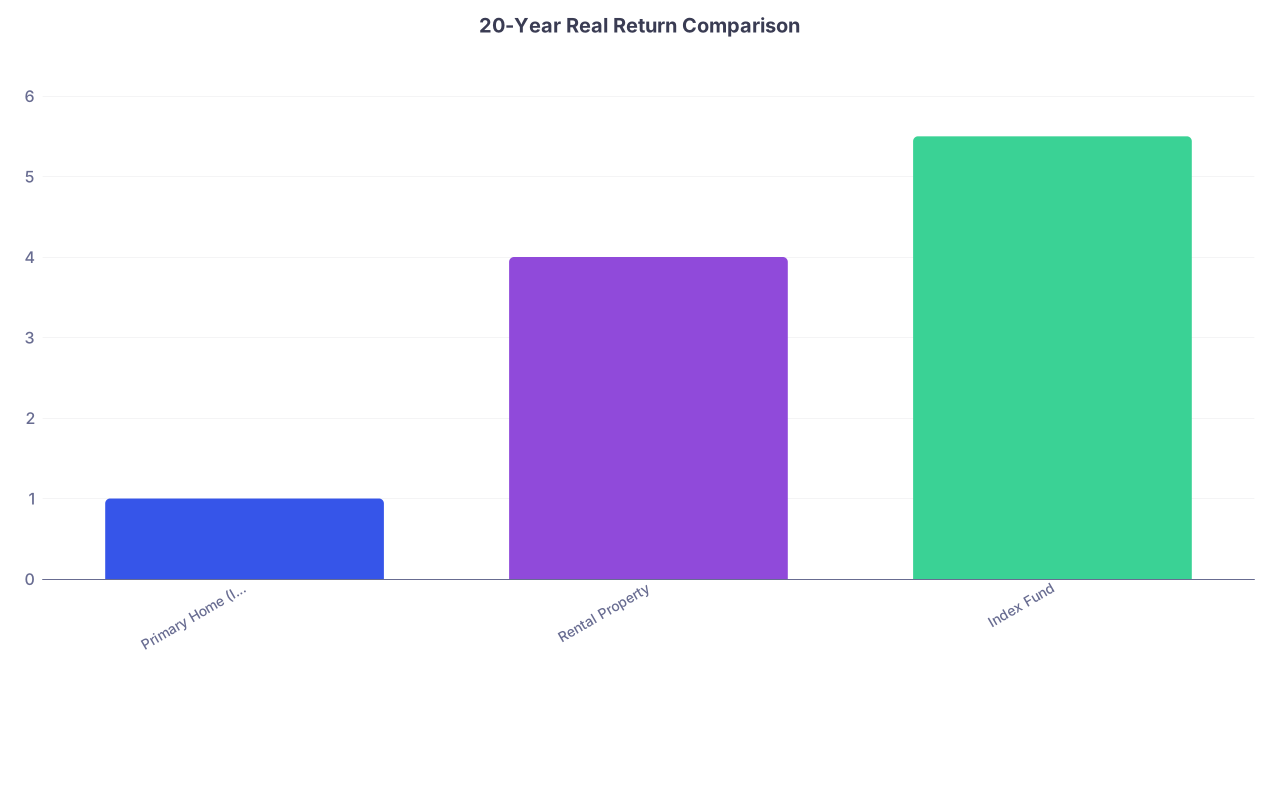
| Category | Value |
|---|---|
| Primary Home (Imputed) | 1 |
| Rental Property | 4 |
| Index Fund | 5.5 |
Those are ballpark real (after inflation) annual returns many investors actually see over decades:
- Primary home: effectively ~1% real after all costs, sometimes less.
- Buy‑and‑hold rental: 3–5% real if done decently well, sometimes higher with value‑add and sensible leverage.
- Broad stock index: historically ~5–7% real over long periods.
So yes, your house “goes up.” But in real, net‑of‑costs terms, it is usually mediocre as an investment compared to alternatives available to a high‑income physician.
The Hidden Cost Stack: Why Your “Return” Is Lower Than You Think
Physicians often confuse gross appreciation with net return. The sticker price moves up, and everyone mentally banks that as profit. Massive mistake.
Look at a pretty standard attending scenario.
- Purchase price: $1,000,000
- Down payment: $200,000
- 30‑year fixed at a normal-ish rate
- Holding period: 10 years
- Sale price after 10 years: $1,300,000 (sounds amazing—“we made $300K!”)
Now strip it down.
Transaction costs:
Buying and selling eats ~8–10% combined in many markets.On a $1.3M sale, 6% agent commission plus closing costs might be $90–$100K gone.
Property taxes:
Say 1.2% of value per year; average over the decade ~$12K/year → ~$120K.Insurance:
$2–3K/year → call it $25K–30K in 10 years.Maintenance and repairs:
The 1% rule is real long‑term: ~1% of property value per year.
On average value ~$1.15M → ~$11–12K/year → $110–120K over 10 years.Mortgage interest:
Early years of a 30‑year mortgage are interest‑heavy.
You’ll easily pay six figures in interest over 10 years on an $800K loan.
By the time you tally all that, your $300K “gain” is already functionally gone. What’s left is principal you forced yourself to pay down, and maybe a modest real gain.
To make this less abstract, here’s a very simple, understated comparison of two choices for that same physician over 10 years.
| Item | Buy $1M Home | Rent + Invest Difference |
|---|---|---|
| Upfront cash (down payment, closing) | $220,000 | $20,000 |
| Monthly housing payment (PITI+maint) | ~$7,500 | ~$4,500 rent |
| Monthly difference invested @ 6% real | $0 | Grows to ~$430,000 |
| Home equity after 10 years (net of costs) | ~\$350,000–$400,000 | $0 |
| Net wealth change (rough, ballpark) | ~$350K–$400K | ~$430K from investments |
This is not a precise model; it’s illustrative. But I’ve seen real‑life spreadsheets with very similar outcomes.
You bought, felt rich because of your home value.
Your colleague rented a nice place, invested aggressively, and quietly ended up wealthier without fixing a roof once.
Does that mean you should never buy? No. It means: stop pretending the primary home is automatically the superior financial choice.
But What About Leverage? “I Turned 20% Into a 100% Gain”
This is the favorite cocktail‑party argument.
“I put 20% down, the house went up 25%, I made a 125% return on my money. Show me a stock that does that.”
Here’s what actually happened: you made a leveraged equity bet on one illiquid asset in one local market. The leverage magnified both upside and risk, while you absorbed all operational costs and vacancy risk (you cannot move easily).
If you’re going to brag about leveraged home returns, you should be comparing them to other leveraged investments: rentals or even margin‑light stock exposure. Not unleveraged index funds.
And you have to factor in:
- All the expenses we just walked through.
- The opportunity cost of that down payment.
- The concentration risk: 7‑figure exposure to one ZIP code.
I’ve watched physicians in San Francisco and Seattle feel like geniuses from 2012–2022. I’ve also watched people in Phoenix 2006–2012 and parts of the Midwest 1990–2010 learn what “flat for 15 years” looks like.
One OR nurse I know bought in a “can’t lose” market in 2007, then watched her home price sit underwater for nearly a decade. She called it “our worst investment” every time the AC died. Not because houses became bad. Because she misunderstood what she actually bought.
Rent vs. Buy for Physicians: A Boring, Data‑Driven Framework
Let me give you a cleaner way to think about this if you’re an internist making $300–400K or a surgeon making more.
The primary decision is lifestyle and stability, not “investment.”
You should lean toward buying if:
- You’re reasonably certain you’ll stay put at least 7–10 years.
- Your total monthly housing cost (PITI + realistic maintenance) is in the same ballpark as renting something you’d actually live in.
- The purchase price is not absurd relative to your income. A 1x–2x gross income home is a different animal than a 4x–6x gross income monster house.
- You’re still on track for retirement savings (20%+ of gross going into real investments) after buying.
But notice something: none of those bullet points say “because it’s the best investment.” They’re about life.
If you’re going to be in an academic position you might leave in 3 years, or your spouse is in a fellowship, or you’re gunning for a competitive private group across the country, renting is not “throwing money away.” It’s paying for flexibility and optionality. That has value.
Primary Home vs. Rental Property: Different Beasts Entirely
Now let’s talk physician real estate investing, because that’s the category you asked for.
A rental property is fundamentally different from a primary home because the economics are explicit.
For a rental, I can underwrite:
- Purchase price
- Expected rent
- Taxes, insurance, maintenance, CapEx
- Property management
- Vacancy assumptions
- Financing terms
If the property produces positive cash flow, builds equity, and has a reasonable appreciation outlook, it’s an investment. It throws off cash now and probably more later.
With a primary residence, you do not have rent. You have “imputed rent” (the rent you’d otherwise pay), but that’s not cash flow, that’s avoided consumption expense. That’s fine, it matters. But it’s qualitatively different.
To make it painfully clear:
| Feature | Primary Home | Rental Property |
|---|---|---|
| Cash flow to you | No (you pay) | Yes (tenant pays) |
| Tenant risk | You | Third party |
| Depreciation deduction | No | Yes |
| Expenses tax‑deductible | Partially (interest, taxes within limits) | Largely, as business expenses |
| Emotional attachment | High | Should be near zero |
From a physician investor standpoint, the rental can be analyzed like a small business. The primary cannot, because you will rationalize irrational choices. You care about the school district, backyard, commute, the kitchen island. So you overpay. And you undercount the costs.
That’s fine—humans do that. Just don’t label it your best “investment.”
The Psychological Trap: Lifestyle Creep in Disguise
Here’s where a lot of high‑income docs get quietly wrecked.
The “my primary home is an investment” story becomes a permission slip for lifestyle inflation.
- “It’s okay that the mortgage is $9,000/month; we’re building equity.”
- “The custom pool will increase resale value.”
- “Upgrading to the better school district is basically investing in the property and the kids.”
Half‑true statements that justify overspending.
Then they realize:
- They’re saving 5–10% of income instead of 20–30%.
- They can’t take a lower‑pay job or cut back clinic days because the house owns them.
- Their net worth is 70–80% tied up in one illiquid asset—while they tell themselves they are “diversified” because they have three different target‑date funds in a 403(b).
I see this over and over in new attendings 3–8 years out. Big house. Nice cars. Minimal taxable investments. “But our net worth is $800K!” And then you look: $650K of that is home equity and $150K is retirement accounts. Zero real liquidity. Zero flexibility.
A genuinely good investment should increase your long‑term flexibility and options, not trap you in a single job in a single city.
When Your Primary Home Is Part of a Rational Strategy
Let me not overcorrect. There are scenarios where a primary home plays nicely inside a real wealth‑building plan.
- You buy below your maximum approval.
- You keep total housing costs sane (say <20% of gross income, especially if you’re also paying loans or childcare).
- You still max out tax‑advantaged accounts and invest heavily in a real portfolio.
- You stay for a long holding period so transaction costs get diluted.
- You resist the constant urge to “upgrade” every 5 years.
In that case, the primary home becomes:
- A forced savings plan.
- A partial inflation hedge.
- A future source of optionality (downsizing later, HELOC, etc.).
But that’s very different from “my home is my main investment.” Healthy framing: my home is a stable base, my rentals/index funds are my investments.
For physicians who want real estate exposure, it usually makes more sense to:
- Keep your primary house reasonable.
- Direct surplus capital into:
- Local rentals you actually underwrite.
- Syndications/funds you understand.
- REITs or index funds.
Instead of “investing” by buying the most house you can get a bank to approve.
A Quick Reality Check Flowchart
If you’re trying to decide how to think about your current or future house, run it through a simple mental process:

| Step | Description |
|---|---|
| Step 1 | Want to buy a house |
| Step 2 | Strongly consider renting |
| Step 3 | Risk of lifestyle trap |
| Step 4 | Buy as lifestyle choice not main investment |
| Step 5 | Staying 7 to 10 years |
| Step 6 | Total cost similar to rent |
| Step 7 | Can still invest 20 percent of gross |
Your answer at G should not be “this is my primary retirement plan.” If it is, you’re behind.
The Tax Myth: “At Least It’s All a Write‑Off”
One more sacred cow.
I’ve heard attendings justify huge houses by saying: “The mortgage interest and property taxes are deductible, so it’s basically a wash.”
No.
The 2017 tax law changes capped state and local tax (SALT) deductions and reduced the benefit of mortgage interest for many high‑income folks who take the standard deduction or are limited by SALT caps. Meanwhile, rentals give you:
- Depreciation on the building.
- Deductibility of a much broader range of expenses.
- Potential to offset other passive income.
Pretending your primary home is some huge tax win is outdated and lazy. The numbers often don’t back it up, particularly in high‑tax states where you blow through the SALT cap just with state income tax.
So What Should a Physician Actually Do?
If you want a clean, non‑romantic strategy:
- Decide where you actually want to live for the next 7–10 years, with a realistic view of your specialty and job market.
- Pick a house where total cost doesn’t crush your ability to save and invest. Run real numbers—PITI, maintenance, tax, insurance—not just the online mortgage estimate.
- Frame your primary home as a lifestyle decision with some equity upside, not your core investment strategy.
- Build your wealth through:
- Broad index funds in tax‑advantaged and taxable accounts.
- Purpose‑bought rental real estate with clear underwriting and positive expected cash flow.
Then, twenty years from now, you’ll have:
- A paid‑off or nearly paid‑off home.
- A real portfolio.
- Optionality to downsize, move, cut back work, or pivot specialties.
Not just a big, impressive house and anxiety about every RVU.
Key Takeaways
- Your primary home is mostly a consumption decision with some forced savings—not a superior investment engine.
- When you factor in all costs and opportunity cost, renting + aggressive investing often matches or beats buying early in a physician career.
- Treat real estate investing as actual investing—via rentals or funds—with clear cash flow and underwriting, and treat your primary home as what it really is: a place to live that you hope does not ruin your balance sheet.