
Afraid to Talk About Salary on Interviews: Can That Hurt My Job Prospects?
What if you don’t bring up salary at all… and they decide you’re naïve, easy to underpay, or not “business-savvy enough” for the job?
That’s the fear, right? Not just “will I annoy them if I talk about money,” but also “will I look stupid or weak if I don’t?”
You’re not crazy for spiraling about this. Physician compensation is opaque, every attending tells you something different, and meanwhile you’re sitting in interviews trying to decide whether talking about RVUs will magically torpedo your chances.
Let me give you the short, slightly uncomfortable truth:
- Avoiding salary completely won’t usually kill your chances.
- But it can absolutely hurt you financially, and sometimes professionally.
- The real risk isn’t asking the “wrong” thing. It’s asking it at the wrong time, in the wrong way, to the wrong person.
Let’s unpack this like two exhausted people in call room chairs, because this topic is messy and people keep giving you garbage advice like, “Just focus on fit, the money will follow.” No. The money does not magically follow. The money gets negotiated. By someone. Ideally you.
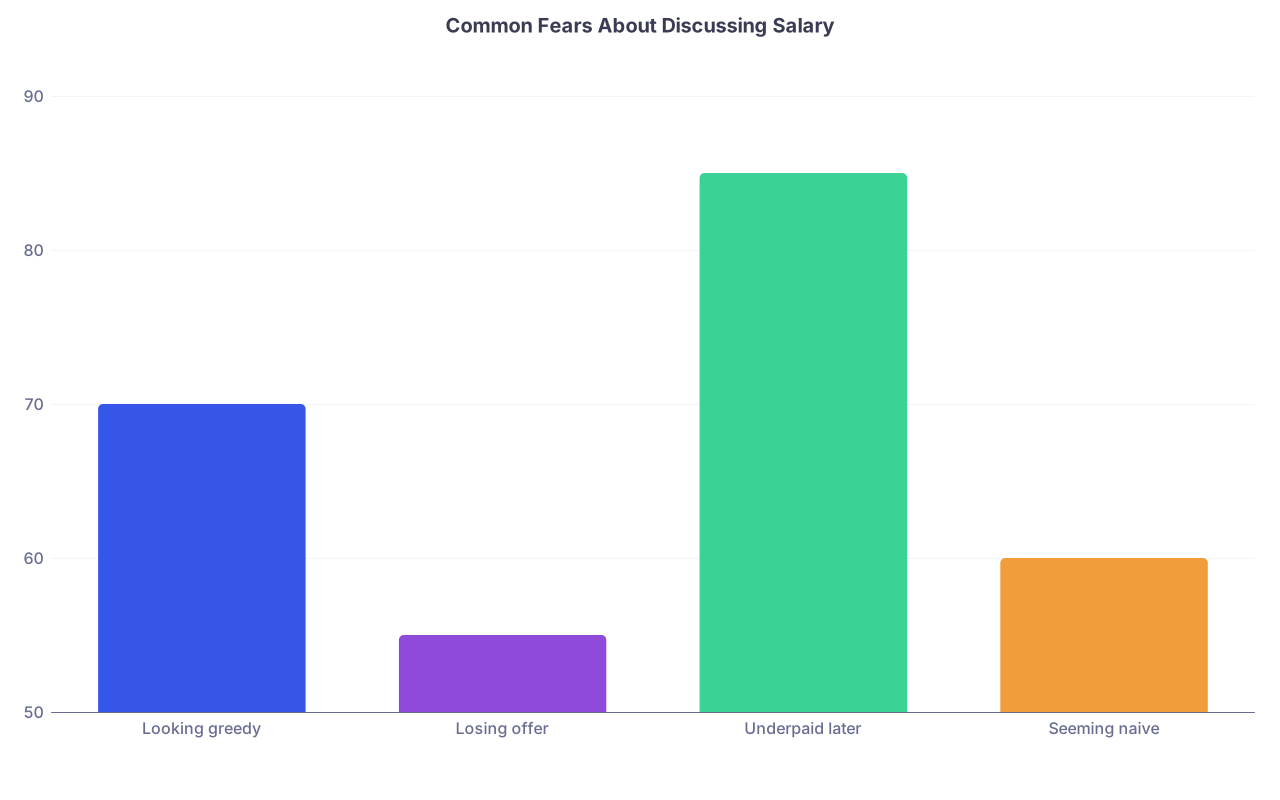
| Category | Value |
|---|---|
| Looking greedy | 70 |
| Losing offer | 55 |
| Underpaid later | 85 |
| Seeming naive | 60 |
Does Not Talking About Salary Make You Look Bad?
This is the nightmare scenario in your head: You finish the interview day, everyone says, “Great to meet you!” and then somewhere in a closed-door meeting, someone says:
“Yeah, candidate was nice, but they never asked about compensation. I’m not sure they understand the business side. Pass.”
I’ve sat in on these meetings. That’s not how it goes.
What actually happens:
- Most interviewers don’t expect you to grill them on compensation structures during the first conversation.
- Many of them don’t even know the exact numbers. They’re faculty, not finance.
- No one’s keeping a tally of “asked about salary = bad” vs “didn’t ask = good.”
But here’s where it can kind of hurt you indirectly:
If you go through the entire process—multiple interviews, even a site visit—and you’ve never once shown any interest in:
- How you’ll be paid
- How productivity is measured
- What the real earning potential is
…you risk looking like someone they can keep in the dark.
And yes, some systems like that. It makes it easier to slide you a mediocre offer and assume you’ll take it.
So no, staying silent about salary doesn’t usually lose you the job.
But it can absolutely:
- Result in a lower initial offer
- Make you seem easier to underpay
- Lead to you signing something you don’t fully understand, then hating your life two years in
The goal isn’t to impress them with your negotiating skills. The goal is to show you are a reasonable adult who understands that a job is, among other things, a financial arrangement.

When Is It Too Early To Talk Salary?
Here’s where people mess this up and then tell everyone, “Never bring up money, it ruined my interview.”
Sometimes, yeah, they did ruin it. But not because they talked about money. Because they did it way too early or with the wrong person.
Bluntly:
- Bringing up salary in the first 5 minutes of a first interview? Bad look.
- Leading with, “How much will I make?” before they even know if you’re a fit? Also bad.
- Asking a random faculty interviewer exact dollar amounts of the contract? Awkward for everyone.
Early-stage interviews are for:
- Fit
- Scope of the role
- Setting—academic/private/hospital-employed
- Call expectations, clinic structure, support staff
If at that point you’re like, “So, what’s the base salary?” it feels transactional too soon. Not because money is off-limits, but because you haven’t even established that you’d want the job if the salary was fine.
So yes, there is a too-early stage. And if you’re terrified of mis-timing it, that’s a valid fear. But the answer is not “never bring it up.” It’s “bring it up later, in the right lane.”
When Is It OK — Even Smart — To Ask?
There’s a predictable rhythm to job processes. And there are “safe” windows to talk about compensation without looking greedy or weird.
Think of it in phases:
Screening / early interview:
Your job: show you’re a serious, reasonable candidate.
Their job: see if you’re worth moving forward.
Salary talk here? Light, if at all. More “range ballpark” than “I need 325k plus 20k sign-on.”Late-stage interviews / site visit:
Your job: decide if you could see yourself actually working there.
Their job: decide if you’re someone they want to court.
Salary talk here? Very reasonable. You can ask about compensation structure, bonuses, RVUs, etc.After verbal or written offer:
Your job: evaluate and negotiate.
Their job: close the deal.
Salary talk here? Mandatory. This is where pretending “I’m just grateful” hurts you the most.
If you’re still worried, use this rule:
If they’re flying you out, showing you housing, or talking about start dates, it is absolutely fine to ask:
“Can you walk me through the compensation structure for this role?”
That question is neutral, non-aggressive, and shows you’re trying to understand, not immediately demand more.
Can Silence Literally Cost You Money?
Yes. 100%. I’ve seen it.
Two new hospitalists, same group, same start date. Let’s call them A and B.
- A: Never asked about compensation at any stage. Accepted first written offer.
- B: Asked politely about how their offer compared to typical hires, asked for clarification of the RVU bonus, and questioned the non-compete.
Result?
- A: Base salary exactly as offered. Minimal sign-on. No relocation help.
- B: Same base. Plus higher sign-on, relocation assistance, some flexibility on call for first year.
Both were liked by the group. Only one asked questions. Guess which one felt “greedy”? Neither. Leadership liked that B “advocated for themselves and asked good questions.”
You don’t get what you don’t ask for. In physician hiring, the “default” offer is often not the best they can do. It’s the best they can do if you never push.
Staying quiet won’t make them like you more. It just makes you cheaper.
| Stage | Salary Talk OK? | How Deep to Go |
|---|---|---|
| First screen call | Light | General range only |
| First on-site interview | Yes, careful | Structure and ballpark |
| Second / final visit | Definitely | Details, components |
| After written offer | Essential | Negotiation, specifics |
How To Ask About Salary Without Sounding Awful
You’re probably not afraid of the concept of money. You’re afraid of sounding like the stereotype: the “money-hungry doctor.”
So here’s the fix: don’t ask like a desperate med student. Ask like a colleague.
Instead of:
“So what’s the salary?”
Use things like:
- “Can you walk me through the overall compensation model for this position?”
- “What’s the typical salary range for new hires in this role?”
- “How is productivity measured and how does that tie into compensation?”
- “What do most physicians here earn by year 2–3 once they’re fully ramped up?”
Notice those aren’t demands. They’re information requests. You’re not negotiating yet. You’re understanding the terrain.
If they say, “We’ll talk specifics later,” you say:
“Totally fine, I just want to make sure the range and structure line up with what I’m looking for long-term.”
Calm. Normal. Adult.
If someone gets offended by those questions? That’s a data point. And a red flag.

| Step | Description |
|---|---|
| Step 1 | Initial Contact |
| Step 2 | First Interview |
| Step 3 | Ask About Comp Structure |
| Step 4 | Site Visit or Second Interview |
| Step 5 | Receive Offer |
| Step 6 | Discuss Specific Numbers |
| Step 7 | Screen Call Done |
| Step 8 | Strong Mutual Interest |
Legal Reality: Are You Even Allowed To Ask?
Yes. You are allowed to ask. You’re not breaking some unwritten professional oath by caring what you’re paid.
In a lot of states, there are now laws that:
- Allow you to discuss compensation openly with other employees
- Sometimes require employers to provide pay ranges in postings or on request
You are not obligated to:
- Accept the first offer
- Pretend compensation doesn’t matter
- Explain your personal finances to justify why you need X salary
You are obligated to understand what you’re signing. If the contract is vague on compensation, RVUs, or bonus structure and you’re too scared to ask, you’re basically volunteering for future regret.
And yes, if you sign a bad deal, it’s very hard to fix later. That’s what scares me more than you sounding “pushy.”
Worst-Case Scenarios (The Stuff You’re Actually Afraid Of)
Let’s walk through the doom-spiral.
1. “If I ask about money, they’ll think I only care about money.”
If a single, neutrally-worded question about compensation makes them write you off, that’s not a place you want to be long-term. That culture will show up in other ways too: exploitative call, opaque RVU targets, “team player” guilt trips.
You might lose that job. But you dodged a bullet.
2. “If I don’t ask, I’ll end up trapped in a terrible contract.”
This one is more real.
If you never ask about:
- Call pay
- RVU targets
- How often bonuses are actually paid vs theoretical
- How long the “guarantee” period lasts
…you can absolutely end up locked into:
- Unsustainable call for peanuts
- Unrealistic productivity thresholds
- A “guarantee” that ends right when you start actually ramping up
- A non-compete that blocks you from moving to a better group nearby
That’s not dramatic. That’s Tuesday in some markets.
Here’s the part people don’t say: the risk of silence is almost always higher than the risk of asking. Not on day one. But by the time an offer is on the table? Staying quiet is the biggest danger.
3. “They’ll compare me to other applicants who didn’t ask.”
They already do that. About everything.
But asking about compensation doesn’t put you in some special “annoying” category. It usually puts you into the “seems like an adult” category.
I’ve literally heard hiring physicians say things like:
“I worry a bit about candidates who never ask about the contract or pay. Feels like they’re not used to advocating for themselves.”
So yes, your silence can be a signal. Not a good one.

Concrete Scripts You Can Steal
If your heart rate spikes just imagining the words coming out of your mouth, use these almost verbatim.
Early-ish (after they show interest):
“I’m very interested in the role and the group. As I’m thinking through long-term fit, can you share a general sense of the compensation range and how it’s structured?”
During a site visit:
“Could someone walk me through how a typical new hire here is compensated in their first couple of years—base, incentives, any bonuses?”
After a verbal “we’d like to hire you” but before written offer:
“Great, I’m excited to review the offer. To make sure we’re in the same ballpark, can you tell me the expected range for base salary and any standard sign-on or relocation support?”
After written offer (this is negotiation, not just asking):
“Thank you for the offer. I had a few questions about the compensation components and how they compare to what’s typical for new physicians in your group. Is now a good time to go through that?”
You’re not threatening. You’re not begging. You’re just… asking.
So… Can Being Afraid To Talk About Salary Hurt You?
Yes. But mostly in these ways:
- You leave money and benefits on the table.
- You look like someone who can be kept in the dark.
- You sign a contract you don’t understand and regret it quietly for years.
What it usually won’t do is:
- Get you blacklisted for asking one polite question.
- Make every interviewer think you’re greedy.
- Blow up the entire opportunity by itself.
The real enemy here isn’t the subject of money. It’s your fear of it.
You’re not a resident begging for a spot. You’re a trained physician entering a business relationship. They’re evaluating you. You’re evaluating them. Salary is part of that.
You don’t have to turn into a shark. You do have to stop pretending you’re above caring.
FAQ (Exactly 4 Questions)
1. Will asking about salary in the first interview ruin my chances?
It can hurt if you lead with it or sound like you don’t care about anything else. If you spend 25 minutes on patient population, team structure, and expectations, then ask a light, general question about compensation structure, you’re fine. The red flag is not the topic; it’s bad timing and bad tone.
2. What if they refuse to give any numbers until after I sign?
That’s a massive red flag. You should never sign a contract without clear written numbers for base pay, bonuses, RVU rates (if relevant), and how changes can occur. If someone says, “Don’t worry, it’s standard, just sign,” I’d seriously consider walking away or getting a physician contract lawyer involved. No clarity, no signature.
3. Is it better to wait for a written offer before mentioning salary at all?
Not always. If you suspect you’re way off from each other (like you need 350k+ for loans and COL and they typically pay 240k), it’s better to get a range earlier so you don’t waste time. High-level questions about structure and range are appropriate once mutual interest is clear, long before you sign anything.
4. I’m terrified I’ll sound ungrateful if I negotiate. Should I just accept the first offer?
You can, but you’ll probably regret it later. Most groups expect some level of discussion or negotiation. You can be appreciative and still ask, “Is there any flexibility on X?” or “How does this compare to what others have received?” Gratitude doesn’t require silence. And no, one respectful ask will not make them yank the offer in some dramatic tantrum.
Key points:
- Staying totally silent about salary won’t usually kill your chances—but it can quietly cost you money and leverage.
- Asking about compensation is normal; just time it right and phrase it like a professional, not a panicked applicant.
- The bigger long-term risk isn’t offending them by asking. It’s trapping yourself in a bad deal because you were too scared to speak up.