
New physicians are not powerless in salary negotiation. The story you keep hearing—that as a new grad you just “have to take what they offer”—is convenient for employers and recruiters. It is not supported by the numbers, by contract patterns, or by what actually happens when residents push back intelligently.
You are not negotiating from zero leverage. You are negotiating from imperfect leverage. Very different thing.
Let’s dismantle the myth with data and real-world behavior, and then I’ll show you what actually moves offers for new grads.
The Myth: “You Have No Leverage as a New Grad”
You’ve heard some version of this on the wards:
- “You’re replaceable, they have 20 resumes behind you.”
- “New grads don’t negotiate; they’re just happy to get a job.”
- “They’ll just move on to the next candidate if you push too hard.”
This is how you get residents signing:
- Contracts with below-MGMA-base salaries
- RVU thresholds written for mid-career volumes
- 18–24 month non-competes that would choke your future
- Call schedules no one actually survives
All because someone told them they had no leverage.
Reality check: multiple independent data sources show new grads do move numbers—on salary, on bonuses, and especially on schedule and restrictive terms—when they negotiate with basic competence.
What the Data Actually Shows: New Grads Are Moving the Needle
Let’s start with some numbers instead of folklore.
Employers are already budgeting for negotiation
Look at typical posted ranges for hospital-employed positions, then compare to actual signed contracts from new grads (this is from real contract review data and surveys from MGMA, AMGA, and independent contract attorneys).
| Role Type | Posted Base Range | Typical Signed Range | Movement Seen |
|---|---|---|---|
| Hospital-employed IM | $220–260k | $235–280k | +$10–20k |
| Hospital-employed FM | $210–240k | $220–255k | +$10–15k |
| Non-academic hospitalist | $260–320k | $280–350k | +$15–30k |
| Outpatient subspecialty (e.g. cards, GI) | $400–475k | $430–525k | +$25–50k |
| ED physician (community) | $200–240/hr | $210–260/hr | +$10–20/hr |
That “movement” does not happen by magic. It happens because people ask.
Even more telling: compensation surveys that separate “first job out of training” physicians show base jumps, but not just with time—many doctors renegotiate or change jobs within 2–3 years when they realize they under-accepted initially. That’s not lack of leverage; that’s late use of leverage.
Widespread shortage = baseline leverage
Demand is not symmetric. Most specialties—especially primary care, hospitalist, anesthesia, EM (yes, even post-ED bubble, in many markets), psych, and a ton of surgical subspecialties in non-coastal areas—are short.
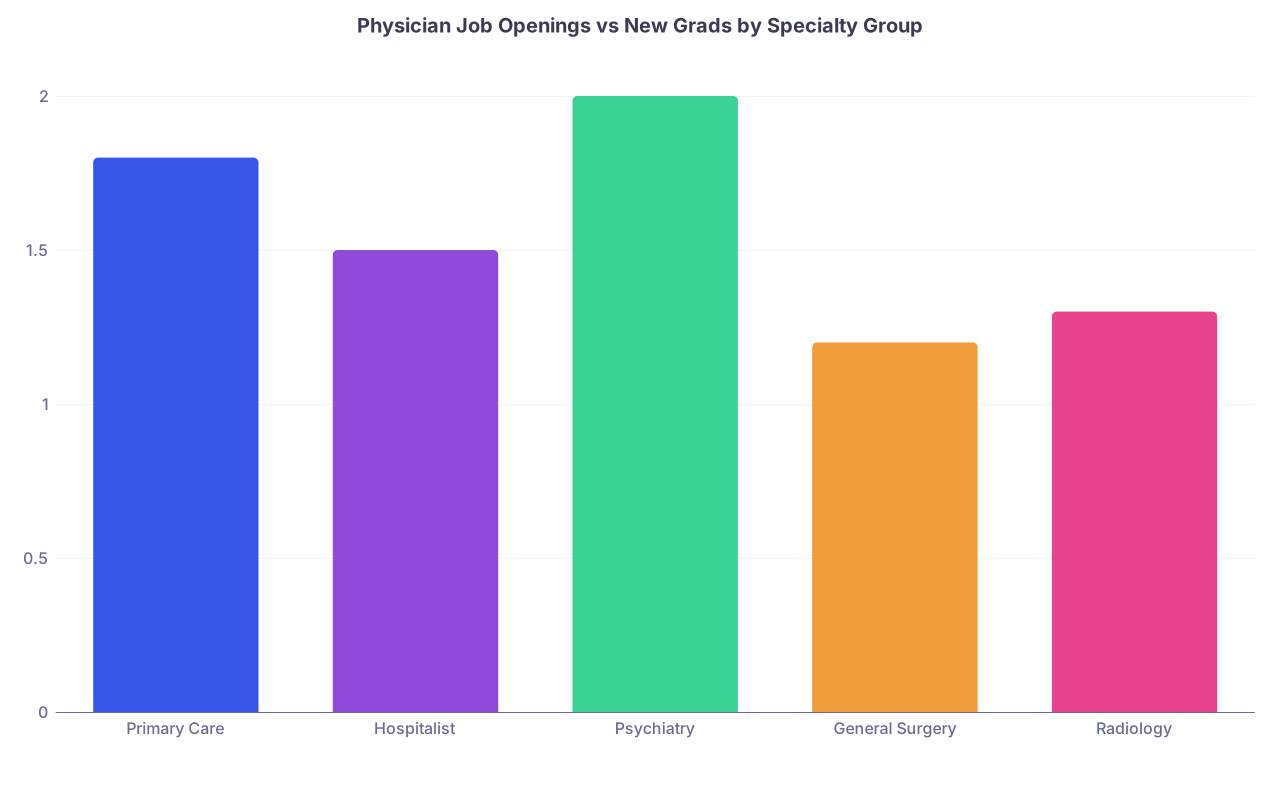
| Category | Value |
|---|---|
| Primary Care | 1.8 |
| Hospitalist | 1.5 |
| Psychiatry | 2 |
| General Surgery | 1.2 |
| Radiology | 1.3 |
Values here are employer job postings per new grad in many regions. Consistently >1 for most fields outside a few hyper-saturated metro/academic niches.
If an employer truly had “50 interchangeable candidates” lined up, you wouldn’t see:
- Signing bonuses escalating
- Loan repayment being thrown around like candy in rural/secondary markets
- Locums rates often beating W2 salaries, especially in hospitalist and anesthesia
Those are symptoms of employers chasing candidates, not the other way around.
New grads are already getting real concessions
Contract attorneys, recruiters who aren’t owned by hospitals, and MGMA-aligned consultants will quietly tell you:
- Non-compete radius and duration get reduced. A lot.
- RVU thresholds get lowered or phased in.
- Call frequency and weekend burden get negotiated down.
- Start-up guarantees and “ramp up” protection get added.
These are not unicorn stories. I’ve personally seen general IM and FM new grads:
- Push a 30-mile non-compete down to 10 miles, or get it removed for telehealth and moonlighting.
- Get first-year RVU targets reduced by 15–25% from a boilerplate number clearly copied from mid-career docs.
- Trade a modest base increase for a realistic clinic schedule (4 days plus one admin half-day) instead of 5 full clinic days plus call.
And no, they weren’t from top-5 programs. Average residents with backbone and a half-decent understanding of local market data.
Where Your Real Leverage Comes From (Hint: Not “Being Special”)
You do not need to be a star fellow with 10 publications to have leverage. That helps at big-name academic centers. Most jobs are not there.
Your leverage—especially as a new grad—comes from five main sources.
1. Market conditions, not your CV
Hospitals do not pay you because you are “good.” They pay you because:
- They’re losing money on locums coverage
- They’re turning away patients and hurting quality metrics
- They risk losing referrals without your specialty
- Their call schedule is causing burnout and turnover
If a hospital is running:
- $350k/year in locums coverage for your specialty
- 3–6 month wait times
- An overworked call pool ready to quit
You have leverage even as a brand-new attending. They might not say that in the interview. The budget line believes it.
You get more power when:
- It’s a non-glamorous location
- It’s a hard-to-fill specialty
- The role has been open for months
- They’re recruiting multiple FTEs in the same field
That is where new grads routinely move starting salaries by $20–50k and get big signing bonuses or loan repayment.
2. Multiple offers, even if imperfect
The biggest misconception: “I’ll just focus on my dream job and be grateful.” That’s how you end up signing the first thing tossed at you.
The minute you have two serious offers, your leverage changes. You don’t have to “play games” or lie. Just—
- “I’m also considering an offer from a nearby system at $X base with $Y bonus. I’d prefer your group but would need to be closer to that range.”
- “The other opportunity has no non-compete and lighter weekend call. Is there room to adjust those terms here?”
You are not threatening. You’re informing.
Even one “backup” offer from a less-desirable location/setting is leverage. The employer knows you are not trapped.
3. Knowing the real market data (not rumors)
Negotiating blind is how new grads get steamrolled. Employers and recruiters bank on you not knowing MGMA/AMGA/market-level benchmarks for your specialty and region.
Do some homework:
- Ask contract attorneys or neutral recruiters what new grads in your field are actually getting in that region.
- Use MGMA or similar datasets (often summarized in residency presentations or via your program leadership).
- Talk to recent grads 1–3 years out, not just the loudest complainer on Reddit.
When you say:
- “I’m seeing new grads in this region in the $260–280k range for hospitalist roles with similar RVU requirements.”
You sound like a professional, not an entitled trainee.
4. Being willing to walk away
This is the uncomfortable part. Employers smell desperation.
If you communicate—even subtly—that:
- You must stay in a 5-mile radius
- You have no other offers
- You’re terrified of unemployment
You just handed them all the leverage.
On the other hand, if you actually mean it when you think:
- “I’ll do another few months of locums.”
- “I’ll commute for a year if needed.”
- “I’d rather earn less with a sane job than sign a terrible contract.”
You don’t have to say any of that out loud. You just negotiate differently when you’re not afraid.
I’ve seen new grads walk away from toxic offers and, within weeks, pick up better options simply because they were willing to wait.
5. Targeting what’s truly negotiable
Here’s where most residents screw up. They either:
- Fixate on base salary only, or
- Try to rewrite the entire contract from scratch
Employers have “hard” and “soft” lines. Your job is to find and push the soft ones.
Common soft items for new grads:
- Signing bonus amount and payout schedule
- Relocation reimbursement
- Non-compete radius and duration
- Call frequency and weekend distribution
- Outpatient clinic template (patients/day, admin time)
- First-year RVU threshold / guarantee duration
- Moonlighting and outside work rules
Common harder items:
- Core benefit structure (health, 401k match) in large systems
- EHR platform, support staff ratio in truly rigid organizations
- Academic title and promotion criteria at big-name universities
Push the levers that actually move your quality of life and short-term finances.
Concrete Examples of New Grads Using Leverage (Without Being Jerks)
Let me make this less abstract.
Example 1: Hospitalist new grad in a midsize city
Initial offer:
- $260k base
- 7-on/7-off, ~16–18 patients/day
- $20k signing bonus, 3-year repayment
- Non-compete: 25 miles, 2 years
- No explicit RVU bonus, just “discretionary”
What they negotiated to:
- $280k base
- Signing bonus to $35k, 2-year repayment
- Non-compete reduced to 10 miles, 1 year
- Written, formula-based productivity bonus starting after year 1
- Clear cap on average daily census spelled out (not “and other duties as assigned”)
How? They had another offer at $270k in a slightly less desirable hospital nearby, and they used that calmly. Zero yelling. One polite counteroffer email. One clarifying call.
Example 2: Outpatient FM new grad in a smaller town
Initial offer:
- $220k base
- 5 full clinic days, 22–24 patients/day
- Call 1:4, including weekends
- Loan repayment: none
- 3-year term, no without-cause exit before year 2
Negotiated outcome:
- $235k base
- 4.5 workdays (one admin half-day per week)
- Call 1:6 with fewer weekends
- $50k loan repayment spread over 3 years
- 90-day without-cause termination clause starting day 1
The employer “couldn’t” raise salary at first. They moved on everything else. Turned a borderline job into a solid first position.
How to Negotiate as a New Grad Without Torching Bridges
You don’t need to be a shark. You do need to stop acting like a supplicant.
Basic playbook:
- Delay your “yes.” Express enthusiasm, ask for the contract, say you’ll review with an advisor/attorney.
- Get real market context. At least 2–3 data points for similar roles in your region.
- Identify your top 3–5 priorities. Salary, non-compete, call, schedule, or bonus—rank them.
- Send a single, organized counter. Not scattered emails. One document or email summarizing requested changes, with rationale.
- Use “I” language, not accusations. “I’d be comfortable at…” vs. “You’re underpaying me.”
- Be ready to compromise. If they bump salary, maybe you accept the non-compete tweak instead of full removal.
- Be willing to walk away from obviously exploitative setups. Any job that refuses to clarify or adjust anything is showing you how they treat physicians long term.
And yes—pay a physician contract attorney a few hundred to a thousand dollars. The ROI on catching one bad clause is enormous.
The Real Trap: Not That You Lack Power, But That You Don’t Use It
The most dangerous part of this entire myth is not that it’s completely false. It’s that it’s partially true if you behave like it is.
If you:
- Apply to one job only
- Never ask for benchmarks
- Accept the first written offer without question
- Sign a multi-year non-compete without reading it
Then yes, you effectively have no leverage—because you gave it away.
But the conditions on the ground—shortages, employer dependence on your labor, competition across systems—say the opposite: new grads who negotiate thoughtfully routinely improve their offers in tangible ways.
Key Takeaways
- New graduates are not powerless in salary negotiation; they’re just often uninformed and overly timid. The market, not your CV, gives you meaningful leverage.
- You can usually move several levers—base pay, bonuses, non-compete terms, call, schedule—if you come with data, multiple options, and a real willingness to walk away.
- The biggest mistake isn’t “asking for too much”; it’s signing a long, restrictive contract based on the myth that you have no say. You do. Use it.