
Do Board Certifications Really Improve Your Compensation? Sorting Myth vs Fact
Does getting “triple board certified” actually put more money in your pocket, or is it mostly an ego trophy that recruiters and hospital websites love?
Let me be blunt: most physicians wildly overestimate the direct financial impact of board certification on salary. The “just get more boards and the money will follow” story is one of the more persistent myths in medicine.
You do not get paid in proportion to the number of certificates on your wall. You get paid in proportion to how replaceable you are, how much revenue you generate, and how badly a given market needs someone with your exact skill set.
Board certification matters. But not in the way people tell you.
Myth #1: “Board Certification = Automatic Higher Salary”
The belief: once you’re board certified, you move to a higher pay tier. Like hitting attending level in a video game.
Reality: in most cases, certification is a binary gate, not a pay ladder. It gets you in the door. Past that, your compensation is driven much more by market forces, geography, and RVUs than by the presence (or number) of certificates.
Look at any MGMA or AMGA compensation survey. They are not stratifying compensation by “board certified vs not” within the same specialty and region. Why? Because for most employers, being board certified is simply the minimum requirement for the job. Not a value-add they’re willing to pay a premium for.
You see this in job postings constantly:
“Requirements: Board certified or board eligible in Internal Medicine.”
Not:
“Board certified candidates: +$40,000/year.”
The actual structure in many contracts looks like this:
- If you are board eligible: you can be hired, but you must become certified within X years
- If you fail to become certified: your contract may be terminated or not renewed
In that world, board certification doesn’t increase your pay. It prevents your pay from going to zero.
Where there is some differential is between “board certified” and “not even board eligible / failed boards / lapsed certification.” Hospitals get twitchy about privileging, malpractice carriers get nervous, and some insurers will not credential you. That affects your employability, not your bonus.
Where Board Certification Does Affect Money (Indirectly)
There are ways certification hits your paycheck, but they’re less glamorous than the myths.
1. Credentialing and payer networks
Insurers often want “board certified or board eligible” in network. If you’re not:
- You may not be credentialed at all
- Or you get credentialed but with more friction, exceptions, or limits
- If you’re in private practice, that means fewer payers you can bill, which is money left on the table
This is especially relevant in competitive urban markets. In a rural town desperate for a pulmonologist? They’ll bend rules. In Boston with four teaching hospitals in a 5-mile radius? Not so much.
2. Hospital privileges and employment eligibility
Some hospitals hard-wire certification into bylaws. Example I’ve seen:
- Must be board certified within 5 years of completing residency
- Failure to maintain certification may trigger reappointment denial
If your entire job (and thus income) depends on having admitting and procedural privileges, then losing certification is effectively a financial amputation. Again, not a “bonus” for certification. A penalty for not having it.
3. Certain subspecialty niches
Here’s where certification can actually move numbers a bit: narrow, high-demand niches that require a specific board certification or added qualification.
Pain medicine, sleep medicine, interventional cardiology, EP, for example. If you’re a neurologist with sleep medicine boards, you now control access to a billable service line (sleep lab, CPAP titrations, etc.).
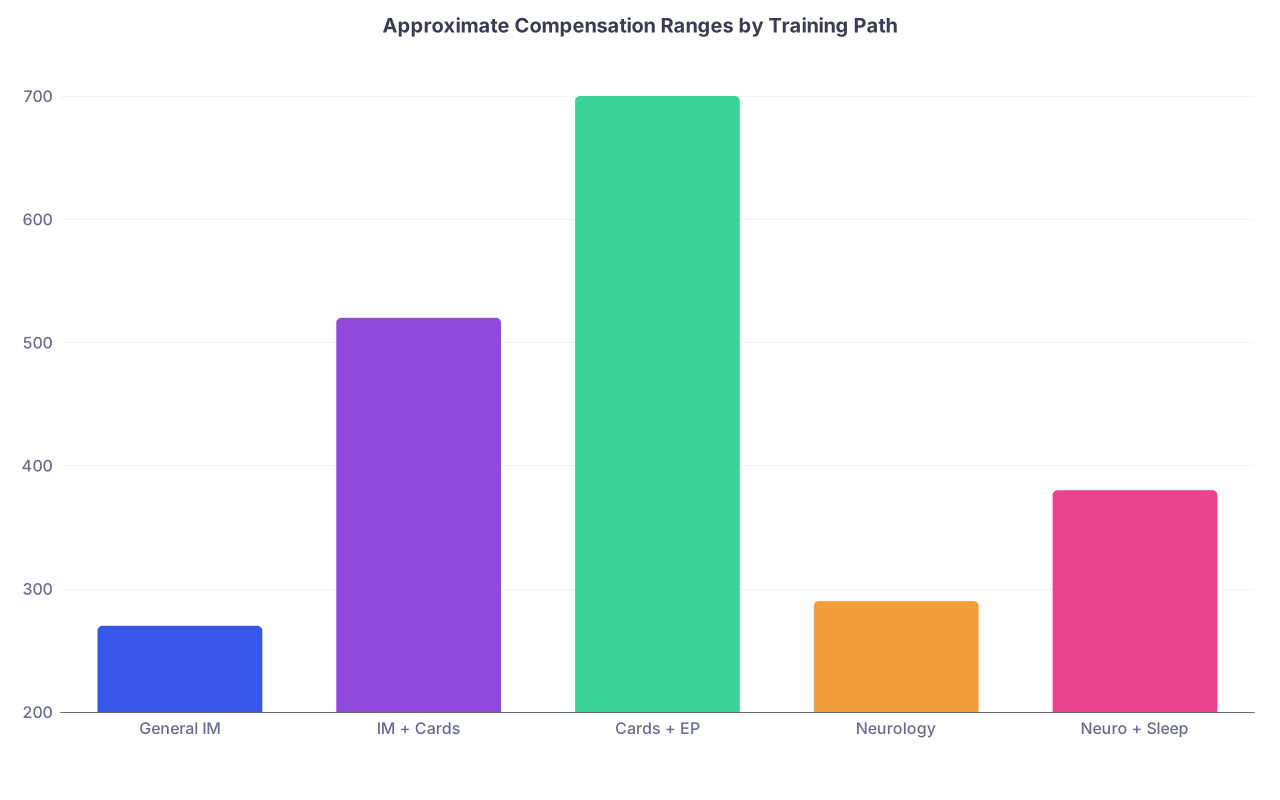
| Category | Value |
|---|---|
| General IM | 270 |
| IM + Cards | 520 |
| Cards + EP | 700 |
| Neurology | 290 |
| Neuro + Sleep | 380 |
Those bumps aren’t because you have more letters. They’re because the board certification allowed you to do different work with different CPT codes and more scarce expertise.
Translation: the money comes from the change in scope and procedure mix, not from the certificate itself.
Myth #2: “More Boards = More Money”
The favorite flex: “I’m triple board certified—IM, nephro, critical care.” Sounds impressive. The question is: is anyone paying you three times?
No. And in many settings, not even one-and-a-half times.
I’ve seen intensivists who are boarded in pulmonary, critical care, and sleep. Their actual work week? Purely ICU. No clinic. No sleep reads. Their compensation? Paid as “full-time intensivist,” often based on shifts and RVUs tied only to critical care billing.
Those extra boards are unused optional accessories. Like buying three toolkits and using one wrench.
The only time multiple boards tend to translate into more dollars is when:
- You are actually using those skill sets regularly, and
- The employer or practice has figured out how to monetize each line of service
An intensivist who also runs a sleep lab and does bronchs in clinic is worth more than one who only rounds in the ICU. But again—money follows billable services and productivity, not the number of ABIM certificates in their CME folder.
Myth #3: “Board Certification Is Your Best ROI Credential”
For residents and fellows buried in debt, it’s rational to ask: what gives the best financial return on my time—more boards, more certificates, or something else?
Board certification is required in many contexts, yes. But once you’ve met the minimum needed to practice your chosen field, more boards are often a lousy investment compared to other levers.
What tends to move actual compensation more?
- Negotiation skills
- Geographic arbitrage (Midwest vs coastal academic center)
- Practice structure (W2 employed vs partnership-track private practice)
- Shift-based vs RVU-based vs salary-only arrangements
- Learning to read a contract properly and push back strategically
I’ve watched physicians obsess over whether an extra year of fellowship and one more board exam will move them from $320k to $380k. Meanwhile, the same person leaves $50k–$100k on the table every year by accepting the first offer without challenging non-competes, call pay, or RVU thresholds.
Get board certified enough to open the door you want. Then turn your attention to leverage—because that’s where the real money lives.
The Hidden Cost: Maintenance of Certification (MOC)
Let’s talk about the part the boards don’t highlight in their marketing.
Maintenance of Certification is not free. Not in money, not in time, not in stress. And for many physicians, the return on that investment is weak.
You’re looking at:
- Recurring exam or “continuous assessment” fees
- Time off work for studying and exam days
- CME time and money—often more than the minimum required by your state or hospital
- For some: hiring locums to cover you during exam windows or review courses
| Component | Approximate Cost (10 years) |
|---|---|
| Exam / assessment fees | $2,000–$3,000 |
| Annual MOC / program fees | $1,500–$3,000 |
| CME above baseline | $1,000–$4,000 |
| Lost income / time | Highly variable |
Is MOC all bad? No. Some components are a decent framework to force periodic updating. But from a pure financial lens, most physicians don’t see a direct pay bump for staying current with MOC.
What they see is a threat: fall off the MOC treadmill and risk your job.
This is why more and more docs are quietly asking: do I actually need to maintain this board, or is state licensure plus another pathway (like NBPAS in some settings) enough for my goals? In some markets, you can get away with alternatives. In many hospital-employed roles, you cannot—yet.
Situations Where Board Certification Actually Moves Compensation
Let’s stop being abstract and talk specific scenarios. Because the answer isn’t the same for everyone.
Scenario 1: Community hospital, generalist role
You are a hospitalist at a community hospital in the Midwest. Job description: “Board certified or board eligible in Internal Medicine or Family Medicine.”
Pay is mostly a function of shifts and RVUs. Everyone gets roughly the same base and rate structure.
If you’re certified vs just finishing residency (board eligible), will they pay you more? Usually not. They may include a “must pass boards within X years” clause, but there is no extra line item: “Board certification stipend: $20,000.”
Financial impact: zero upside, enormous downside if you fail.
Scenario 2: Highly competitive academic center
Now picture a big-name academic center in a saturated urban market. Tons of applicants, lots of fellows trying to stay on as faculty.
Here, being board certified may not give you more money, but it might be the difference between getting any offer at all and being stuck in perma-locums limbo.
Where certification can help here is indirectly: academic promotion, leadership roles, program director positions, etc. Those admin roles sometimes come with stipends. The certificate didn’t generate the stipend, but it was often required for the title that did.
Scenario 3: Private practice subspecialist with procedure-heavy scope
Cardiology group. Two interventional cardiologists. One decides to do extra training and become board certified in structural heart interventions.
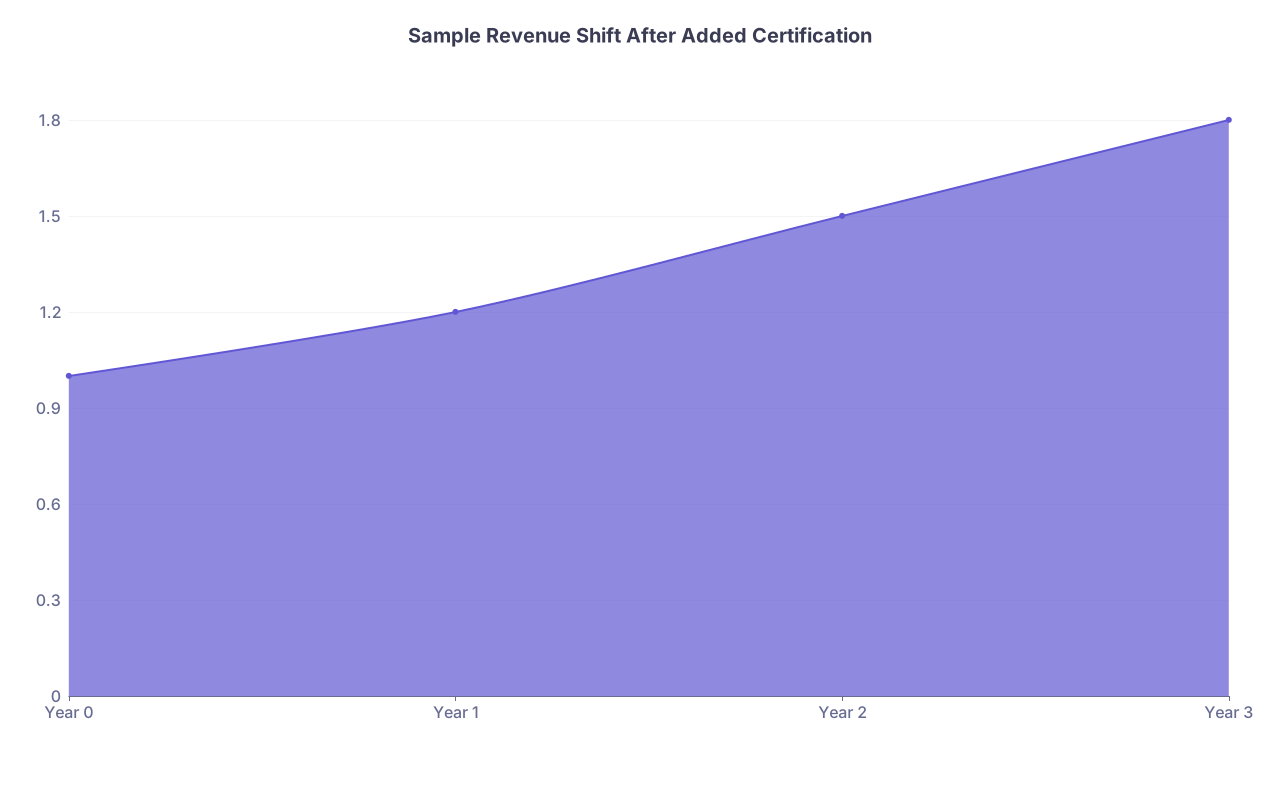
| Category | Value |
|---|---|
| Year 0 | 1 |
| Year 1 | 1.2 |
| Year 2 | 1.5 |
| Year 3 | 1.8 |
Their personal wRVUs jump because they’re now doing TAVRs, MitraClips, structural consults—all high-paying procedures. Practice revenue increases. Their compensation, if productivity-based or tied to partnership distributions, rises.
Key point: the board certification was the gate to the procedure mix. The compensation increase is tied to that new clinical activity, not to the letters themselves.
The Legal and Contractual Angle You’re Probably Ignoring
Here’s where this leaves the “feel-good career” space and enters the actually-important financial and legal territory.
Board certification status shows up in:
- Employment contracts
- Medical staff bylaws
- Insurance panel agreements
- Quality metrics and marketing materials
That means losing or changing your certification status isn’t just “annoying.” It can trigger real contractual consequences.

| Step | Description |
|---|---|
| Step 1 | Lose Board Certification |
| Step 2 | Privileges at risk |
| Step 3 | Check payer rules |
| Step 4 | Employment threatened |
| Step 5 | Decredentialed by payers |
| Step 6 | Minimal direct impact |
| Step 7 | Income drops or job loss |
| Step 8 | Hospital bylaws require certification |
| Step 9 | Payers require certification |
I’ve seen contracts that quietly embed clauses like:
- “Physician must maintain board certification in [Specialty]. Failure to do so shall constitute cause for termination.”
- “Physician acknowledges that loss of certification may impact ability to provide services and bill payers, and compensation may be adjusted accordingly.”
If you are signing a contract and you are not reading the board certification sections like a hawk, you’re playing financial roulette. At a minimum, you should know:
- Is certification required or just preferred?
- Is maintenance of certification required, or only initial?
- What happens if you fail an exam or miss a deadline?
- Is there any grace period, remediation, or automatic termination?
You will not find this nuance on ABIM or ABFM marketing pages. You’ll find it in the small print of your employment paperwork.
What About Non-ABMS Boards and Alternative Certifications?
Another myth: “Any extra board or certificate raises my market value.”
No. A random “board in obesity medicine” or some diploma from an online course is usually not moving your base salary. But sometimes they can be smart niche builders if you’re intentional.
For example:
- An internist who becomes formally credentialed in obesity medicine and uses that to build a self-pay or hybrid weight-management practice on the side
- A psychiatrist adding a legit addiction medicine board and using that to contract with rehabs or build a subclinic
Those can absolutely move your total income. But again, employers typically do not hand you a higher W2 just for showing a new certificate. You make more only when you turn that training into billable work, direct-pay services, or a distinct patient base with higher demand.
So, Should You Chase More Boards?
Here’s the sober version.
Get the board certification you need:
- To practice in your chosen specialty
- To meet hospital bylaws and payer requirements in the region where you want to live
- To maintain your current job if that job is worth keeping
After that, every additional board should pass a ruthless test:
- Does this unlock a new scope of practice or procedure category with significantly higher reimbursement?
- Is there real, local demand for that service?
- Will my contract or practice structure actually let me capture the financial upside (RVUs, collections, partnership share)?
If the answer is no, then the extra board is probably a prestige play, not a financial one.
](https://cdn.residencyadvisor.com/images/articles_svg/chart-relative-impact-on-physician-compensation-4048.svg "Relative Impact on Physician Compensation")
| Category | Value |
|---|---|
| Extra board in same field | 10 |
| Initial board vs none | 40 |
| Negotiating contract well | 60 |
| Moving to higher-need region | 70 |
| [Changing to productivity-based pay](https://residencyadvisor.com/resources/physician-salaries-guide/how-groups-use-productivity-metrics-to-quietly-cap-your-earnings) | 80 |
That chart is conceptual, not literal MGMA data—but it reflects what I’ve actually seen over and over again. Moving from LA academic to Idaho community. Shifting from salary-only to RVU + partnership. Renegotiating call pay. Those choices can swing income by 50–150%. Extra letters on your CV? Maybe 5–10%, and usually only if they change how you practice.
The Short Version: Myth vs Fact
Board certification is not pointless. But the mythology around it is bloated.
The key truths:
- Certification is mostly a threshold requirement, not a direct raise generator. It keeps doors open; it rarely opens the vault by itself.
- Extra boards only matter financially if they let you do different, better-paid work that you can actually bill for or monetize.
- If you care about your income, spend as much energy on contracts, practice model, and geography as you do on exam prep. That’s where the real leverage is.