
Prestige does not pay your mortgage. RVUs do.
The medical training world is obsessed with brand names: Harvard, Mayo, Hopkins, MGH, UCSF. Residents will contort their lives, relationships, and sanity to chase “top” programs because they think it guarantees higher long‑term income.
It does not. At least, not in the way people think.
Does pedigree matter? Sometimes. But the story is much narrower, more conditional, and frankly more boring than the mythology floating around residency subreddits and hallway gossip. The data we have on physician compensation tells a very consistent story: specialty, geography, and practice type dwarf the effect of elite vs community training nameplates.
Let’s walk through what actually moves your paycheck and where prestige very occasionally sneaks in through the side door.
What Really Drives Physician Income (And It’s Not Your Residency Logo)
Strip away the marketing and personal insecurity and your attending income comes down to three big levers:
- Specialty
- Practice setting/ownership
- Geography and market conditions
The “where you trained” part is somewhere down around lever #7 or #8, and mostly as a proxy for career path, not standalone earning power.
Look at any major compensation survey:
- MGMA
- Medscape Physician Compensation Report
- Doximity Physician Compensation Report
They all show the same pattern: emergency medicine vs endocrinology, ortho vs pediatrics, rural vs coastal urban, private vs academic – that’s where the huge differences live.
Here’s a simplified comparison from typical recent data ranges (these are ballparks, not contracts):
| Factor | Lower Range (Approx) | Upper Range (Approx) |
|---|---|---|
| Low‑paying specialties (endo, peds, ID) | $220k | $280k |
| Mid‑tier (IM, hospitalist, cards non‑invasive) | $280k | $400k |
| High‑paying (EM, GI, heme/onc, radiology) | $400k | $700k |
| Very high (ortho, neurosurg, CT surg) | $600k | $1M+ |
Notice what’s missing: “Residency from Big Name vs Community.” It barely registers.
Where you trained does correlate with some of those categories:
- Elite academic programs overproduce future academics
- Community programs overproduce private practice clinicians
- Some “big name” places dominate ultra‑competitive niches (peds neurosurg, advanced heart failure, etc.)
But that’s path selection, not an automatic salary bump for having a famous logo on your CV.
The Myth: Elite Training = Higher Lifetime Income
Let me be blunt: for most physicians, the “elite vs community” decision is financially neutral or even slightly negative for the elite programs.
Not because they’re bad. Because of who they funnel you toward becoming.
Academic Trap vs Income Reality
Many of the top‑brand residencies are deeply academic: heavy research, niche fellowships, NIH grants, tenure talk in the hallways. You’re surrounded by people who measure status by papers and invited talks, not by take‑home pay.
That environment quietly nudges you in a certain direction:
- You stay for a fellowship (or two).
- You pick an academic career over community practice.
- You accept a lower salary in exchange for “protected time” and “incredible colleagues.”
I’ve watched this play out repeatedly at places like Hopkins, UCSF, and big‑name internal medicine programs. A massive proportion of grads end up:
- In academic jobs paying 20–50% less than community counterparts
- In high‑COL cities where that smaller paycheck is being eroded further
- Starting their “real” earning years later because of longer training pipelines
So yes, elite training can be a route to lower lifetime income if it pulls you toward low‑paying, high‑prestige roles in expensive cities.
That isn’t failure. It just destroys the childish belief that prestige always equals more money.
Where Prestige Can Indirectly Matter for Income
There are a few domains where elite programs can tilt the financial trajectory. But the effect is mostly indirect.
1. Matching into Hyper‑Competitive, High‑Paying Specialties
Some specialties print money. Some are gate‑kept like crazy.
Think:
- Dermatology
- Orthopedic surgery
- Neurosurgery
- Some surgical subspecialties (ENT with certain niches, plastics)
- Certain interventional fields (IR, interventional cards)
Big‑name academic programs have:
- Stronger track records placing grads into these specialties
- Deep research infrastructure (which match committees love)
- Letters from big‑name faculty that carry more weight
So if a Harvard‑level internal medicine resident pivots to interventional cardiology, or a top‑tier general surgery resident wins a crazy competitive fellowship, that early prestige supports access to high‑paying niches.
But you know what else does?
- Hustling at a solid community program
- Strong board scores
- Real research output with meaningful roles
- Good mentorship and networking
People match derm and ortho out of non‑famous programs every year. It’s harder. Not impossible.
The point: prestige is one lever among many to access a field. Once you’re in that field? The logo fades. Your current productivity, location, and job type crush everything else.
2. Opening Doors to Lucrative Leadership or Industry Roles
Later in your career, brand may have a weak but non‑zero signal value:
- Chief of a big‑system service line
- C‑suite or VP‑level roles in healthcare systems
- Medical director roles with industry or large corporations
- High‑billing referral streams in subsubspecialty clinics
Elite training backgrounds are overrepresented in those seats. Not because the brand directly prints them money, but because:
- Those programs cultivate certain networks
- Alumni fill leadership roles and then select in their own likeness
- You get more chances to publish, present, and build a national name early
But the selection bias is heavy. Highly motivated, ambitious people self‑select into those elite places in the first place, then continue doing ambitious things after graduation. The name on the diploma is a co‑traveler, not an independent fuel source.
And again: plenty of community‑trained docs become CMOs, mega‑group partners, or industry KOLs. They just do it through performance and relationships, not brand halo.
3. Academic Salary Grids and Promotion
In the pure academic track, there’s a marginal advantage: some universities still quietly value pedigree for initial hiring and promotion.
You’ll hear it in meetings:
- “He’s a Stanford grad.”
- “She trained at Brigham.”
- “This candidate is from a smaller community program; we need to see more publications.”
Does that change your salary a lot within one institution? Usually not by much. Academic centers use rigid pay scales by rank and years out of training.
But:
- Elite‑trained faculty might get hired into research‑heavy roles with more startup money
- They may get promoted faster, which bumps salary under those grids
- They’re more likely to land big grants (again, partially self‑selection)
Even optimistically, you’re usually looking at tens of thousands per year difference, not hundreds. And that’s within a pay band that already lags far behind private practice.
The Boring Truth: Community Program → Massive Income
Let’s talk about the path almost no one brags about at conferences but quietly dominates the upper tiers of physician income.
Scenario:
- You match into a solid, not‑famous community program in internal medicine, EM, radiology, or anesthesia
- You get solid training, do fine on boards, maybe a straightforward fellowship
- You move to a mid‑cost or lower‑cost region (Midwest, smaller Southern city, non‑coastal West)
- You join or build a high‑volume private or private‑equity‑backed group
- You work… a lot. And efficiently.
Those are the docs showing up in Doximity reports with $500k–$900k incomes while nobody in Boston knows their names.
Here’s a rough contrast using typical real‑world numbers for two hypothetical cardiologists 7–10 years out:
| Role | Setting | Approx Income |
|---|---|---|
| Academic interventional cardiologist, top‑tier coastal center | Elite academic | $450k–$550k |
| Community interventional cardiologist, mid‑size city | Private practice | $650k–$900k |
Same specialty. Same board certification. One trained at Big Name U, one at a normal community program plus fellowship.
Guess who’s winning the lifetime earnings race 20 years in? It’s not the one with the better grand rounds.
When Going Elite Is Financially Dumb
There are specific, predictable ways prestige actually hurts your financial life.
1. Extra Training Years for Marginal Gain
A common trap:
- You match a big‑name IM residency
- Everyone is doing cardiology, GI, or heme/onc
- You “have” to fellowship because that’s what “top” residents do
- You burn 3 extra years tinkering with your CV to stay “competitive” for an academic post
Three years at attending pay vs three years at fellow pay is easily a 7‑figure swing over a lifetime, especially if it also delays buying into a practice or partnership.
Do the math sometime rather than just absorbing the peer pressure.
2. High‑COL Cities That Bleed You Dry
Most elite programs cluster in cities that financially punish you:
- Boston
- San Francisco
- New York
- LA
- Chicago (less than the coasts, but still)
Residents tell themselves, “Yeah, but the money later will make up for it.”
Then they:
- Fall in love with the city
- Marry someone with a job tethered to that city
- Get hired at the same or similar academic center at suppressed academic rates
- Pay $3,500/month in rent or $1.2M for a mediocre house
Meanwhile, their community‑trained counterpart is making the same or more in a smaller city with a $3,000 monthly mortgage on a 4‑bedroom house.
3. The Prestige Ego Tax
People trained at elite centers sometimes unconsciously self‑select away from:
- Small towns
- Community hospitals
- RVU‑heavy jobs
- Locums contracts in “unsexy” regions
Because it “feels beneath them.”
That’s an ego tax. It’s real. And it’s expensive.
The high six‑figure salaries in those places are not fake. They’re just not Instagrammable.
Data Snapshot: What Surveys Actually Show
Compensation surveys very rarely even bother to stratify earnings by residency program prestige. When they do subgroup analysis, they care about:
- Academic vs non‑academic
- Ownership vs employed
- Region
- Years in practice
When they survey academic physicians, you see massive compression: associate professors at top programs vs mid‑tier programs differ by maybe 10–20% in salary at most, if adjusted for region.
You don’t see a clean “Harvard bump” across specialties.
What we do see is this kind of thing:
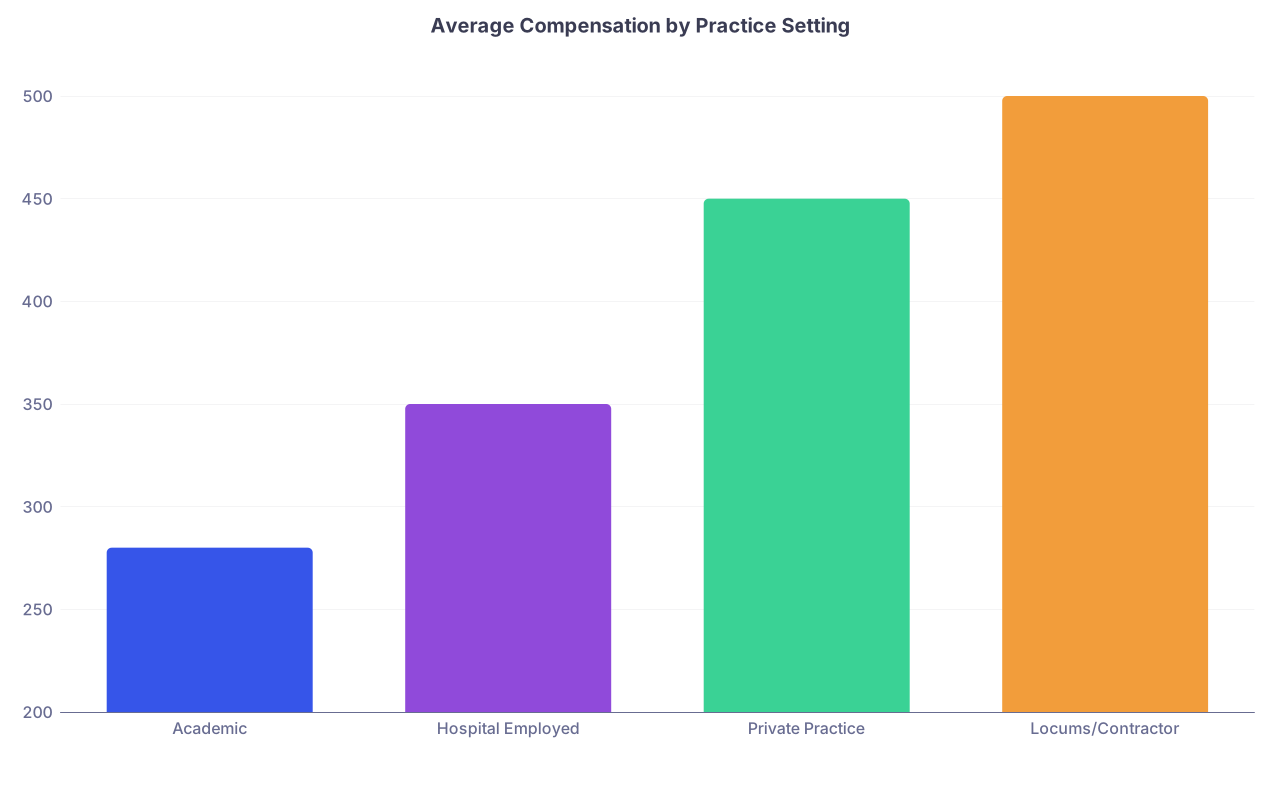
| Category | Value |
|---|---|
| Academic | 280 |
| Hospital Employed | 350 |
| Private Practice | 450 |
| Locums/Contractor | 500 |
Academic centers – where elite grads cluster – reliably pay the least across nearly every specialty, even adjusting for some benefits and perceived stability.
Again: the salary gap is about practice type, not the training brand. Prestige just changes which pipeline you fall into.
Where Your Energy Should Actually Go
If your primary concern under “Physician Salaries – Financial and Legal Aspects” is lifetime earning power, prestige chasing is one of the least efficient strategies you can pursue.
Use your finite energy on things that actually move the needle:
- Choosing a specialty with a compensation profile that matches your goals and tolerance for lifestyle tradeoffs
- Learning how RVU systems, collections, and contracts actually work
- Understanding partnership tracks, equity, and call structures
- Positioning yourself geographically where your skill set is scarce and valued
- Maintaining a strong work ethic and clinical reputation (referrals pay more than logos)
If you like the idea of an elite program for intellectual reasons, mentorship, or pure pride – fine. That’s valid. Just stop pretending it’s an automatic income booster. It isn’t.
A More Honest Rule of Thumb
Here’s the blunt distillation.
If you:
- Train at a community program
- Enter a moderately or highly compensated specialty
- Work in a non‑saturated region
- Join a practice where you participate in profit and not just salary
You will almost always out‑earn:
- The elite‑trained academic in a coastal city
- The double‑fellowship, grant‑chasing subspecialist
- The brand‑obsessed clinician who chose prestige over leverage
Not immediately. Over the arc of 20–30 years.
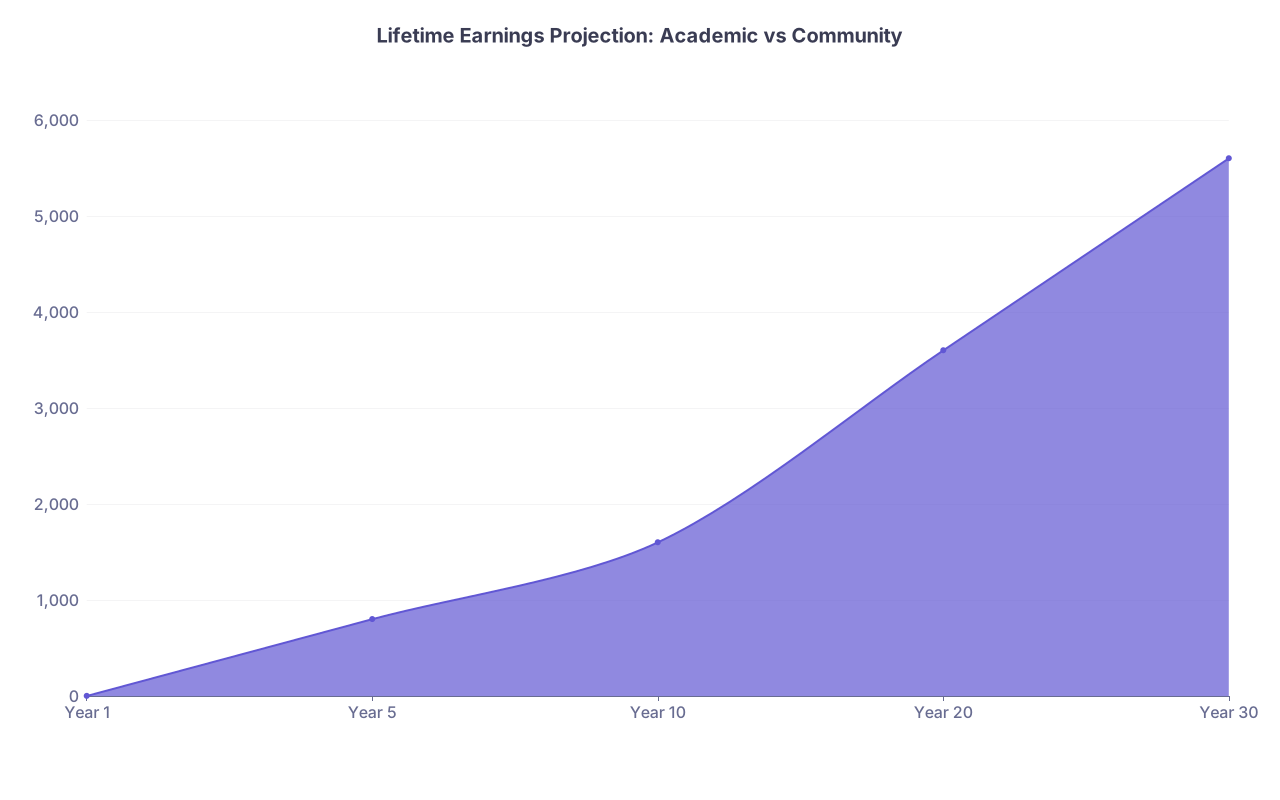
| Category | Value |
|---|---|
| Year 1 | 0 |
| Year 5 | 800 |
| Year 10 | 1600 |
| Year 20 | 3600 |
| Year 30 | 5600 |
Now imagine drawing a second line 20–30% higher across the same timeline for the high‑earning community/private practice path. That’s the spread you’re arguing about when you fixate on “top programs.”
How to Decide Without Lying to Yourself
If you’re choosing between an elite and a community program, ask yourself two blunt questions:
- Do I genuinely want an academic, research‑heavy, prestige‑sensitive career?
- Am I okay if that path means earning less than I otherwise could?
If the answer to both is yes, then by all means:
- Go to the elite place
- Use its network
- Accept the financial tradeoff as the cost of the career you want
If your honest priority is maximizing financial flexibility, early debt payoff, and long‑term earning power? Then:
- Favor programs that set you up for strong clinical skills
- Don’t be seduced by brand alone
- Look hard at where the alumni actually practice, not where they trained
And stop treating “community program” like a consolation prize. It is often the most direct road to actual financial freedom.
Key Takeaways
- Prestige by itself does not reliably increase long‑term physician income; specialty, practice type, and geography are far more powerful levers.
- Elite programs often nudge you toward academic, high‑COL, lower‑pay roles, while community programs more often feed into high‑earning private practice paths.
- Choose prestige for mentorship, research, and career fit if you want – but don’t kid yourself that the logo on your diploma will be what pays off your loans.