
Last fall, a PGY-3 sat in my office, eyes half-dead from nights, telling me he “loved hospital medicine and teaching.” Two weeks later, after a couple of “informal chats” with faculty, he was suddenly “strongly considering” cardiology. By winter, he was networking with an interventional group that starts at mid-600s.
He thought this was his idea. It wasn’t.
Let me walk you through how program directors and attendings quietly nudge residents toward higher-paying paths—and why they do it, even if they won’t say it out loud.
The Uncomfortable Truth: Money Shapes Training More Than You Think
Programs never say it directly: “Go into a high-paying specialty.” That would sound crass, unethical, and frankly too obvious. But you feel it in who gets attention, who gets opportunities, and what is praised as “smart planning.”
Behind closed doors, here’s the real equation being run in your PD’s head:
- How will this graduate’s career reflect on our program?
- Will they be “successful” by external metrics (income, prestige, fellowships, titles)?
- Will their path help us with recruitment, case volume, faculty retention, and department politics?
High-paying paths—cards, GI, ortho, derm, IR, EM with lucrative moonlighting, surgical subspecialties—check a lot of those boxes.
And your PD knows something else: more money usually means more options and less burnout risk. They’ve seen mid-career primary care docs drowning in RVUs and prior auth while their subspecialty classmates are cutting checks for a vacation house.
So they start steering. Quietly. Consistently. Systematically.
The Subtle Ways Residents Get Steered
It’s rarely, “You should do interventional cardiology so you can clear seven figures.” That’s amateur hour. The real influence is much quieter and much more effective.
1. Who Gets “Accidentally” Exposed to What
Your schedule is supposedly “fair.” On paper. But I’ve sat in those rotation planning meetings. And the conversations sound like this:
“She’s talking about primary care, but honestly she’s strong enough for GI. Let’s make sure she gets extra time with Dr. X; he’s great at selling the field.”
“He’s not sure what he wants—put him on more EP and cath time. Once he sees the cases, he’ll be hooked.”
Residents who show any interest—or even just aptitude—get slotted into rotations with high-paying subspecialties and star attendings. Not by coincidence.
And not everyone gets that treatment.
The resident who mentions primary care or academic general IM? They get the “you can always do that later” brush-off and mysteriously fewer subspecialty electives during their earlier years, where choices are still fluid.
2. Language: The Code Words You Hear and Don’t Register
Listen carefully to how PDs and attendings talk about choices:
- “Smart move”
- “Sets you up nicely”
- “Gives you flexibility”
- “You’ll be compensated appropriately for your work”
- “You don’t want to limit yourself too early”
Translation:
Smart = highly paid.
Flexibility = salary cushion.
Compensated appropriately = higher RVU value procedures.
Now look at the flip side:
- “Pure primary care”
- “Generalist”—often said with polite respect, not genuine admiration
- “Lifestyle field” for lower-paying options like peds, family med, psych
- “Noble work” (that’s the kiss of death phrase; it means “underpaid and overworked, but we’ll clap for you at graduation”)
Residents absorb these value judgments. Even if nobody says “money,” everyone hears it under the surface.
3. Who Gets Extra Letters, Calls, and Advocacy
Letters of recommendation are a bottleneck. Strong ones from the right names are career-altering. Program leadership knows this. They choose, very deliberately, where they spend political capital.
Between two residents of similar quality:
- One wants cards or GI.
- One wants general IM with a teaching focus.
Guess who gets the PD personally calling big-name fellowship directors, pushing, “You really should look closely at this one”?
The PD will still support the generalist. But the tone is different. Less urgency. Fewer phone calls. Less, “We need to place this person at a top fellowship because it reflects on us.”
You feel that difference. And you react to it.
Why Program Directors Quietly Favor Higher-Paying Paths
This isn’t just greed or status-chasing. The incentives are built into the system.
1. Match Data and Marketing: “Our Grads Go to…”
Programs love to advertise where residents go:
“80% of our graduates match into competitive fellowships.”
“Our alumni are leaders in cardiology, GI, heme/onc, and procedural subspecialties.”
Notice what’s almost never on the glossy brochures:
- “Our graduates thrive in long-term primary care practices and community hospitals at 230k–260k.”
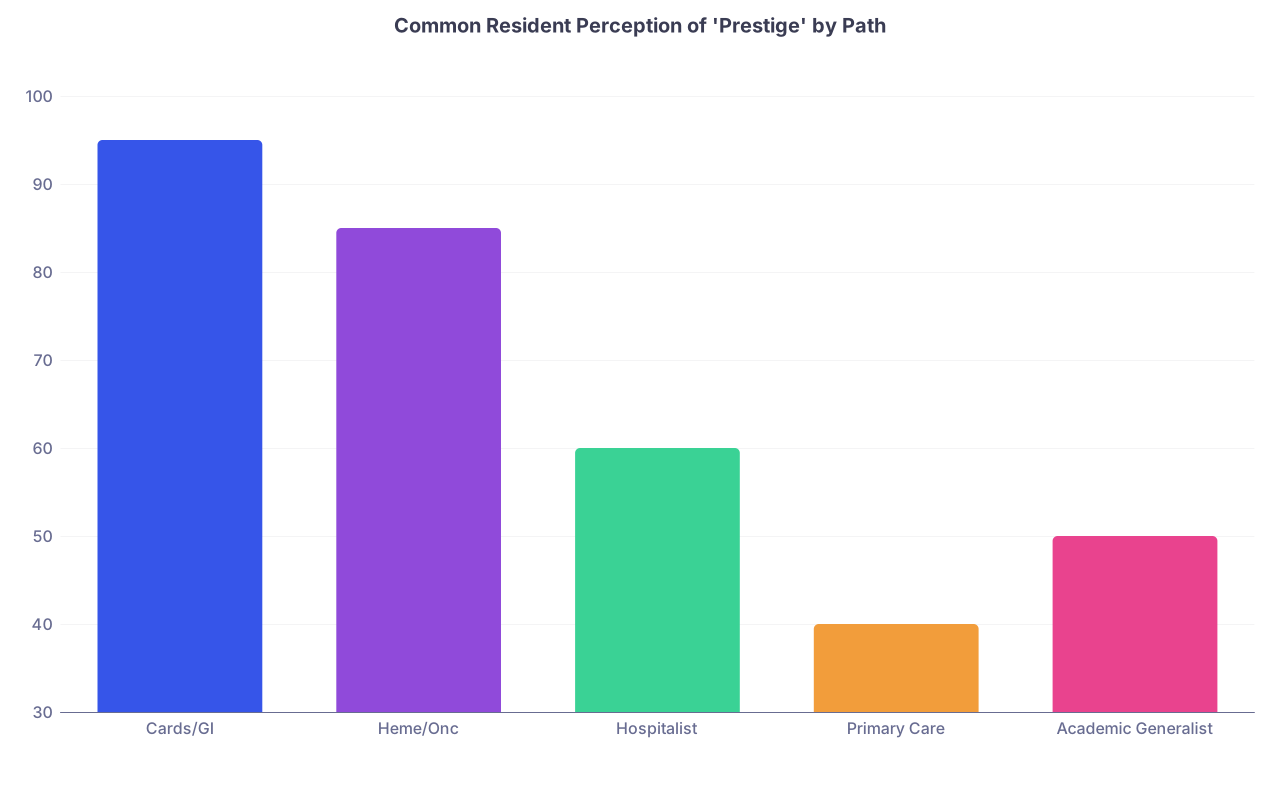
That doesn’t sell. Future applicants want “prestige” and “opportunity.” Translation: high subspecialty and procedural match rates.
So PDs feel pressure—from chairs, from GME, from applicants—to produce “impressive” outcomes. That means more high-paying tracks, not because of the money itself, but because money follows prestige and procedure density.
| Category | Value |
|---|---|
| Cards/GI | 95 |
| Heme/Onc | 85 |
| Hospitalist | 60 |
| Primary Care | 40 |
| Academic Generalist | 50 |
Prestige perception is tightly tied to reimbursement. Everyone pretends it’s not. It is.
2. Departmental Revenue and Influence
- Procedures and associated RVUs
- Research dollars
- Industry relationships
- High-profile clinical programs: cath labs, EP labs, advanced endoscopy, structural heart, IR suites
When your residents go into those fields, they often keep ties to your institution. They:
- Refer cases back
- Join as junior faculty with revenue-heavy practices
- Help maintain or grow service lines that justify more hiring, equipment, and space
A PD thinking long-term knows: more GI, more cards, more heme/onc grads = more downstream money and leverage for the department. It’s not written anywhere, but every good PD knows it.
3. Retention: High Earners Stay, Burned-Out Low Earners Quit
Here’s a less talked about angle: retention and alumni positivity.
I’ve watched mid-career docs in low-paying, high-burnout lanes become bitter. They come back to give noon conferences and basically say, “Do not do what I did. Run the other way.” It poisons the well for recruitment.
Compare that to the interventional cardiologist flying in with upgraded status, talking about how challenging but rewarding their work is, and how they still “manage to travel a lot.” That sells the program and the career.
High-paid grads tend to:
- Donate more to the institution
- Mentor your residents
- Open doors for job placements and fellowships
PDs understand this, even if they’d never phrase it this bluntly.
Concrete Tactics: How Steering Actually Looks on the Ground
Let’s get specific. These are the patterns I’ve seen repeatedly.
1. Tactical Timing of Conversations
Early in residency (intern year), most people are malleable. PDs and key attendings know this. That’s when you get the “Have you considered…?” conversations.
- After you impress on a subspecialty service, the attending pulls you aside: “You’d be phenomenal in this field.”
- Your PD at mid-year review: “Your scores, evaluations, and work ethic would make you very competitive for [high-paying specialty]. I’d hate to see you close that door too soon.”
If you mention something less lucrative—general IM, community peds, outpatient psych—you rarely get a forceful, “Yes, absolutely, go for it.” You get hedged validation:
“That’s a totally reasonable path, but let’s at least keep your options open.”
Options = money.
2. Selective Exposure to “Reality”
Residents are shown curated versions of different careers.
For high-paying tracks, you’re shown:
- The heroic cases
- The team camaraderie
- The advanced technology
- The fellowship grad who just “found a great job”
You rarely see:
- The RVU pressure
- The call burden in private practice
- The insane malpractice premiums in some procedural fields
For primary care or nonprocedural generalist roles, you’re told:
- About panel management headaches
- Prior authorization hell
- “The system is tough on primary care”
Is that reality? Sure. But it’s a selective reality. The financial upside of being lean, entrepreneurial, or doing concierge/Direct Primary Care? Often glossed over. Because that path doesn’t tie back cleanly to the academic center’s priorities.
3. The “Research Opportunity” Game
Who gets pulled into big, career-shaping research projects?
- The resident flirting with cards gets plugged into the PCI outcomes registry or structural heart team.
- The one vaguely mentioning heme/onc gets handed co-authorship on trials.
These projects translate into abstracts, podium presentations, and name recognition—currency for competitive, high-paying fields.
The resident who expresses interest in outpatient medicine? Maybe a QI project on hypertension control if they push for it. Not nothing, but not the same springboard.
| Resident Interest | Typical Project Type |
|---|---|
| Cardiology | Procedural outcomes registry |
| GI | Advanced endoscopy studies |
| Heme/Onc | Clinical trial sub-analysis |
| Hospitalist | QI on readmission rates |
| Primary Care | Clinic workflow/QI |
Which paths correlate with future earning power? You know the answer.
Where the Money Really Enters the Conversation (Quietly)
PDs are not supposed to give financial advice. But they do. Indirectly, cautiously, with euphemisms.
1. “You’ll Have Loans, You Need to Think Long-Term”
I’ve heard this speech almost verbatim:
“You are going to graduate with $250–300k in debt. If you go into a field that pays you 220 versus one that starts you at 450–600, it changes how fast you get out from under that. Just something to think about.”
That’s as close as many PDs get to saying, “Pick the path with real money.”
They’ll frame it as:
- “Keeping doors open”
- “Choice and flexibility”
- “Financial security for your family”
Notice something: you rarely hear the mirror advice encouraged with the same intensity, like, “Yes, this lower-paying field is riskier financially, but if you love it, do it anyway.” That line shows up, but often only after they’ve tried to sell you on higher-paying alternatives first.
2. Using Outliers as Cautionary Tales
There’s always some cautionary story:
- The primary care doc working 70 hours with 14-minute visits and “only” making 210.
- The community psychiatrist drowning in admin work with low pay.
These stories get repeated as warnings all the time.
You know what you almost never hear from PDs? The mirror-image stories:
- The concierge internist making 500 seeing 8 patients a day.
- The DPC family doc taking home 350 with no insurance billing and almost no admin staff.
Those people exist. I know some. But their models don’t feed the academic machine—no referrals, no trials, no departmental RVUs. So their stories are not amplified.
Legal and Ethical Shadows Around Steering
You asked about financial and legal angles, so let’s stop pretending this is just “advice.”
1. Conflict of Interest, Light Version
Formally, program directors are supposed to:
- Support resident autonomy
- Provide unbiased career guidance
- Avoid conflicts of interest
Informally, there’s a built-in conflict. The department benefits, reputationally and financially, from graduates entering certain fields. The PD’s own status in the institution is tied to “success metrics” like competitive fellowship matches and academic placements.
So when a PD “gently nudges” residents into highly reimbursed subspecialties that feed back into the hospital system, that’s a conflict of interest, whether anyone uses that language or not.
Nobody’s going to court over it. But ethically, it’s a gray zone.
2. Legal Line: What They Won’t Put in Writing
No PD in their right mind will email you something like:
“You should go into GI because you’ll make three times as much as primary care.”
They keep it verbal. “Off the record.” Hallway conversations. Office chats without notes.
Why? Because once it’s written, it can be scrutinized against program accreditation standards, institutional policies, or even used in complaints.
I’ve seen PDs get very careful the second you start sounding like you might quote them:
- “I’m just saying you have many options; I support whatever you decide.”
You will not find a paper trail of financial steering. You’ll just feel the pattern.
How to Recognize When You’re Being Steered
Once you see it, you cannot unsee it. Watch for these tells in your own training environment.
1. Disproportionate Enthusiasm
Notice when your PD’s energy changes.
You say: “I’m thinking about academic hospital medicine.”
Response: mild nod, generic support.You say: “I’m considering interventional cards or advanced GI.”
Response: they sit up, start naming specific faculty, conferences, programs, “We can totally make that happen.”
That shift in excitement is not random.
2. The “Access Gradient”
Ask yourself:
- How easy is it for you to get time with the big-name proceduralists compared to the people in less lucrative fields?
- Who returns your emails faster?
- Who invites you to join research or go to national meetings?
Look at where the institutional energy is. It almost always follows the money.
3. Subtle Devaluation of Lower-Paying Paths
You’ll hear things like:
- “You’re too smart for that field.”
- “You’d be wasting your potential just doing clinic medicine.”
- “You can always do teaching as a subspecialist, but not the other way around.”
What they mean is: “You’re too strong a candidate not to be monetized at procedural or subspecialty rates.”
If You Actually Want a Lower-Paying Path, Read This Twice
Here’s the punchline: PDs aren’t evil for doing this. They’re responding to the same broken system you’re stuck in. But you need to decide how much of your life you want shaped by their incentives.
If your gut wants something that doesn’t scream “high-paying,” you’ll need to:
First, get brutally clear on your numbers.
What does your loan balance really look like? What’s your minimum acceptable lifestyle? Do the math for a 220–260k job versus a 450–600k one over 10–15 years. You might still choose the lower-paying path. At least you’ll be choosing with eyes open, not just reacting to soft pressure.
Second, ask for the same level of support.
“I want to pursue academic general internal medicine with a focus on teaching. I’d like the same degree of mentorship and advocacy you’d offer someone going into cardiology.” Say it out loud. Force them to confront their bias.
Third, find non-institutional mentors.
Faculty whose money and status don’t depend on your path. Docs who built nontraditional careers: concierge practices, locums-heavy portfolios, part-time clinical plus industry or consulting. They’ll talk about money directly in ways academic PDs usually won’t.

| Step | Description |
|---|---|
| Step 1 | Resident Preference |
| Step 2 | More exposure to lucrative fields |
| Step 3 | Neutral support |
| Step 4 | Subspecialty or procedural path |
| Step 5 | Resident chosen path |
| Step 6 | Program Influence |
Final Word: What You Need to Remember
Three things.
First, program directors quietly favor paths that pay more not because they’re cartoon villains, but because prestige, revenue, and institutional success are welded to those paths. You are living inside those incentives whether you notice them or not.
Second, the steering is subtle: extra exposure, selective enthusiasm, better letters, and curated narratives about what “smart” careers look like. Nobody will put the word “money” on the table, but it’s sitting there.
Third, if your authentic interest doesn’t line up with those high-paying routes, you’ll need to push back deliberately—by recognizing the bias, demanding equal support, and seeking mentors outside the institutional echo chamber who will talk to you like an adult about money, tradeoffs, and long-term autonomy.