
The usual physician salary advice completely breaks when you’re married to a non‑physician high earner.
Most guidance assumes you’re the primary breadwinner, your income is the engine, and everything else orbits around that. But if your spouse is a software engineer pulling $450k with equity, or a finance exec making seven figures, or a business owner taking home $600k… then the math, the leverage, and the tradeoffs are different. Radically different.
I’m going to talk to you like you’re already in this situation, not “someday maybe.” You’ve got a high-earning spouse, you’re a physician (resident, fellow, or attending), and you’re trying to decide:
- Do I chase the highest salary?
- Do I prioritize lifestyle?
- Do we still live like residents?
- Do I do PSLF or just pay it all off?
- Does a $40k pay cut for a better schedule actually make sense or is that just rationalization?
Let’s walk through what actually changes when you’re married to a non‑physician high earner—and what to do about it.
1. The Big Shift: Your Income Is No Longer The Star
When you’re married to a non‑physician who out-earns you significantly, your income becomes one of two things:
- A stabilizer (safety net, baseline)
- A lever (to buy back time, reduce risk, or open options)
What it stops being is your entire identity and justification for sacrificing your life.
If your spouse makes, say, $500k+ and you’re looking at $260k vs $340k job offers, you are probably making job decisions wrong if you’re optimizing only for the extra $80k. That marginal money has less impact than you think once you combine incomes.
Here’s the mental model: Your household is the unit—not you. You choose jobs based on household goals, not personal ego.
Common reality I’ve seen:
- Dual high income couple (tech + physician)
- Household income: $700k–$1.2M
- Physician is killing themselves for a marginal bump from $290k to $340k
- Meanwhile, the tech spouse’s RSUs swing $200k up or down depending on stock price
That extra $50k you’re chasing? It’s noise compared to your total risk profile.
2. First Move: Get Clear on Your Household “Enough” Number
You can’t make sane salary decisions until you know what “enough” is for your house, not your ego.
Do this once, properly, together.
Figure your core lifestyle number (post-residency, not fantasy).
- Housing (mortgage or rent, including taxes/insurance)
- Childcare/tuition (be brutally realistic here)
- Transportation (cars, insurance, maintenance)
- Food, utilities, insurance, basic travel
- Minimum debt payments
Then add your “nice but realistic” upgrades:
- One nicer vacation per year
- Occasional house cleaner
- Family help (e.g., flying parents out, etc.)
- Increased retirement savings
Convert it to gross household income needed.
Let’s make this concrete.
| Item | Annual Cost (Approx.) |
|---|---|
| Housing (mortgage + prop tax) | $60,000 |
| Childcare / school | $40,000 |
| Food & utilities | $30,000 |
| Transportation | $18,000 |
| Travel & discretionary | $36,000 |
| Insurance & misc | $26,000 |
| Total Annual Spending | $210,000 |
To fund $210k in spending plus robust saving, a household income of $400k–$450k is usually more than enough in most markets (except some ultra-HCOL situations).
If your spouse alone is at or above that, then your income is now primarily:
- Optional security
- Debt destroyer
- Freedom fund
That means your default shouldn’t be “maximize my salary.” It should be “optimize my life and our long-term flexibility.”
3. How a High-Earning Spouse Changes Key Career Tradeoffs
Let’s talk through specific salary-related choices where being married to a high earner changes the calculus.
3.1 Academic vs Private Practice vs Hospital Employment
Normally:
- Academic: lower pay, more prestige, more teaching/research, less lifestyle
- Private practice: higher pay, more business risk, possibly more call
- Hospital employed: middle ground, W-2, standardized benefits
When your spouse has serious income:
- Academic becomes much more viable without feeling like self-sacrifice.
- Private practice “hustle for every RVU” becomes less necessary.
- You can aggressively prioritize schedule, call burden, and commute over raw dollars.
Example:
- Academic job: $230k, lighter call, good colleagues, some admin headache
- Private job: $330k, heavy call, more nights/weekends, high burnout risk
If spouse makes $600k, the $100k delta is no longer life-changing money—especially after progressive tax.
You are effectively trading:
- Some extra discretionary income
- For your own sleep, mental health, and physical longevity
That’s usually a bad trade if your household already has enough.
3.2 W-2 vs 1099, Locums, and Side Hustles
If you were the primary earner, you’d care a lot about:
- Maximizing pretax retirement space
- Squeezing every deduction out of 1099 work
- Building side income quickly
With a high-earning spouse, your tax bracket is already high. The marginal benefit of grinding more for 1099 income may be minimal, and the energy cost could be high.
What changes:
- W-2 stability + benefits may be perfectly fine; you don’t need 1099 optimization games.
- Locums becomes more of a lifestyle / flexibility tool, not a pure money-maximizer.
- Side gigs only make sense if you actually enjoy them or they buy you future freedom—do not stack more stress just for more already-high income.
3.3 Geographic Choices
Here’s where the dynamic often flips:
Tech/finance/high-comp industry spouse:
- Jobs cluster in SF Bay, Seattle, NYC, Boston, Austin, etc.
You:
- Could earn more if you move to rural/smaller markets
- But that might undercut your spouse’s earning potential massively
If your spouse is making $800k in NYC and you’re offered:
- $320k in NYC vs $450k in mid-sized Midwest city
Moving for your higher pay while your spouse downgrades to $300k remote role (or loses equity upside) is almost always dumb financially.
The household objective number rules here. If staying in HCOL city means:
- You’re at $300k instead of $450k
- But your spouse is at $800k instead of $300k
You know the right answer. You don’t chase the extra $150k if it costs the household $500k and career upside.
4. Debt, PSLF, and Tax Strategy When Married to a High Earner
This is where people really mess up—especially with student loans.
4.1 PSLF: Probably Dead Once You’re Married High-Income
If you’re married to a high earner and file taxes jointly:
- Your payment on IDR plans will be based on joint AGI
- That often eliminates the PSLF benefit—your payments become so high you’d pay off most or all of the principal anyway
Could you file separately to preserve PSLF? Yes. But then:
- You lose certain tax benefits
- Your joint effective tax rate rises
- Complexity goes way up
I’ve seen couples spend years contorting their life around PSLF to save what amounts to $50k–$100k total, while ignoring the fact they were burning out and making dogshit life decisions to protect “forgiveness.”
Rule of thumb:
- If spouse is making $300k+ and you expect your own attending income to be $250k+
- It’s usually cleaner to treat your loans like a high-interest business investment and just kill them aggressively with your combined income.
4.2 Rapid Payoff vs Slow-Rolling Loans
With high combined income, you have options:
A) Aggressive 3–5 year payoff
B) Moderate payoff while also aggressive investing
C) Minimal payments + PSLF attempt (often dubious in this demographic)
What actually makes sense?
- If your interest rates are >5–6% and your spouse’s job is volatile (stock-based comp, startup, etc.), I lean toward aggressive payoff. Debt = fragility.
- If rates are lower and spouse has stable, durable income, a blended strategy (solid retirement + moderate loan payoff) works fine.
The key: You can end your loans much faster than most of your co-residents. That means your incentive to chase the highest possible starting salary drops once you commit to a solid plan.
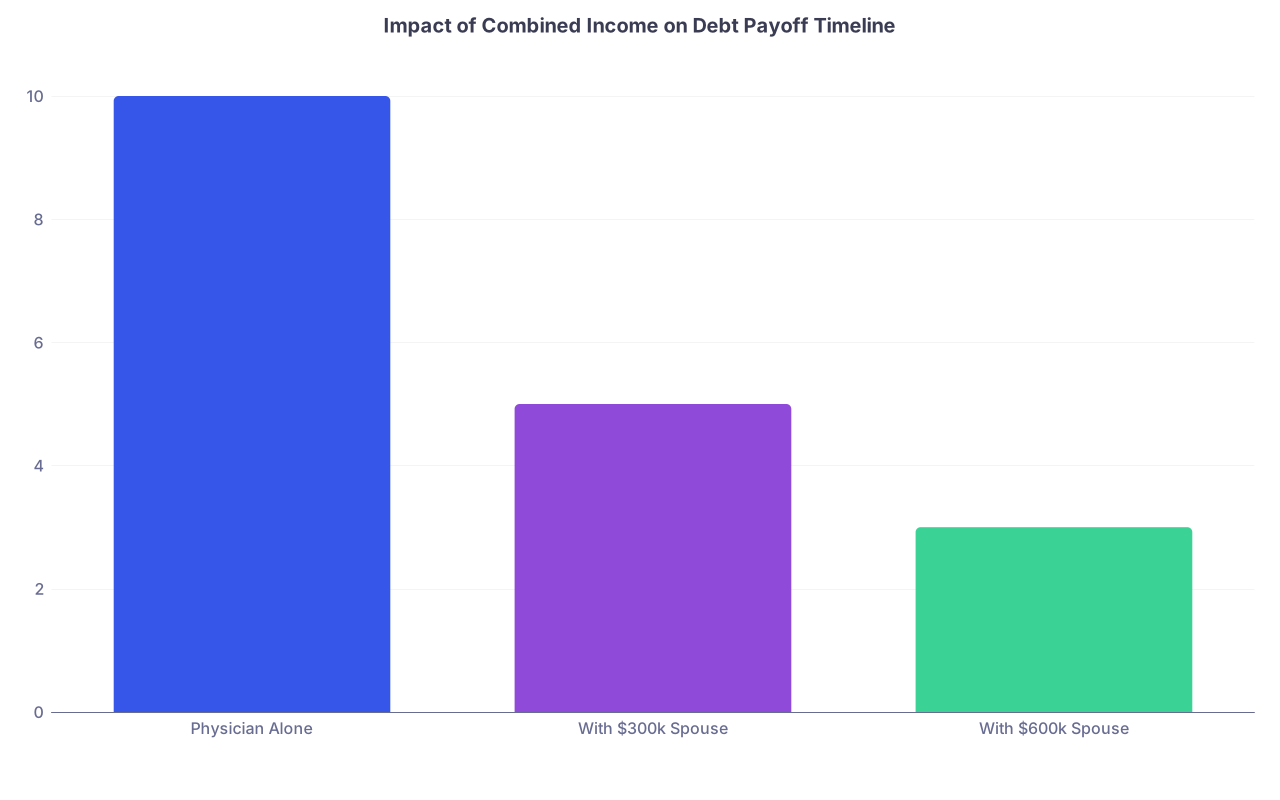
| Category | Value |
|---|---|
| Physician Alone | 10 |
| With $300k Spouse | 5 |
| With $600k Spouse | 3 |
5. Time vs Money: Rewriting Your Default Settings
You have a high-earning spouse. That gives you a luxury many doctors never admit they want: permission to buy back your time.
Here’s where this hits:
- Taking a 0.8 FTE job for fewer clinic days
- Choosing a group with no nights/weekends for slightly lower pay
- Working at a community hospital instead of high-prestige tertiary center
- Saying no to extra admin committees that don’t pay
The Core Question You Should Ask
Every job change, every FTE negotiation, every offer:
“Given our household income, is this extra money worth the extra time, stress, or risk?”
Let’s make up numbers.
Job A:
- $350k
- 1:4 call
- 5 days/week
- High RVU expectations
Job B:
- $290k
- 1:8 call
- 4 days/week
- More relaxed pace
Extra $60k at the cost of:
- Roughly 25–30% more time/stress
If household income with Job B + spouse = $800k vs Job A + spouse = $860k…
Are you really going to burn yourself for the marginal 7%? Especially if that 7% is heavily taxed?
You can say yes. But at least be honest that’s a choice of ego or habit, not necessity.

6. Legal and Risk: Malpractice, Divorce, and Asset Protection
Now the slightly uncomfortable part: high-income marriages are also high-stakes legally.
6.1 Malpractice Risk When Your Spouse Has Assets
If your spouse is accumulating serious wealth (equity, business ownership, real estate), your malpractice risk now intersects with their balance sheet.
You cannot afford sloppy asset structuring.
Basics you should be thinking about (with an actual attorney, not TikTok):
- Max out all protected accounts (401k, 403b, 457, HSA, etc.)
- Consider appropriate malpractice limits (do not cheap out here)
- Understand your state’s protections around home equity, retirement, and tenancy
- Avoid co-mingling certain high-risk assets in your name unnecessarily
With a high-earning spouse, your job is not to become the household’s legal weak point.
| Priority | Why It Matters |
|---|---|
| Adequate malpractice cover | Protects spouse assets |
| Max retirement accounts | Often creditor-protected |
| Proper home titling | Varies by state |
| Umbrella insurance | Non-medical liability |
6.2 Prenups and Postnups: Not Just for Billionaires
If your spouse came into the marriage already earning big, or you both expect rapid wealth growth, pretending divorce is impossible is naive. You don’t have to be cynical to be prepared.
Things I’ve seen:
- Physician with modest income, spouse with startup equity that becomes eight figures
- Bitter divorce where physician gets hammered because everything’s marital property and no one set boundaries early
A well-structured prenup or postnup can:
- Clarify separate vs marital property
- Protect inheritance or family business interests
- Reduce conflict later if something goes sideways
If you’re already married and there’s no agreement, a postnup is still an option in many states. You get it done by a real family law attorney, not off some template.
7. Career Leverage: Using Your Position Wisely
Being married to a high earner is not just about comfort. If you’re smart, it increases your career leverage.
You can:
- Walk away from toxic jobs faster because you’re not paycheck-desperate
- Negotiate more aggressively on schedule, call, and non-compete terms
- Say no to leadership tracks that pay peanuts but demand your soul
- Pivot specialties (early) or do an extra fellowship if it truly aligns with long-term goals
A Practical Framework For Evaluating Offers
When you look at a job offer, rank these four factors:
- Schedule and call
- Culture and team
- Compensation
- Geography
If you were single or sole earner, compensation might be #1 or #2. In your situation, it should usually be #3.
Your spouse’s income buys you the right to demote money in your priority list. Take that seriously. Otherwise you’re just cosplaying scarcity while burning out anyway.

| Step | Description |
|---|---|
| Step 1 | Job Offer |
| Step 2 | Reject or Negotiate Base Pay |
| Step 3 | Reject or Use as Leverage |
| Step 4 | Reconsider - Not Worth Marginal Pay |
| Step 5 | Accept or Shortlist |
| Step 6 | Meets Household Enough? |
| Step 7 | Improves Schedule or Culture? |
| Step 8 | Increases Stress More Than 20 pct? |
8. Concrete Moves To Make In The Next 12 Months
Let’s get very specific. Here’s what I’d tell you to do if you were sitting in front of me.
- Sit down with your spouse and define your household “enough” number. In writing.
- Map your current job or target jobs against that:
- Are you way above “enough”? Then you have slack to optimize for time and lifestyle.
- Build a 3–7 year plan for:
- Loan payoff
- Retirement contributions
- Major shared goals (kids, housing, maybe one partner dialing back hours)
- Reevaluate your willingness to:
- Take lower intensity jobs
- Drop to 0.8–0.9 FTE
- Choose better culture over $
- Meet with:
- Fee-only financial planner (ideally used to high-income couples)
- Asset protection / estate planning attorney
- If relevant, a family law attorney if you’re considering prenup/postnup
Then make one decision in the next year that clearly trades marginal money for sustainable life.
That might be:
- Saying no to extra call for a modest stipend
- Turning down the “higher pay but nightmare culture” job
- Choosing academic/hospital employment with lower pay but human hours
And then not feeling guilty about it—because mathematically and strategically, it makes sense.
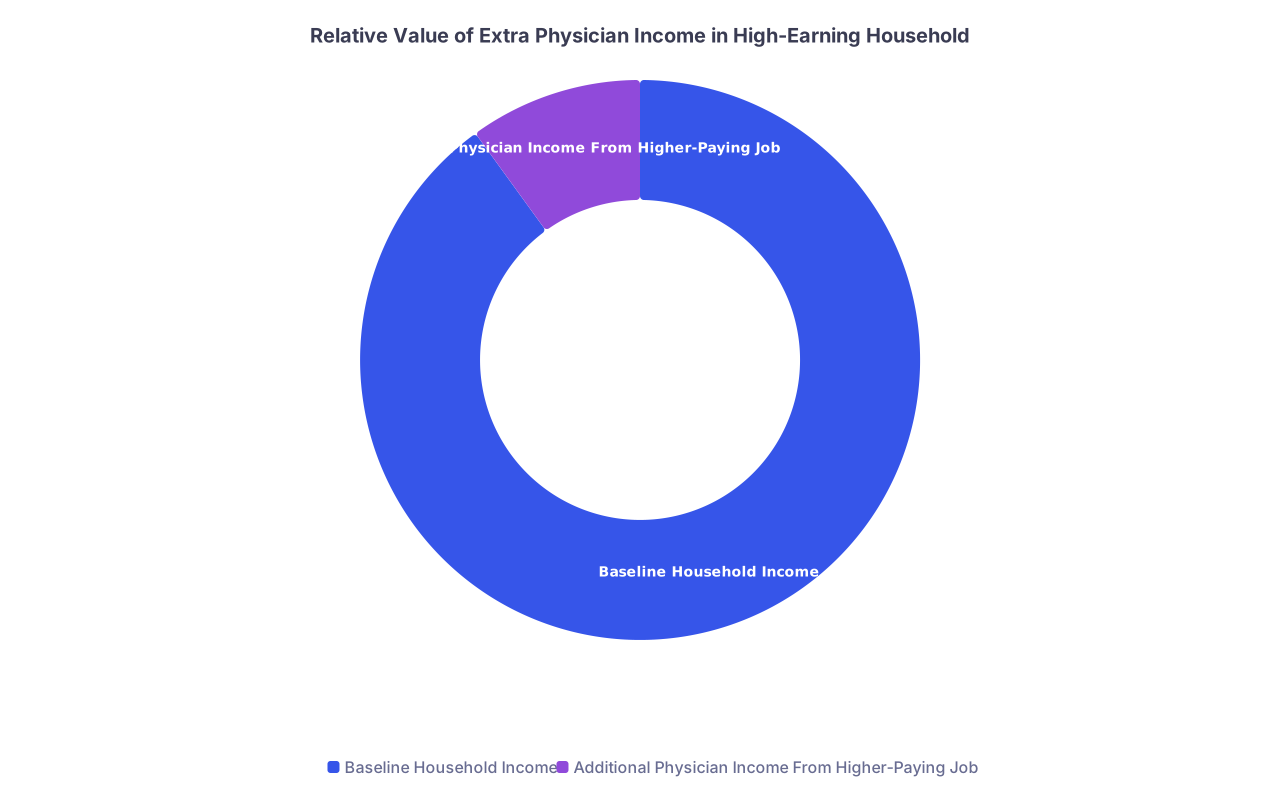
| Category | Value |
|---|---|
| Baseline Household Income | 90 |
| Additional Physician Income From Higher-Paying Job | 10 |

FAQ (Exactly 4 Questions)
1. Should I ever take the highest paying job if my spouse already makes a lot?
Yes, sometimes it still makes sense. If the highest-paying job also has good culture and tolerable call, take the money; there’s no virtue in leaving it on the table. It also makes sense early on (first 3–5 attending years) if you’ve got massive loans you want gone fast. But if the highest paying job clearly wrecks your sleep, your mental health, or your family time, and you’re already above your “enough” number, your spouse’s income tilts the scale strongly toward better lifestyle over max dollars.
2. Does being married to a high earner change how much I should save for retirement?
The target doesn’t really change: you still want to hit 20–25x annual expenses eventually. What does change is how quickly you can get there and how much you need your own accounts versus your spouse’s. Often, the smartest move is both of you maxing tax-advantaged accounts, then investing in a taxable brokerage under a coordinated household plan. Your spouse’s high income gives you room to either (a) front-load retirement savings and reach “work optional” earlier, or (b) intentionally choose lower-paying but more fulfilling roles while still staying on track.
3. Is it unfair if my spouse pays more of our shared expenses because they earn more?
“Fair” in high-income marriages is about agreement, not symmetry. Many couples in your situation adopt percentage-based contributions (each pays proportional to income) or “one income lives, one income builds” (one income covers lifestyle, the other crushes debt/invests). What’s dumb is pretending you’re financially separate when tax, liability, and life are deeply intertwined. The grown-up move is to decide together what feels equitable, document the plan, and revisit every year or two as incomes change.
4. If my spouse earns more, does my career still matter financially?
Yes. A lot. Your income may not be the headliner, but it’s still a stabilizer and a powerful lever. If your spouse’s industry is cyclical (tech, finance, startups, entrepreneurship), your steady physician income is the ballast that keeps the ship upright in storms. It also hedges against disability, burnout, job loss, or divorce. The goal is not to turn your career into a hobby; it’s to stop treating it like it has to single-handedly justify every sacrifice. Your career still matters—now you just get to design it more intentionally.
With these decisions reframed around your household, not just your individual salary, you’re in a rare position of leverage. Use it well, and your job becomes a sustainable part of a good life instead of an endless grind. The next frontier after that? Learning when—and how—to actually pull back your hours without blowing up your identity. But that’s a conversation for another day.