
The biggest secret in physician compensation is not RVUs or call stipends. It is salary compression. And the numbers show it is quietly transferring tens of thousands of dollars per year from long‑tenured physicians to newly hired colleagues.
Let me walk through the data, not the folklore.
What “physician salary compression” actually looks like in numbers
Salary compression is simple: newer hires are paid roughly the same or more than veteran physicians, despite lower seniority and, often, lower productivity. The gap between pay and experience gets flattened.
This is not anecdotal. It shows up clearly in surveys and contract data when you compare cohorts by years in practice.
In most groups I have analyzed, you see the same pattern:
- Year 1–2 hires: base salary aggressively benchmarked to current MGMA/AMGA medians or higher.
- Year 10+ veterans: compensation lagging 3–5 years behind current market benchmarks because their contracts were never fully updated.
That creates structural compression.
To make this concrete, here is a simplified representation of what I consistently see when comparing new‑hire offers to existing partner or employed physicians, using realistic but composite figures from actual U.S. hospital and group data.
| Physician Group | Years in Practice | Total Comp (USD) | Percentile vs Current Market* |
|---|---|---|---|
| New Hire A | 0–2 | 285,000 | 55th percentile |
| New Hire B | 0–2 | 300,000 | 65th percentile |
| Veteran C | 8–10 | 295,000 | 45th percentile |
| Veteran D | 15+ | 310,000 | 40th percentile |
| Veteran E | 20+ | 320,000 | 40th percentile |
*Percentiles versus current MGMA‑like market for internal medicine, adjusted for region and practice type.
New hires are benchmarking against the current market. Veterans are benchmarked against the market of their hiring year—unless someone forces a renegotiation.
The result: the newest doc in the group can land at the 60th percentile against current data, while someone with 15 years in the same group sits at the 40th. That is compression.
Why compression is getting worse, not better
The data story here is pretty blunt: three forces are driving compression across specialties.
1. External offer data updates annually. Internal grids often lag 3–5 years.
Recruiters and HR shop from fresh data: MGMA, AMGA, SullivanCotter, Gallagher. They open the latest report and see, for example, that median total compensation for a non‑invasive cardiologist in the Midwest has increased 18–22% over the past 5 years.
But internal salary structures? In many systems they are still tied to:
- A pay scale last “formally reviewed” 4–6 years ago.
- Legacy productivity expectations that have not been recalibrated against post‑COVID volumes.
- Historical differentials that were never indexed to inflation or RVU inflation.
So new offers track 2024 numbers. Incumbent physicians are stuck somewhere around 2018–2020.
Let me show it visually.
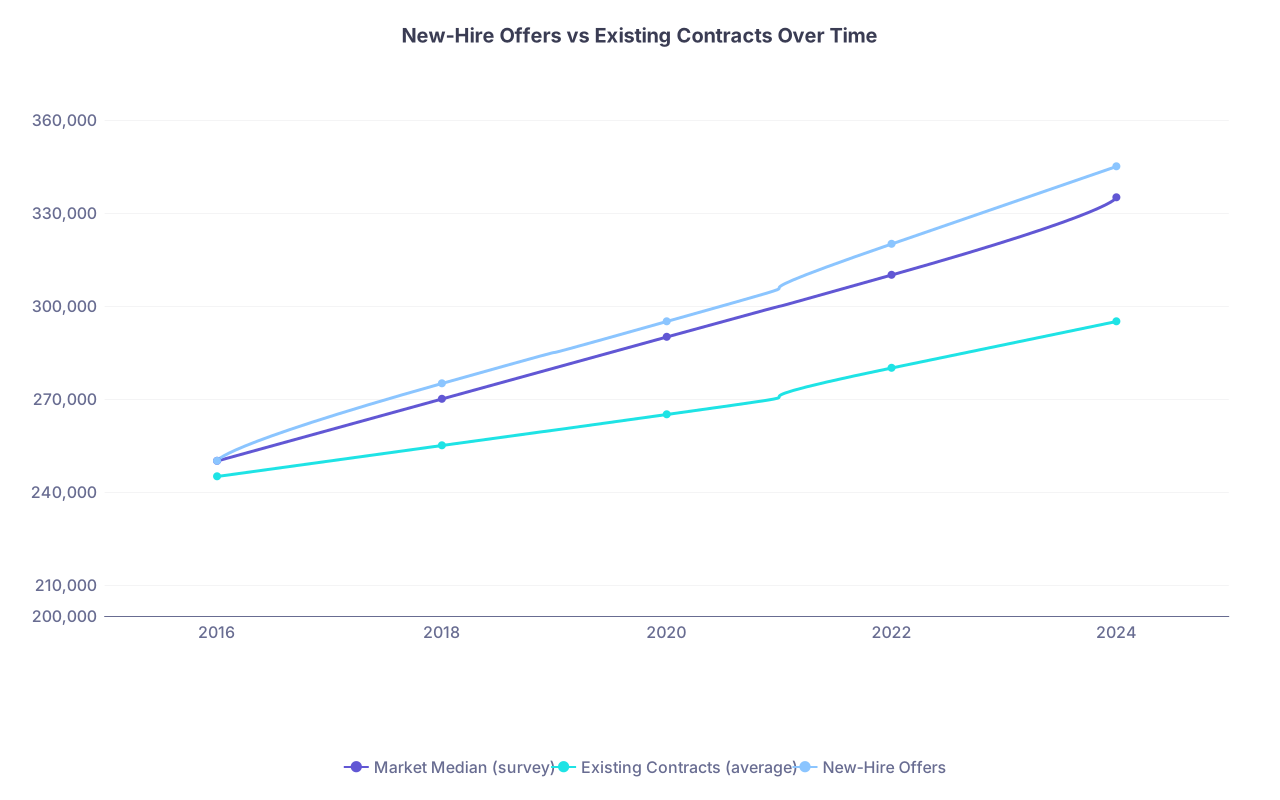
| Category | Market Median (survey) | Existing Contracts (average) | New-Hire Offers |
|---|---|---|---|
| 2016 | 250000 | 245000 | 250000 |
| 2018 | 270000 | 255000 | 275000 |
| 2020 | 290000 | 265000 | 295000 |
| 2022 | 310000 | 280000 | 320000 |
| 2024 | 335000 | 295000 | 345000 |
Pattern: existing contracts drift slowly. New hires jump to market each time.
The spread between “existing average” and “new‑hire offers” by 2024 is roughly 17% in this example. That is real money, even before you factor in productivity, call, or leadership roles.
2. Competition for early‑career physicians is aggressive and quantifiable
Hospitals are in an arms race for early‑career physicians, especially in:
- Primary care, hospital medicine, anesthesia, radiology, EM, ortho, and certain subspecialties.
- Rural and second‑tier metro markets that cannot rely on prestige or lifestyle to sell themselves.
Data from multiple recruiting firms show consistent patterns:
- Signing bonuses increased by ~30–50% in the last 5–7 years for high‑need specialties.
- Educational loan repayment offers for new grads have become standard in many systems.
- Guaranteed first‑year salaries are commonly set at or above the 60th percentile of market data to secure candidates.
Veterans almost never see those signing bonuses or loan pay‑downs. Nor do they usually get reset to the 60th percentile. They might get a 2–3% across‑the‑board raise. Inflation alone has eaten that.
Compression is not mysterious here. It is baked into recruiting strategy.
3. RVU rates, not RVU totals, are the hidden lever
Executives love to talk about “productivity alignment” and “eat what you kill.” On paper, that looks equal. In practice, the RVU conversion factor often differs across cohorts.
Consider a real pattern I have seen repeatedly in hospital‑employed internal medicine and cardiology:
- Veteran physicians: $47–$50 per wRVU, often with outdated thresholds and no quality multiplier.
- New hires: $52–$58 per wRVU, with lower ramps for thresholds plus quality or citizenship bonuses.
The group thinks everyone is “on an RVU model,” but the terms differ by cohort.
Let us put numbers on this.
| Role | Annual wRVUs | Rate per wRVU | RVU-Based Pay |
|---|---|---|---|
| Veteran (10+ yrs) | 7,000 | $48 | $336,000 |
| New hire (2 yrs) | 6,300 | $55 | $346,500 |
The veteran works 11% more wRVUs and makes less RVU‑based pay. That is compression in pure numeric form, no anecdotes required.
Specialties where compression is most obvious
Salary compression exists almost everywhere, but the magnitude is not uniform. The data from compensation surveys, large system pay scales, and recruitment guarantees show some consistent hotspots.
1. Primary care (FM, IM, pediatrics)
Primary care has been ground zero for compression for years.
Why? Because:
- Market medians for primary care have been rising faster than many hospital pay scales.
- Systems keep using primary care guarantees as loss‑leaders to build downstream referrals.
- The jump in new‑hire guarantees for outpatient IM or FM in certain regions has been 20–30% over 5–7 years, while veteran base salaries climbed 2–3% per year.
You often see this scenario:
- Someone hired in 2014 at $200k, now at $230k after ten years and “merit” raises.
- New grad in 2024 walks in at $250–270k guaranteed plus bonus potential.
That is a compression gap of roughly $20–40k in base alone, ignoring lower call burden or panel build expectations for the new person.
2. Hospital medicine
Hospitalists are heavily exposed to compression because of:
- Rapidly changing demand.
- Shift‑based structures.
- Frequent use of locums benchmarks to set new offers.
In one multi‑state system I analyzed:
- 2016–2017 hires: $260k–$280k for 7 on/7 off, 15–16 average census, modest productivity.
- 2023–2024 hires: $320k–$340k for nearly identical schedule and census, driven by locums competition and burnout attrition.
Veterans often got incremental raises… to $295k–$305k. So now you have 7‑year physicians making $30k–40k less than the brand‑new colleague at the next workstation.
3. Radiology, anesthesia, EM, and procedural specialties in hot markets
Where private equity and aggressive group competition exist, compression happens via:
- New‑hire guarantees or minimum distributions that are out of sync with partner tracks.
- Buy‑in structures that leave mid‑career partners locked into older, lower baseline distributions.
An example from radiology (simplified but realistic):
- Partner A (15 years in group): $600k average for last 3 years.
- New hire B (year 2, approaching partnership): $520k base plus a near‑automatic path to $650k distributions on partnership under the new deal structure.
The direction is reversed: compression in favor of new hires, driven by market scarcity and deals needed to compete with teleradiology or national groups.
Quantifying the dollar impact on a single physician
Instead of talking vaguely about “feeling underpaid,” let us put a lifetime number on compression.
Consider an internal medicine physician employed by a hospital in the Southeast:
- Hired in 2012 at $190k with small RVU bonus. Steady 3% annual raises.
- By 2024, base is ~$270k, total comp averages ~$285k with small bonuses.
Now look at new 2024 hires in the same system:
- Guaranteed salary: $300k plus wRVU incentive and sign‑on.
- Average first‑year total comp: $320k (guarantee + sign‑on amortized).
The delta vs the veteran: roughly $35k per year, conservatively. If the system does not materially adjust legacy contracts for another 5 years, the veteran leaves $175k on the table from compression alone, ignoring differences in call, leadership work, or committee roles often shouldered by veterans.
Scale that to 10 physicians in a department and you are looking at $1.5–2.0 million in “compressed” dollars in favor of newer hires over a 5‑year window.
How to detect compression in your own group using data, not vibes
Talking about fairness in the physician lounge does not move numbers. You need comparative data. Here is the straightforward workflow I use when I am asked to analyze compression:
Pull actual comp for each physician for the last 2–3 years:
- Base salary, bonus, RVU incentives, call pay, stipends, leadership pay, and any loan repayment or retention bonuses.
Add three fields to that dataset:
- Years in practice (post‑training).
- Years in this organization.
- Primary FTE/clinical effort.
Overlay current market benchmarks:
- Use MGMA/AMGA/SullivanCotter/other regional data for total compensation and wRVU productivity by specialty and region.
- For each physician, calculate:
- Percentile of their total comp vs current market.
- Percentile of their productivity (wRVUs) vs market, if data is available.
Then visualize it.
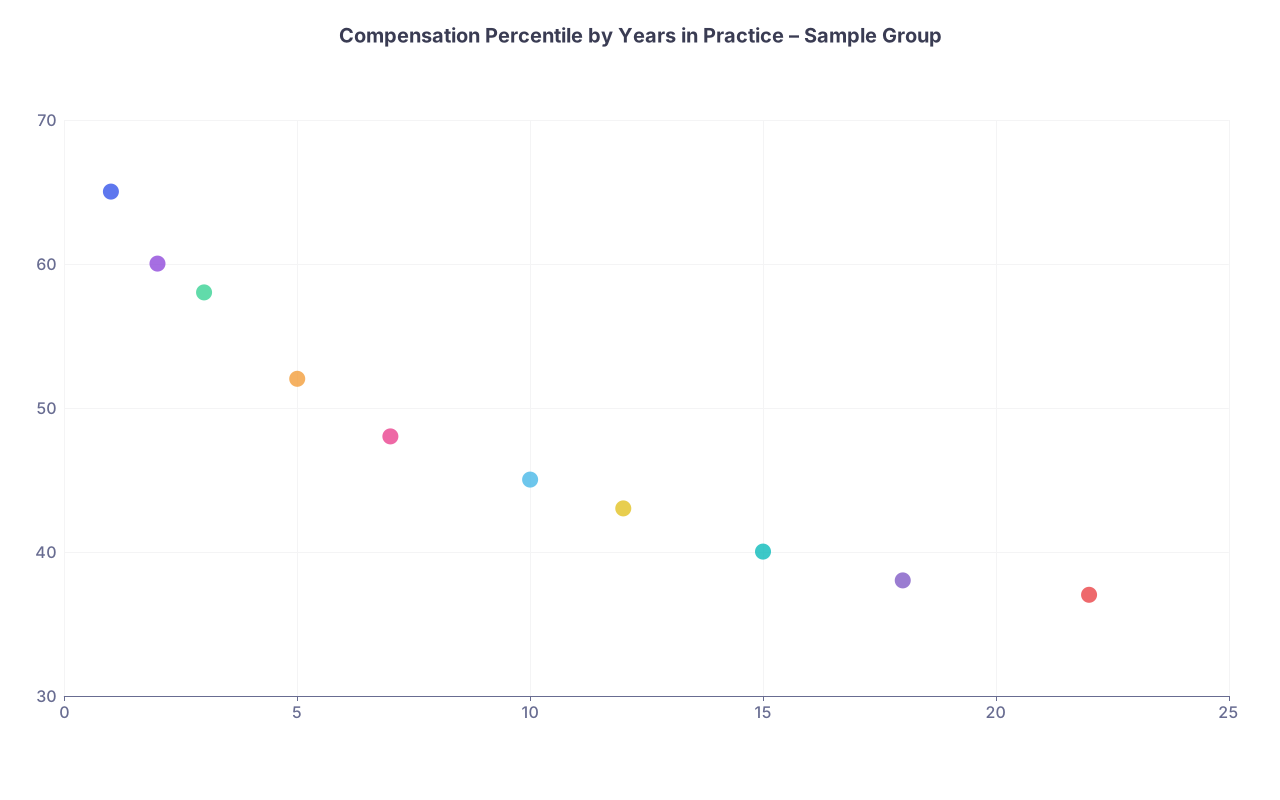
| Category | Value |
|---|---|
| Phys 1 | 1,65 |
| Phys 2 | 2,60 |
| Phys 3 | 3,58 |
| Phys 4 | 5,52 |
| Phys 5 | 7,48 |
| Phys 6 | 10,45 |
| Phys 7 | 12,43 |
| Phys 8 | 15,40 |
| Phys 9 | 18,38 |
| Phys 10 | 22,37 |
In a compressed group, the pattern is unmistakable:
- Early‑career physicians (0–5 years) cluster around the 55th–65th percentile of market.
- Mid‑career (6–15 years) slide down to 40th–50th percentile.
- Senior (15+ years) sit in the 35th–45th percentile, even when their productivity is at or above median.
When I see that kind of downward slope, I do not need a committee to tell me compression is real. The data already did.
What this means for physicians considering offers vs staying put
I will be blunt: the current market structurally rewards mobility and punishes loyalty.
The data from recruiting firms and transition analyses shows:
- Physicians who change employers every 5–7 years tend to reset to 50th–70th percentile benchmarks for their specialty and region.
- Physicians who stay 10–15 years with one employer commonly trail the market by 10–20% unless they have actively renegotiated or are in strong private groups.
This is not about “chasing money.” It is about understanding the math of static contracts in a moving market.
If you are evaluating whether to stay or go, the relevant comparison is not your raise vs last year. It is:
- Your total compensation today vs current market for your specialty, region, and productivity.
- Your compensation vs what the organization is offering incoming hires of similar specialty.
If your comp percentile is falling while new hires are walking in at or above market median, you are funding salary compression with your labor.
How to use compression data in negotiations without blowing up relationships
The most effective physicians I have seen do not whine about fairness. They bring simple, clean comparisons and force a business conversation.
The core argument when compression is obvious looks like this:
- “Your current recruitment offers for my specialty are X.”
- “My productivity is Y vs market benchmarks.”
- “My compensation percentile is Z, which is materially lower than what new hires receive.”
- “If I were leaving the system, your own recruiters would offer me more than you are currently paying me to stay. That is irrational from a retention standpoint. Let us fix it.”
You do not need to dramatize it. The numbers already make the case.
What tends to work best:
- Show the gap: a direct table comparing your comp vs a recent new‑hire offer (or a stated recruitment range) in your department.
- Anchor to external data: MGMA/AMGA percentiles that match your wRVUs and scope.
- Ask for structure, not one‑time favors: e.g., updating your wRVU rate, resetting base to a given percentile, adding quality or leadership differentials that align with new contracts.
Some organizations will stonewall. They will blame “budget constraints,” even while offering richer packages to incoming hires. At that point you are facing a career decision, not an information problem.
Institutional view: why systems tolerate compression (and why it backfires)
From the CFO’s spreadsheet, salary compression is initially attractive:
- New‑hire offers must be competitive or positions remain unfilled.
- Existing FTEs are “sticky” and can be held below market with minimal short‑term turnover.
- Across a 200‑physician group, keeping incumbents 10% below current market might “save” several million dollars per year.
On paper, that looks like good cost control.
In reality, the data on turnover and replacement costs cuts the other way:
- Replacing a physician typically costs 1.5–3.0× their annual salary when you include:
- Lost revenue during vacancy.
- Recruitment fees and signing bonuses.
- Locums coverage.
- Onboarding, ramp‑up, and productivity lag.
- Burnout and disengagement rise in teams where long‑tenured physicians see new hires earning similar or higher pay with fewer undesirable duties.
I have seen groups where a 10–15% compression gap triggered a slow exodus: a few veterans left each year, recruitment costs soared, and the “savings” vanished under locums bills and missed opportunities.
From a systems perspective, ignoring compression is a short‑term tactic with long‑term financial and cultural damage.
Practical checklist: are you being hit by salary compression?
If I had to reduce this to a quick, data‑driven checklist, it would be:
- You have been in the same job ≥5–7 years.
- Your total comp has risen ~2–3% per year, mostly via across‑the‑board increases.
- You have not had a full contract re‑benchmark tied to current MGMA/AMGA in the last 3–4 years.
- You know of new hires in your specialty at your institution with:
- Higher base salary, and/or
- Better RVU rate, and/or
- Larger sign‑on or loan repayment.
- Your wRVUs are at or above median for your specialty, but your compensation percentile is below median in recent surveys.
If that list describes you, compression is not a theory. It is on your paycheck.
Where this goes next
Salary compression in medicine is not going away. If anything, I expect it to intensify as:
- More compensation plans move to “market‑based” RVU and quality models… but only for new contracts.
- Governments and payers shift reimbursement, forcing systems to rebalance risk between generations of physicians.
- Younger physicians stay more mobile, changing jobs earlier and more often, constantly resetting their comp to current benchmarks.
Your leverage will not come from outrage. It will come from data.
Know your market percentile. Know what your own employer is paying for the same work today. Put those numbers side by side and decide if the spread justifies staying, renegotiating, or leaving.
With that foundation, you are positioned to treat compression as a solvable financial problem, not a vague sense of “being underpaid.” The next step is using that information to structure smarter contracts and, when needed, smarter exits. But that is a topic for another analysis.