
The fellowship you choose can quietly cost you millions of dollars over your career.
Not because you picked the “wrong” specialty morally or intellectually. Because you walked into predictable, avoidable financial traps that almost no one in training will warn you about.
I am going to be blunt: I have watched very smart residents lock themselves into lower lifetime earnings, worse contract leverage, and miserable geographic constraints because they treated fellowship choice like an academic decision instead of a financial and legal one.
You are not just choosing what you will do. You are choosing:
- How much you will eventually earn
- How long you will delay earning it
- How much leverage you will have with employers
- How easily you can leave a bad job
If you are not factoring that in, you are making a serious mistake.
1. Treating “Prestige” as a Proxy for Lifetime Income
The most expensive fellowship mistake I see? Confusing reputation with revenue.
You hear it all the time on rounds:
- “You have to do Cards at a big-name academic place.”
- “That program places people at top centers.”
- “You will be more competitive if you do a second fellowship.”
None of those statements mention actual money. Or contract terms. Or job market saturation.
Here is the ugly truth: a “prestigious” fellowship can absolutely reduce your lifetime earnings if it:
- Adds years of low-paid training
- Funnels you into academic tracks that pay less
- Forces you into saturated urban markets where you have zero leverage
- Normalizes abusive non-competes and RVU expectations
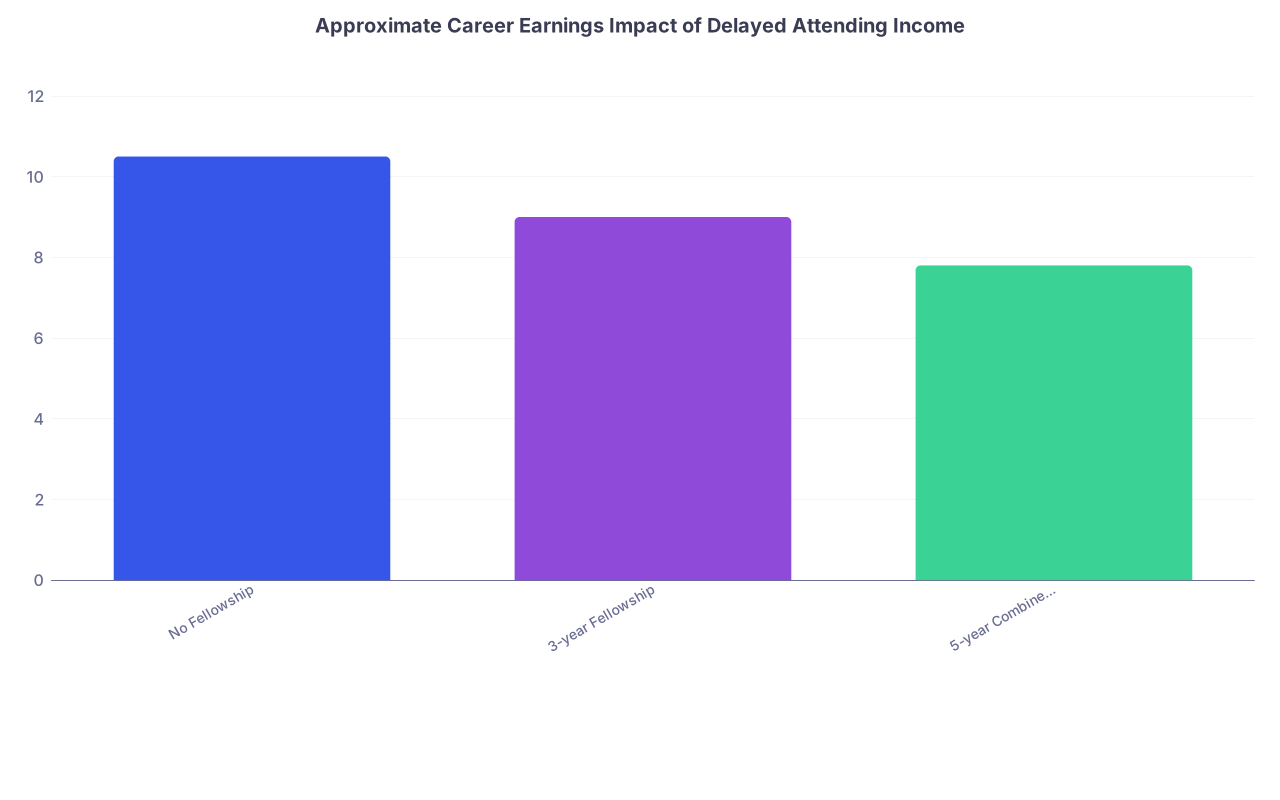
| Category | Value |
|---|---|
| No Fellowship | 10.5 |
| 3-year Fellowship | 9 |
| 5-year Combined Fellowships | 7.8 |
(Values in millions over 30 years assuming a conservative earning path and no investing advantage from earlier cash flow.)
Here is the mistake pattern:
- Resident falls in love with the idea of being at a “top program.”
- Chooses a longer or extra fellowship because the culture there sees it as the “next logical step.”
- Accepts an academic or large system job where the pay is “fine” but 20–40% below what they could make in a less shiny but high-demand region.
- Ten years later, realizes they traded seven-figure lifetime income for name recognition that patients do not care about and employers exploit.
What you should do instead:
- Get real salary data. Not rumors. Pull MGMA/AMGA data if you can, talk to recent fellows in actual jobs, not “I am still in my research year” limbo.
- Separate ego from math. If the “elite” program adds 2–3 years of extra training or research and leads to a job that pays $75k–$150k less per year than a community role…run the calculation honestly.
- Ask this question: “Where did your last 10 graduating fellows end up, and what are their typical compensation ranges?” If they cannot answer or dodge it, that is a red flag.
Do not confuse a big-name badge for big-time pay. The two often diverge.
2. Ignoring Time Value of Money and the Cost of Extra Training
Another subtle but lethal mistake: treating all training years as equal.
They are not.
Each extra year of fellowship is not just “one more year before I am an attending.” It is:
- One fewer year of high-earning compounding
- One more year of lower resident/fellow salary
- One year of delayed retirement savings, debt payoff, and investment growth
Let me put rough numbers to it.
Say:
- You could finish residency and earn $320k/year as a generalist
- Or you do a 3-year fellowship to earn $450k/year afterward
Easy call, right? Not so fast.
Lost income over 3 years of fellowship:
- 3 × ($320k – $75k fellow salary) ≈ $735k pre-tax difference
Now factor investing:
- If you had invested even $75k/year of that difference for those 3 years, compounding at a modest 5–7% over 25–30 years, the opportunity cost lands easily in the high six to low seven figures.
If your post-fellowship salary bump is only $80k–$120k/year above the generalist path, the math often becomes very tight. Especially once you adjust for:
- Extra call burden
- Shorter career horizon (burnout, exit into non-clinical work)
- Academic vs private practice pay gaps
Do not make the mistake of:
- Looking only at the end salary number
- Ignoring the time cost required to get there
At minimum, do this:
- Build a simple 30-year projection comparing:
- No fellowship
- One fellowship
- Extra/second fellowship
- Include:
- Years at trainee pay
- Expected starting attending pay
- Conservative annual increases
- A basic assumed savings rate and investment growth
If that sounds tedious, that is exactly why most physicians never do it. And why they quietly sacrifice $500k–$2M in lifetime net worth without realizing it.
3. Underestimating How Geography Controls Your Income
I have seen this play out more times than I can count:
- Resident trains on the coasts
- Does fellowship at another coastal academic center
- Spouse has a job or family there
- They “have” to stay in that city afterward
And just like that, their effective earning ceiling drops by 20–40% compared with the exact same specialty in a less saturated, lower-COL region.

Fellowship choice locks you into geography more than you think because:
- Most people take jobs where they train or where their co-fellows are going
- Family, schools, and social networks anchor you
- Academic mentors often push you toward their institutional network
And unfortunately, “desirable” cities often mean:
- Higher cost of living
- Lower relative salaries
- Less negotiating power (you are easily replaceable)
Your mistake if you are not careful:
- Picking a fellowship solely on perceived prestige or location quality, then waking up to a job market where your “dream city” pays 30% less than a mid-sized or rural city that desperately needs your skill set.
What to check before ranking fellowships:
- Where do graduates actually work geographically?
- What are typical starting offers by region for that specialty?
- How many job options would you realistically have if you insist on staying in one city or state?
The worst financial trap is being over-trained for a saturated market. Highly sub-specialized, minimal portability, and stuck competing for a small number of jobs at large systems that all share the same compensation philosophy.
4. Choosing Ultra-Narrow Subspecialties Without Market Research
Hyper-specialization looks sexy during fellowship interviews.
Interventional niche. Rare procedural focus. Ultra-specialized imaging. A 2-year “super fellowship” that three people in your state can do.
You get promised:
- Intellectual challenge
- Cutting-edge techniques
- “You will be indispensable”
No one says:
- “Your job options will be extremely narrow.”
- “If the hospital decides to cut that service line, you are sunk.”
- “Private groups may not need you full time for that niche.”
| Path | Training Length | Typical Job Options | Market Risk |
|---|---|---|---|
| General GI | 3 yrs | Hospital, PP, ASC, mixed | Low–Moderate |
| Advanced GI only | 4 yrs | Tertiary centers mainly | Moderate–High |
| General Cards | 3 yrs | Hospital, PP, multi-state | Low–Moderate |
| Structural-only Cards | 4–5 yrs | Limited high-volume centers | High |
| Gen Heme/Onc | 3 yrs | Community + academic | Low |
The financial danger is simple:
- You become employable only at a narrow set of institutions
- Those institutions know it
- Your leverage disappears
If your only viable jobs are:
- A couple of big urban academic centers
- A few multi-hospital systems that already have similar specialists
then:
- Your chance of landing a top-paying, lifestyle-balanced role drops
- Your risk of getting stuck with a mediocre salary and terrible call goes up
- If you need to move for family reasons, you may have to downshift into general work you have not done in years, which weakens your negotiating posture
How to avoid this:
- Before you commit to a highly specialized fellowship, call actual community and regional groups in 3–4 states. Ask:
- “Would you ever hire someone with this specific training?”
- “Do you have enough volume to support this focus?”
- Talk to graduates 5+ years out, not just the recent ones still riding academic inertia. Ask about:
- Job flexibility
- How many real offers they had
- Whether they could move states without a pay cut or role shift
Do not let your career be held hostage by a niche that three hospitals control.
5. Ignoring Legal Landmines: Non-Competes, Call, and Contract Leverage
Here is the quiet killer almost no resident reads carefully: fellowship contracts and the patterns they normalize.
Fellowship is where you absorb what is “standard”:
- Call burden
- RVU targets
- Non-compete clauses
- Restrictive covenants
- Expectations for “academic productivity” on your own time
You see abusive or one-sided terms repeatedly, and they start to feel normal.
Then you go to sign your first attending contract and you under-react to red flags because everything looks vaguely familiar.

| Step | Description |
|---|---|
| Step 1 | Fellowship Norms |
| Step 2 | High call overload |
| Step 3 | Low pay as default |
| Step 4 | Non-competes seen as normal |
| Step 5 | Accept heavy call in first job |
| Step 6 | Underestimate legal risk |
| Step 7 | Burnout and early exit |
| Step 8 | Trapped or forced to move far |
Specific fellowship-choice mistakes here:
Training only in systems with harsh non-competes
- You normalize 20–50 mile non-competes, multi-year restrictions, and “you cannot practice in this specialty” clauses.
- When a future employer offers you a slightly “better” version, you think you are winning. You are not.
Choosing programs that indoctrinate you into toxic call expectations
- If you train where q2 or q3 call is standard and people brag about it, you get desensitized.
- Private or community groups later know you will tolerate more than you should.
Exposure only to one employment model
- Only large health system. Or only academic. Or only private group.
- You never see how different the legal and financial structures can be, so you have no comparison point.
What to do differently:
- During fellowship interviews, ask pointed questions about:
- Non-competes in the affiliated health system
- Typical attending call schedules in that specialty
- How often fellows see contracts or are offered basic contract-education sessions
- Talk to recent grads about their first attending contracts, not just their current job. Ask:
- “What surprised you legally or financially when you first signed?”
- “Did your fellowship prepare you for that at all?”
You want a fellowship environment that at least acknowledges the legal traps. If they dismiss all of it as “that is just how it is,” be wary.
6. Chasing Passion While Ignoring Burnout Risk and Lifestyle Reality
“Yes, the hours are bad now, but it gets better after fellowship.”
Sometimes it does. More often, it…shifts. Different flavor, same volume.
Certain fellowships are burnout factories by design:
- Heavy night call
- High-acuity, emotionally brutal patient populations
- Constant emergency add-ons and unpredictable volume
- Hospital cultures that glorify self-sacrifice
The financial problem is not just that you are tired. It is that burnout:
- Shortens your career
- Drives you into early semi-retirement, part-time work, or non-clinical roles
- Cuts the “back half” of your highest-earning years
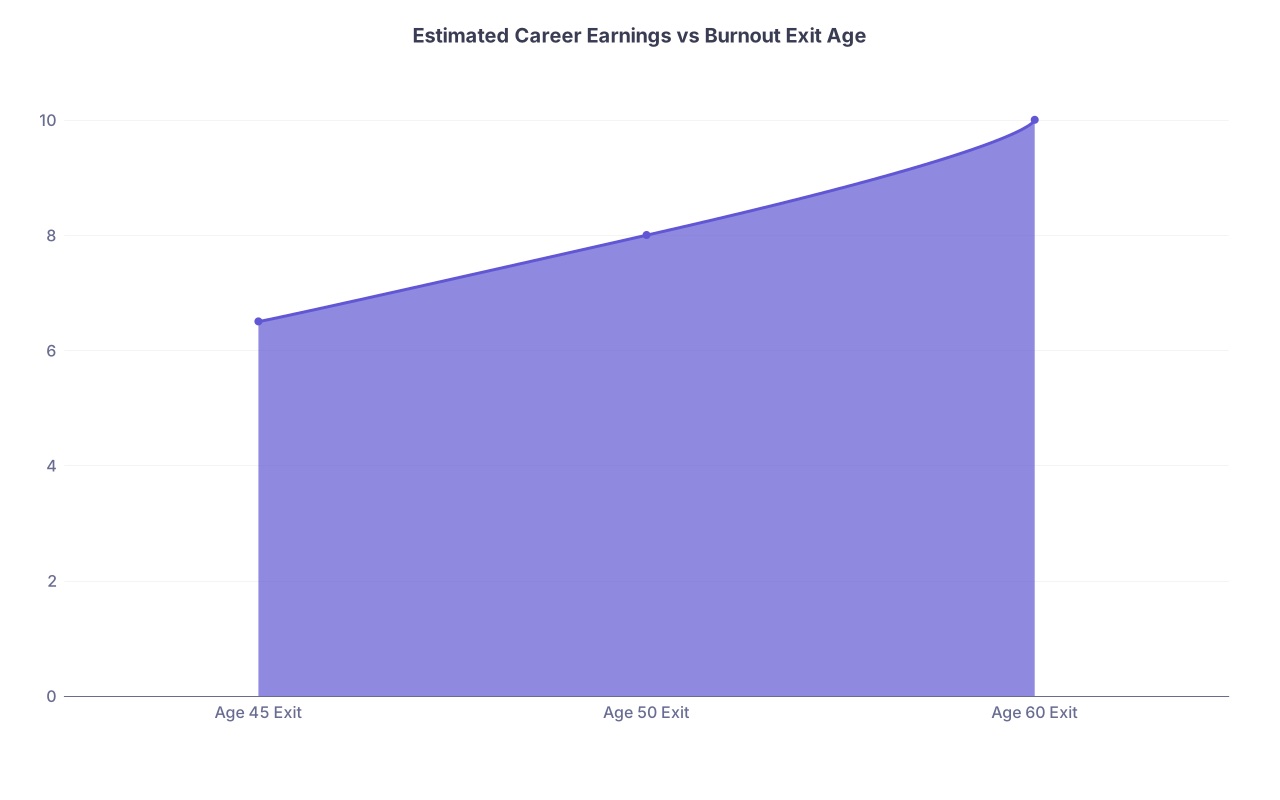
| Category | Value |
|---|---|
| Age 45 Exit | 6.5 |
| Age 50 Exit | 8 |
| Age 60 Exit | 10 |
(Rough illustrative millions over career in a high-paying specialty. Leaving 10–15 years early erases huge chunks of income.)
If you pick a fellowship with:
- Chronically understaffed coverage
- Endless weekends and nights
- Little backup for complications or volume surges
you are loading the dice toward earlier burnout, especially once:
- You have children
- Aging parents need help
- Your own health is not invincible
Mistake: assessing fellowship based only on “am I interested in this disease process?” instead of “can I sustainably do this work in my 40s and 50s without hating my life?”
Questions you should ask current fellows and attendings:
- “How many attendings have left in the last 5 years, and why?”
- “What percentage of people in this subspecialty cut to part-time by mid-career?”
- “How realistically do people here protect their days off and vacations?”
Your passion for the field will not overcome a structurally abusive service line forever. It will just delay the crash. And that crash is expensive.
7. Neglecting Exit Options and Transferable Skills
Another under-discussed mistake: choosing a fellowship that traps you if you ever want out of full-time clinical work.
Some fields integrate naturally into:
- Industry roles (pharma, med devices, biotech)
- Consulting
- Hospital admin and leadership
- Informatics
- Population health
Others are so deeply procedural and OR-anchored that your non-clinical leverage is limited unless you start building alternate skills early.
I have watched people train 6–7 extra years for hyper-procedural specialties, burn out by 45, then scramble to find something else because:
- Their entire identity and skill set are built on being in the lab/OR/cath suite
- They have minimal experience with research, QI, operations, or broader systems work
This is not about abandoning medicine. It is about preserving optionality. Because life happens:
- Chronic illness
- Family crises
- Institutional collapse
- Reimbursement cuts in your specific niche
You want a fellowship that either:
- Keeps you broad enough to pivot (e.g., gen cards vs ultra-niche only)
- Or, if narrow, is paired with mentorship and exposure to non-clinical pathways
When interviewing and choosing, ask yourself:
- “If I cannot or do not want to do full-time clinical work in this niche at 50, what else will this fellowship make me credible for?”
- “Are there graduates who moved into industry, admin, or other roles? Or is everyone locked into one clinical track?”
Failing to think about exit options is a long-term earnings mistake. Because forced, desperate career pivots rarely pay well.
8. Letting Mentors and Culture Decide for You
Last mistake, and probably the most common: outsourcing your decision to the culture around you.
You hear a version of:
- “You are too smart not to subspecialize.”
- “People with your board scores should do X.”
- “Our program sends its best people to ____.”
Here is what those people are not thinking about:
- Your student loan balance
- Your partner’s career
- Your need to support parents or siblings
- Your personal risk tolerance for long training paths
- Your retirement goals or desire for location flexibility
They are thinking about:
- Their own specialty bias
- Their program’s match list
- Their research pipeline
- Their department’s prestige
I have watched IM residents who could have been very happy, very well-paid hospitalists get talked into:
- Cards → EP → structural
- GI → advanced → another add-on
- Heme/Onc → narrow malignant-only niche
Each extra “layer” added delay, complexity, and sometimes boxed them into academic salaries they never really wanted.
You must separate:
- What impresses your mentors
- From what serves your financial, legal, and personal reality
A practical filter: if someone is strongly pushing you toward a longer or narrower fellowship, ask them directly:
- “What do you see as the financial and lifestyle downsides of this path?”
- “If I decided not to subspecialize, what would I be giving up, and what would I be gaining?”
If they cannot articulate clear pros and cons beyond prestige, title, and niche expertise, take their advice with caution.
FAQs
1. How do I quickly sanity-check whether a fellowship makes financial sense?
Use a simple three-step check:
- Compare no-fellowship vs fellowship incomes over 30 years, including training years.
- Estimate debt payoff and investing timeline for each path (earlier attending income has huge compounding advantages).
- Adjust for realistic burnout and lifestyle—if the higher-earning path also has a significantly higher burnout risk, do not assume a 30-year career at full blast.
If you cannot reasonably argue that the fellowship path will leave you clearly better off financially and sustainably, you should pause.
2. Are academic fellowships always a bad financial choice?
No. The mistake is going academic by default, or for prestige alone, without understanding trade-offs. Many people choose academic careers for research, teaching, or very specific types of work. That is valid.
The problem is when someone who actually values higher income, geographic flexibility, or shorter training gets pulled into academic fellowship tracks that underpay and overbind them legally, just because the name looks better. Align the fellowship with your real priorities, not your mentors’ priorities.
3. What if I am already in a fellowship that might be a financial mistake?
Then your job is to salvage leverage:
- Get aggressive about understanding compensation data and non-compete trends now.
- Build broad skills (admin, QI, informatics, teaching) that give you more job options later.
- Network outside your institution and region so you are not hostage to one job market.
You cannot undo the time you are spending, but you can prevent a second mistake: drifting into the first job offered without ruthless evaluation of salary, call, legal terms, and long-term growth.
Key points to remember:
- Fellowship choice is a financial and legal decision disguised as an academic one.
- Time, geography, and niche all quietly cap or expand your lifetime earnings.
- If you do not actively protect your leverage, someone else will quietly use it against you.