
The way most practices handle losing an associate is financially lazy and ethically shaky. They quietly expect you to absorb the work while pretending your compensation structure doesn’t need to change.
You cannot afford to play along with that.
This is one of those inflection points in a career: a colleague leaves, the schedule blows up, and suddenly you’re seeing 20–40% more patients with zero formal conversation about pay, liability, or burnout. I’ve watched people ride that wave for 6–12 months “to be a team player” and end up resentful, exhausted, and underpaid.
Let’s not do that.
This is a playbook for what to do the moment your practice loses an associate: how to handle the extra work, how to protect yourself legally and financially, and exactly what to ask for when you sit down with leadership.
Step 1: Get Clear on What Just Changed (Before You Volunteer for Anything)
Do not start by “being helpful.” Start by getting data.
Ask yourself and your admin team some very specific questions:
What was the associate actually doing?
- Number of clinic sessions per week?
- OR days / procedure blocks?
- Call coverage %?
- Specific subtypes of patients/procedures (e.g., all OB, mostly complex spine, mostly nursing home work)?
What’s already on the books?
- How many of their follow-ups and post-ops are already scheduled?
- How far out is the schedule now pushed for new patients?
- Are there specific payor contracts or hospital expectations tied to that associate’s FTE?
What is leadership assuming?
- Are they assigning patients to you by default?
- Are they cancelling clinic sessions, or just piling people on?
- Is anyone saying words like “temporary,” “bridge,” or “team effort” without dates and numbers attached?
This is where you pull some quick numbers. Rough is fine, but write them down:
- Your average weekly clinic volume before they left
- Your current schedule (next 4–8 weeks)
- Your wRVUs or collections trend from the last 6–12 months
Then estimate what’s coming your way. For example:
- The associate saw 80 patients/week
- There are 3 of you left
- Admin is “distributing evenly”
- That’s ~25–30 extra patients/week for you
That’s not a rounding error. That’s a different job.
Step 2: Know Whether Your Compensation Structure Protects You
How you respond depends heavily on your comp model.
| Comp Model | Extra Work Impact | Key Risk to You |
|---|---|---|
| Straight salary | More work, same pay | Burnout, resentment |
| Base + productivity | More work, some more pay | Underpaid rate per RVU |
| Pure productivity | More work, more pay | Capacity + burnout |
| Partnership/eat-what-you-kill | Big upside/ downside | Unequal risk vs ownership |
If you’re:
Straight salary (no RVU/bonus)
Every extra patient you see is essentially free labor for the practice. You’re subsidizing their staffing problem. That doesn’t mean you never help. It does mean you set limits or renegotiate.Base + RVU/collections bonus
Extra patients should increase your pay. The question becomes:- Are RVUs valued fairly?
- Is there a cap?
- Are there bottlenecks (OR time, imaging slots, staff) that limit your ability to actually realize that upside?
Pure productivity
You might win financially if you can absorb volume. But you must negotiate:- More block time / exam rooms / MA support
- Call stipends if call increases
- Explicit guardrails on “temporary” admin expectations
Owner/partner with shared overhead
Losing an associate can raise your overhead percentage. If you are also taking extra work and extra risk, your conversation shifts to:- How quickly are we recruiting?
- Do we adjust overhead allocation temporarily?
- Do we use locums, and who absorbs that cost?
If you do not know exactly how your comp formula works, this is the moment you sit down with the practice manager or CFO and say:
“Walk me through exactly how extra RVUs or collections convert to my paycheck. Show me last year’s numbers and what happens if my volume increases by 20–30%.”
No more guessing.
Step 3: Decide What You’re Actually Willing to Take On
Before you step into any negotiation, you need your own boundaries.
Break the problem into 4 buckets:
- Clinic volume
- Procedures / OR time
- Call coverage
- Administrative/leadership tasks (e.g., covering committees, supervising APPs, med director roles)
For each one, ask:
- What’s my current level?
- What’s the ask (explicit or assumed)?
- What is my hard ceiling?
Be specific. For example:
- Clinic: “I can add 1 half-day session per week for 3 months. Not more.”
- Call: “I can increase from 1:6 to 1:5 short term if we have a written plan to hire within 6 months.”
- OR: “If I take on these extra surgeries, I need guaranteed block time, not ‘squeeze them in’ nonsense.”
Write this out. Your future self needs this when the guilt trip starts.
Step 4: Do the Math on “Fair Compensation” Before You Talk
You can’t negotiate effectively with vibes. You need numbers.
Here’s a simple workflow.
A. Estimate extra work RVUs or revenue
Take the associate’s prior year data if you can get it:
- Annual wRVUs or collections
- Percentage of that you’re realistically expected to cover (e.g., 30–60%)
If the associate generated 7,000 wRVUs and there are 3 remaining physicians:
- 7,000 / 3 ≈ 2,300 wRVUs potentially heading to you
- If your compensation per wRVU is $50, that’s $115,000 in additional value you are creating
Now ask: how much of that will actually reach your paycheck under the current structure?
If your current RVU rate is low, or the bonus threshold is high, you may be giving the practice a six-figure gift for free.
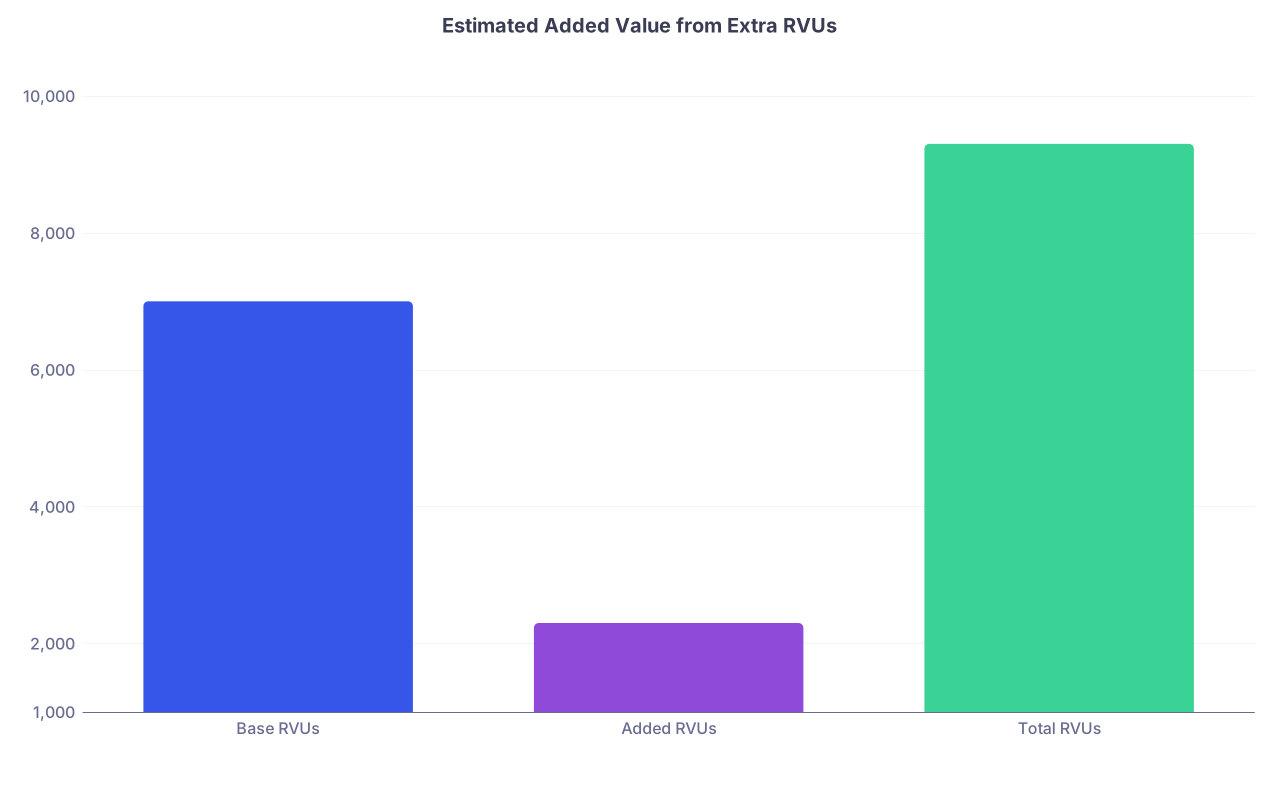
| Category | Value |
|---|---|
| Base RVUs | 7000 |
| Added RVUs | 2300 |
| Total RVUs | 9300 |
B. Compare to local and specialty norms
Look at:
- MGMA or specialty society data for:
- $ per wRVU
- Total comp for your specialty at your percentile of productivity
- Colleagues in similar markets and practice types
If you are jumping to 75th percentile productivity, you should not be stuck at 50th percentile pay.
C. Translate to specific asks
You do not go into the meeting saying, “I want to be treated fairly.” That’s useless.
You say things like:
- “If I absorb this additional clinic and associated RVUs, I want my RVU rate increased from $50 to $60 for RVUs above my current target for as long as we’re understaffed.”
- “If I’m covering an additional 5 call days per month, I’m asking for $X per weekday and $Y per weekend day as a call stipend, retroactive to the date Dr. Smith left.”
- “If we’re moving me from 0.8 FTE to de facto 1.0 FTE, I want my base aligned with the 1.0 FTE rate, not frozen where it is.”
Have your numbers ready in a one-page summary. Not a manifesto. Just clean math.
Step 5: Sit Down With Leadership – And Run the Conversation Like a Businessperson
Let me be blunt: if you walk into this meeting in “good soldier” mode, you will lose.
You’re not being selfish. You are aligning incentives so you can sustainably do more work without burning out.
Structure the conversation.
1. Start with facts, not emotions
Something like:
“Since Dr. Patel left, my clinic volume has increased by about 25%. My next available new-patient slot is 6 weeks out instead of 2. I’m also on call 1:5 now instead of 1:6. I want to talk about how we handle this extra work and how my compensation aligns with it.”
Then show (briefly) your one-page numbers.
2. Explicitly separate temporary vs permanent
Ask direct questions:
- “Is this increase in volume expected to be temporary or permanent?”
- “What’s our realistic timeline for hiring a replacement?”
- “If we haven’t recruited someone by [X date], do we reassess this plan?”
People will avoid specifics unless you force them. Don’t let them.
3. Propose concrete structures, not just “more money”
Here are a few workable frameworks I’ve seen negotiated:
Temporary RVU uplift:
“For all RVUs above my pre-departure baseline, pay at $X per RVU for 12 months or until a new physician starts, whichever comes first.”Call stipend:
“For each extra call shift beyond my prior average, pay $X. We review volume, admissions, and any associated liability after 3 months.”Temporary FTE change:
“Adjust my contract from 0.8 to 1.0 FTE for the next 9 months with corresponding base salary increase and vacation adjustment. When the new hire starts, we revisit my FTE and schedule.”Leadership supplement:
If you’re taking on supervisory/admin load the associate used to carry:
“Add a $X/month medical director or lead physician stipend for the duration of these extra responsibilities.”

4. Put time limits and review points on everything
No open-ended “for now.”
Say:
- “Let’s set a formal 3-month review on this, with updated RVU and scheduling data.”
- “If we haven’t hired by 6 months, I want the right to revisit my schedule and FTE.”
And then get it in writing. Email recap at minimum. Contract addendum ideally.
Step 6: Legal and Contractual Safeguards You Should Not Ignore
You don’t have to be paranoid. But you do have to be precise.
A. Re-read your contract
Look specifically for:
- FTE definition and expectations
- Language about “duties as assigned”
- RVU/bonus formulas and caps
- Call coverage requirements and compensation
- Non-compete and termination clauses
If your contract is vague like “physician will perform such duties as reasonably requested,” that’s a blank check. You need to narrow it in practice with written side agreements.
B. Watch for scope creep that becomes the “new normal”
Here’s a common pattern:
- Associate leaves.
- You take extra clinic, call, and admin “temporarily.”
- Practice drags its feet recruiting because the revenue is fine.
- One year later, your schedule is still jammed, and management talks about your “established panel” like this was always the plan.
To avoid that, you want language in writing like:
“These additional sessions / call burdens are temporary measures associated with the vacancy created by Dr. X’s departure and will be revisited upon hiring of a replacement physician or by [date], whichever comes first.”
It does not have to be fancy legalese. It just has to be written.
C. Consider talking to a physician contract attorney
Especially if:
- They want you to sign a new comp plan that is hard to reverse
- You’re being offered partnership or equity in lieu of cash
- Your non-compete and call obligations are expanding
Spending $500–$1,500 on a contract review is trivial compared to the six figures at stake.
Step 7: Operational Realities – You Can’t Just “Work Harder” Forever
Even if you’re being paid fairly, there are physical limits.
You need to look at your days like an engineer, not just a martyr.
A. Infrastructure check
Ask for specific support if volume is going up:
- More MA or RN staffing
- Scribe support
- Extra exam room
- Additional block time in OR / procedure suite
- Scheduling triage (e.g., APPs see low-acuity follow-ups)
If they want more RVUs from you, they need to invest to make that feasible without torpedoing your life.
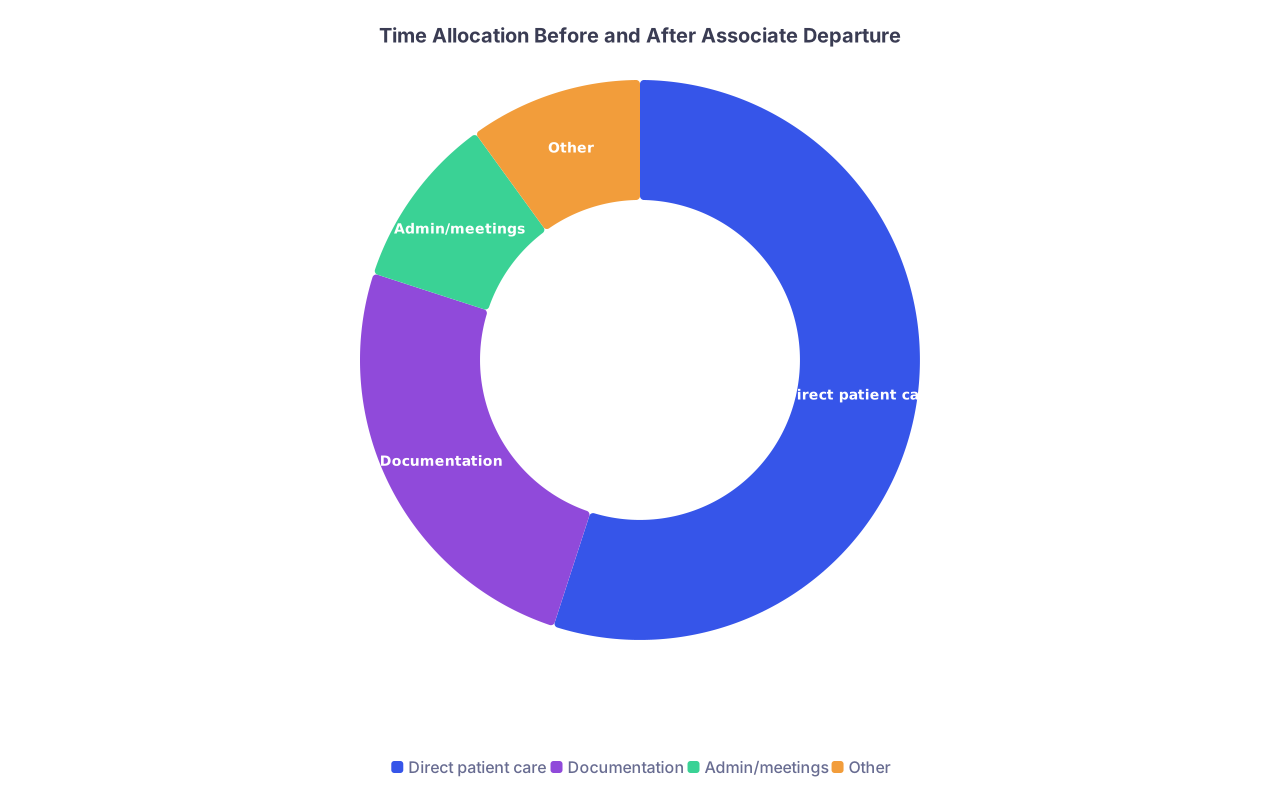
| Category | Value |
|---|---|
| Direct patient care | 55 |
| Documentation | 25 |
| Admin/meetings | 10 |
| Other | 10 |
Then post-change, you monitor whether documentation/admin starts eating into nights and weekends. If your after-hours charting time jumps by 50–100%, you have data to push for scribes or devoted admin time.
B. Patient safety and quality
If leadership tries to push you to unsafe volumes, say it out loud:
“I am concerned that increasing to X patients per day will compromise quality and increase risk. Here’s what I believe is a safe and sustainable ceiling: [number]. Beyond that, we need additional clinicians or APP support.”
Quality and liability are not just altruistic concerns. They’re shields in negotiation.
C. Protecting your personal capacity
Red flag checklist. You’re heading toward trouble if:
- You’re charting more than 1–1.5 hours routinely after getting home
- You’re consistently skipping lunch or bathroom breaks
- Your error/near-miss rate is creeping up
- Family or friends are complaining they never see you
Extra pay doesn’t fix a wrecked life. Build in no-clinic half-days, protected admin blocks, and actual vacations, and tie them to your willingness to sustain higher productivity.
Step 8: Special Situations (Hospital-employed vs Private Practice vs Academic)
The tactics shift a bit depending on where you work.
Hospital-employed
You usually have:
- HR-driven comp plans
- Less flexibility on base salary
- More ability to get temporary stipends and “adjustments” approved
Tactics that work:
- Temporary “critical coverage” stipend
- RVU uplift above baseline
- Protected admin time if you’re covering leadership gaps
- Documentation of how your extra work supports hospital service-line goals (they love that language)
Private practice (non-owner)
You’re often dealing directly with partners who benefit from your extra production.
You push on:
- RVU/collections split (percentage to you vs group)
- Formalized path to partnership if you’re now essentially carrying partner-level workload
- Locums or temporary hires to relieve you if recruiting drags on

Owner/partner
Now it’s you on both sides of the table. Financially, you might want the revenue. Personally, you may not want the burnout.
Be honest:
- If volume is up, profits should be up. Fine.
- But do not confuse “this is good for the practice” with “this is sustainable for me.”
You may decide to:
- Temporarily reduce your clinic for lower-margin work (e.g., nursing home rounds, low-level follow-ups) and let APPs handle those
- Increase your own take-home proportionately instead of adding another partner immediately
- Or decide the answer is a locums or another full FTE, even if it means lower short-term profit
Academic is its own beast—often you’ll bargain time (protected academic time, reduced committees) rather than direct dollars, but the logic is the same: more clinical = you get something back.
Step 9: If They Refuse to Compensate You Fairly
Sometimes leadership just shows you who they are. Believe them.
If any of this sounds familiar:
- “We’re all family here, everyone has to pitch in.”
- “Think of the patients, we can’t just let them go elsewhere.”
- “This is an opportunity for you to show you’re a team player.”
- “We’ll remember this at bonus time” (with no specifics)
…then you’re not dealing with a compensation problem. You’re dealing with a cultural problem.
Your options:
Set hard limits anyway
“I will see X patients per day. I will take call at my prior rate. Beyond that, we need to bring in locums or APPs.”Quietly start planning your exit
Non-compete, tail coverage, and repayment clauses all matter here. Check them now, not after you explode.Document everything
Emails where you raised concerns about workload and safety. Requests for support that were denied. This isn’t to be dramatic; it’s to protect yourself if/when something goes wrong.

| Step | Description |
|---|---|
| Step 1 | Extra work after associate leaves |
| Step 2 | Negotiate details and document |
| Step 3 | Set firm workload limits |
| Step 4 | Stay with boundaries |
| Step 5 | Plan exit and review contract |
| Step 6 | Fair compensation offered |
| Step 7 | Culture acceptable long term |
What “Good” Looks Like: A Reasonable Outcome
Just so you have a reference point, here’s a composite example of a reasonable outcome I’ve seen:
- FP doc in a hospital-employed group; associate leaves
- Her volume increases by ~20%
- Hospital offers:
- Temporary $10/wRVU uplift for RVUs above prior 12-month baseline
- Extra MA support and part-time scribe
- Increase from 0.9 to 1.0 FTE with prorated base increase
- Promise to reassess after 9 months or at hire of replacement
- They put it in a 2-page addendum. Everyone signs.
Is it perfect? No.
Is it fair enough and time-limited? Yes.
Does it respect that her time and risk are valuable? Also yes.
That’s the bar.
You’re not just covering a gap. You’re absorbing real financial and legal risk on behalf of the practice. If they want you to carry that, they need to pay for it—and they need to structure it in a way that doesn’t wreck your career longevity.
With those boundaries and numbers in hand, you’re prepared for the compensation side of a colleague’s departure. The next battle, if you stay, is making sure recruiting doesn’t stall forever and you’re not trapped at “crisis tempo” indefinitely. But that’s a story for another day.