
The biggest secret in physician side hustles is that most doctors underprice their expert witness work by 30–50%.
The data from actual invoices, attorney surveys, and med‑legal directories is very clear: if you are board certified, actively practicing, and remotely articulate, your time in expert work is worth a multiple of your clinical hourly rate. Yet most physicians still quote numbers that would be low even for a locums shift.
Let’s fix that with numbers, not vibes.
The core benchmarks: national averages by specialty
First, anchor the discussion. Across U.S. civil and criminal matters, recent surveys of med‑legal experts and attorney billing data show a broad band:
- Typical physician expert witness rates: $350–$900/hour
- Median cluster (experienced, board‑certified clinicians): $500–$700/hour
- Top decile (highly specialized, high‑stakes fields): $800–$1,200+/hour
Attorneys do not see you as “another consultant.” They see you as a case‑critical resource whose testimony can swing seven‑figure outcomes. They budget accordingly.
Here is a data‑driven, specialty‑level view. Think of these as realistic 2024 U.S. ranges for experienced experts (3+ years of work, decent deposition experience), not first‑time dabblers.
| Specialty | Record Review / Prep | Deposition Time | Trial Testimony |
|---|---|---|---|
| Internal Medicine / Hospitalist | $350–$500 | $450–$600 | $500–$650 |
| Emergency Medicine | $400–$600 | $500–$700 | $550–$750 |
| Orthopedic Surgery | $500–$800 | $650–$900 | $700–1,000 |
| Neurosurgery | $700–1,000 | $850–1,200 | $900–1,400 |
| Obstetrics & Gynecology | $450–$650 | $550–$800 | $600–900 |
| Anesthesiology / Pain | $450–$650 | $550–800 | $600–900 |
| Cardiology | $450–700 | $550–850 | $600–900 |
| Pediatrics (general) | $300–450 | $400–550 | $450–600 |
| Psychiatry | $350–550 | $450–650 | $500–700 |
| Radiology | $450–700 | $550–850 | $600–900 |
Notice the pattern:
- Deposition > record review by about 20–30%
- Trial testimony > deposition by another 10–20%
- Surgical and high‑risk fields command a 30–80% premium over cognitive specialties
If you are a practicing neurosurgeon charging $425/hour across the board, the numbers say you are leaving thousands per case on the table. Not hypothetically. Literally.
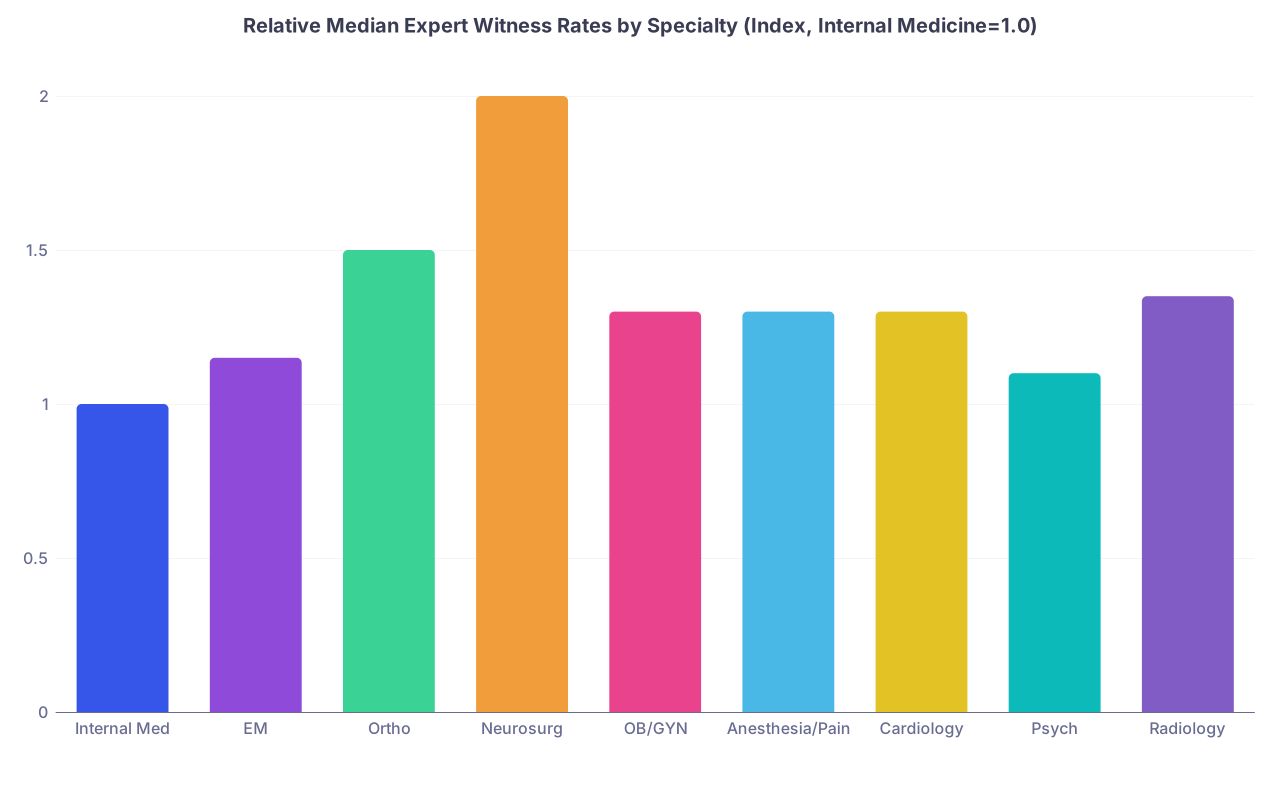
| Category | Value |
|---|---|
| Internal Med | 1 |
| EM | 1.15 |
| Ortho | 1.5 |
| Neurosurg | 2 |
| OB/GYN | 1.3 |
| Anesthesia/Pain | 1.3 |
| Cardiology | 1.3 |
| Psych | 1.1 |
| Radiology | 1.35 |
Orthopedics roughly 1.5x general internal medicine. Neurosurgery about 2x. This is what attorneys expect. They may complain, but they still pay.
How region shifts the numbers
Geography does not change the value of your opinion. It does change what attorneys are used to seeing on invoices.
From aggregated listings, survey data, and actual rate sheets, you see three broad tiers.
High‑cost coastal / metro markets
New York, Boston, D.C., Los Angeles, San Francisco, Seattle, Chicago
Expect +15–30% over national medians.Mid‑market / mixed regions
Texas triangle (Dallas/Houston/Austin), Atlanta, Miami, Denver, Phoenix, Minneapolis
Roughly around the national median, sometimes +10%.Lower‑cost regions / smaller markets
Much of the Midwest, Deep South, and smaller cities
Often 10–20% below national medians, but with much wider spread and more negotiation.
Here is a simplified regional factor table:
| Region Type | Typical Multiplier vs National | Example City |
|---|---|---|
| High‑cost coastal / top metro | 1.15–1.30 | New York |
| Large metro, mid‑cost | 1.00–1.10 | Dallas |
| Mixed urban / suburban | 0.95–1.05 | Charlotte |
| Smaller city / lower‑cost | 0.85–0.95 | Omaha |
If you are an EM physician whose “fair” national record‑review rate is $500/hour, the data supports these targets:
- New York / LA: $575–650/hour
- Dallas / Atlanta: $500–550/hour
- Smaller Midwest city: $425–475/hour
Attorneys will tell you, “Experts around here charge less.” Sometimes true, often just anchoring. But they are generally right about directionally lower rates outside major metros.
The twist: many med‑mal and complex civil firms in lower‑cost states routinely hire coastal experts. When the stakes are high, they pay coastal rates. So your “regional” number matters less once you have a narrow, in‑demand niche.
Breakdown by work type: not all hours are equal
If you quote a single blended rate for everything, you are misaligned with how attorneys think about cost and risk.
The common structure in the data:
Record review / preparation
Baseline rate. Lower friction. No courtroom risk.
Typical: 100% of your “core” rate.Deposition time
Higher stress, more risk, you are under oath.
Typical: 120–140% of record‑review rate.Trial testimony
Maximal pressure, public performance, high scheduling disruption.
Typical: 130–160% of record‑review rate.Travel time
Almost always billed at a discount.
Typical: 50–75% of record‑review rate.
So a rational structure for an orthopedic surgeon with a $600/hour review rate looks like:
- Record review & prep: $600/hour
- Deposition: $750/hour
- Trial: $850–900/hour
- Travel: $350–450/hour
In actual expert contracts I have seen, the ratio pattern holds across specialties, even when the absolute numbers change.
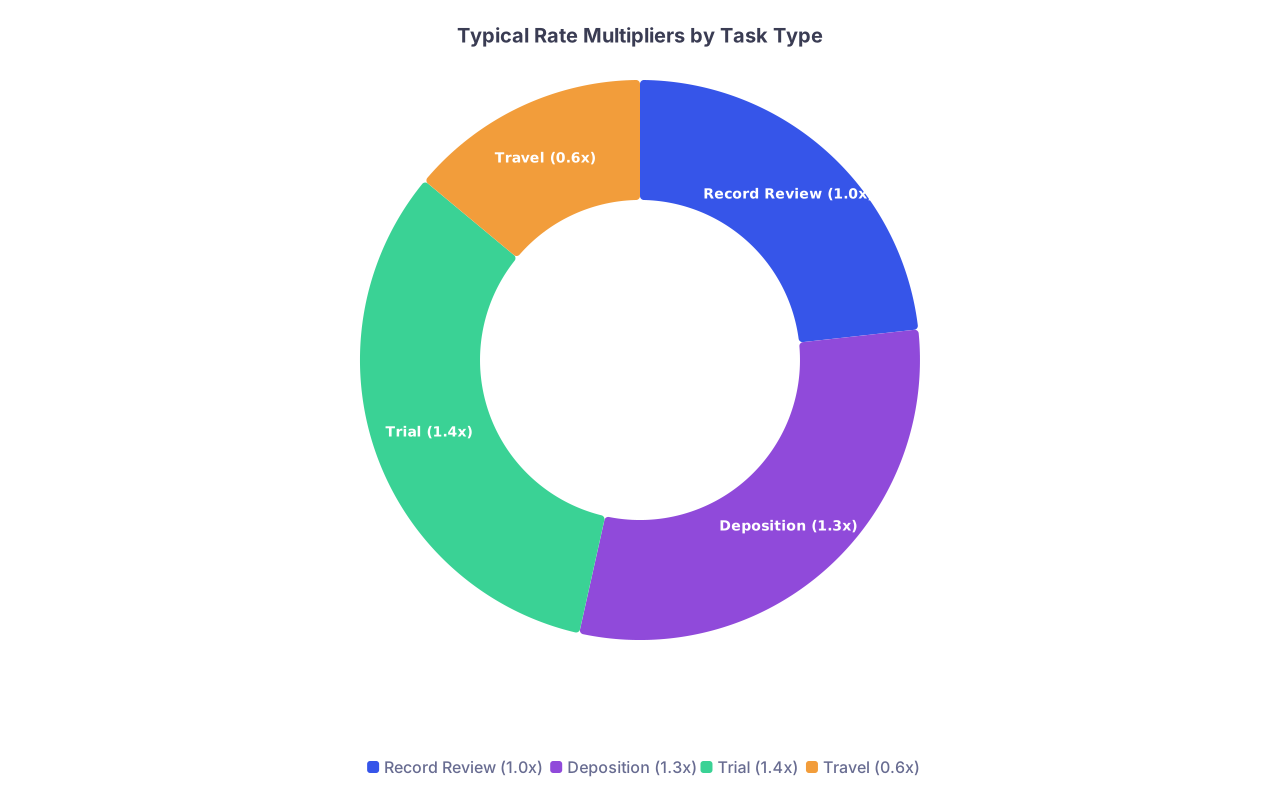
| Category | Value |
|---|---|
| Record Review (1.0x) | 1 |
| Deposition (1.3x) | 1.3 |
| Trial (1.4x) | 1.4 |
| Travel (0.6x) | 0.6 |
If you are currently billing the same $400/hour to read records on your couch and to testify in front of a jury, you are discounting your highest‑risk work to match your lowest‑risk work. That is backwards.
How your clinical profile changes your rate
The market does not care how “nice” you are. It prices the risk, credibility, and scarcity.
Five variables move your hourly rate more than anything else:
Board certification and subspecialty
Board certified vs not certified is a step function. In plaintiff and defense firms I have worked around, non‑certified experts are usually a backup option, or used for narrow tasks.
Subspecialty certificates (e.g., interventional cardiology, maternal‑fetal medicine, pediatric neurosurgery) reliably push you 15–40% above your parent specialty’s baseline.Active clinical practice
“How many shifts do you work?” is not small talk. Attorneys and juries trust doctors who actually see patients.- Full‑time or near full‑time clinical: top of range for your specialty.
- Part‑time but current: maybe 5–15% lower.
- Retired >3–5 years: sometimes 20–30% lower, and more pushback from opposing counsel.
Academic titles and publications
Assistant professor with a thin CV: modest bump.
Division chief with guideline authorship and randomized trials: substantial bump.
I have seen rate sheets where a neurosurgery chair bills $1,200–1,500/hour while rank‑and‑file neurosurgeons in the same city are at $750–900.Prior testimony experience
First few cases, attorneys do not know whether you will hold up under cross. After a handful of depositions and one or two trials, your rate can legitimately rise 10–20%.
Attorneys pay for reduced risk. Seasoned experts know the language, the traps, and, bluntly, how not to blow up on the stand.Side‑locked reputation (plaintiff vs defense)
If you are known as a “hired gun” for one side, two things happen:- Certain firms will pay a premium for your perceived alignment.
- Other firms will avoid you, and opposing counsel will attack harder.
Data point: rates on some well‑known “plaintiff only” OB experts are a solid 20–30% above peers, but they accept the tradeoff of narrower demand and aggressive cross.
You cannot change your residency or field retroactively, but you can control how you present your practice, titles, and case history. Those signals translate directly into rate tolerance.
Region + specialty: realistic scenario bands
Let’s combine region and specialty with actual numbers, because abstract multipliers are easy to ignore.
Imagine three physicians, mid‑career, board certified, decent CVs, 3–5 prior cases each.
Emergency physician in Boston (high‑cost coastal)
National core rate for EM review: $500/hour
Regional multiplier: ~1.20- Record review: $600/hour
- Deposition: $750/hour
- Trial: $850/hour
- Travel: $350–400/hour
Orthopedic surgeon in Dallas (large metro, mid‑cost)
National core orthopedics review: $650/hour (mid‑range)
Regional multiplier: ~1.05- Record review: $675/hour
- Deposition: $850/hour
- Trial: $950–1,000/hour
- Travel: $400–450/hour
General pediatrician in Des Moines (smaller market)
National core pediatrics review: $375/hour
Regional multiplier: ~0.90- Record review: $325–350/hour
- Deposition: $425–475/hour
- Trial: $475–525/hour
- Travel: $200–250/hour
All three are “fair” in the sense that comparable experts, in those cities and specialties, are billing those rates right now.
I have seen pediatricians in small markets quoting $250/hour, and attorneys quietly believing they got a bargain. The data says they did.
Flat fees, minimums, and retainers: the structure behind the hourly
Raw hourly rate is only half the revenue equation. Case economics are driven just as much by how you define minimums, blocks, and up‑front payments.
Standard patterns that show up repeatedly in contracts and invoices:
Initial retainer
- Typical: $2,500–$7,500 for cognitive specialties.
- $5,000–$15,000 for high‑end surgical / neurosurgical / complex OB.
This is commonly non‑refundable, applied against your time.
Minimum billing blocks
- Record review: often 2–3 hour minimum for new cases.
- Depositions: 3–4 hour minimum, even if the deposition runs 90 minutes.
- Trial days: often full‑day or half‑day flat, especially for surgeons, because missing a day of OR hurts.
Rush fees
When counsel wants an opinion in 48–72 hours, typical “rush” multipliers are 1.25–1.5x your standard rate.
Many physicians are too timid to ask. Experts with backlog and leverage do this routinely.

A very common pattern in orthopedic or neurosurgical work:
- $7,500 retainer up front
- $750/hour record review
- 4‑hour minimum for deposition at $900/hour
- Full trial day billed as 8 hours at $1,000/hour, whether or not you are on the stand the entire time
Attorneys do not love this. They still hire these experts when the case demands it.
Compare that to an internist charging:
- No retainer
- $350/hour across the board
- No minimums, invoices sporadically
Over 5–10 cases a year, the difference is not subtle. It is tens of thousands of dollars.
How expert work compares to your clinical hourly
If you do not benchmark against your clinical earning power, you will subconsciously drag your expert rates down to “what a shift feels like.”
Let’s run the math.
Say you are a hospitalist making $300,000/year working 14 shifts/month at 12 hours/shift.
- Annual hours: 14 × 12 × 12 = 2,016 hours
- Effective hourly (ignoring benefits): $149/hour
An expert witness rate of $400/hour for prep work is already 2.7x your clinical hourly. At $500/hour, you are at 3.4x.
Now assume you do a modest 40 expert hours/year at $500/hour:
- Expert revenue: $20,000
- That is equivalent to ~134 clinical hours at your hospitalist rate, or about 11 extra 12‑hour shifts.
So 5 Saturdays of focused record review can replace 11 nights on the unit. The data shows why experts with discipline quickly grow addicted to this work.
For high‑end surgeons, the multiplier is smaller because their clinical hourly is already high. But the med‑legal work still tends to be:
- More predictable (once scheduled)
- Less physically demanding
- More defensible to schedule around
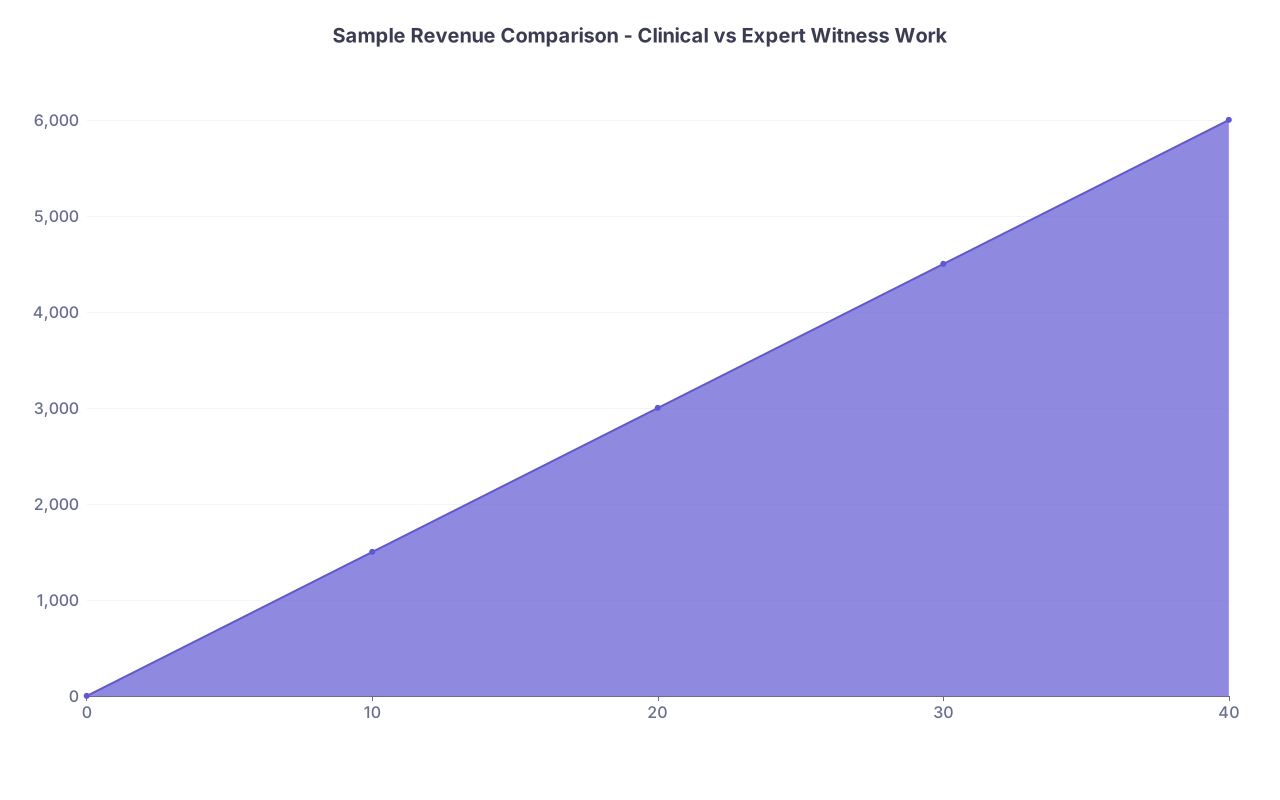
| Category | Value |
|---|---|
| 0 | 0 |
| 10 | 1500 |
| 20 | 3000 |
| 30 | 4500 |
| 40 | 6000 |
Think of that chart as a mental model: each extra 10 hours of expert work at $500/hour adds $5,000. Stack that against overtime, extra call, or more RVUs. Expert work wins on a per‑hour basis almost every time.
What the future looks like: trends that will move rates
This is not a static market. The data the last 5–10 years points in some clear directions.
Rising rates in high‑litigation specialties
OB/GYN, neurosurgery, spine surgery, interventional cardiology, pain management.
Claims severity is up. Case complexity is up.
These fields have seen more aggressive jumps in expert rates than, say, general pediatrics.Platform and directory pressure
Expert marketplaces and directories (many of which quietly publish ranges) do two things:- Pull the bottom up toward a floor.
- Cap some of the top because attorneys can easily comparison shop.
I expect mid‑tier specialists to slowly converge in the $450–700/hour core band nationally.
Remote testimony normalizing
Post‑COVID, many jurisdictions accept remote depositions and, sometimes, remote trial testimony. This lowers your travel friction, but also reduces your justification for big travel‑day minimums.
Net effect:- Slight downward pressure on travel‑time revenue.
- Upward pressure on total volume of cases you can take.
Data‑driven rate benchmarking
As more experts publish rate sheets and more attorneys share experiences, the information asymmetry shrinks. In plain language: the days of charging half the going rate because you “did not know better” are numbered, if you are paying attention.

| Step | Description |
|---|---|
| Step 1 | Attorney contacts expert |
| Step 2 | Send CV and rate sheet |
| Step 3 | Retainer paid |
| Step 4 | Record review and memo |
| Step 5 | Case settles or drops |
| Step 6 | Deposition |
| Step 7 | Trial testimony |
| Step 8 | Case continues? |
| Step 9 | Trial? |
Notice where the highest hourly rates sit: G and I. You want to structure your pricing so that the most disruptive, highest‑risk parts of that flow are compensated accordingly.
How to set your rate intelligently (not emotionally)
You do not need a massive spreadsheet. Just a clear, data‑oriented process:
Identify your national specialty band
Use the table above and cross‑check a few med‑legal directories for your field and experience. Get a low–mid–high band.Apply a regional factor
High‑cost coastal: add 15–25%.
Smaller markets: subtract 10–15%.
Mid‑markets: stay close to national midpoints.Adjust for your profile
- Active, full‑time, subspecialty, good CV: push toward the upper half of your band.
- Part‑time, limited experience: stay closer to the median initially.
Define a structured schedule
- Record review rate = your “base.”
- Deposition = base × 1.25–1.35.
- Trial = base × 1.35–1.5.
- Travel = base × 0.5–0.75.
Add a retainer that covers at least 3–5 hours of your time.
Recalibrate annually
If you are consistently busy and never hear pushback, you are underpriced. Raise 10–15%.
If you are slow and constantly negotiated down, your marketing and positioning may be the problem, not just the rate.

I have watched multiple physicians go from $300/hour “just happy to be asked” to $550–650/hour with structured retainers within 2–3 years, with no change in credentials. The only difference was better data and less apologetic pricing.
The bottom line
Three takeaways, without fluff:
Most physicians underprice their expert witness work by 30–50%. National data for experienced experts clusters in the $500–700/hour range, with high‑risk specialties pushing well beyond that.
Rates are a function of specialty, region, and risk of the task. Use clear multipliers: coastal markets and surgical fields run higher; deposition and trial testimony should be billed meaningfully above record review.
Structure matters as much as the raw hourly number. Retainers, minimums, and differentiated rates for deposition and trial will drive your actual revenue. One or two well‑priced cases can equal a month of extra clinical call.