Most physicians are underestimating telehealth’s earning potential as a side gig—and the data proves it.
Telehealth is no longer a pandemic patch. It is a durable revenue channel with clearer utilization trends, increasingly standardized pay, and growth projections that look better than many traditional moonlighting options. If you are not at least running the numbers on telehealth as a side gig, you are almost certainly leaving money and flexibility on the table.
I will walk through three angles only: how much telehealth is actually being used, what physicians are getting paid, and what the next 3–5 years look like based on current trajectory. You can decide where you fit in those curves.
1. Utilization: How Much Telehealth Are Patients Actually Using?
The hype curve around telehealth was ridiculous in 2020, then everyone declared it “dead” in 2022. Both takes were wrong. The data show something much more boring—and much more valuable: stabilization at a high plateau.
Let’s anchor with real numbers.
Before COVID, telehealth visits were a rounding error:
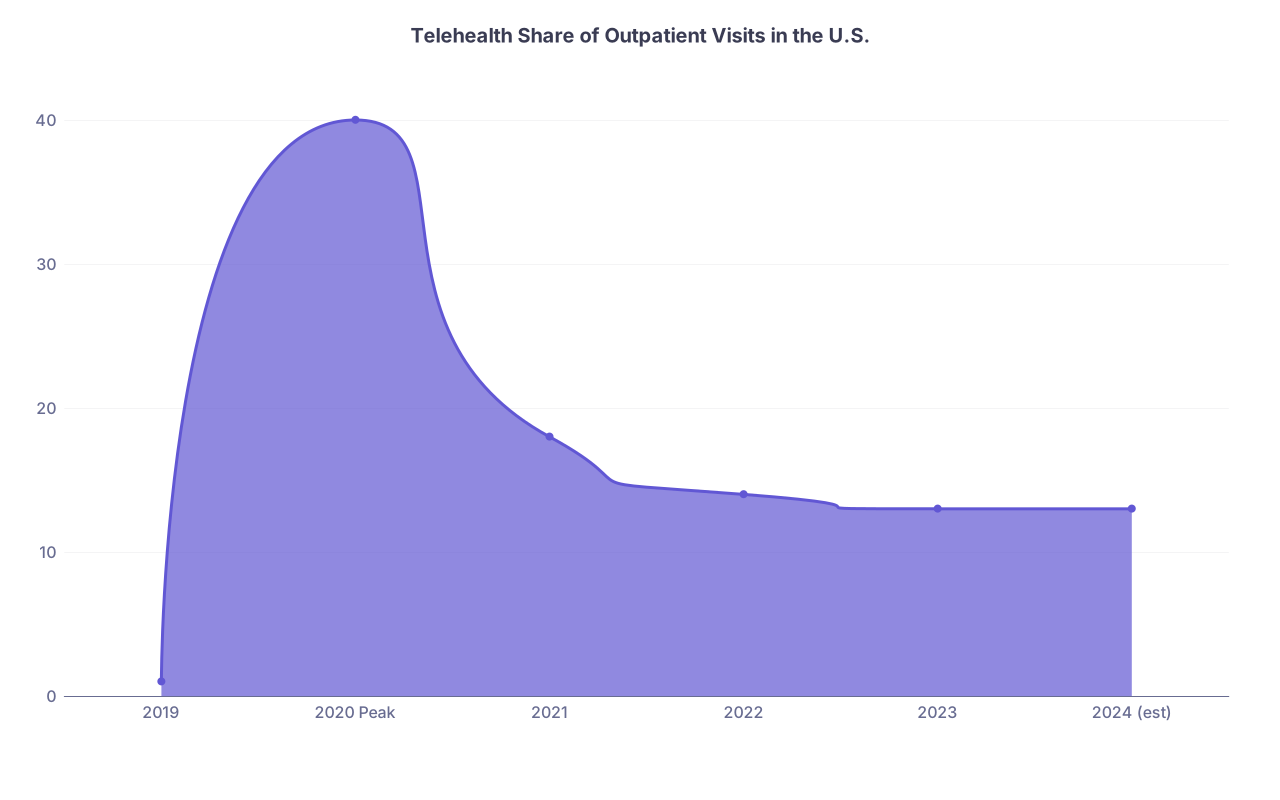
- 2019: Telehealth accounted for roughly 0.5–1% of outpatient visits in the U.S.
- Early 2020 peak: Telehealth briefly spiked above 40% of outpatient encounters in some systems.
- 2023–2024: Stabilized around 10–15% of outpatient visits, depending on specialty and payer mix.
Health systems and claims data converge on the same story: the initial spike collapsed, then leveled off at a usage rate roughly 15–25 times higher than pre‑pandemic.
| Category | Value |
|---|---|
| 2019 | 1 |
| 2020 Peak | 40 |
| 2021 | 18 |
| 2022 | 14 |
| 2023 | 13 |
| 2024 (est) | 13 |
You can argue about a percentage point or two, but the trend is unmistakable: telehealth has become a stable minority share of care, not a passing fad. That matters for side gigs, because side work thrives on:
- Predictable volume
- Repeatable visit structures
- Asynchronous options
Telehealth checks all three boxes.
Where utilization is concentrated
Telehealth is not evenly distributed. Some areas are drowning in virtual volume; others are a desert. The pattern is rational if you look at the data:
- Behavioral health / psychiatry: 50–80% of visits are virtual in many systems
- Endocrinology, allergy, geriatrics, rheumatology: often 20–40% virtual
- Primary care: 10–20%
- Surgical specialties: typically 5–10%, dominated by pre-op/post-op and quick follow-ups
For a side gig, this is pure signal. You want:
- High virtual acceptance by patients
- Low need for physical exam or procedures
- Reimbursable visit types
Behavioral health and primary care–like services (urgent care, basic chronic disease management) dominate the telehealth marketplace right now. That is exactly why most big telehealth platforms structure their workflows like urgent care + light primary care.
When patients use telehealth
Telehealth side gigs live or die on time-of-day patterns. You are trying to layer this on top of a main job.
Real utilization data from large commercial platforms typically show:
- 55–65% of telehealth visits occur outside standard office hours (before 8 am, after 5 pm, or weekends)
- Evening peaks around 6–10 pm local time
- Weekend spikes in urgent-care–style visits
This is good news. The time distribution of demand lines up almost perfectly with a physician’s feasible side-gig windows.
If you only care about “Can I find 5–10 hours a week that match patient demand?” the answer is almost always yes. The more meaningful questions are about pay and friction.
2. Pay: What Do Telehealth Side Gigs Actually Pay?
Let me be blunt: the pay distribution is wide, some of it is embarrassingly low, and many physicians accept bad rates because they never benchmark.
We will break this down by three pay structures:
- Per-visit
- Hourly
- Per‑encounter bundles (asynchronous work, inbox, refill protocols)
2.1 Per-visit pay: the most common—and the easiest to misjudge
Most large direct-to-consumer telehealth companies (and several insurer-run platforms) pay per completed visit. Typical ranges, based on actual contracts and self-reported data from physicians in 2023–2024:
- Low end: $15–$25 per brief visit (often 5–10 minutes)
- Mid range: $30–$55 per visit
- High end: $60–$90+ per visit (usually for psychiatry or more complex longitudinal care, or where you bill under your own NPI with insurance reimbursement)
The key is throughput. Per-visit rates are meaningless without visit length and idle time.
Here is a simplified comparison using realistic numbers:
| Scenario | Pay per Visit | Visits per Hour | Effective Hourly Rate |
|---|---|---|---|
| Low-rate volume | $25 | 4 | $100 |
| Typical urgent care | $40 | 3 | $120 |
| Higher-complexity | $60 | 2 | $120 |
| Psychiatry extended | $120 | 1 | $120 |
The data show something counterintuitive: once you are in a reasonable band of per-visit rates and visit durations, most setups cluster near $100–$150 per hour actual earnings, give or take.
Where people get burned:
- Platforms that pay $15–$20/visit but do not guarantee steady volume
- Long documentation or clunky EHR that turns “10 min” into “20–25 min”
- Unpaid pre-work or post-visit messaging baked into the expectation
If you are looking seriously at a platform, you should be tracking:
- Time from “available” to visit start (idle time)
- Visit duration from first click to last documentation
- Any unpaid tasks (messaging, refills, forms)
Then compute your effective hourly rate. If it is under your threshold (for most physicians I work with, that is $100–$125/hr for side work), walk.
2.2 Hourly telehealth roles: stable but capped
Some systems hire telehealth physicians directly on an hourly basis, particularly health systems and payers with their own virtual clinics.
Common ranges:
- Primary care / urgent care telehealth: $100–$160/hr
- Psychiatry telehealth: $150–$250/hr
- Certain high-demand states or nights/weekends: modest premiums of 10–20%
You trade upside for stability. If the system has low call volume, you still get paid. If volume is high, your per-visit effective rate might look low, but at least you know your floor.
For a side gig, hourly can be attractive if:
- You dislike volume-driven work
- You want to block fixed sessions (e.g., every Thursday evening 5–9 pm)
- You are optimizing for predictable income rather than maximum yield
2.3 Asynchronous telehealth: quiet but highly scalable
Asynchronous work—chart reviews, e-consults, text-based consults, refill protocols, remote monitoring interpretation—is one of the most underutilized side gig categories.
Payout structures vary:
- Per message thread (e.g., $10–$25 per resolved thread)
- Per e-consult (e.g., $30–$70 per consult)
- Per batch of monitoring data (e.g., $15–$40 per review)
The time is often small and discontinuous. Five minutes here, seven minutes there. When you normalize it:
- Efficient physicians often hit $120–$200/hr effective rates, because they batch review and maintain tight templates
- Less organized or overly perfectionistic physicians end up nearer $70–$90/hr because they overwork each encounter
This category is gold for physicians with fragmented downtime and good templating discipline. But it requires you to track actual time spent, otherwise you will underestimate your workload.
3. Telehealth vs Traditional Moonlighting: Numbers, Not Vibes
I have seen the same argument replayed for years: “Just pick up hospitalist shifts, those pay better.” Sometimes true. Often lazy thinking.
You should be comparing actual hourly effective rates, adjusted for commute, recovery time, malpractice risk, and burnout.
Let us lay some basic numbers side by side.
| Gig Type | Typical Pay | Effective Hours (incl. overhead) | Effective Hourly Range |
|---|---|---|---|
| Hospitalist moonlighting shift | $1,800–$2,400 per 12-hr | 14–16 hrs (incl. commute, signout) | $113–$171 |
| ED moonlighting | $180–$260/hr | 1.1x (prep/commute) | $164–$236 |
| Clinic Saturday | $900–$1,400 per 8-hr | 9–10 hrs total | $90–$155 |
| Telehealth per-visit | Varies (see above) | Usually 1.0x (no commute) | $90–$180+ |
| Async e-consults | $30–$70 per consult | 5–15 min | $120–$280+ |
A few firm conclusions from this comparison:
- Telehealth does not annihilate traditional moonlighting on pay. But it competes directly with many options.
- Once you factor in commute, fatigue, and schedule control, telehealth often has a better “money per unit of life energy” ratio.
- Async work, when done efficiently, can quietly out-earn a lot of in-person side work on a per-hour basis.
The physician who can clear $130/hr sitting at home for 6–8 extra hours a week, with flexible scheduling, often has a better overall setup than the one grinding overnight shifts for $200/hr with recovery hangovers.
4. Growth Projections: Is Telehealth Side Work Getting Better or Worse?
You do not want a side gig that is peaking and collapsing. You want one riding structural tailwinds.
Here is where the data land.
Macro trend: total telehealth volume
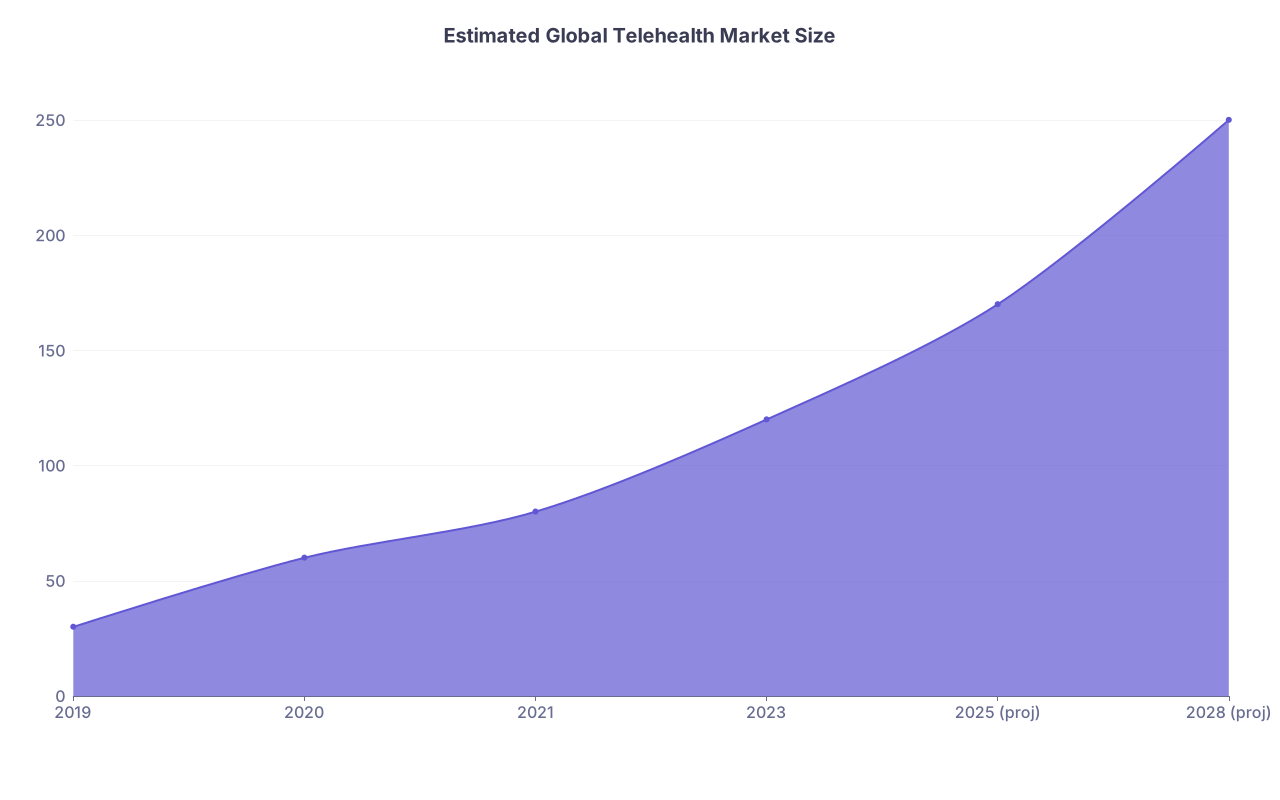
Aggregate U.S. telehealth spending (payer plus patient) has been on a steep climb:
- 2019: ~ $3–4 billion
- 2020: Jump to low double digits (roughly $12–13 billion)
- 2023: Estimates cluster in the $30–40 billion range
- 2028: Multiple market reports project $70–120 billion globally, with the U.S. a large chunk of that
The exact dollar amount is less important than the slope. Growth is positive, multi-year, and now supported by:
- Payer infrastructure (permanent coverage for many telehealth codes)
- Patient behavior ingrained from the pandemic
- Employer benefit designs emphasizing virtual-first options
| Category | Value |
|---|---|
| 2019 | 30 |
| 2020 | 60 |
| 2021 | 80 |
| 2023 | 120 |
| 2025 (proj) | 170 |
| 2028 (proj) | 250 |
(Values are in billions of USD; different analysts disagree on exact levels, but agree on the upward curve.)
Policy and reimbursement: the main risk factor
The main headwind is not patient demand, it is policy.
Key points:
- Many commercial payers have normalized telehealth coverage at parity or near-parity for common E/M codes.
- Medicare has extended many telehealth flexibilities through at least the end of 2024, with strong political pressure for permanence in some form.
- Some states have enacted payment parity laws; others are more restrictive.
For side gigs, what matters is not theoretical policy risk but observed platform behavior:
- Are platforms cutting per-visit rates over time?
- Are they shifting more volume to non-physician providers at significantly lower cost?
- Are they adding unpaid work expectations?
So far, the market shows:
- Slight downward pressure on straightforward urgent-care style visits (simple URI, UTI)
- Stable or rising rates in behavioral health and complex chronic management where physician involvement still commands premium
- Increasing segmentation: algorithmic triage + APPs for low-complexity; physician-heavy for higher-risk or higher-complexity
If your skillset matches the high-complexity side, your telehealth prospects look materially better than the average urgent-care commodity doc.
5. Where Telehealth Side Gigs Fit in a Physician’s Career Strategy
Data first, judgment second.
Let us categorize telehealth side work by career phase:
Resident / fellow:
Limited by moonlighting rules, licensing, and time, but high-yield if you can do small asynchronous chunks or a few weekend/evening blocks.Early attending:
Telehealth is a flexible way to stabilize cash flow while you build a practice, pay down debt, or hedge against variable bonuses.Mid-career:
Often becomes a diversification tool—hedge against burnout, reduce in-person call, test alternate career paths (e.g., fully virtual roles).Late career / pre-retirement:
Frequently used to taper clinical intensity while preserving income, especially in cognitive specialties.
The data show another subtle advantage: optionality. It is far easier to scale telehealth hours up or down in 2–4 week increments compared with renegotiating hospital moonlighting or clinic sessions.
6. Practical Metrics: How to Decide If a Telehealth Gig Is Worth It
You should evaluate any telehealth side gig like a small business analyst, not like a desperate resident who is just grateful someone is sending W‑2 income.
Use a minimal metric set:
Effective hourly rate
(Total pay over 2–4 weeks) ÷ (All time: log-ins, idle, charting, messaging)Flexibility score (subjective but real)
- Can you log in and out within 15–30 minutes’ notice?
- Are you required to commit fixed blocks?
- Can you cancel or scale down easily?
Cognitive load / burnout risk
- Are you doing high-volume “fast food” medicine that drains you?
- Or moderate volume with acceptable complexity?
The data: physicians with lower perceived autonomy and higher throughput expectations burn out faster, even at higher pay.
Risk profile
- Malpractice coverage clear and adequate?
- Scope of practice aligned with your comfort?
- Clear protocols for high-risk situations (chest pain, suicidality, pediatric fevers, etc.)?
Trajectory
- Has the platform cut rates in the last 12–18 months?
- Are they moving volume to non-physician providers?
- Are they adding new revenue lines that might improve your pay (e.g., care management, RPM)?
Track for 1–2 months. Then be ruthless: if the gig does not clear your target rate and your personal “sanity threshold,” move on.
7. Future Directions: Where the Telehealth Side-Gig Market Is Heading
Let us zoom out and look at the structural shifts already visible in the data.
Consolidation and platform power
A handful of large platforms are absorbing an increasing share of telehealth traffic, while many small, single-specialty offerings get acquired or priced out. This is classic platform economics.
For physicians, that means:
- Fewer but larger places to work
- More standardized pay scales
- More leverage for platforms in setting rates—unless you have niche skills
Niche wins. Psych subspecialties, complex endocrine, sleep medicine, pain, and subspecialty e-consults are all examples where physicians still maintain considerable bargaining power.
AI and automation: threat or multiplier?
Artificial intelligence is already nibbling at triage, note drafting, and patient education. The data so far:
- Chat triage systems reduce simple, low-value physician encounters.
- Automated documentation can cut charting time 30–60% when implemented reasonably.
- Symptom-checker style bots offload some patient questions before they hit your queue.
Net effect for a side gig physician:
- Low-complexity, high-volume encounters will be commoditized first. Bad for platforms paying you $15–$20/visit.
- Moderate and high-complexity encounters become more efficient. Good for your hourly effective rate if the platform does not cut pay proportionally.
The physicians who lean into tooling—templated notes, AI-assisted documentation, batch workflows—will maintain or grow their hourly equivalent; those who work like it is 2015 will watch their value erode.
8. A Simple Decision Framework
To make this brutally practical, here is how I would decide as a data-oriented physician:
- Set a hard floor effective hourly rate (for example: $125/hr).
- Pick 2–3 telehealth platforms or roles that fit your license and specialty.
- Test each for 2–4 weeks, logging every minute you are “on.”
- Compute:
- Total income / total time = effective hourly
- Subjective flexibility and burnout scores
- Keep the one or two that:
- Beat your floor consistently
- Do not wreck your sleep, relationships, or main job
You do not need the “perfect” telehealth gig. You need one or two with good-enough pay, stable demand, and low friction.
| Category | Value |
|---|---|
| Week 1 | 900 |
| Week 2 | 1120 |
| Week 3 | 980 |
| Week 4 | 1050 |
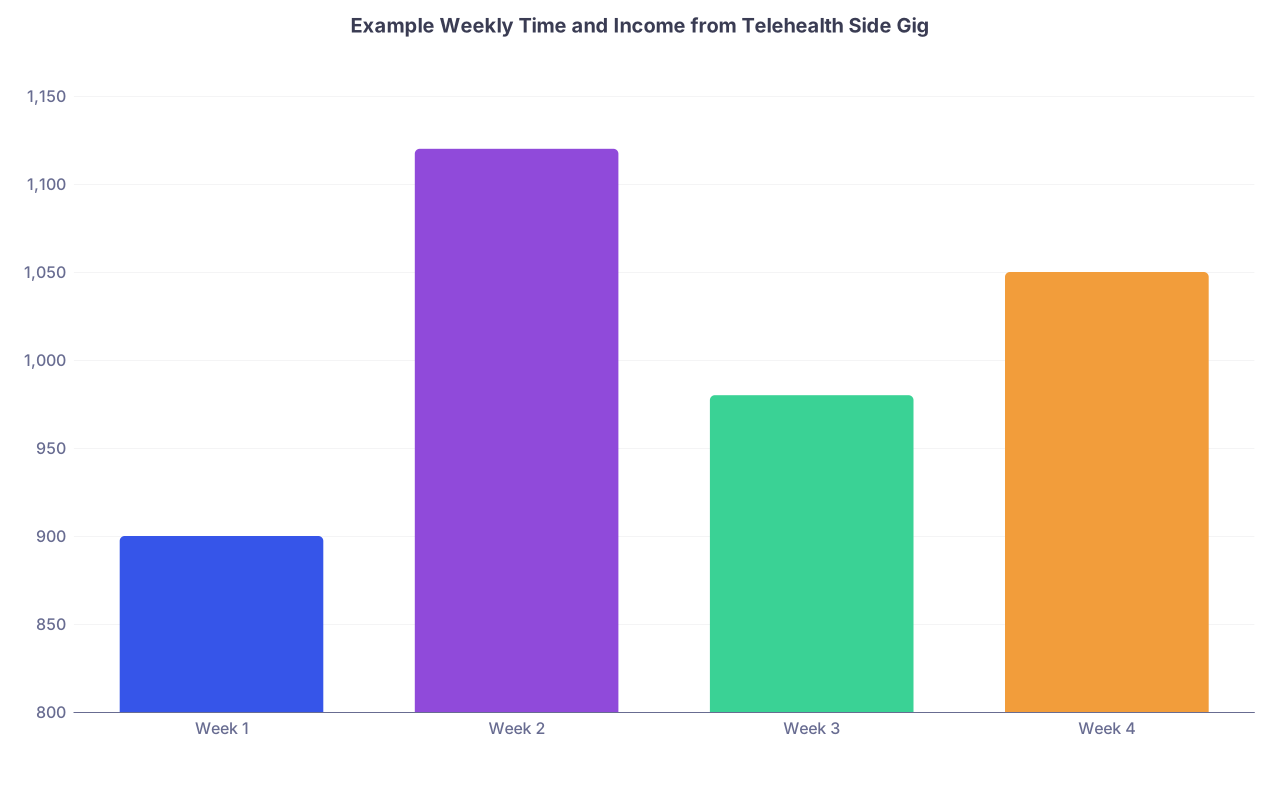
Imagine this bar chart as a physician doing 7–9 telehealth hours per week, hovering around $1,000/week. That is $4,000/month gross. Layer that on top of a standard attending salary and you are changing the trajectory of your loan payoff, savings rate, or early semi-retirement clock.
9. Process Snapshot: How a Telehealth Side Gig Typically Runs
To ground this in reality, here is the workflow most physicians end up living:

| Step | Description |
|---|---|
| Step 1 | Log in to platform |
| Step 2 | Set availability |
| Step 3 | Review brief chart |
| Step 4 | Video or phone visit |
| Step 5 | Document and orders |
| Step 6 | Finish visit |
| Step 7 | Idle or log off |
| Step 8 | Queued visit? |
The friction points in this flow—idle time, documentation burden, clunky interfaces—are exactly what erode your effective hourly rate. Watch them closely.
Telehealth as a side gig is not magic. It is just another revenue stream with definable utilization, measurable pay, and reasonably predictable growth. The data show it is no longer an experiment. It is infrastructure.
If you treat it like an experiment in your own career—test, measure, iterate—you can convert that infrastructure into flexible, meaningful income without sacrificing your primary job or your sanity.
With those numbers in hand, you are ready for the next question: how telehealth fits into a broader portfolio of side hustles and long-term career design. But that is a separate analysis.
FAQ (5 Questions)
1. What is a reasonable minimum hourly rate to target for a telehealth side gig?
Most attending physicians I work with set a floor between $100 and $150 per effective hour. Below $100/hr, telehealth starts to compare poorly with traditional moonlighting when you account for total years of training and opportunity cost. If you are in a high-paying specialty or doing this during limited free time (e.g., residency), your personal floor may be higher.
2. Do I need multiple state licenses to make good money with telehealth?
More licenses usually mean more available volume, especially with large national platforms. However, a single well-chosen license in a populous state (e.g., Texas, Florida, California, New York, though some are more regulated) can still support a solid side gig. The incremental benefit of each additional license tends to diminish after 3–5 states unless you are going close to full-time telehealth.
3. How volatile is telehealth income month to month?
Per-visit roles can be volatile, especially early on, with 20–40% swings in monthly income based on seasonal illness patterns and platform marketing. Hourly telehealth roles are much more stable. Asynchronous e-consult work tends to smooth out once referral patterns are established, though it can be slow to ramp in the first few months.
4. Is telehealth side work realistic for surgical specialists?
Yes, but with narrower scope and typically lower volume. Surgical specialists may focus on pre-op counseling, post-op follow-up, wound checks, and second opinions. The income opportunity is smaller than for primary care or psychiatry, but the effective hourly rate can still be attractive when billed as consults or second opinions, especially if you target higher-complexity cases.
5. How likely is telehealth pay to decrease over the next few years?
Commodity urgent-care style telehealth (simple acute issues) is under the most downward pressure, from both APP labor and automation. I expect modest rate compression there. For cognitive, higher-complexity care—behavioral health, chronic disease management, subspecialty consults—rates are more likely to remain stable or even improve slightly as demand grows and payers see value in avoiding in-person or hospital-based care. The mix of your telehealth work will determine whether your personal rate goes up, down, or sideways.