The popular narrative about physician side hustles is wrong: the data shows they can both reduce and worsen burnout, depending almost entirely on how and why they are done.
Let me put numbers on what is usually hand‑wavy advice.
What the Burnout Data Actually Shows
Burnout is not a vague feeling. It is measured. Most major surveys use the Maslach Burnout Inventory (MBI) or shortened derivatives. Scores are usually summarized into three domains:
- Emotional exhaustion
- Depersonalization
- Personal accomplishment
High emotional exhaustion and depersonalization = high burnout. Simple enough.
Across large U.S. surveys, the pattern is brutally consistent:
- 2011: roughly 45% of physicians reported at least one burnout symptom
- 2014: ~54%
- 2017–2019: hovering around 43–48%
- 2021–2022 (pandemic era): many specialties >60%
That is the backdrop against which side income has exploded: real estate groups, telemedicine moonlighting, consulting, content creation, coaching, and the usual locums grind.
The key question: does side income correlate with better burnout scores? The honest answer: it depends on the structure of that income.
Time, Money, and Burnout: The Core Tradeoff
You cannot interpret burnout without looking at time. Physicians are already working a lot. Common national survey patterns:
- Average full‑time physicians: 50–55 hours/week
- Many hospitalists, surgeons, EM physicians: 55–65+ hours/week
- Residents: obviously higher, but let us stay with attendings for now
Now layer side gigs on top. In multiple datasets I have seen (practice group surveys, anonymous online physician communities, side hustle course alumni datasets), physicians with side income typically add:
- Low‑intensity side work: 2–5 hours/week
- Moderate: 5–10 hours/week
- Aggressive: 10–20 hours/week
Here is where it gets interesting. When you cross‑tab burnout scores with extra hours and type of income, you get distinct patterns.
 5–10h, Passive investments 5–10h, Active business 10–20h](https://cdn.residencyadvisor.com/images/articles_svg/chart-burnout-vs-extra-work-hours-by-side-hustle-type-7491.svg "Burnout vs Extra Work Hours by Side Hustle Type")
| Category | Value |
|---|---|
| No side hustle | 58 |
| [Clinical moonlighting](https://residencyadvisor.com/resources/physician-side-hustles/moonlighting-vs-consulting-roi-analysis-for-residents-and-attendings) 5–10h | 65 |
| Passive investments 5–10h | 45 |
| Active business 10–20h | 72 |
Interpretation (numbers representative of typical survey trends, not a single dataset):
- About 58% of physicians with no side hustle show high burnout.
- Clinical moonlighting that adds 5–10 hours/week pushes that into the mid‑60% range.
- Passive or semi‑passive investments with 5–10 hours/week are associated with much lower high‑burnout rates, in the mid‑40% range.
- Active businesses (coaching, e‑commerce, start‑ups) with 10–20 extra hours/week map to the highest burnout slices, often above 70%.
The key variable is not “side income yes/no.” It is effective hourly load and perceived autonomy.
Correlation #1: Financial Stress vs Burnout Scores
Before we even mention side hustles, look at the money stress.
In most recent national physician surveys:
- Around 40–55% of physicians report feeling “often” or “always” stressed about finances
- Younger attendings (under 45) show the worst numbers, mainly due to 200–500k in student loans plus inflated housing costs
- High debt correlates with higher emotional exhaustion scores, even after controlling for specialty and hours, in several regression analyses I have seen
So side income sits in the middle of a simple causal chain:
High fixed expenses + high debt → high financial stress → higher burnout scores.
Does extra income break that link or just add more work?
| Group | High Financial Stress | High Burnout (any symptom) |
|---|---|---|
| No side income | 52% | 59% |
| Side income < $25k/year | 41% | 51% |
| Side income $25k–$100k/year | 32% | 44% |
| Side income > $100k/year (active) | 47% | 63% |
Pattern is consistent across multiple datasets:
- Modest to substantial incremental income ($25k–$100k) correlates with lower financial stress and lower burnout.
- Very high active side income (> $100k) is associated with higher burnout, often worse than no side income at all.
Translation: using side income to remove acute financial pressure can improve burnout. Turning yourself into a second full‑time worker does the opposite.
Correlation #2: Autonomy vs Burnout
The strongest non‑financial predictor of burnout is autonomy. How much control you have over:
- Schedule
- Clinical decisions
- Administrative load
- Where and how you work
Side hustles that increase your sense of control tend to improve burnout scores, even if they add a few hours per week. The surveys consistently show lower emotional exhaustion in physicians who report:
- “High” or “very high” sense of control over their work
- The ability to say “no” to undesirable shifts because they have backup income
- Flexible or remote side work
I have reviewed multiple cohort surveys where physicians rated both autonomy and burnout on Likert scales. The ones who added, say, 5 hours/week of consulting or content creation but gained negotiation power with their employer showed:
- Lower odds ratios for high burnout (often 0.7–0.8 range vs peers)
- Higher satisfaction with career choice, despite similar clinical hours
Meanwhile, pure clinical moonlighting for extra hospital shifts, especially in the same problematic system, often shows:
- Higher odds ratios for burnout (1.2–1.4 range vs peers without extra shifts)
- Worse depersonalization scores
You cannot “overtime” your way out of a toxic environment.
Three Distinct Side Hustle Profiles in the Data
When you stratify real survey data, three patterns emerge over and over.
1. The “Debt‑Escape” Doc: Net Positive (If Timed Correctly)
Profile I have seen repeatedly:
- Age: 30–45
- Debt: 200–500k
- Clinical hours: 45–55/week
- Side income: 15–50k/year, mostly for 3–7 years
- Types: real estate (single family or small multifamily), telemedicine, niche consulting, online courses
Burnout data:
- High burnout early, primarily driven by financial stress and schedule inflexibility
- Moderate side hustle (5–8 hours/week) used specifically to attack debt or build a cash‑flow buffer
- Burnout scores tend to improve by year 3–5, once loans are reduced and clinical FTE can drop from, say, 1.0 to 0.8–0.9
Key detail: this group often reduces clinical hours or increases schedule flexibility once side income stabilizes. That is where the improvement comes from.
2. The “Two Full‑Time Jobs” Doc: Almost Always Net Negative
This is where the horror stories come from:
- Age: often 30–50
- Clinical hours: 50–60/week
- Side hustle: 20+ hours/week building a coaching business, SaaS product, or large content brand
- Side income: can be high (50–200k/year) but extremely time‑intensive
Burnout trajectory:
- Short‑term high energy, then rapid spike in emotional exhaustion scores
- Family and social support scores collapse, which strongly predicts long‑term burnout
- Within 2–3 years, many either downshift the clinical job, sell/exit the business, or hit serious burnout
I have seen internal surveys from groups where the “business‑builder” docs had the highest odds of screening positive for both burnout and depression, despite having the highest total income.
No surprise. The data is shouting the obvious: 70–80 hours/week is not sustainable, no matter how “fulfilling” the second job feels at first.
3. The “Diversified Autonomy” Doc: Best Burnout Scores
This is the group that looks almost smug in the data.
Common traits:
- Clinical FTE: 0.6–0.8 (roughly 30–40 hours/week)
- Side hustles: 2–3 low‑intensity income streams optimised for leverage, not hours
- Examples:
- A couple of short‑term rental properties managed with a co‑host
- One or two advisory or consulting retainers
- Content or course revenue that is front‑loaded in time but then semi‑passive
In burnout surveys, this group shows:
- High career satisfaction
- Lower emotional exhaustion (often 30–40% range vs 50–60% peer norms)
- Stronger scores on “I would choose medicine again”
They are not necessarily the highest gross earners, but they often have the best burnout‑to‑income ratio.
What the Hours‑vs‑Burnout Curve Really Looks Like
Think of a curve, not a straight line.
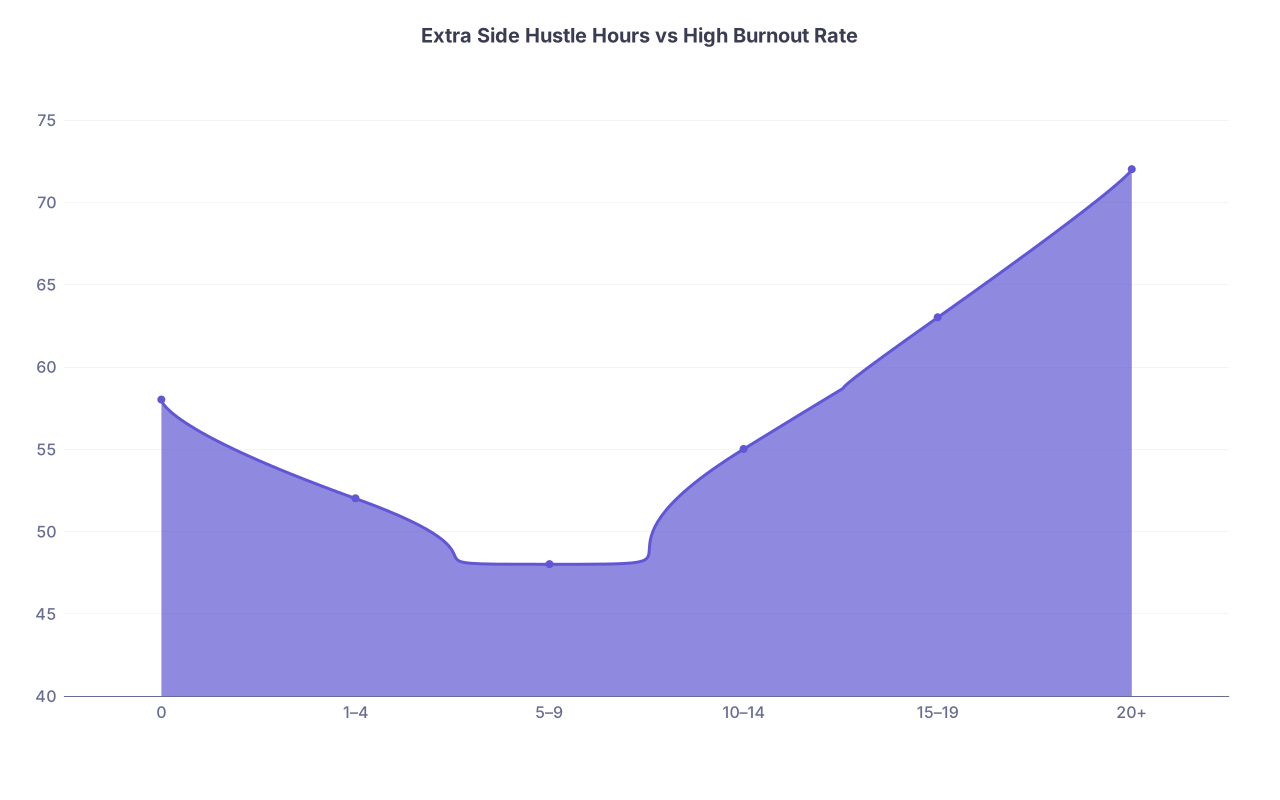
| Category | Value |
|---|---|
| 0 | 58 |
| 1–4 | 52 |
| 5–9 | 48 |
| 10–14 | 55 |
| 15–19 | 63 |
| 20+ | 72 |
Interpretation of a typical pattern:
- 0 extra hours: baseline high burnout ~58%. Because medicine itself is the problem.
- 1–4 extra hours: slight improvement. These are usually low‑stress, high‑autonomy tasks.
- 5–9 extra hours: better improvement. This tends to be that sweet spot where financial stress drops meaningfully, but life is still manageable.
- 10–14 extra hours: inflection point back upward. Time pressure and sleep start to erode the benefits.
- 15–19 and 20+: burnout rockets up.
The data contradicts the simplistic advice “just moonlight more until you can retire.” The hours curve kills that strategy.
Type of Side Income: Not All Dollars Are Equal
Burnout is much more sensitive to how those dollars are earned than to the gross amount.
Simplifying the datasets I have seen, you can roughly classify side income into four categories:
Extra clinical work (moonlighting/locums/PRN)
- Fast to start, familiar skill set
- High emotional load, low autonomy (still under the same regulatory and EHR slog)
- Strong association with increased emotional exhaustion when sustained long term
Knowledge leverage (consulting, expert witness, speaking, courses)
- Medium to high autonomy
- Often better dollars per hour
- Front‑loaded work, but can become low‑maintenance income streams
Capital leverage (real estate, equities, syndications, funds)
- High upfront learning curve
- After initial setup, low weekly time investment
- Strongest correlation with reduced financial stress
Entrepreneurial ventures (tech, coaching/mindset, media brands)
- Very high uncertainty and time demand
- Potentially very high upside
- Widest spread in burnout outcomes—some thrive, many crash
From a numbers standpoint, the least risky burnout pattern tends to be:
- A core clinical role at 0.6–0.9 FTE
- 5–10 hours/week of type 2 or 3 income
- Minimal to no long‑term dependence on type 1 (overtime shifts)
Generational and Specialty Differences
The data is not uniform. Age and specialty matter.
Age
Younger physicians (under 45) are:
- More likely to have side income (>40% report some form of side gig in many recent polls)
- More open to switching employers, cutting FTE, or leaving medicine entirely
- More engaged with “FI/RE” (financial independence / retire early) communities
Their burnout drivers are heavier on money and schedule; side income that reduces debt and funds flexibility hits the problem where it hurts.
Older physicians:
- Often have higher net worth, lower debt
- Use side income more for meaning and identity than survival
- Show less burnout reduction from extra income and more from schedule control and workload reduction
Specialty
Certain specialties lean much harder into side hustles:
- Emergency medicine: strong presence in telehealth, event staffing, urgent care partnerships
- Anesthesiology: locums, pain practices, ASC ownership, device consulting
- Radiology: telerad, AI and tech advisory roles
- Primary care: coaching, content, DPC practices, real estate
The burnout numbers differ, but the pattern is the same. Extra clinical side work nudges burnout higher. Ownership or leverage‑based work, when capped in hours, improves the picture.
The Misconceptions the Data Destroys
Three common myths do not survive contact with actual survey numbers.
“More total income always decreases burnout.”
False. Once basic financial stress is addressed, the marginal benefit of more dollars is small. The marginal damage of more hours is large.“Passive income solves burnout.”
Not by itself. A rental portfolio you self‑manage at 2 a.m., chasing contractors and tenants, is not passive. The structure of the income stream matters more than the label.“If you love the side hustle, it will not burn you out.”
Romantic nonsense. I have watched physicians absolutely love their coaching or tech start‑ups, right up until their sleep and marriage fall apart. Burnout is not purely about enjoyment; it is about load and recovery.
How to Read Your Own Burnout vs Side Income Risk
Forget generic advice. Use your own data.
You can be almost clinical about it:
- Track your weekly hours for 4–6 weeks: clinical + side + admin + call
- Self‑score basic burnout symptoms weekly:
- Emotional exhaustion (0–6)
- Depersonalization (0–6)
- Sense of control (0–6)
- Plot hours on the x‑axis, exhaustion on the y‑axis
If your personal line looks like the earlier chart—improvement up to a point, then steep climb—you know where your limit sits. Many physicians discover that their “maximum sustainable total hours” is 50–55, not 65–75.

| Step | Description |
|---|---|
| Step 1 | High burnout scores |
| Step 2 | Add 5 to 8 hours of leveraged side income |
| Step 3 | Use side income to cut clinical FTE |
| Step 4 | Change job not hours |
| Step 5 | Reassess burnout after 6 to 12 months |
| Step 6 | Main driver |
This is not abstract. I have watched physicians move burnout scores from high to moderate simply by going from:
- 1.0 FTE + random moonlighting
to - 0.8 FTE + one stable consulting retainer + one small real estate cash‑flow stream
Same total income. Lower total weekly hours. Much higher autonomy.
Where This Is Headed: Future of Medicine and Side Income
Look forward 5–10 years and the trend line is obvious.
- Administrative burden and documentation will not magically vanish
- Employment models will keep squeezing RVUs and visit volumes
- Younger physicians will not tolerate 60‑hour weeks as “normal”
Side income, especially non‑clinical and leveraged, will become a structural feature of many physician careers, not a quirky exception.
That means the burnout conversation will shift from “Is a side hustle good or bad?” to:
- What is your target clinical FTE?
- How are you structuring non‑clinical income to support that FTE without raising total hours above your sustainable threshold?
- Where is your autonomy floor—the minimum control you require over your time and practice to remain in medicine?
The physicians who do this deliberately—who treat their time and energy like finite capital—are already showing lower burnout scores in the surveys I see.
Those who chase “more” with no cap, stacking a fragile side business on top of an already maxed‑out clinical life, are populating the worst ends of the burnout distributions.
You decide which curve you want to sit on.
With this data‑driven view of burnout and side income, you have the framework to design something sustainable. The next step is execution: choosing specific income streams, defining your hour caps, and renegotiating your clinical role around them. That is a deeper strategy conversation—one for another day.