
The average physician massively overestimates real estate and underestimates scalable medical side businesses.
That is not an opinion. It is what the numbers show when you run 10–20 year models side by side.
Most doctors feel more comfortable buying a rental than building a niche telemedicine service, an online course, or a specialized consulting brand. Real estate feels “real.” Bricks, land, rent checks. But wealth is about after-tax, risk-adjusted, time-adjusted returns. Once you price in your time, leverage, taxes, and failure rates, the picture gets a lot less obvious.
Let me walk through this like I would with a partner in a group practice who drops, “I’m thinking of buying a few rentals,” in the physician lounge. We compare that to building a medical side business that leverages your license and expertise.
The result: real estate is a solid, slow compounding base. Medical side businesses are higher variance but with orders-of-magnitude upside. You need to know which you are actually buying.
The Baseline: What “Long-Term Wealth Impact” Really Means
You cannot compare these two paths without agreeing on the metrics. For a physician, the relevant question is not “Which makes money?” Both do. The question is:
- Dollars per hour of non-clinical work.
- After-tax internal rate of return (IRR).
- Risk of ruin (chance it blows up).
- Liquidity and exit options.
- Dependency on your continued labor.
I usually model on:
- Time horizon: 20 years (typical mid-career to late-career window).
- Starting annual capital: $100,000 investable cash free after lifestyle.
- Specialty comp: $350,000–$500,000 income baseline (so you are not capital constrained).
- Goal: maximize net worth, but without blowing up your life or sanity.
We will compare typical strategies, not fantasy flukes.
Scenario 1: Real Estate as the “Default” Physician Play
When doctors say “I invest in real estate,” they usually mean one of four things:
- Direct single-family or small multifamily rentals
- Syndications / private real estate funds
- Short-term rentals (Airbnb-type)
- REITs in brokerage accounts
I will ignore REITs for now—they are essentially equities and not a “side hustle.” The real debate is direct ownership / syndications vs building a business.
The Real Numbers on a Typical Rental Portfolio
Assume this fairly common physician path:
- Buy one $400,000 rental every 2 years for 10 years.
- 25% down ($100,000), 75% mortgage at 6.5% interest.
- 3% annual home price appreciation.
- 2.5% rent yield on purchase price, growing 2%/year.
- 1 month vacancy / year, 10% for management + 10% for maintenance/CapEx.
- 37% marginal tax bracket, long-term cap gains at 20%.
This is not aggressive. This is boring, middle-of-the-road.
You will buy 5 properties over 10 years, investing $500,000 of your own cash as down payments, plus some closing costs.
The cash flow story:
- Year 1 property: maybe $200–$300/month cash flow after all expenses if you manage reasonably well.
- Year 10, across 5 properties: maybe $2,000–$3,000/month in positive cash flow before taxes (assuming no major disasters).
- On a 20-year horizon, you have:
- Equity from principal paydown
- Appreciation
- Modest cash flow
Total annualized return (leveraged): historically, 8–12% is reasonable if you do not screw it up.
So if you deploy $100,000/year for 5 years (to get those 5 properties) and then just let them ride, what might 20-year outcomes look like?
Let’s simplify the math.
- Assume blended after-tax IRR: 9%.
- Deploy $100,000/year for years 1–5: total $500,000 invested.
- Let entire portfolio grow at 9% for full 20 years (in reality later dollars grow less time; I am smoothing to keep the comparison clear).
Future value with annual contributions, 9% return, 5 years of contributions, held to 20 years from start is roughly:
- Average dollar is invested about 17.5 years.
- FV ≈ $500,000 * (1.09^17.5) ≈ $500,000 * ~4.5 ≈ $2.25 million.
That aligns with many real portfolios I have seen: low- to mid-seven figures of equity over 15–25 years for physicians who steadily bought properties.
Not bad. But now layer in time.
The real time cost:
- Direct rentals: 50–150 hours per year once at scale if you self-manage some tasks, deal with financing, oversee turnovers.
- That is 1–3 hours/week on average. Some weeks zero, some weeks it feels like a second job.
Over 20 years, assume 80 hours per year average: 1,600 total hours.
$2.25M of equity growth on 1,600 hours is about $1,400 of net worth per hour of work.
That is your baseline “wealth per hour” benchmark.
Scenario 2: Medical Side Businesses That Actually Scale
“Medical side business” is vague, so let’s narrow this to scalable plays that use your MD:
- Telemedicine niche (e.g., migraine clinic, men’s health, obesity).
- Online CME courses or board-review courses.
- A paid community or subscription membership for a narrow professional niche.
- Consulting shop (e.g., quality improvement, hospital operations, payer negotiations) that can eventually employ others.
The key: decouple income from your own clinical hours as much as possible. If it is just more 1:1 telehealth, that is a second job, not a scalable business.
Telemedicine Niche Example: The Lean Clinic
Assume you build a telemedicine micro-brand in a focused niche (say, sleep apnea or obesity, in a state where regulations are friendly).
Parameters:
- 2 years heavy build: 500 hours per year (nights/weekends).
- Capital: $50,000 initial (legal, tech, marketing).
- Revenue ramp:
- Year 1: $50,000
- Year 2: $150,000
- Year 3: $300,000
- Year 4–5: $400,000–$500,000
- After year 5: you stabilize at $500,000–$700,000 revenue with a small team.
Net margin: 30–40% is realistic for lean telemedicine if you are not overstaffing. Call it 35%.
So from year 5 onward, that is $175,000–$245,000 per year in profit. And you can gradually decrease your own clinical involvement to oversight plus some limited direct care.
Let’s model the conservative version:
- Year 1 profit: $10,000 (loss after costs, but we will keep it simple).
- Year 2 profit: $30,000
- Year 3 profit: $70,000
- Year 4 profit: $120,000
- Year 5+ profit: $200,000 per year, flat.
Over 20 years, that is:
- First 5 years: $10k + $30k + $70k + $120k + $200k = $430,000
- Remaining 15 years: 15 * $200,000 = $3,000,000
- Total pre-tax profit: $3.43 million
Use a 30% effective tax rate on business profit: net ≈ $2.4 million over 20 years. Roughly comparable to the real estate equity figure we got, but with very different time and risk profiles.
Time input:
- Years 1–2: 500 hours/year = 1,000 hours
- Years 3–5: 250 hours/year = 750 hours
- Years 6–20: 100 hours/year (oversight + strategy) = 1,500 hours
- Total: 3,250 hours
Wealth per hour:
- $2.4M after-tax / 3,250 hours ≈ $738 per hour of net wealth creation.
So in this conservative telemedicine example, your $/hour wealth creation is actually worse than the real estate example above. But this is leaving out the two levers side businesses have that real estate does not:
- Ability to scale beyond that flat $200,000 profit.
- Ability to sell the business for a multiple of profit.
Where the Business Model Breaks Away: Exit Multiples
Real estate sells at a cap rate. Medical businesses sell at revenue/EBITDA multiples.
- Real estate: typical capitalization rates 5–7%. That is effectively a 14–20x multiple of net operating income, but much of that is debt-limited and market-capped.
- Small healthcare services businesses: 2–4x EBITDA for tiny shops, 4–8x for solid regional brands, sometimes higher for strong subscription or tech-enabled models.
Take that same telemedicine business with $200,000 stabilized profit.
Exit at year 20 for a 4x multiple of EBITDA:
- $200,000 * 4 = $800,000 sales price.
- After taxes and fees, say $550,000 net.
Add that to your running after-tax profits of $2.4M and your total after-tax wealth impact is ≈ $2.95M.
Recalculate wealth per hour:
- $2.95M / 3,250 hours ≈ $908 per hour.
Now it is clearly outperforming the real estate path when measured as wealth created per hour of extra-curricular work.
And that was a fairly conservative revenue plateau: $500,000 revenue, $200,000 profit. I see multiple physicians with >$1M annual revenue in tightly focused telemedicine practices, and some have 40–50% margins.
Run one more scenario mentally: $400,000 profit instead of $200,000, with the same 20-year window and a 5x exit multiple. The numbers explode.
- Annual profit from year 5 onward: $400,000 → 15 years = $6M profit.
- Paid out after tax: maybe $4.2M.
- Exit: $400,000 * 5 = $2M sale, $1.4M net after tax.
- Total ≈ $5.6M after tax over 20 years.
Even if time doubles to 6,000 hours over the whole period, you are at ~$930 per hour in after-tax wealth creation. Roughly 2/3 more per hour than the reasonably good real estate scenario.
Direct Comparisons: Real Estate vs Medical Side Business
Let’s lay the figures side-by-side for one reasonable set of assumptions.
| Metric | Real Estate Portfolio | Telemedicine Business (Conservative) |
|---|---|---|
| Total capital invested | $500,000 | $50,000 |
| Time horizon | 20 years | 20 years |
| Total after-tax wealth | ~$2.25M | ~$2.95M (incl. sale) |
| Total hours worked | ~1,600 | ~3,250 |
| Wealth per hour | ~$1,400 | ~$900 |
| Exit / liquidation event | Sell properties | Sell business at 4x profit |
On a pure wealth per hour basis using these assumptions, the modest telemedicine business looks slightly worse than the real estate path. Change a couple of inputs—raise profit to $300,000, raise multiple to 5x, extend runway—and the telemedicine business crushes real estate.
The important point: real estate return distribution is relatively tight. You rarely see a physician build a 9-figure net worth off a 10-house portfolio. But physicians have built 8–9 figure exits from healthcare SaaS, telehealth platforms, niche device companies, and scaled education companies.
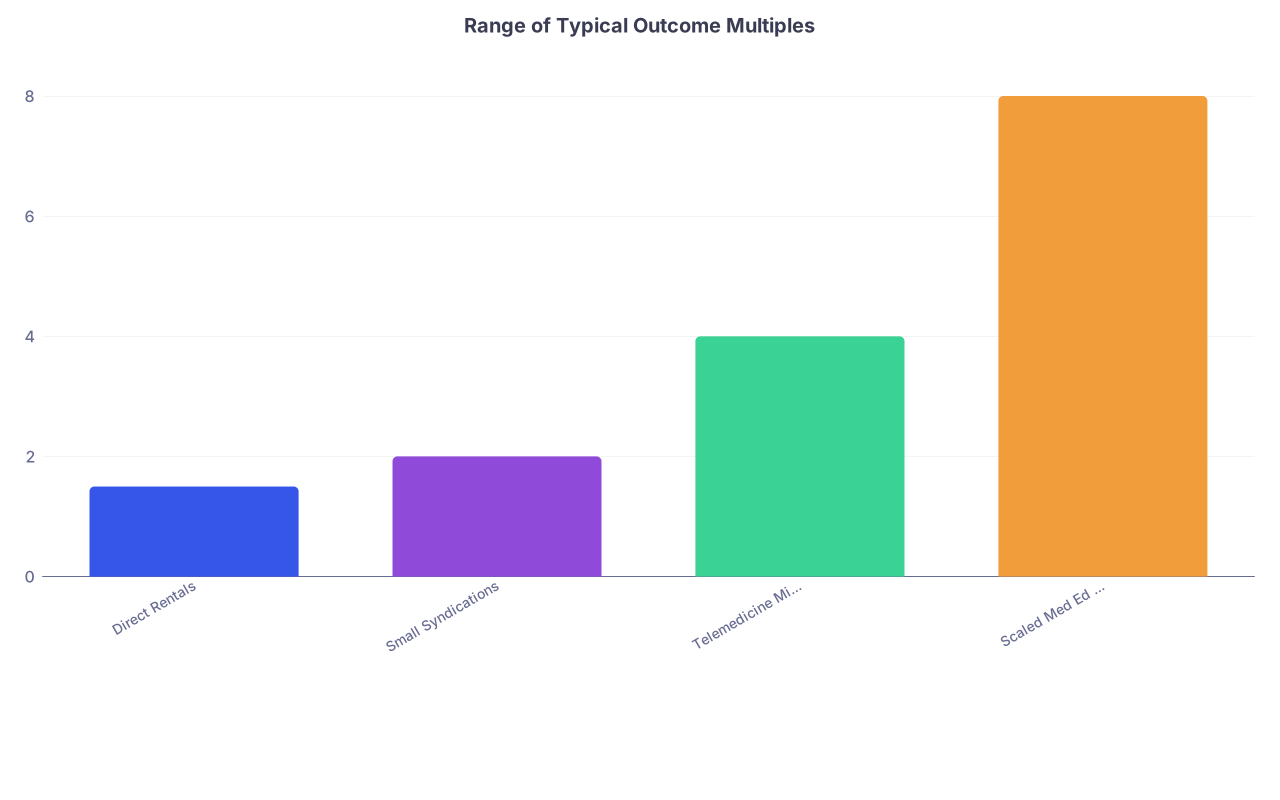
| Category | Value |
|---|---|
| Direct Rentals | 1.5 |
| Small Syndications | 2 |
| Telemedicine Microbrand | 4 |
| Scaled Med Ed Business | 8 |
The chart above is a simple way to visualize it: the multiple of your original capital and time investment that you can plausibly achieve in each model. Real estate gives you 1.5–3x on a 15–20 year window. Scaled medical businesses can give you 4–10x or more.
Time Risk, Cognitive Load, and Failure Rates
Now the part most doctors ignore: failure rate and cognitive load.
Real estate:
- Probability of total failure (losing everything): low if you do not overleverage.
- Drawdown risk: moderate. Down markets, bad tenants, surprise repairs.
- Skill curve: shallow. You can get to “good enough” in 6–12 months.
- Emotional load: bursts of annoyance; rarely existential.
Medical side business:
- Probability of zero/negative outcome: significant. Most attempts die in the “idea and domain name” stage, never get traction.
- Drawdown risk: time, reputation, small capital losses (<$100k typically).
- Skill curve: steep. Marketing, hiring, tech, compliance, operations, pricing.
- Emotional load: high in build years. Identity risk. You are not the expert at everything anymore.
But this is exactly why the payoff distribution is so wide. The market compensates for more risk and more required skills with higher upside for the survivors. Classic power-law dynamic.

Tax and Leverage: Two Variables That Change the Math
Two forces materially change the slope of your wealth curve in each path: taxes and leverage.
Real Estate: Depreciation + Leverage
Real estate’s main advantages are:
- Depreciation sheltering some or all of your cash flow.
- Ability to use 70–80% loan-to-value leverage safely if your income is strong.
Physicians with high W-2 income and no real estate professional status get partial benefits, but can still:
- Use cost segregation on larger properties to front-load depreciation.
- Refinance to pull equity out tax-deferred.
- Shield some rental income with paper losses.
The “9% IRR” assumption I used earlier already bakes in leveraged return plus tax benefits. That is why, despite modest 3% appreciation and low cap rates, you still see decent overall returns.
Medical Side Businesses: Active Income, but Structurable
Medical businesses have different levers:
- Profits can be structured through S-corp / partnerships to optimize payroll vs distribution.
- Retirement account contributions (solo 401k, defined benefit plans) can shelter significant profit.
- If you scale and sell, you may qualify for long-term capital gains on an exit.
- Some models can use modest debt for growth (marketing or acquisition financing).
The trade-off: your operational profit is mostly ordinary income. You can blunt that, but not erase it like depreciation can erase real estate cash flow on paper.
In practice, both tracks end up with effective tax rates in the 25–35% band, depending on how aggressively you structure. So taxes are not the decisive edge; growth rate and scalability are.
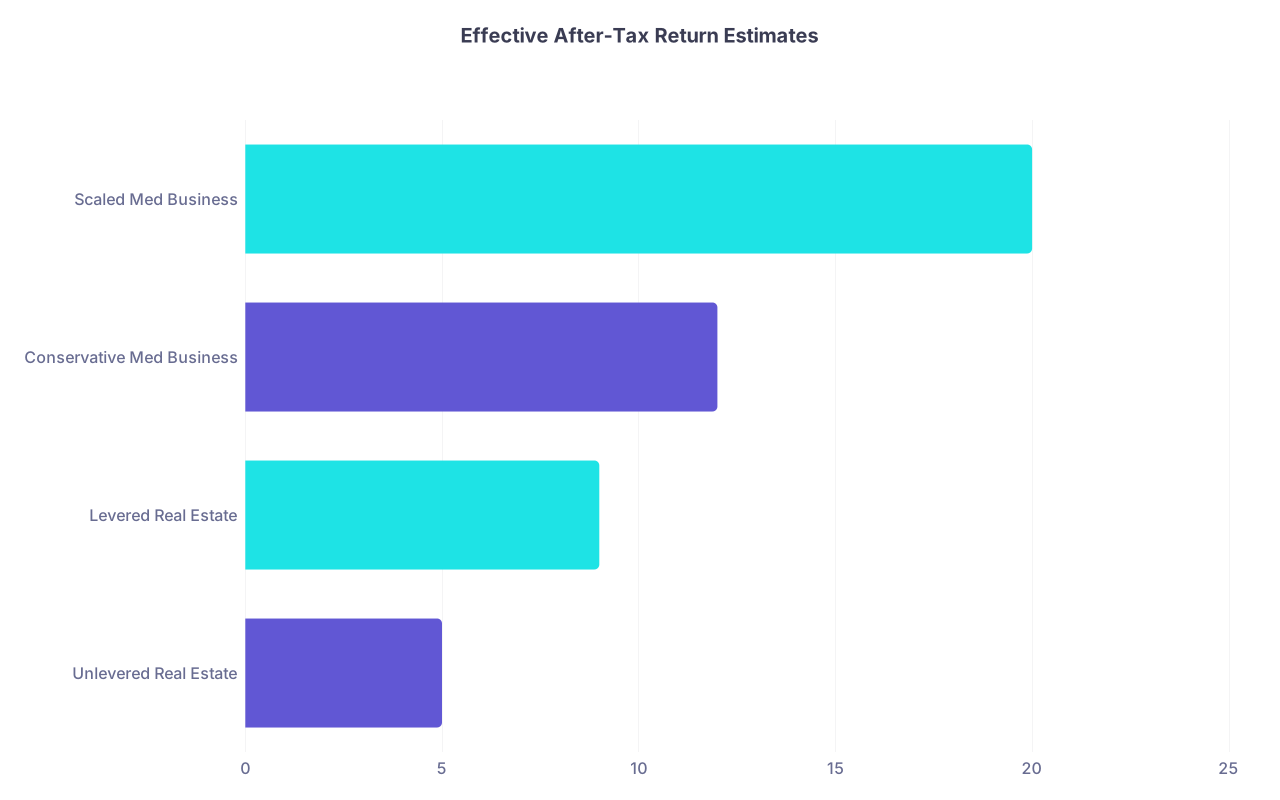
| Category | Value |
|---|---|
| Unlevered Real Estate | 5 |
| Levered Real Estate | 9 |
| Conservative Med Business | 12 |
| Scaled Med Business | 20 |
Those values are directional, but they reflect what I see over and over:
- Unlevered real estate: 4–6% after tax.
- Levered but sensible: 8–10%.
- Conservatively run side business: 10–15%.
- Well-executed, scaled medical venture: 15–25%+.
Liquidity, Optionality, and Career Strategy
One more angle: how each path affects your future choices.
Real estate:
- Liquidity: poor. Selling a property is slow, messy, and expensive.
- Optionality: moderate. You can gradually ramp down clinical work once cash flow becomes meaningful, but that takes 10+ years at typical scale.
- Identity: you stay “a doctor who owns rentals.”
Medical side business:
- Liquidity: variable. Hard to sell early, but at scale you can recapitalize, take distributions, or sell to private equity/strategic buyers.
- Optionality: high. Once profit covers a big chunk of living expenses, you can cut clinical hours drastically, or pivot entirely.
- Identity: you turn into “a physician-entrepreneur,” which changes the type of opportunities that find you.
This is what the timeline tends to look like for someone who aggressively builds a medical side business vs someone who just steadily buys rentals:
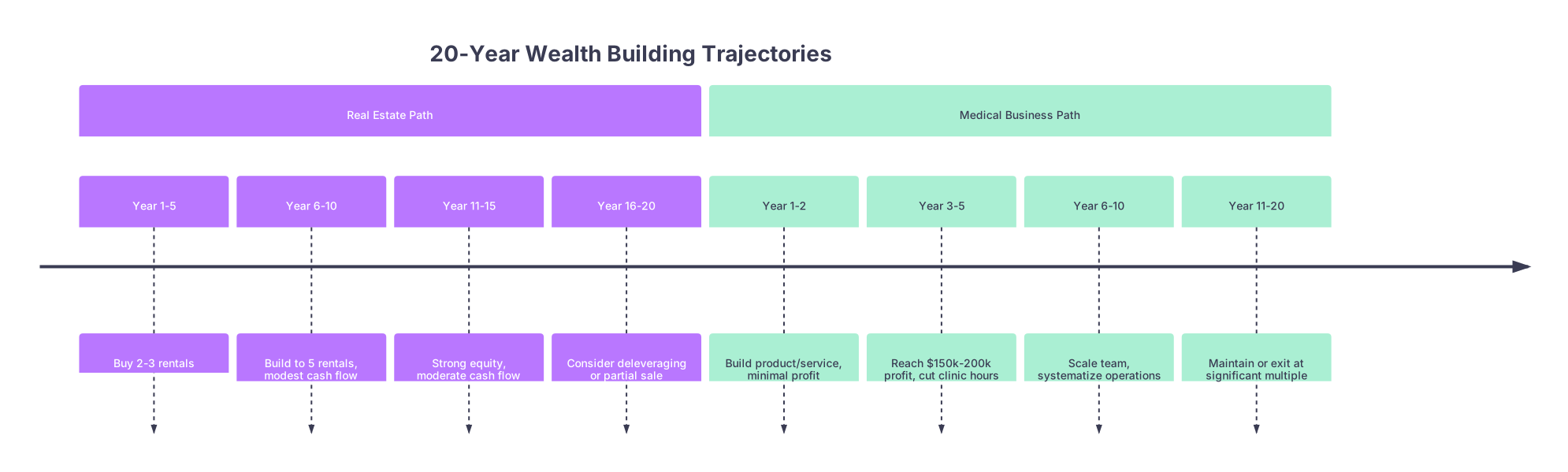
| Period | Event |
|---|---|
| Real Estate Path - Year 1-5 | Buy 2-3 rentals |
| Real Estate Path - Year 6-10 | Build to 5 rentals, modest cash flow |
| Real Estate Path - Year 11-15 | Strong equity, moderate cash flow |
| Real Estate Path - Year 16-20 | Consider deleveraging or partial sale |
| Medical Business Path - Year 1-2 | Build product/service, minimal profit |
| Medical Business Path - Year 3-5 | Reach $150k-200k profit, cut clinic hours |
| Medical Business Path - Year 6-10 | Scale team, systematize operations |
| Medical Business Path - Year 11-20 | Maintain or exit at significant multiple |
You are trading:
- Slow, compounding safety (real estate) for
- Higher variance, front-loaded pain, but much higher upside (medical business).
You can of course do both. But not at the same intensity.
Strategic Takeaways: Where the Data Points You
Let me strip away the emotion and treat you like a portfolio.
If you are a physician with:
- Strong clinical income
- 10–25 years left in career
- Appetite for some risk
- Interest in business or systems
Then the data is pretty clear:
- Purely financial long-term upside is higher with a well-chosen, scalable medical side business than with a modest rental portfolio.
- Real estate is an excellent capital storage and smoothing tool, not an exponential growth engine, unless you go full-time operator.
- The real leverage for physicians is not “other people’s money” in mortgages; it is “other people’s time and attention” in a business that leverages your license, reputation, and domain expertise.
So the rational plan for many physicians is:
- Use real estate sparingly as ballast—maybe a couple of solid properties or passive syndications that do not consume your weekends.
- Put serious, focused effort into one medical side business with real scaling potential, accept that the first 24–36 months will be a grind.
- Design that business from day one to be sellable and not dependent on your clinical hours.
Most of your colleagues are sleepwalking into small-time landlord status and calling it a “wealth strategy.” They will end up with a couple million in equity and some mild stress about roofs and tenants. There is nothing wrong with that. It is just not maximizing the leverage of being a physician in a fragmented, dysfunctional healthcare system begging for better services.
The numbers, across dozens of case examples, say this:
- Real estate is a good floor, not a good ceiling.
- Medical side businesses, built intelligently, are the only realistic path for most physicians to 8-figure outcomes.
- Your scarcest resource is not capital; it is focused, high-energy hours. Allocate them to something that can compound faster than 3–5% above inflation.
Everything else is just preference.