
The most expensive mistake physicians make with side hustles is choosing the wrong tax structure and not even realizing it.
The core problem: you are probably paying more tax than you think
Let me be blunt. Most physicians with side income are either:
- Letting an employer put everything on a W‑2 and losing flexibility, or
- Taking 1099 income and never optimizing self‑employment tax, or
- Forming an LLC “because someone said it was smart” and not using it correctly.
The tax code does not care that this is a “little” side hustle. The percentages are the same. A side consulting gig that nets you $40,000 can easily bleed $12,000–$18,000 in taxes depending on structure and planning. I have seen that gap in real returns more than once.
Let’s quantify it. Numbers only. W‑2 vs 1099 vs LLC (including S‑corp election) under typical physician income conditions.
Baseline assumptions: what the data says a “typical” physician looks like
To compare structures, we need a consistent baseline. I will use this profile, which roughly matches national income data for many attending physicians:
- Primary job: W‑2 attending, $300,000 salary
- Filing status: Married filing jointly
- State: Assume no state income tax for clarity (think TX, FL); you can mentally add your state rate later
- Side hustle profit: $50,000 per year (after direct business expenses)
- Year: 2024 tax brackets and self‑employment rates
- No student loan interest deduction (you are far over the income limit)
- Standard deduction used
The key lever we will track: total tax paid on that extra $50,000 of profit under different structures.
We will separate:
- Federal income tax (marginal rate)
- FICA / self‑employment tax (Social Security + Medicare)
- Impact of payroll vs non‑payroll income
Structure #1: Side hustle as W‑2 income
This is usually the worst structure from a pure tax flexibility perspective, but it does happen. Example: a hospital system wants you to do “extra” work or admin projects and just increases your W‑2 compensation.
How it is taxed
All side hustle income is simply added to your W‑2 wages. Mechanically:
- Income tax: taxed at your marginal federal bracket
- FICA (Social Security + Medicare):
- Employee portion: 7.65% on wages up to the Social Security wage base; 1.45% Medicare on all wages; plus extra 0.9% Medicare surtax on wages above $250,000 (MFJ)
Given $300,000 base salary, Social Security tax is already maxed out at the main job (wage base $168,600 for 2024). So for the $50,000 side hustle as W‑2:
- No additional Social Security tax
- Additional Medicare tax (1.45%) + 0.9% surtax on amounts above $250k
- Marginal income tax likely around 32–35% depending on deductions and exact stacking
A reasonable combined marginal rate on that extra $50,000 for a $300k earner:
- Federal income tax: ~32–35%
- Medicare + surtax: about 2.35% (1.45% + 0.9%)
- Total marginal burden: roughly 34–37%
So your $50,000 side hustle W‑2 likely nets:
- Tax cost: $17,000–$18,500
- After‑tax keep: $31,500–$33,000
The point: You pay full marginal income tax, no special deductions, and no flexibility for business expenses (those are employer’s, not yours).
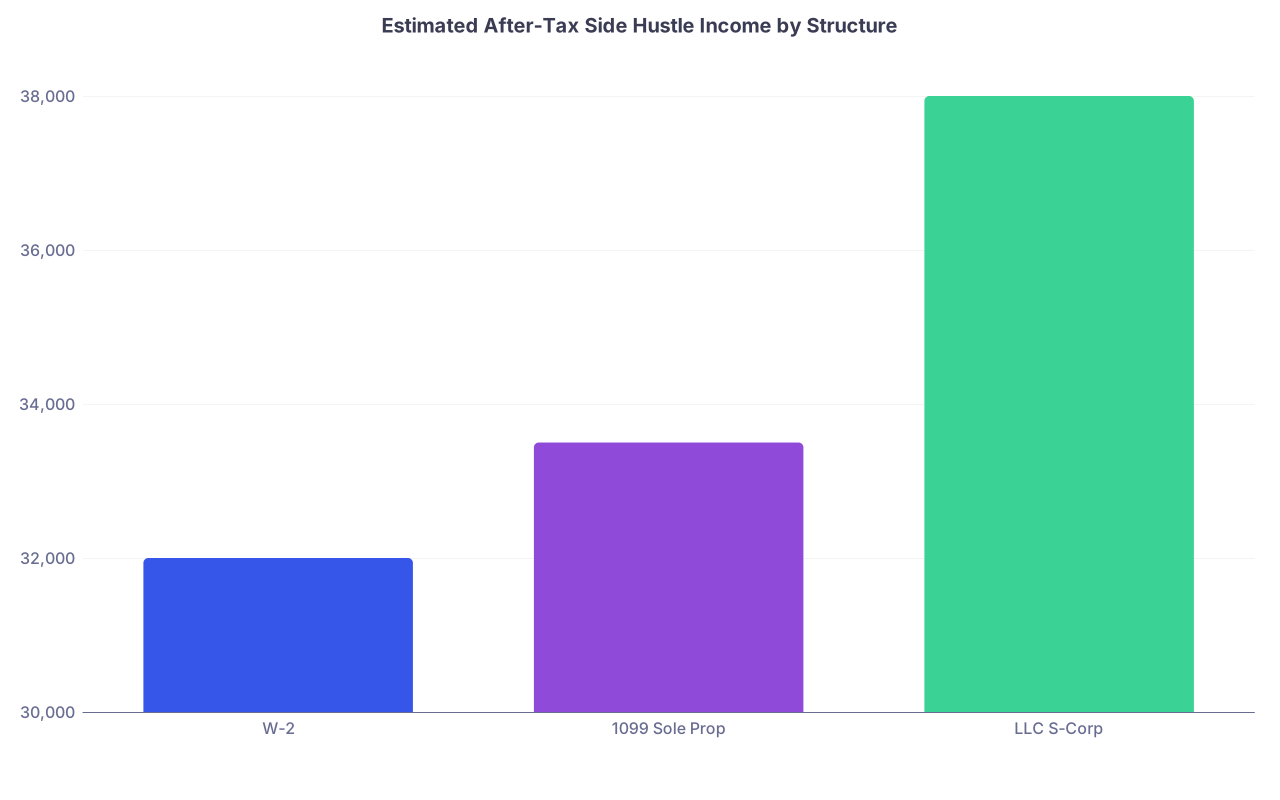
| Category | Value |
|---|---|
| W-2 | 32000 |
| 1099 Sole Prop | 33500 |
| LLC S-Corp | 38000 |
Structure #2: 1099 independent contractor (no LLC, just sole proprietor)
This is the most common and often the most misunderstood. You receive a 1099‑NEC for your side work, report it on Schedule C, and pay self‑employment tax plus income tax on net profit.
The math of self‑employment tax
Self‑employment (SE) tax is 15.3% on net earnings up to the Social Security wage base, then 2.9% Medicare beyond that, plus 0.9% Additional Medicare Tax at high incomes.
Here is where physician incomes matter. With $300,000 of W‑2 wages:
- You already max Social Security at $168,600 on the main W‑2 job
- So your SE tax on the $50,000 side hustle is only the Medicare component:
- 2.9% Medicare (employer + employee equivalent) plus 0.9% Additional Medicare Tax above $250,000 joint income
- Effective SE tax rate on that $50,000: 3.8%
Then you pay regular income tax on top of that. Assume a 32–35% marginal federal rate again.
So, roughly:
- Income tax: ~34% of $50,000 = $17,000
- SE Medicare tax: 3.8% of $50,000 = $1,900
- Total tax: ~$18,900
- Net after tax: ~$31,100
That looks similar to W‑2 at first glance. But there is a critical difference: deductions.
The business expense advantage
As a 1099 contractor, you can deduct legitimate business expenses:
- CME, boards, licenses specific to that work
- Home office portion (if actually used regularly & exclusively)
- Equipment, software, malpractice related to that gig
- Travel, mileage, conferences tied to the side activity
- Retirement contributions (Solo 401(k) or SEP‑IRA) based on net earnings
A realistic scenario: you have $10,000 of legitimate, ordinary, and necessary expenses tied to the side gig. Your 1099 shows $60,000, but Schedule C net profit is $50,000 after $10,000 of expenses.
Each $1,000 of expense at a combined marginal 37–38% tax saves you ~$370–$380. With $10,000 in expenses, that is $3,700–$3,800 tax reduction. W‑2 structure generally does not give you that flexibility.
So from a data standpoint, for physicians above the Social Security cap, 1099 income is structurally more flexible than W‑2, and often slightly more tax‑efficient once you account for deductible expenses and retirement contributions.
Structure #3: LLC (disregarded entity) – when it’s just a wrapper
Many physicians form an LLC, but then do not change anything else. The IRS sees a single‑member LLC as a “disregarded entity” by default.
Translation: tax‑wise, you are still a sole proprietor. Same Schedule C. Same SE tax. Same income tax. The LLC is a legal shield, not a tax strategy by itself.
For the pure taxation:
- 1099 paid to: “[Your Name], LLC”
- You report on Schedule C as if you were a sole proprietor
- Numbers are effectively the same as the 1099 scenario above
So when someone says, “Forming an LLC saved me a ton in taxes,” the data usually says otherwise. The savings almost always come from:
- Electing S‑corp status for that LLC, or
- Becoming more organized about expenses and retirement contributions, not the LLC label itself.
Structure #4: LLC taxed as S‑Corporation – where the real delta often appears
This is where things get interesting. And where people screw it up.
An LLC that elects to be taxed as an S‑corp can split your side hustle profit into:
- Reasonable salary (W‑2 from your own S‑corp), subject to payroll tax (Social Security up to the wage base + Medicare), and
- Distributions (profit), not subject to self‑employment tax or payroll tax
For physicians who already max Social Security from their main W‑2, the benefit is mostly about reducing Medicare tax on the side hustle piece.
Concrete example: $50,000 side hustle profit via S‑corp
Assume:
- You set a reasonable salary of $30,000
- The remaining $20,000 is S‑corp distribution
Now:
- Salary $30,000:
- Subject to Medicare (1.45% employee + 1.45% employer equivalent, plus possible 0.9% Additional Medicare Tax at high incomes)
- Subject to federal income tax like any W‑2
- Distribution $20,000:
- Not subject to SE tax or payroll Medicare
- Still subject to federal and state income tax
Since Social Security is already maxed at your main job, we focus on Medicare.
Rough Medicare hit without S‑corp (plain 1099):
- On full $50,000: 3.8% SE Medicare → $1,900
With S‑corp structure:
- Medicare on $30,000 salary (employer + employee + 0.9% extra above the threshold):
- Roughly 3.8% of $30,000 ≈ $1,140
- No Medicare tax on $20,000 distribution
Medicare tax savings: $1,900 − $1,140 ≈ $760 per year in this simple setup.
This is not life‑changing. But it is real.
Now scale it:
- $100,000 side hustle profit, salary $60,000, distribution $40,000
- Medicare savings could approach ~$1,500–$2,000+ each year
For a growing side business, that adds up.
But this ignores something else: S‑corp compliance costs. Payroll service, separate tax return (Form 1120‑S), additional accounting. Call that $1,000–$2,000 per year if you do it cleanly.
So here is the actual data‑driven conclusion: S‑corp begins to make consistent economic sense for a physician side hustle when:
- Net profit is at least $60,000–$80,000 per year, and
- You run it cleanly with reasonable salary and professional bookkeeping
Below that level, the Medicare savings often do not exceed the cost and hassle.
| Structure | Extra Payroll/SE Tax | Income Tax Flexibility | Typical Net After Tax* |
|---|---|---|---|
| W‑2 Side Income | Low (no SS, some Med) | Very low | ~$32k |
| 1099 Sole Prop | ~3.8% Medicare | High (expenses, Solo 401k) | ~$33–35k |
| LLC (disregarded) | Same as 1099 | Same as 1099 | ~$33–35k |
| LLC taxed as S‑corp | On salary only | High, plus SE savings | ~$36–38k after costs |
*Assuming strong use of deductions and retirement; illustrative only, not personalized advice.
Where each structure wins and loses: quantified scenarios
Let’s run three quick scenarios using the same physician profile (300k W‑2, 0% state tax) and different side profit levels. All numbers are ballpark, not penny‑exact, but directionally accurate.
Scenario A: Small side hustle – $10,000 net profit
W‑2 addition:
- Income tax at ~34% → $3,400
- Medicare 2.35% → ~$235
- Net ≈ $6,365
1099 sole prop:
- Income tax ~34% → $3,400
- SE Medicare 3.8% → $380
- Net ≈ $6,220
- But likely more deductible expenses (phone, small CME, software) → may actually net closer to W‑2 level or better
S‑corp:
- Honestly, pointless here. Compliance cost > tax savings.
Conclusion: At $10k, structure choice matters less than simple record‑keeping and not missing deductions.
Scenario B: Moderate side hustle – $50,000 net profit
Reasonable comparative net, assuming:
- $10k expenses on 1099/LLC and S‑corp
- S‑corp salary at $30k, $20k distribution
- $1,500 annual extra admin cost for S‑corp
Approximate:
- W‑2 side income: Net ~$32k
- 1099 sole prop: Net ~$33–35k (because expenses + Solo 401(k) flexibility)
- LLC disregarded: Essentially same as 1099
- LLC S‑corp: Net maybe ~$36–38k after admin cost if done well
You are looking at a ~10–20% improvement vs W‑2 when moving to an optimized S‑corp structure at this level, mostly from better expense use + slightly lower Medicare tax.
Scenario C: Large side hustle – $150,000 net profit
Now the gap grows. Assume:
- 1099 profit after expenses = $150k
- S‑corp salary = $90k, distribution = $60k
- Same income tax bracket
- S‑corp cost = $2,000 annually
Roughly:
- 1099 sole prop extra Medicare (3.8% on $150k): $5,700
- S‑corp Medicare (3.8% on $90k salary): $3,420
- Savings: $2,280 per year, minus $2,000 admin cost → net ~$280. Small but still slightly positive.
Where S‑corp really improves things in higher ranges is when combined with more sophisticated planning: health insurance through S‑corp, accountable plans for some reimbursements, etc. But that gets bespoke fast.
The raw data though: the bigger the side income, the more S‑corp can matter. But it never overcomes bad income tax planning or poor expense tracking.
Common physician errors the numbers expose
I keep seeing the same patterns.
Treating all income as W‑2 “for simplicity”
You give up: business deductions, retirement plan flexibility, and any control over FICA/SE tax structure. Simplicity is expensive at your income level.Forming an LLC and stopping there
The LLC gives legal separation. It does not magically drop your tax rate. Without S‑corp election or disciplined expense and retirement planning, your tax profile is nearly identical to a bare 1099 sole prop.Ignoring retirement space created by side income
A $50,000 net 1099 can reasonably support a ~$10,000+ Solo 401(k) contribution (depending on how it integrates with your W‑2 plan), which can reduce current year federal tax by $3,000–$4,000 alone. I have watched physicians leave that on the table year after year.Underpaying estimated taxes on 1099 / LLC income
That “extra” $50k looks great until the IRS wants its share. You should be making quarterly estimated payments or adjusting W‑2 withholding. Penalties and interest do not care that this was “just a side thing.”Playing games with “reasonable compensation” in S‑corps
Paying yourself a $5,000 salary on $200,000 of side profit is not “aggressive planning.” It is a red flag. The data from IRS audits is very clear: unreasonable compensation is one of the top S‑corp audit targets.
Decision framework: how to choose your structure
Here is a practical, data‑driven way to think about this as a physician.

| Step | Description |
|---|---|
| Step 1 | Side hustle income |
| Step 2 | Keep 1099 or W-2 focus on deductions |
| Step 3 | Use 1099 or LLC optimize expenses and Solo 401k |
| Step 4 | Consider LLC with S-corp election model tax savings vs costs |
| Step 5 | Under 20k/year? |
| Step 6 | 20k-80k/year? |
| Step 7 | Over 80k/year? |
Rough guidelines:
Under $20k/year side income:
Keep it simple. 1099 is fine. Track every legitimate expense. Skip the S‑corp overhead.$20k–$80k/year:
Strongly favor 1099 or an LLC (disregarded) with disciplined bookkeeping, Solo 401(k), and proper estimated taxes. Run real projections before jumping to S‑corp.Over $80k/year consistently:
Now S‑corp might make sense. Have a CPA model:- Reasonable salary vs distributions
- Medicare savings vs legal + accounting fees
- Interaction with your main W‑2 retirement plan and benefits
The data point you care about is not “S‑corp vs not.” It is “After‑tax dollars in your pocket per hour of hassle and risk.”
The future: why this matters more every year
Side hustles for physicians are not going away. If anything, the data shows:
- Burnout pushes doctors toward consulting, telemedicine, content creation, expert witness work, and small practices
- Hospital employment dominates primary jobs (W‑2), which makes the side hustle the only flexible piece of their financial life
- Legislative and IRS scrutiny of S‑corps and independent contractor misuse is increasing
So three trends are colliding:
- More physicians with significant non‑W‑2 income
- More use of LLCs and S‑corps without clear understanding
- More attention from regulators on misclassification and abusive compensation strategies
Translation: doing this sloppily is becoming more dangerous, while doing it intelligently is increasingly valuable.

What you should actually do next
You do not need a 50‑page tax treatise. You need three moves:
Quantify your side hustle
- What was your last 12 months of gross and net income?
- Is it stable, growing, or one‑off?
- Over or under $80k net annually?
Model two or three structures with real numbers
Ask a CPA (or do a spreadsheet) to compare for your situation:- W‑2 vs 1099 vs LLC vs LLC S‑corp
- Total federal income tax
- Total FICA / SE tax
- Compliance costs and time
Commit to one system and run it clean
- Separate business bank account
- Track expenses monthly
- Schedule quarterly tax estimates
- Re‑evaluate structure once every 1–2 years as income changes
If your accountant cannot show you, in numbers, how much tax each structure will likely cost on your next $50,000 of side hustle income, get a better accountant. The data is not complicated. It is just often ignored.