
Moonlighting looks lucrative on paper. Consulting looks glamorous on LinkedIn. The data says both are overrated if you ignore one thing: return on time, not just return on money.
This is where most residents and attendings miscalculate. They chase the highest hourly rate or the easiest gig, instead of running an honest ROI analysis across money, risk, burnout, and long‑term upside.
Let’s run the numbers.
1. The Core Equation: What “ROI” Actually Means For Physicians
For side hustles, ROI is not just dollars divided by hours. You are trading three scarce assets:
- Time (finite, often already overcommitted)
- Energy / cognitive bandwidth
- Reputation / credential leverage
I use a simple working metric:
Effective ROI per hour = (After‑tax cash + realistic long‑term upside value) / Total true hours
Total true hours is where people lie to themselves. It includes:
- Direct work hours
- Commute and setup time
- Unpaid admin (EMR, invoicing, email)
- Recovery / fatigue cost (nights wrecking your week)
To keep things grounded, I will use conservative U.S. numbers, typical 2023–2024 rates, and ignore extreme outliers like celebrity expert witnesses or FAANG medical directors.
2. The Money: Side‑by‑Side Financial Comparison
At a high level, moonlighting is “cash now, high certainty, limited upside.” Consulting is “cash later, higher variance, strong upside for some specialties.”
Typical hourly ranges
| Role Type | Resident (Hourly) | Attending (Hourly) |
|---|---|---|
| Clinical moonlighting | $80–$150 | $130–$250 |
| Telemedicine moonlighting | $70–$120 | $100–$180 |
| Med-legal consulting | $150–$300 | $250–$600+ |
| Industry consulting (ad hoc) | $125–$250 | $200–$400 |
| Ongoing advisory (retainer) | $100–$200* | $200–$350* |
*Retainer rates are often blended; some hours are “light touch” emails / meetings, not all deep work.
Where the rates actually land
- Residents almost never get paid more than $150/hr clinical unless it is rural, high‑acuity, or brutal shifts.
- Attendings pushing past $250/hr moonlighting are typically in EM, anesthesia, critical care, or low‑desirability locations.
- Med‑legal hits $500–$700/hr for seasoned subspecialists with trial experience. Not for PGY‑2s.
The punchline: raw hourly rates do not tell the full story. The workload and leverage differ drastically.
3. Time and Fatigue Load: What the Hours Really Cost
Moonlighting and consulting use different parts of your brain. That matters.
Workload characteristics
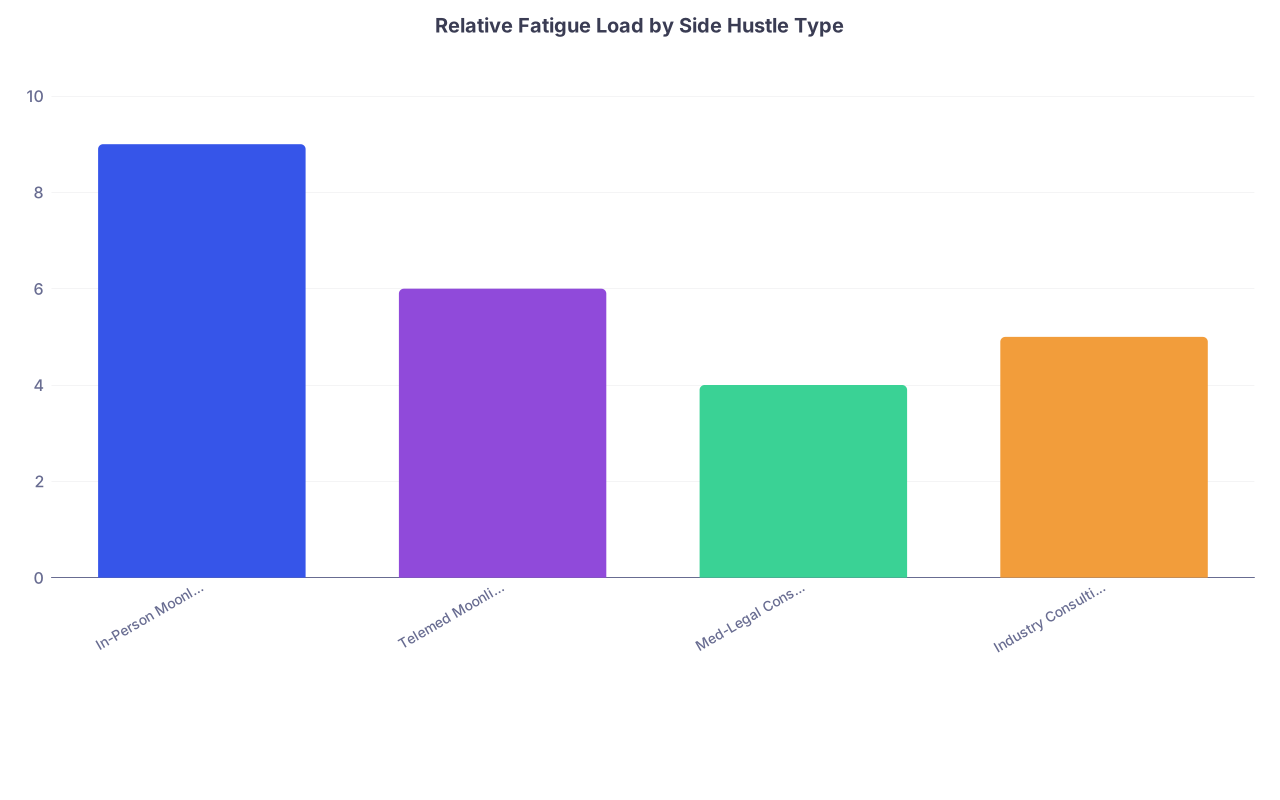
| Category | Value |
|---|---|
| In-Person Moonlighting | 9 |
| Telemed Moonlighting | 6 |
| Med-Legal Consulting | 4 |
| Industry Consulting | 5 |
Scale: 1 = very light / low stress, 10 = heavy / high stress. These are realistic averages from what physicians report, not vendor marketing.
- In‑person moonlighting: high acute cognitive load, circadian disruption, physical fatigue.
- Telemed moonlighting: moderate load; high volume but less physical stress, less travel.
- Med‑legal and industry consulting: cognitively demanding but usually predictable hours, no 3 a.m. pages.
Hidden time costs
Let’s take a typical resident EM moonlighting gig:
- Advertised: 10‑hour overnight shift, $120/hr → $1,200 gross.
- Hidden:
- 1 hr total commute
- 0.5 hr pre‑shift sign‑in / admin
- 1 hr post‑shift debrief / notes finishing
- 0.5–1 full day of reduced productivity afterward
If you amortize the “wrecked next day” as another 4–6 hours of meaningful capacity lost (because you are a zombie in clinic or on consults), your real denominator might be:
10 + 1 + 0.5 + 1 + 4 = 16.5 “impact hours”.
Now the pay looks like:
- Gross rate per impact hour ≈ $1,200 / 16.5 ≈ $72.73/hr
- After 30% effective tax rate (federal + state + FICA) → $840 → $50.91/hr after‑tax per impact hour
Still not bad. But not the headline $120/hr anymore.
Compare that to an industry consulting call:
- 2 hours of prep (reading slides, background materials)
- 1 hour Zoom advisory board
- 0.5 hour follow‑up email & invoicing
- Total: 3.5 hours
- Rate: $300/hr for attendings, $200/hr for experienced fellows or residents in some niches
Attendings:
- Gross = 3.5 * $300 = $1,050
- Impact hours = 3.5 (no circadian hit)
- Gross per impact hour = $300
- After 35% effective tax (consulting income often self‑employment) → ~$682.50 net → $195/hr after‑tax per impact hour
On an honest time basis, industry consulting can be 3–4x the effective ROI of moonlighting for some attendings. Residents have fewer options but the gap is still real once they have niche expertise.
4. Risk, Liability, and Burnout: The Non‑Cash ROI
If you ignore non‑financial risk, you will make bad decisions.
Clinical moonlighting risk profile
- Malpractice: You are exposed. Even with coverage, you carry stress and reputational risk.
- Fatigue: Night shifts and extra calls increase error rates. The literature backing this is not subtle.
- Burnout: Each incremental shift has diminishing marginal dollars versus sharply increasing marginal burnout. I have watched residents go from “this is great money” to “I hate medicine” in one flu season.
Consulting risk profile
- Malpractice: Minimal to none, unless you are giving direct clinical advice or badly documented med‑legal work.
- Fatigue: Much more controllable. You can often choose daytime windows and decline projects.
- Ethical / compliance risk: Real. If you blur boundaries with pharma/device, do sloppy conflict‑of‑interest disclosure, or misrepresent expertise, that can blow back on you.
But as hard data, clinical moonlighting carries more direct career‑ending downside than consulting.
Burnout ROI comparison
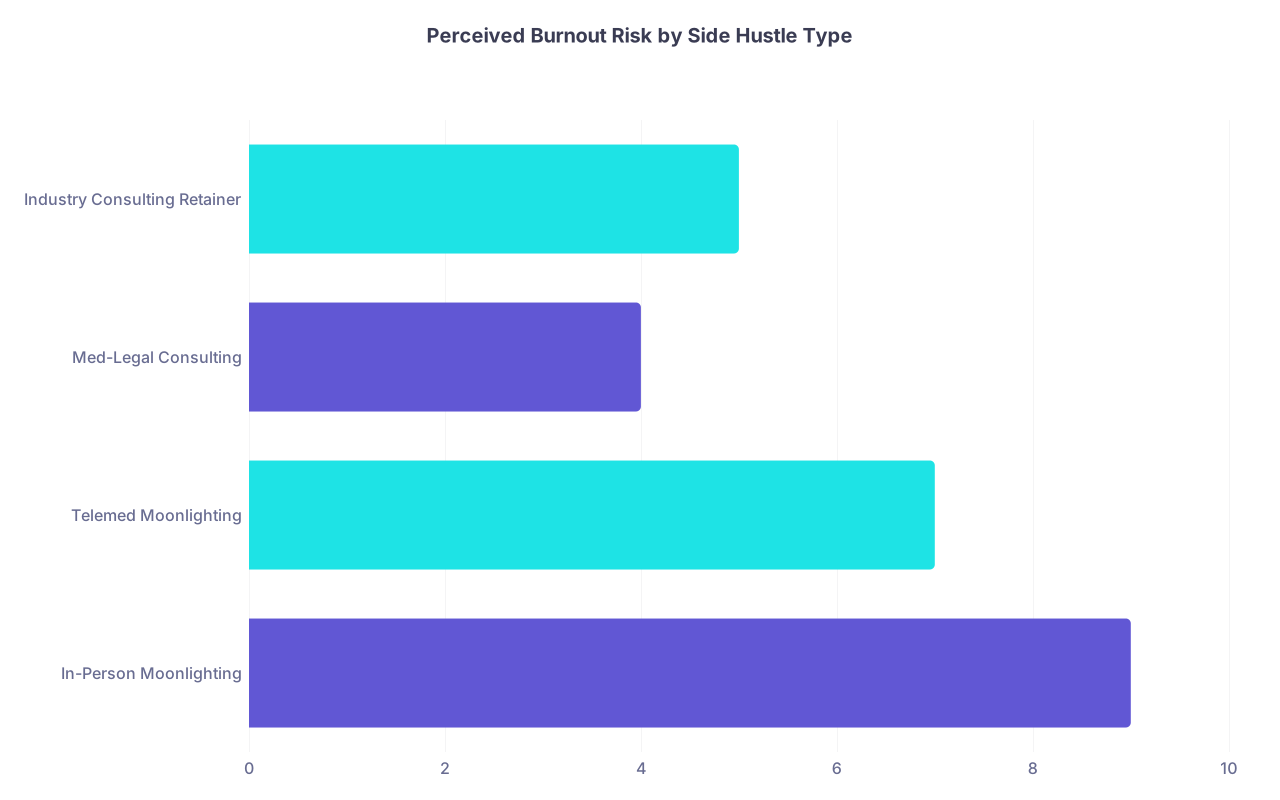
| Category | Value |
|---|---|
| In-Person Moonlighting | 9 |
| Telemed Moonlighting | 7 |
| Med-Legal Consulting | 4 |
| Industry Consulting Retainer | 5 |
Again, 1–10 scale based on composite of published physician burnout data and what physicians actually report to colleagues.
You pay for extra clinical work in ways not captured by your W‑2.
5. Short-Term vs Long-Term ROI: Career Capital
If you only care about next month’s rent or loan payment, moonlighting often wins. If you care about what your life looks like 5–10 years out, the numbers flip.
How each path compounds
Moonlighting:
- Skills gained: More reps, procedural skill, speed, maybe independence.
- Market value: Marginally higher if you want more clinical FTE or locums work.
- Ceiling: You cannot scale beyond your own body. 1 physician hour = 1 billing unit.
Consulting:
- Skills gained: Industry literacy, communication with non‑clinicians, strategic thinking, regulatory knowledge.
- Market value: Direct pathway to:
- Part‑time medical director roles
- Full corporate roles (MSL, medical affairs, clinical development, health tech leadership)
- Paid speaking, advisory panels, expert witness work
You are building leverage. 1 hour of advisory experience this year might contribute to a $250k+ non‑clinical offer later.
Example: 5‑year scenario comparison (attending)
Assume two internists, both 0.9 FTE clinically.
Physician A: Moonlighting focused
- 15 hrs/month moonlighting at $175/hr gross
- Gross side income: 15 * 12 * 175 = $31,500/year
- After 35% tax: ~$20,475
No major career change. Maybe small incremental raises.
Physician B: Consulting focused
Year 1–2:
- 8 hrs/month industry advisory / med‑legal blended at $275/hr
- 8 * 12 * 275 = $26,400/year gross
- After 35%: ~$17,160
Year 3–5: Builds network, takes 0.2 FTE medical director role at $80k/year plus ongoing 4 hrs/month advisory at $300/hr:
- Medical director: $80,000
- Advisory: 4 * 12 * 300 = $14,400
- Total = $94,400/year gross side income
Over 5 years:
- Physician A total side gross ≈ 5 * 31,500 = $157,500
- Physician B total side gross ≈ (2 * 26,400) + (3 * 94,400) = $336,000
Physician B also now has an exit ramp out of full‑time clinical work if desired. Physician A has a fatigued adrenal axis.
The data is unforgiving: once consulting leads to even one stable non‑clinical role, long‑term ROI dwarfs moonlighting.
6. Resident vs Attending: Stage-Specific ROI
Residents and attendings are not playing the same game.
Residents: liquidity vs leverage
Residents usually say, “I need cash, not networking.” Understandable, but incomplete.
Let’s quantify.
Resident A: Max moonlighting
- PGY‑3, internal medicine
- 2 weekend shifts/month, 12 hrs each, $110/hr
- Annual gross side income: 2 * 12 * 12 * 110 = $31,680
- Assume aggressive 25% effective rate (lower bracket): net ≈ $23,760
If this lets them avoid 7.5% interest capitalization on $150k loans for 2 years, that is significant:
- Without moonlighting: 150,000 at 7.5% for 2 years ≈ 150k * (1.075^2 – 1) ≈ $23,363 in interest.
- With moonlighting aggressively paying interest: you might cut that by 50–70%.
So clinical moonlighting for residents has a clean, mathematically defensible ROI on debt alone.
Resident B: Strategic consulting
This resident does less moonlighting and deliberately builds consulting capital:
- 5 hrs/month med‑legal literature reviews for an attorney at $100/hr → 5 * 12 * 100 = $6,000/year
- 3 hrs/month unpaid or low‑paid advisory with a digital health startup (equity or $50/hr) → call it $1,800 in cash equivalent.
Purely by near‑term cash, Resident B loses. But:
- They learn how to structure contracts and invoices.
- They start building a track record and references outside the hospital.
- They can step straight into $200–300/hr consulting as an attending with proof of work.
From a lifetime earnings perspective, the resident who takes some consulting exposure early is stacking long‑term ROI, even if they do less of it than moonlighting.
So the optimal data‑driven strategy for residents is usually not “only moonlighting” or “only consulting.” It is:
- 70–80% of extra time to moonlighting for liquidity and debt.
- 20–30% to building a targeted consulting profile that pays off after training.
7. Specialty Differences: Where Consulting Crushes Moonlighting
Not all specialties see the same spread.
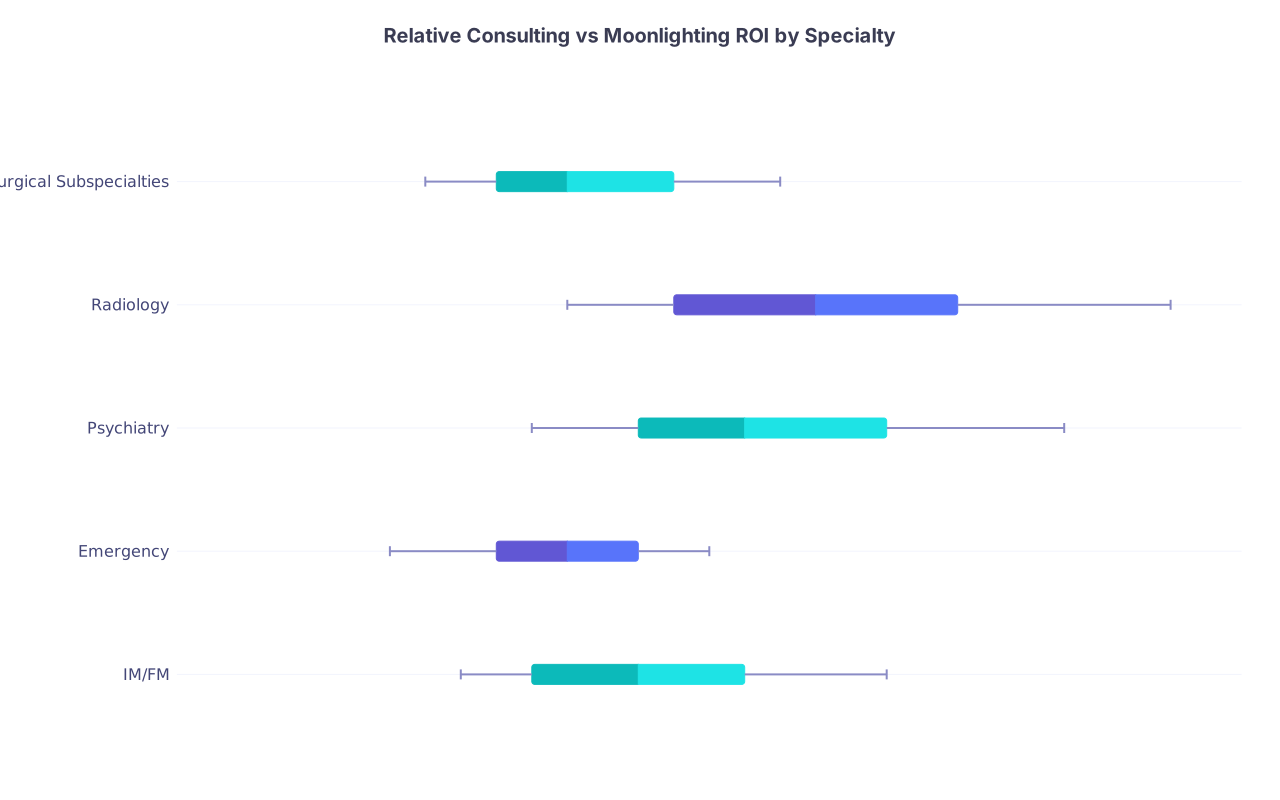
| Category | Min | Q1 | Median | Q3 | Max |
|---|---|---|---|---|---|
| IM/FM | 0.8 | 1 | 1.3 | 1.6 | 2 |
| Emergency | 0.6 | 0.9 | 1.1 | 1.3 | 1.5 |
| Psychiatry | 1 | 1.3 | 1.6 | 2 | 2.5 |
| Radiology | 1.1 | 1.4 | 1.8 | 2.2 | 2.8 |
| Surgical Subspecialties | 0.7 | 0.9 | 1.1 | 1.4 | 1.7 |
The numbers here are stylized “consulting ROI / moonlighting ROI” ratios (1.0 = equal, 2.0 = consulting yielding 2x long‑term ROI per hour at maturity).
- Internal medicine / family medicine: strong upside in value‑based care, population health, digital health, guideline work. Consulting ROI can easily be 1.5x+ moonlighting.
- Psychiatry: huge demand in digital mental health, utilization management, policy. Consulting ROI often 1.5–2x.
- Radiology: teleradiology moonlighting already pays well; consulting ROI still favorable, but the spread is narrower unless you are deeply involved in AI / workflow startups.
- Emergency medicine: moonlighting rates are high; consulting is attractive but the ratio is closer to parity unless you branch heavily into operations, staffing models, or prehospital care.
- Surgical subspecialties: med‑legal consulting is strong; industry roles (devices, robotics) can explode in value, but the on‑ramp is narrower and more political.
If you are in IM, psych, or radiology and not at least testing consulting waters, you are almost certainly leaving long‑term ROI on the table.
8. Operational Friction: Getting In vs Getting Paid
Some residents love moonlighting because it is “plug and play.” Show up, see patients, submit hours, get paid. That matters. Transaction cost is part of ROI.
Barriers to entry
| Dimension | Moonlighting | Consulting |
|---|---|---|
| Credentialing | High (privileges, payer, HR) | Low–moderate (contract, NDA) |
| Time to first dollar | 2–6 months | 1–3 months (can be sooner) |
| Marketing required | Minimal | Moderate (networking, outreach) |
| Negotiation needed | Low–moderate | High (rates, scope, IP, COI) |
| Billing complexity | Low (W‑2/1099 from group) | Moderate–high (invoices, 1099, SE tax) |
Moonlighting wins the “friction” game early. But once you build a consulting pipeline, friction falls dramatically. One well‑negotiated relationship can produce repeat engagements for years, with very low marginal friction.
9. A Simple Decision Framework: Where Should You Put the Next 10 Hours?
You can overcomplicate this or you can run a simple triage.
Step 1: Quantify your constraints
- Do you have acute cash / debt pressure? (Yes → moonlighting gets weight.)
- Are you already at risk of burnout? (Yes → beware more nights / weekends.)
- Do you want an exit ramp from full‑time clinical in the next 5–10 years? (Yes → consulting has to be in the mix.)
Step 2: Score the options
For your next 10 discretionary hours, you can assign a crude score (1–10) for:
- Cash ROI
- Energy impact (reverse scored – lower fatigue = higher score)
- Long‑term career leverage
Then do a weighted sum. An example:
| Metric | Moonlighting (10 hrs) | Consulting (10 hrs) |
|---|---|---|
| Cash ROI (weight 0.5) | 9 | 7 |
| Energy impact (0.2) | 4 | 8 |
| Long-term leverage (0.3) | 3 | 9 |
| Weighted score (0–10) | 9*0.5+4*0.2+3*0.3=5.6 | 7*0.5+8*0.2+9*0.3=7.9 |
In that example, if you care about more than just this month’s paycheck, consulting clearly dominates where to place your next incremental hours.
You can shift the weights based on your reality. Crippling short‑term financial pressure? Make cash ROI 0.7 and rerun. You will still usually see that some small allocation to consulting has the highest marginal long‑term return.
10. Implementation: How To Actually Start Consulting Without Blowing Up Your Life
Conceptually, consulting wins long‑term ROI. Practically, most physicians never start because they have no idea how to operationalize it. Or they are allergic to self‑promotion.
Here is a minimal‑viable‑strategy that does not require you to become a LinkedIn influencer.
1. Pick a narrow, non‑generic niche
“Internal medicine doctor” is not a consulting niche. Examples that actually move contracts:
- “Hospitalist with 5 years in value‑based care and sepsis quality metrics”
- “Psychiatrist focused on digital CBT and serious mental illness”
- “Cardiologist experienced with remote monitoring workflows”
Your niche is the intersection of what you see every week and what non‑clinical stakeholders care about: risk, cost, growth, regulation.
2. Build 2–3 proof points
You do not need a 40‑page portfolio. You need:
- One short case example: “I helped our hospital reduce unnecessary telemetry use by X%.”
- One talk / grand rounds / webinar slide deck that shows you can explain complex clinical topics to non‑physicians.
- One visible professional profile (LinkedIn, personal website) that states your niche clearly and lists a few specific interests (e.g., “digital health,” “medico‑legal review,” “utilization management”).
This is your entry‑ticket to $150–$300/hr work, not to $800/hr expert witness land. That comes later.
3. Start with warm channels
- Former co‑residents now in industry
- Local attorneys who handle med‑mal or personal injury
- Alumni networks from med school or residency
- Hospital committees that interface with payers or vendors
You are not cold‑emailing 500 VCs. You are making 5–10 targeted introductions with people already predisposed to trust you.
4. Set sane minimums and say no
Moonlighting trains you to accept volume. Consulting punishes you if you do the same.
If you let yourself be pulled into $75/hr work with unlimited email access, your ROI collapses. Set minimums:
- Do not open your laptop for less than $150–$200/hr as an attending, $100–$150/hr as a senior resident with rare skills.
- Define scope in writing: number of hours, type of deliverable, response expectations.
Most physicians under‑negotiate consulting and over‑work moonlighting. Flip that.
11. So Which One “Wins”? A Data-Driven Summary
If we pull everything together—cash, time, risk, fatigue, and long‑term upside—the pattern is clear:
Short term, high‑pressure finances (most residents, early attendings)
Moonlighting is the blunt instrument that works. High certainty, fast cash, straightforward to access.Medium term, moderate financial pressure, desire for options
A mixed portfolio—some moonlighting, deliberate early consulting—is mathematically superior. You keep your head above water and build non‑clinical leverage in parallel.Long term, stable finances, burnout risk present or rising
Consulting wins. Repeatedly. It offers better per‑impact‑hour ROI, lower malpractice exposure, and a direct path out of the 1:1 time‑for‑money trap.
One last visual to drive the trajectory home:
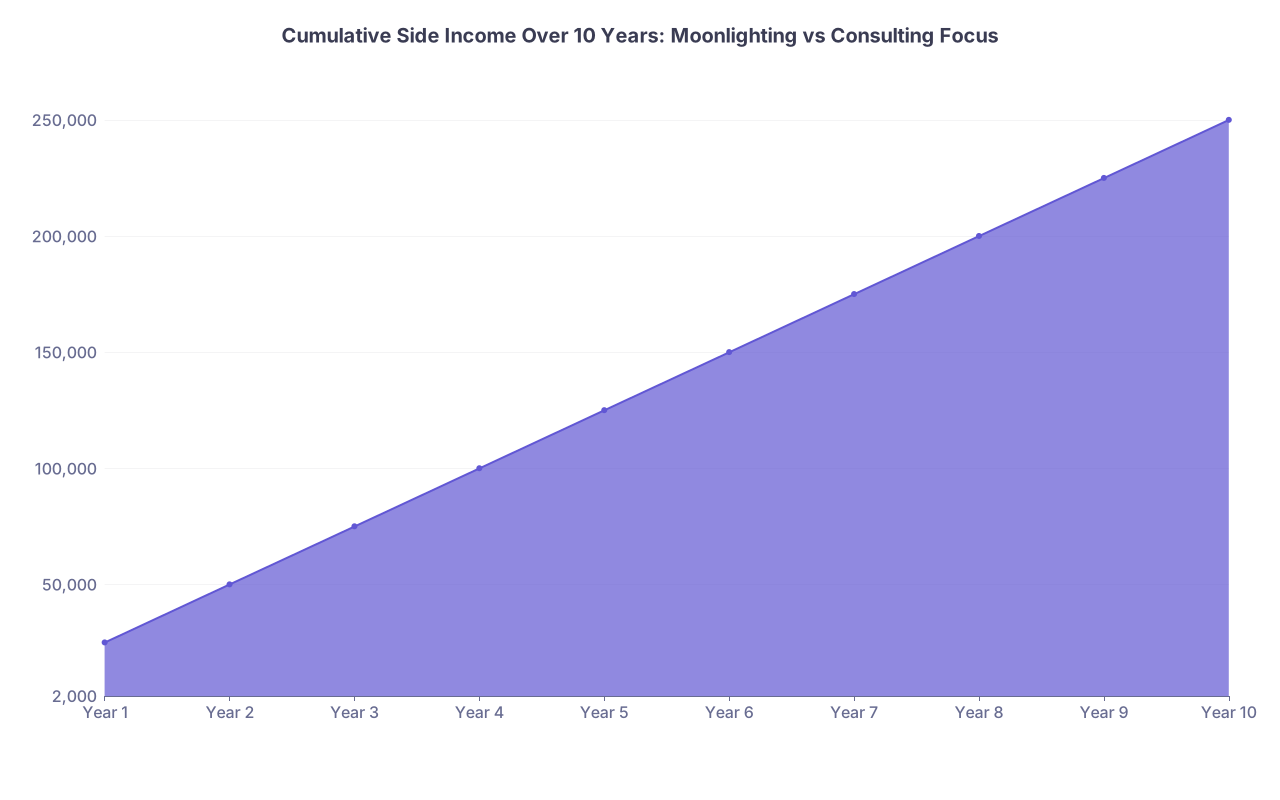
| Category | Value |
|---|---|
| Year 1 | 25000 |
| Year 2 | 50000 |
| Year 3 | 75000 |
| Year 4 | 100000 |
| Year 5 | 125000 |
| Year 6 | 150000 |
| Year 7 | 175000 |
| Year 8 | 200000 |
| Year 9 | 225000 |
| Year 10 | 250000 |
Imagine a second curve above this one—consulting with step‑ups as you add director roles and equity. It climbs slower at first, then pulls away and never looks back.
The typical resident thinks the game ends at “can I pick up one more shift this month.” It does not. The real game is how you allocate your marginal hour over the next decade.
Moonlighting will fix this year’s budget. Consulting can change what your career looks like in five years.
With the math in front of you, your next move is not to sign up for every open call shift. It is to decide, deliberately, how many of your next 10 discretionary hours go to pure cash and how many you are willing to invest in leverage. Once you make that choice, then you can talk about specific consulting niches, contracts, and negotiation tactics—but that is a deeper playbook for another day.