
The standard advice that “if you’re burned out, the last thing you should do is start a side hustle” is wrong. Or at least, dangerously incomplete.
The idea that any work outside your W‑2 job will automatically accelerate burnout has been repeated so many times it sounds like dogma. Attendings say it on rounds. Wellness committees hint at it in slide decks. Some PDs basically equate “side gig” with “about to flame out or leave medicine.”
But that’s not what the data actually show.
Under the right conditions, a side hustle does not just “not harm” you. It can function as a psychological buffer against the very drivers of burnout that are chewing physicians up. The key phrase there is “under the right conditions” — which most people completely ignore.
Let’s separate the myths from the reality.
What Burnout Actually Is (And Is Not)
Before talking side hustles, get honest about burnout.
The most cited framework comes from Christina Maslach’s work: burnout has three dimensions — emotional exhaustion, depersonalization (cynicism), and reduced sense of personal accomplishment. The big physician surveys, from the Mayo Clinic / Shanafelt group to Medscape, use variations on this.
Notice what is not in that definition: “number of total hours worked.”
That matters. Because the lazy narrative is: more hours = more burnout. So any extra work (like a side hustle) must be bad.
The research is different. Across multiple large studies of physicians and other professionals, the dominant drivers of burnout are:
- Loss of control/autonomy
- Mismatch between values and daily tasks
- Lack of perceived fairness or respect
- Chaotic work environment and admin overload
- Inadequate reward/recognition relative to effort
Volume and hours matter, yes. But only as part of that context. An extra 6 hours a week doing something you choose, that reflects your values, where you feel competent and respected, is not the same as 6 more hours of inbox messages and RVU hamster wheel.
Lumping those together as “more work” is sloppy. And wrong.
The Core Myth: “Any Side Hustle = More Burnout”
I hear versions of this constantly:
- “I’m already fried. Why would I add more to my plate?”
- “Isn’t a side gig just another job?”
- “People doing side hustles are running from medicine.”
Some are. But that’s not the whole story.
Look at broader occupational psychology data, not just medicine. There’s a consistent pattern: multiple role identities — if they’re chosen and not forced — can reduce stress and protect against burnout. In other words, if you’re not putting all of your identity eggs in one brittle basket, you’re less likely to shatter when that one role goes sideways.
In non-medical samples:
- Professionals who have a secondary role that provides autonomy and creative control often show lower emotional exhaustion and higher work engagement in their primary job.
- Role diversification is associated with resilience after workplace stressors and layoffs.
Medicine is unique in many ways, but human psychology is not magically different in white coats.
The problem is not “having more than one thing you care about.” The problem is:
- Overcommitting out of financial desperation or FOMO
- Letting the side gig mirror the worst parts of your day job
- Treating it as another obligation instead of a self-directed, values-aligned project
That’s not a side hustle. That’s self-inflicted scope creep.
What the Physician Data Actually Suggest
No, there’s not a giant RCT called “Randomize 1000 internists to Etsy stores vs no Etsy.” But we do have related lines of evidence.
First, physicians who control more of their schedule and scope of work have lower burnout. That includes:
- Locums physicians who can say no to certain assignments
- Physicians with meaningful leadership roles (real authority, not “committee mule”)
- Doctors who partially shift time to non-clinical work they value (informatics, education, research, consulting)
What is a well-designed side hustle? It’s essentially a self-created, non-clinical or semi-clinical role that scores high on:
- Autonomy
- Control over time and place
- Alignment with your interests/values
- Skill variety and growth
That’s exactly the profile associated with better professional well‑being in multiple studies.
Second, physicians with diversified income streams are less trapped. Financial precarity and “I can’t afford to cut back” are massive accelerators of burnout. Several survey studies show physicians who feel able to reduce hours or leave if needed have significantly lower burnout scores. You don’t even have to actually quit. Just knowing you could changes how stuck you feel.
A side hustle that brings in even a modest but reliable $1–2k/month gives psychological leverage. It’s not about the number; it’s about the option value.
So no, the evidence does not support the blanket claim that side hustles increase burnout. It suggests that control, fit, and financial flexibility decrease it. A side hustle can move those levers. Or make them worse. Design determines the direction.
The Good, the Bad, and the Completely Misdesigned
Let’s be specific. Not all side hustles are created equal from a burnout standpoint.
| Type | Burnout Risk Profile |
|---|---|
| Extra PRN clinical shifts | High |
| Chart review / UR | Moderate |
| Med-legal consulting | Low–Moderate |
| Online course / content | Low |
| Coaching / consulting | Low |
| Real estate management | Variable |
At the high-risk end are “side hustles” that are really just more of your primary job’s pain points:
- Picking up more hospitalist shifts because the group is short
- Covering an extra urgent care weekend for “easy cash”
- Telemed shifts scheduled at rigid times controlled by someone else
These give you more income, sure. But psychologically they:
- Increase exposure to EMR/inbox load
- Reinforce being a replaceable RVU unit
- Suck time from sleep, family, and recovery
That’s not protection from burnout. That’s pouring gasoline on it.
On the other side are side hustles built around autonomy, creativity, and leverage:
- Creating CME content or online courses where you own the IP
- Selective expert witness or med-legal consulting at rates that make “no” easy
- Niche consulting (quality improvement, informatics, startup advising)
- Writing, podcasting, or teaching in areas you actually care about
These can:
- Restore a sense of mastery (“I’m more than my EPIC inbox”)
- Connect you with different, often more respectful, audiences
- Create income not tied to churning through patients
That’s where the protective effect shows up.
How a Side Hustle Can Mechanically Protect Against Burnout
This is not “follow your passion” fluff. There are real psychological mechanisms at work.
1. Identity diversification
When I ask burned out attendings, “Who are you if you stop being a doctor tomorrow?” the silence is brutal.
If your entire identity is “I am a clinician,” any threat to that role — an irate patient, a lawsuit, a bad outcome, an administrator’s insult — hits like an existential attack.
A good side hustle gives you alternative answers:
- “I’m also a writer who explains complex medical issues to the public.”
- “I’m a consultant who helps digital health companies not screw up.”
- “I’m an educator with thousands of learners outside my clinic.”
When clinical medicine punches you in the gut, you’re not psychologically defenseless.
2. Restoring autonomy
Burnout research is crystal clear: loss of control is toxic. Medicine has become a masterclass in micro‑control — from 15-minute slots to pre-auth scripts.
Design a side hustle where you:
- Choose the topic
- Set the timeline
- Decide what “good enough” looks like
You literally retrain your brain to experience work as something you direct, not just absorb.
3. Financial optionality
Burnout accelerates when you feel trapped. The story in your head sounds like: “I hate this, but I can’t afford to cut back.”
Even a modest, growing side income can let you:
- Drop one clinic session per week
- Say no to a soul-destroying administrative task
- Move to a slightly lower-paying but saner job
The data on physician burnout and intent to leave the profession show a tight link between feeling economically trapped and emotional exhaustion. Optionality loosens that knot.
4. Meaning and impact, uncoupled from RVUs
A depressing number of doctors will tell you their most meaningful work is not the RVU firehose. It’s the one patient they counseled for 30 minutes off the clock, or the lecture they gave to med students, or the blog post that went semi-viral and actually helped people.
A side hustle that systematizes that kind of meaning — making it a regular, structured part of your life — means your sense of impact is not held hostage by clinic metrics.
Where People Screw This Up
Let me be blunt: a lot of “burnout from side hustles” stories are not evidence that side hustles are bad. They’re evidence that physicians are very good at overachieving their own misery.
Patterns I see constantly:
Greed or fear-driven design
“I need to replace my income ASAP,” so you pick the highest-paying, fastest thing — which usually looks suspiciously like more clinical slog. You successfully replicate your primary burnout engine… just after hours.No boundaries
You build a coaching or consulting practice, then let clients text you at all hours. You answer DMs at midnight. You promise unrealistic turnaround times because “that’s how I am as a doctor.” Congratulations, you exported the worst parts of medicine into your side gig.Status chasing
You don’t even care about podcasting, but you start one because “everyone has a podcast.” You hate social media, yet you’re forcing yourself to be a “physician influencer.” If the work doesn’t align with your temperament and values, it will drain you, not buffer you.Timeline insanity
You expect a meaningful income within three months while working 1 FTE clinically. That leads to late nights, rushed decisions, and chronic frustration. Burnout fuel.
This is not a hustle problem. It’s a design problem.
What a “Well-Designed” Side Hustle Actually Looks Like
Let’s define “well-designed” in burnout terms, not in Instagram entrepreneur terms.
A protective side hustle usually has:
Low mandatory time, high optional time
Maybe 3–5 guaranteed hours per week, with the option to do more when life is calmer. The base schedule is sustainable even on a bad call month.Asynchronous work whenever possible
Creating content, building products, consulting on your own schedule. Minimal fixed appointments.Autonomy and ownership
You decide the clients you work with, the topics you tackle, and you can fire bad fits.Clear stop rules
Hours cap per week. Income threshold below which you say no. If clinical life ramps up temporarily, the side hustle scales down without guilt.Alignment with your best self, not your worst obligations
That part of medicine you’d still do for free? Put that at the center. Teaching. Explaining complex things. Pattern recognition. Advocacy. Whatever you actually enjoy.
Here’s the contrast in visual form:
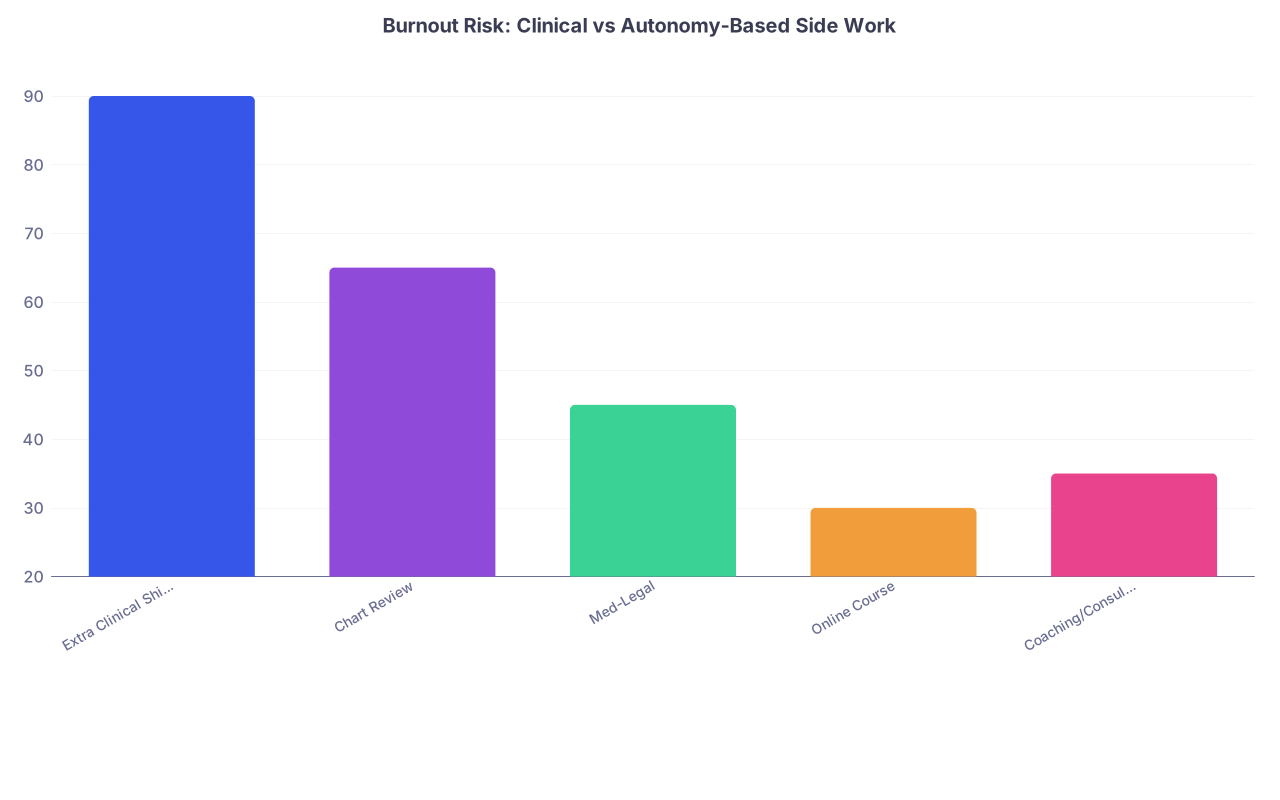
| Category | Value |
|---|---|
| Extra Clinical Shifts | 90 |
| Chart Review | 65 |
| Med-Legal | 45 |
| Online Course | 30 |
| Coaching/Consulting | 35 |
Think of those numbers as a rough “burnout risk index.” The more your side work looks and feels like the left end of that chart, the worse your odds. The more it moves toward the right — autonomy and creativity — the better.
Realistic Scenarios: What Actually Helps
A few composite examples based on what I have seen over and over:
The hospitalist who reclaimed her brain
Full-time hospitalist, totally fried by 7-on/7-off and admin pressure. She carved out only her off weeks to work 5–8 flexible hours building an online board review course. Year 1: negligible income, but massive psychological impact — she felt like an expert again, not a cog. By year 3: enough revenue to cut clinical shifts by 25%. Burnout scores? Way down.The EM doc who finally felt safe saying no
Mid-career EM, terrified of leaving a toxic group because of mortgage, college, the usual. Started med-legal consulting very selectively, 1–2 cases per quarter at high rates. It never replaced his income. But it covered enough fixed expenses that he stopped feeling trapped. He eventually walked away from the worst schedule demands. “Knowing I had another way to use my skills changed everything” was his phrase.The primary care doc who stopped caring about admin theatrics
Built a small niche teleconsulting practice for a specific chronic disease, self-pay only, a few high-touch patients. Total side time: 4–5 hours/week. The revenue was secondary. The real effect: he no longer felt that his entire value was dictated by his clinic’s productivity spreadsheet. That shift alone made the EHR nonsense more tolerable.
None of these people “worked less.” They worked differently. And the net effect was less burnout, not more.
A Simple Reality Check Before You Start
Here’s the most honest litmus test I can give you.
If you think about your proposed side hustle and feel:
- A subtle lift of energy
- A sense of curiosity or “I’d like to get better at that”
- Relief at the idea of being valued outside your hospital system
You’re probably pointing in a protective direction.
If instead you feel:
- Tightness in your chest
- “I have to do this or I’m screwed”
- Dread at the logistics
You’re likely building another trap. Different paint color, same prison.
One more thing: the first phase of any side hustle usually does feel heavier. You’re learning, fumbling, figuring out tech, making $0. That’s normal. The difference is whether, even in that messy phase, it feels like building something that could ultimately give you more control over your life — or just more obligations.
The Future: Side Hustles as a Safety Valve, Not a Symptom
Here’s the contrarian take most institutions will not like: in the future of medicine, physician side hustles are not a “problem” to be stamped out. They’re an adaptive response to a system that chronically underestimates how much autonomy and respect professionals need to stay healthy.
If administrators actually took burnout seriously, they’d be asking:
- How do we give our physicians more control over schedule and scope?
- How do we support non-clinical roles that use their skills differently?
- How do we avoid forcing them to choose between sanity and salary?
Instead, some of them are suspicious when doctors build parallel careers.
They should be careful. Because a physician with a well-designed, values-aligned side hustle is a physician who has options. And someone with options is much less tolerant of mediocre, disrespectful working conditions.
That’s not a bug. That’s the point.
Years from now, you probably will not remember the extra Wednesday you spent doing notes until 11 p.m. You will remember the moment you realized your entire worth did not live and die inside an EMR. A good side hustle will not fix the system. But it might just keep you intact long enough to decide, on your own terms, what you want your future in medicine to look like.

| Step | Description |
|---|---|
| Step 1 | Feeling Burned Out |
| Step 2 | Extra Clinical Shifts |
| Step 3 | Higher Burnout Risk |
| Step 4 | Design Values Aligned Side Hustle |
| Step 5 | Identity Diversification and Optionality |
| Step 6 | Potential Burnout Protection |
| Step 7 | Focus on Rest and System Changes |
| Step 8 | Want More Money Only |
| Step 9 | Want More Autonomy and Meaning |