
You’re in the call room between pages, scrolling your email. Every “physician side hustle” thing you see is the same: TikTok docs, Instagram “brands,” YouTube channels, LinkedIn thought-leader nonsense.
You don’t want any of that.
You don’t want to film yourself. You don’t want to post. You don’t want to “build an audience.” You just want to use your skills, earn more money, and have more control over your work — without turning your life into a content factory.
Good. Because most doctors trying to do side hustles through social media end up with unpaid hobbies and burnout 2.0.
Let’s talk about side hustle models that fit you if you hate social media and prefer real work, real people, and real checks.
Step 1: Get Clear On Your Constraints (And Non‑Negotiables)
Before we talk models, you need to know the sandbox you’re playing in. Otherwise you’ll pick something that sounds great on paper and is miserable in reality.
Grab a pen and answer these in writing (actually do it, not in your head):
Time:
- How many reliable hours per week can you give a side hustle?
- What’s realistic on a bad call week vs a light clinic week?
Energy:
- Are you okay doing more clinical work? Or do you want something that uses your brain differently?
- How phone-call tolerant are you? How email tolerant?
Risk and Capital:
- How much money are you actually willing to risk? $0? $5k? $50k?
- How comfortable are you with something that might lose money for 6–12 months?
Compliance:
- Are you employed by a large system with non-compete, exclusivity, or moonlighting restrictions?
- Do they have rules on outside consulting or use of your professional title?
Write short answers. This becomes your filter.
Now, with that in mind, let’s get concrete.
Model 1: High-Value Consulting (No Followers Required)
You already have something organizations will pay for: expertise, MD credibility, and real-world clinical judgment. None of that requires a single post.
The trick is to package that expertise into something specific enough that people understand what they’re buying.
Forms this can take
- Clinical advisory for health tech startups
- Workflow and operations consulting for clinics/ASC groups
- Medical advisory for law firms (not just expert witness)
- Curriculum design for universities, nursing programs, allied health
- Policy and guideline review for payers or hospital systems

Concrete example
You’re a hospitalist who’s good at throughput and handoffs. Possible packaged offer:
“I help mid-size hospitals reduce average length of stay and 30-day readmissions by fixing their handoff and discharge processes.”
You don’t announce this on Twitter. You:
- List yourself on 2–3 expert networks (GLG, Guidepoint, AlphaSights, Tegus)
- Tell 10 people you worked with who now sit in admin or industry roles
- Reach out directly (email / LinkedIn DM) to:
- Vendors selling EHR tools
- Local hospitals expandingist inpatient services
- Regional ACOs / payer-medical management teams
No posts. Just targeted messages like:
“I’m a hospitalist at [Hospital] with 8 years’ experience and prior QI work on discharge efficiency. I’ve started taking on small advisory projects (2–4 hours/month) for organizations working on inpatient workflows. If you ever need a clinician sounding board for [X, Y, Z], I’m happy to help.”
Income reality
You’re not doing this for $50/hr. Properly framed, physician consulting is $200–$500/hr for short calls, and $3k–$15k for fixed-scope projects.
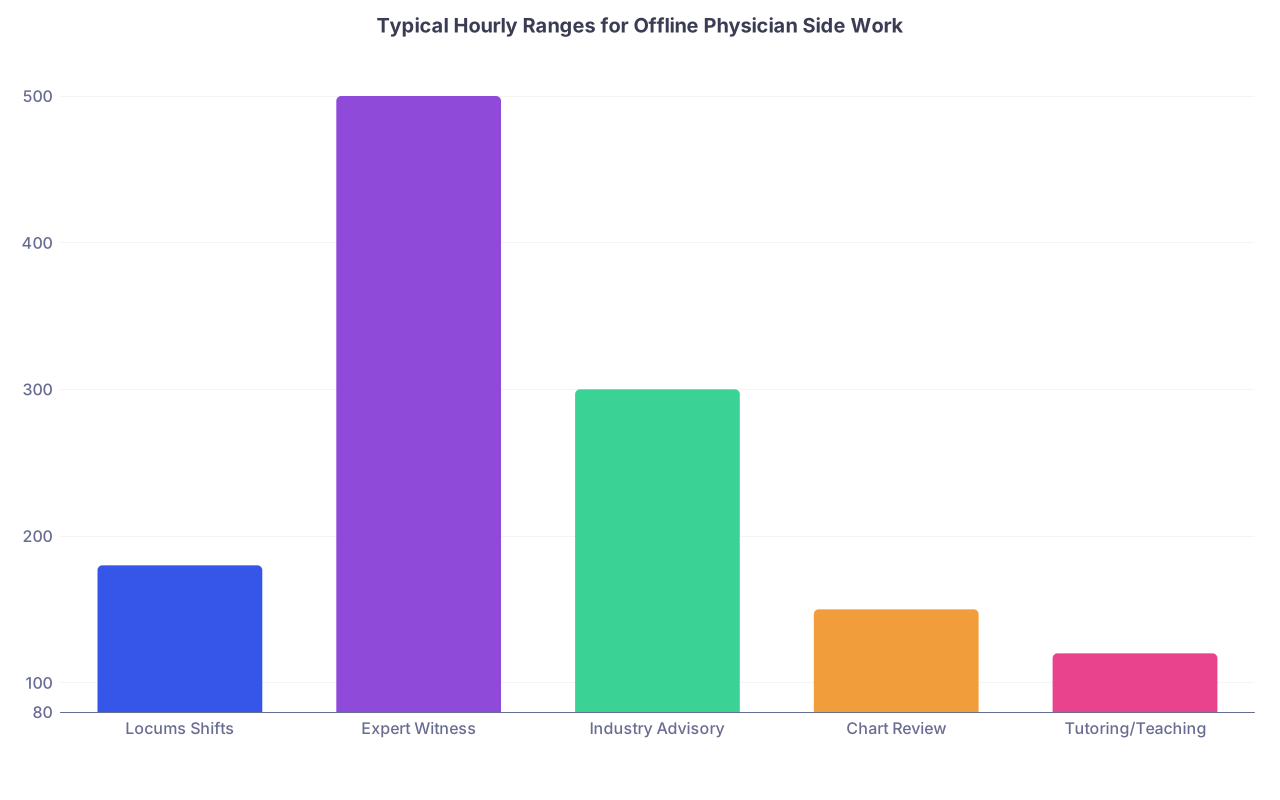
| Category | Value |
|---|---|
| Locums Shifts | 180 |
| Expert Witness | 500 |
| Industry Advisory | 300 |
| Chart Review | 150 |
| Tutoring/Teaching | 120 |
You do not need a brand. You need:
- A clear niche
- Two or three tight “offers”
- A simple one-page CV tailored to that niche
If you feel lost on “what would I offer?” — ask two colleagues, “If a company paid me $400/hr, what problem related to medicine would they be crazy not to ask me about?” You’ll get better insight from that than from any online course.
Model 2: Expert Witness & Med-Legal Work
If you want high leverage, no social, purely reputation and competence: med-legal.
You’re not on TikTok. You’re on the phone with attorneys who want one thing: a reliable expert they can trust not to implode on cross.
What this actually looks like
Common buckets:
- Case review for merit (chart review)
- Written reports / affidavits
- Deposition prep and testimony
- Trial testimony
Most of the work is reading charts, writing, and occasionally talking. No content, no audience.
How to get started (actual steps)
Check your contract
- Some hospital systems get weird about med-legal work. You want to know if they require pre-approval or conflict checks.
Set a floor rate
- Stop underselling. As of now:
- $400–$600/hr is very normal for physicians
- Higher if you’re highly specialized or in a niche field
- Stop underselling. As of now:
List with 2–3 expert witness directories
- SEAK
- JurisPro
- Local bar association referrals
Send a short letter to 10–20 local plaintiff and defense firms that handle cases in your specialty. One page. Old school. Mail or email:
“I am a board-certified [specialty] physician in active clinical practice at [Hospital], with [X] years of experience and [Y] procedures annually. I am available for independent chart review and expert witness work for both plaintiff and defense in [geographic area / tele-review]. CV enclosed.”
- Create a one-page “Expert Witness Fee Schedule”
- Distinct rates for:
- Record review
- Report writing
- Deposition
- Trial
- Minimum 3–5 hour retainers
- Distinct rates for:
You will not get flooded immediately. But once you do a good job for 2–3 attorneys, they will reuse you. Word spreads quietly in legal circles.
Who this is good for
- Detail-oriented physicians who can write clearly
- People comfortable saying “I don’t know” on record
- Those okay with a bit of conflict and adversarial questioning
If you want fully offline, minimal marketing, high hourly rates — this is one of the most efficient models.
Model 3: Locums + Strategic Moonlighting (But Smarter)
You already know about moonlighting. Most people treat it as “extra shifts when available.” That’s the lazy version.
The better version is treating your labor as a business and being strategic:
- Which shifts have the best effective hourly rate?
- Where can you negotiate housing / travel?
- Which settings build skills you can later leverage into consulting or leadership?
| Model | Typical Rate/hr | Scheduling Control | Upfront Setup | Non-Clinical? |
|---|---|---|---|---|
| Locums / Moonlighting | $150–$300 | Medium | Low | No |
| Expert Witness | $400–$600 | High | Medium | Yes |
| Industry Consulting | $250–$500 | High | Medium | Yes |
| Chart Review (UM) | $125–$200 | High | Low | Yes |
| Private Tutoring | $80–$150 | High | Low | Yes |
If you hate social media but don’t mind more clinical work, you can still be strategic:
- Pick 1–2 locums agencies and one independent relationship with a site if possible
- Be explicit about:
- What shifts you want (nights, weekends, rural, etc.)
- Your minimum rate and no-go situations
- Treat it as a 12–24 month tool to:
- Kill high-interest debt
- Build a cash position to fund other, less clinical side hustles
- Test practice environments if you’re thinking about moving or changing jobs
Locums is not creative, but it’s simple, offline, and pays.
Model 4: Utilization Review & Chart-Based Work
If you want out of patient-facing work (or at least less of it), but still want to use your medical brain, utilization review / chart work is a very realistic side hustle.
No followers. No content. You and a laptop. Often remote.
Types of work here
- Utilization review (for insurers or hospitals)
- Peer-to-peers for payers
- Disability / workers comp chart reviews
- Independent medical exams (IME) and paperwork
- Mortality / case review for hospital committees on a paid basis
These often start as “side” but can be scaled if you want.
How to get in
- Search for “physician reviewer,” “medical director,” “utilization review physician” on job boards
- Look up major insurers and review companies directly and submit CV
- Talk to your own hospital’s case management or UM team and ask who they contract with
You won’t need a single social account. You need a clean CV, reliable availability, and a tolerance for documentation and policy language.
This tends to pay $125–$200/hr depending on specialty, experience, and whether you’re W2 vs 1099.
Model 5: Offline Teaching & Exam-Prep Work
If you like teaching but have zero interest in becoming an “influencer educator,” good. Most of the real money isn’t in the public face anyway.
Angles that actually work offline
- Contract teaching for MCAT/USMLE/COMLEX/ABIM prep companies
- Building paid, closed small group courses (not mass online platforms)
- Local CME workshops for community physicians or APPs
- In-person board review weekends for nearby hospitals or groups
You don’t need thousands of followers for any of that. You need:
- Credibility (you passed the exam / have relevant experience)
- A clear syllabus
- A group willing to pay to not reinvent the wheel
Example: You’re an EM attending good at procedures and bedside teaching. You:
- Design a 1-day “Procedural Confidence for New Interns” workshop
- Offer it to nearby community hospitals or residency programs for a flat fee + per-learner
- Run 3–4 sessions per year on weekends
No TikTok dancing. Just real teaching, in a room, with people.
Model 6: Bricks-and-Mortar, But Sane
Some doctors do want a physical thing: a clinic, a med spa, a DPC practice, occupational medicine service, infusion center, etc. Many of those can be built without relying on social at all, if you accept slower but steadier growth.
The strategy: build referral-driven, relationship-driven businesses.
Examples:
- Niche DPC practice focused on a specific employer group
- Occupational health clinic contracted with local factories or municipalities
- Procedure-only clinic (e.g., vasectomy, joint injections) fed by PCP referrals
- Chronic care management program through contracts with SNFs or ALFs
Growth comes from:
- Contracts and B2B deals
- Traditional local marketing (mailers, talks, employer lunches)
- Doing such a good job that word-of-mouth handles the rest
Will a med spa in 2026 grow faster with Instagram? Of course. But you can absolutely build a profitable, smaller, less chaotic operation with zero posting if you lean on:
- Employer contracts
- Referring docs
- Local organizations (unions, churches, schools)
You trade virality for stability. Reasonable choice, honestly.
Model 7: Boring But Powerful – Equity & Quiet Investing
Here’s the part people overlook because it’s not flashy: for many physicians, the best side hustle is simply owning better assets, not inventing a second job.
Totally offline models:
- Buying a small stake in a surgery center where you operate
- Co-owning imaging or diagnostics (within legal bounds, Stark etc.)
- Limited partnerships in local real estate or small businesses
- Being the capital partner in another clinician’s business idea
This is the opposite of “build a following.” It’s: write a check, do your due diligence, go to quarterly meetings, get distributions.
You still have to be smart:
- Don’t chase every “doctor investment” pitch
- Make sure you understand how you get paid, when, and what could kill the business
- Have your own attorney review anything substantial
But if you’re exhausted, hate social, and don’t want a second job — capital leverage often beats hustle.
How to Choose: A Simple Decision Flow
You’re not picking your forever game. You’re picking your next 12–24 months.
Use this quick flow:

| Step | Description |
|---|---|
| Step 1 | Start |
| Step 2 | Locums or Moonlighting |
| Step 3 | Procedural clinic or IME |
| Step 4 | Utilization review or chart review |
| Step 5 | Expert witness and med-legal |
| Step 6 | Industry consulting and advisory |
| Step 7 | Teaching, exam prep, or quiet investing |
| Step 8 | Want more clinical work? |
| Step 9 | Want face to face patients? |
| Step 10 | Like detailed chart work? |
| Step 11 | Comfortable with legal settings? |
| Step 12 | Want to advise companies? |
Read down that tree once. Where do you naturally land? Start there. Iterate later.
The Anti-Social Media Plan: 90 Days, No Posts
Let’s put this into an actual 90-day action plan with zero requirement to post content.

| Category | Value |
|---|---|
| Week 1-2 | 5 |
| Week 3-4 | 10 |
| Month 2 | 15 |
| Month 3 | 20 |
Assume you can spare ~3–5 hours/week.
Weeks 1–2: Decide + Prep
- Pick one model from above. Not three. One.
- Create:
- A focused 1-page CV tailored to that model
- A simple fee schedule (if applicable)
- A short “this is what I do” paragraph you can paste into emails
Weeks 3–4: First Outreach
Send 20 targeted emails or letters:
- Attorneys (for med-legal)
- UM companies / insurers (for review work)
- Local hospitals / clinics (for teaching, consulting, or workshops)
- Startups / vendor companies (for advisory)
Register with 2–3 relevant networks:
- Expert networks
- Med-legal directories
- Locums agencies
You are not “launching.” You’re signaling your availability.
Months 2–3: Do Real Work + Refine
Once you land 1–2 small projects:
- Deliver flawlessly. On time, professional, responsive.
- Ask at the end: “If you know anyone else who needs this sort of help, I’m happy to talk with them.” That single sentence is your growth engine.
- Adjust pricing if it was too easy or too painful for the money.
You’ll notice something: you’re building a side business, not a public persona.
One Thing to Do Today
Print your current CV.
Right now, take a pen and cross out every line that would be irrelevant to one of these paths:
- Med-legal
- UM/chart work
- Consulting
- Locums
- Teaching
Then rewrite three bullet points that clearly show you can solve a specific problem in that lane.
When that’s done, you’ll have the seed of an offline side hustle. No hashtags. No reels. Just you, your experience, and people willing to pay for it.