

It’s 11:45 p.m. You just finished your last note, signed out, and you’re scrolling through your group chat. Half your co-residents are bragging about how they picked up three moonlighting shifts this month. One’s paying off loans, another just booked a vacation. You? You’re on a J‑1 or H‑1B, HR already told you “absolutely not” when you asked about outside work, and the one attending who said “just do it under the table” clearly doesn’t understand USCIS, ICE, or what “status violation” actually means.
You feel stuck. Trapped by your visa, your contract, and your finances.
You’re not stuck. You just don’t have the same menu as a citizen on an unrestricted license. Different game. Different rules. You need income options that:
- Don’t trigger immigration violations.
- Don’t breach your employment contract.
- Actually pay enough to be worth your very limited time and energy.
That’s what we’ll do here: walk through what you can do, what you absolutely should not mess with, and how to build leverage for later when your visa opens up.
Step 1: Get Very Clear On Your Actual Visa Constraints
Before you chase any income idea, you need to know the rules you’re playing under. Not vibes. Not what that one guy in the call room “heard you can do.”
The basic reality
On a typical training/faculty visa:
- J‑1 (ECFMG): You’re authorized for training at the specific institution(s) listed on your DS‑2019.
- H‑1B: You’re authorized to work only for the petitioning employer(s) on your I‑129 approval, for the specific job/location(s) described.
Anything outside that? Very often unauthorized work. And unauthorized work is how people blow up future green card chances.
Visa plus contract is your cage. You need to know its exact shape.
What you do this week
- Pull your visa paperwork: current DS‑2019 or I‑797, your employment contract, any GME manual or HR policies about outside work.
- Email or schedule with:
- GME office or HR: Ask in writing:
“Are there any forms of outside compensation, consulting, or 1099 work that are allowed for residents/fellows on my visa category?” - Your institution’s immigration lawyer (or your own if you have one):
“Which types of activities are considered ‘employment’ vs. permissible passive income for someone on my status?”
- GME office or HR: Ask in writing:
Yes, this is annoying. But without clarity, everything else is just gambling with your status.
Step 2: Understand the Big Categories – What’s Usually Safe vs. Off-Limits
Here’s the rough framework I’ve seen work for visa‑restricted physicians.
| Income Type | Usually Allowed? |
|---|---|
| Extra clinical work (W-2) | No, unless same employer/approved |
| 1099 locums/moonlighting | Almost always no |
| Passive investment income | Generally yes |
| Royalties (books/courses) | Often yes if structured right |
| C-corp/S-corp compensation | Usually no |
| Rental real estate income | Usually yes (passive) |
This is general and not legal advice. But it’s how most good immigration attorneys draw the lines.
Key concept:
Active labor = usually “work” = needs explicit authorization
Passive return on capital/ideas = often okay
So your playground is: assets, intellectual property, and leverage. Not additional shifts.
Step 3: Build Passive and Semi-Passive Income That Stays Inside the Rules
If you can’t sell your time clinically, sell your capital or your ideas.
1. Real estate: boring, legal, and powerful
For most visa‑restricted physicians, rental real estate is the most straightforward option. This usually falls into “investment income,” not unauthorized employment, if done right.
How it can look in reality:
- PGY‑3 on H‑1B buys a small condo in a cheaper state near their residency program.
- Hires a property manager for 8–10% of rent.
- Manager screens tenants, handles calls, arranges repairs.
- You collect rent, pay mortgage/HOA/taxes, and maybe cash flow a small amount.
Where people screw this up: personally doing everything and turning it into an obvious active business. If you’re fixing toilets at 2 a.m. and advertising on Facebook, that starts to look like labor.
Keep it as passive as possible:
- Property manager.
- Bookkeeper or decent accounting software.
- You make high-level decisions, not day-to-day operations.
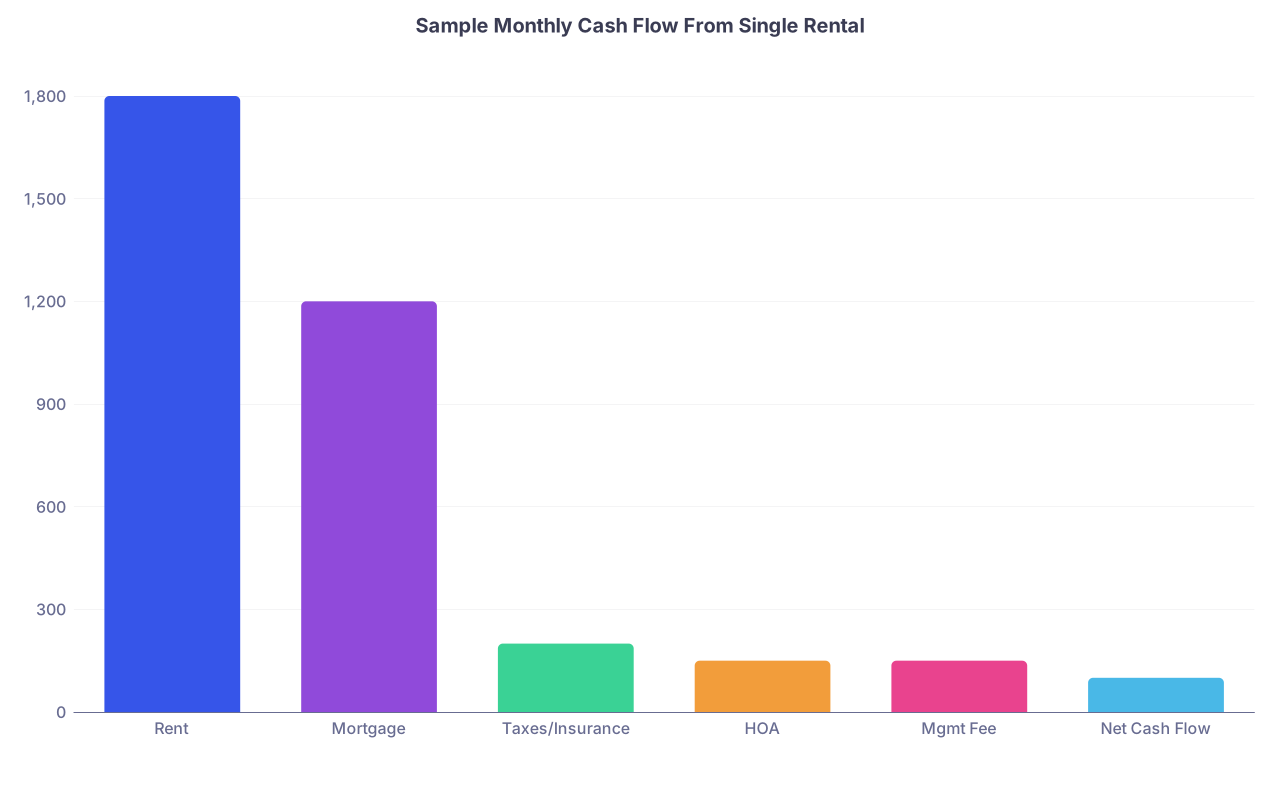
| Category | Value |
|---|---|
| Rent | 1800 |
| Mortgage | 1200 |
| Taxes/Insurance | 200 |
| HOA | 150 |
| Mgmt Fee | 150 |
| Net Cash Flow | 100 |
Not a huge amount monthly at first, but over 5–10 years, equity + appreciation + rent increases is not trivial.
Concrete action:
Run numbers on 1–2 properties in your current city and one lower-cost market (e.g., midwest). Look for:
- 20–25% down payment you can realistically manage
- Cap rate that isn’t a joke (I’d say 5%+ in many markets)
- Strong renter base (universities, hospitals, stable employers)
2. Broad-based investing: making your savings work
You’re probably already doing some version of this, but most residents seriously underutilize it.
You can invest in:
- Low-cost index funds (VTI, VXUS, etc.)
- ETFs in a taxable brokerage
- Retirement accounts your employer offers (403b, 401k) if allowed
These generate:
- Dividends
- Capital gains
- Interest
All are typically passive income, not “work.”
You’re not going to triple your income overnight with this. But if you can get even $500–$1,000/month consistently funneling into a broad index fund during training, your 10-year future self is going to thank you.
Step 4: Monetize Your Brain, Not Your License
The rule of thumb: if you’re practicing medicine, it’s probably not allowed without explicit authorization.
But you have other skills. You just don’t think of them as monetizable yet.
3. Create content that pays you later: books, courses, templates
You’re allowed to write books. You’re allowed to create digital products. You’re allowed to get paid royalties and product revenue.
The government cares that you’re not doing unauthorized employment. It generally does not care that you wrote a book that sells on Amazon, or that people buy your Notion template.
The trick is how you operate:
- You as an individual create and sell through platforms like Amazon KDP, Gumroad, Etsy (for digital), Teachable, etc.
- You’re not on a payroll somewhere. No W‑2.
- You’re not holding yourself out as “providing medical care.”
Realistic ideas for physicians:
- “IMG Match Playbook” ebook for future IMGs.
- “Step 2 CK Anki & Schedule Pack” as a paid digital download.
- “How I survived intern year with systems that worked” – full video course.
- Specialty-specific study guides.
You build once. It sells while you sleep. That’s royalty-type income.

The big pitfall: don’t cross over into telemedicine or giving personalized medical advice online for pay. Stick to education, exam strategy, workflows, and systems.
4. Medical writing and editing – gray zone, but often doable
Some immigration lawyers are okay with this if it’s clearly separate from clinical care, especially structured as royalty or per-piece freelance and not ongoing “employment.”
Typical gigs:
- CME content writer
- Question writer for USMLE prep companies
- Editing for medical journals or textbook publishers
- Creating layperson health education content
The problem: companies want IC contracts (1099). That’s technically “work.” Some lawyers say “strict no” for J‑1/H‑1B. Others say it can be okay if it’s limited, IP-focused, and doesn’t look like ongoing employment.
So here, you must run it by an immigration attorney who knows your case.
But as a category? It’s one of the better nonclinical monetizations of your expertise.
Mileage: I’ve seen fellows on H‑1B writing board questions at $25–$40 per question on limited contracts with explicit legal blessing.
Step 5: Leverage Skills That Aren’t “Doctoring”
You have more to sell than you think.
5. Teaching, tutoring, and exam coaching
Straight clinical moonlighting is out. But what about teaching people how to pass the exams you already passed?
You can:
- Tutor for USMLE/COMLEX/PLAB/IELTS/TOEFL.
- Coach IMGs through ERAS, personal statements, interview prep.
- Help premeds with MCAT and application strategy.
Structure matters. If you sign on as “employee tutor” with W‑2 comp, that’s almost certainly a no. If you create your own small thing and charge clients directly through Stripe/PayPal as an individual, some attorneys are okay with this as “self-directed consulting.”
Others will hate it.
So again: legal review. But from a business perspective, this is incredibly high ROI on your time. $75–$150/hour is realistic if you’re good.
What I’ve seen work best:
Packaged offerings instead of hourly:
“4-session USMLE Step 2 game plan”; “IMG ERAS prep package”Clear boundaries: you’re not their doctor, you’re their exam coach or application mentor.
6. Tech, data, and coding – if you have the skills
If you can code, analyze data, or build simple tools, you’re in a good spot. Tech work that’s not healthcare delivery can sometimes be more defensible.
Examples:
- Building a simple scheduling web app and selling subscriptions.
- Creating productivity tools for residents/fellows (Excel templates, small utilities).
- Doing one-off data analysis projects for non-US clients (complex, talk to lawyer).
But the catch: true consulting is work. Period. So even if it’s “one hour of Python,” if you’re doing it for a US company under a contract, most lawyers will tell you it’s unauthorized employment.
The safe variation: building your own product (an app, SaaS, or tool) and selling access. That’s closer to business income from intellectual property.
Think:
- “Residency rotation planner web app” at $9/month.
- “On-call handover tool” subscription.
You build it, the internet pays you. Not an employer.
Step 6: Side Hustles You Absolutely Should Avoid
Let me be blunt: these are bad ideas on a visa unless you have explicit written clearance from an immigration lawyer.
- Cash-only “side jobs” (bartending, Lyft, random clinical work paid under the table). USCIS will not care that “it was cash.” Unauthorized work is unauthorized work.
- Locums or telemedicine 1099 gigs. That’s textbook unauthorized employment.
- Becoming “medical director” for an aesthetic spa while on J‑1/H‑1B for a hospital. No, it is not clever. It is dumb.
- Any 1099/W‑2 work for another US entity that isn’t on your visa petition.
Short version: if they’re paying you for your time in a structured ongoing way, and they’re a US entity, huge red flag.
If you’re not sure if something is allowed, the answer is: pretend it’s not, until a lawyer who’s actually read your documents says otherwise in writing.
Step 7: Think Like a Business, Even If You’re Still in Training
You’re restricted now, but you won’t be forever. J‑1s can finish waiver jobs, move to H‑1B, get green cards. H‑1Bs can adjust status. At some point, your clinical moonlighting will be allowed or at least more flexible.
When that day comes, you do not want to be starting from zero.
You want:
- Systems already in place.
- Assets already growing.
- Income streams that don’t care which hospital sponsored your last visa.
That’s what you build during your “caged” years.

| Step | Description |
|---|---|
| Step 1 | Residency - Visa Restricted |
| Step 2 | Start Passive Investing |
| Step 3 | Create Digital Products |
| Step 4 | Build Small Audience |
| Step 5 | Transition to Less Restricted Visa |
| Step 6 | Add Legal Clinical Moonlighting |
| Step 7 | Diversified Income Mix |
The path I like:
Year 1–2 (earlier training)
- Learn basics of investing.
- Build small buffers: emergency fund + monthly investing habit.
- Start documenting what you know (notes that later become a book/course).
Year 2–4
- Launch one small digital product (ebook, template, course).
- Consider first rental property if your finances and risk tolerance allow.
- Start collecting emails/social following of people you can help (IMGs, premeds, residents).
Post-training / Waiver years
- Scale what worked; kill what didn’t.
- Add legal moonlighting only if it doesn’t trap you in 100% clinical income.
- Keep growing the non-clinical streams.
Step 8: How To Vet Any New Income Idea in 5 Minutes
Before you get excited about any side hustle you see on TikTok or in the resident lounge, run it through this quick mental filter.
| Question | If Answer is Yes/No |
|---|---|
| Does it pay for my time directly? | Yes = likely NOT allowed |
| Is it obviously clinical/medical care? | Yes = needs explicit auth |
| Is it US-based W-2 or 1099 work? | Yes = big red flag |
| Could this be treated as passive/IP? | Yes = maybe, talk to lawyer |
| Would I be okay disclosing this to USCIS? | No = do not do it |
If you’d be terrified to show it to an immigration officer during a green card interview, drop it. There are other paths.
Step 9: Realistic Income Ranges – What You Can Expect
Let’s stay grounded. You’re not going to replace your attending salary while on visa through “passive income.” But you can meaningfully move the needle.
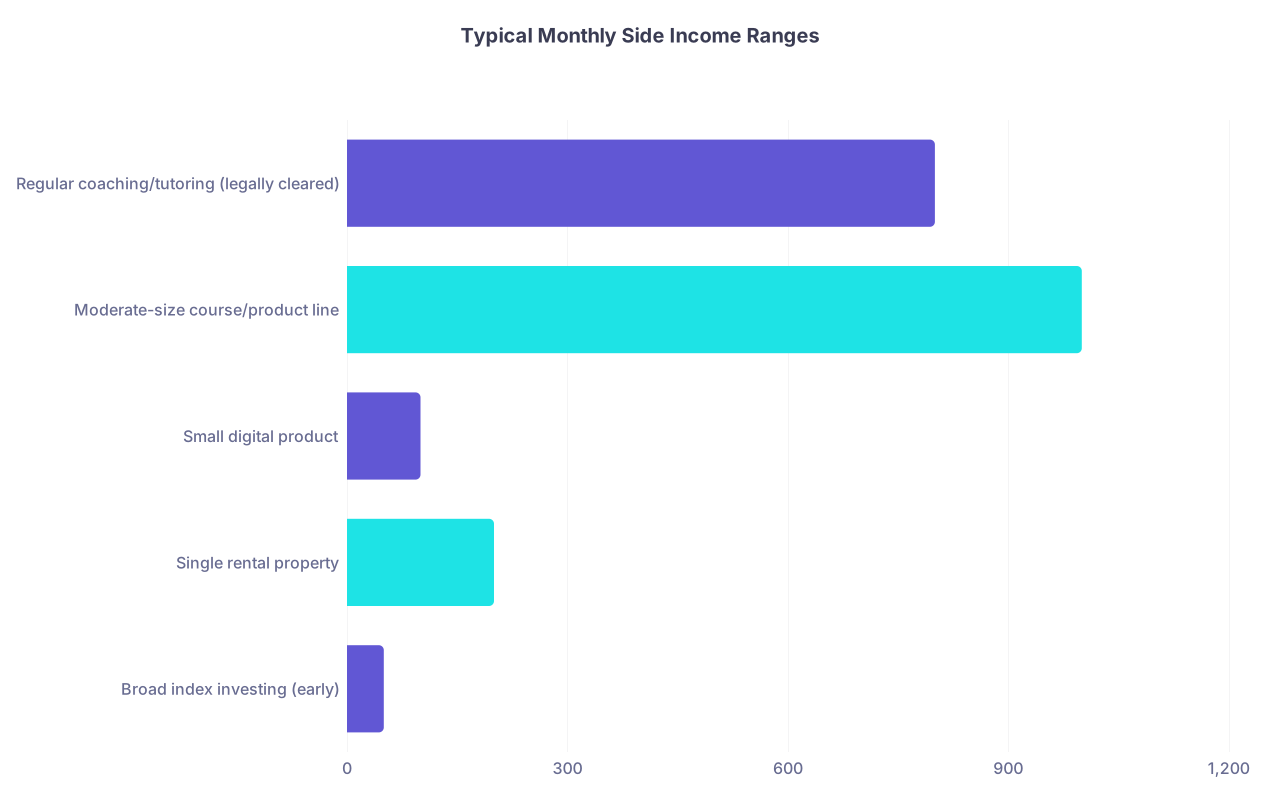
| Category | Value |
|---|---|
| Broad index investing (early) | 50 |
| Single rental property | 200 |
| Small digital product | 100 |
| Moderate-size course/product line | 1000 |
| Regular coaching/tutoring (legally cleared) | 800 |
Rough ranges (very approximate):
Index fund investing (residency-level contributions)
Early years: $20–$100/month dividends.
Later: the compounding matters more than the current income.One decent rental
$100–$400/month net cash flow if bought well, plus principle paydown and appreciation.Basic ebook or template
$50–$300/month if it’s actually useful and marketed even a little.Serious course or product ecosystem
$500–$2,000+/month, but requires real up-front work and iteration.Coaching/tutoring (if legally allowed)
2–5 clients/month at $200–$400 each is $400–$2,000. Very time-leveraged.
You don’t need all of these. One or two built well can change how stressed you feel about money during training.
Step 10: Exactly What To Do This Month
Here’s a direct action plan, assuming you’re a visa‑restricted resident/fellow right now.
Week 1:
- Pull your visa docs and contract.
- Email HR/GME and your immigration counsel with specific questions about “passive income” and “royalties/online content.”
Week 2:
- Open or review your taxable brokerage account.
- Set up or increase an automatic monthly transfer, even if it’s only $100–$200. Pick one or two broad index funds and stop overthinking it.
Week 3:
- Brain dump 20 problems you’ve solved that other people would pay for:
- Matching as an IMG
- Passing Step 3 first try
- Surviving nights on busy services
- Efficiently studying for your boards
Pick ONE that seems especially painful and common.
Week 4:
- Create a minimum-viable digital product around that problem:
- A 40–60 page PDF guide
- Or a set of templates/checklists
- Or a short video mini-course
Put it on Gumroad/Teachable/Etsy (for digital) and price it reasonably ($19–$59 range). Tell 20 people. Post 2–3 times in the right online spaces. See what happens.
If even a handful buy, you now have proof that:
- You can make money without moonlighting.
- You can sell your expertise without risking your visa.
Then you iterate.
Open the notes app on your phone right now and write this heading: “Things I Know That Other People Would Pay To Learn.” List at least 10 items in the next 10 minutes. That’s the raw material for the income you can build, even when you’re not allowed to moonlight.


