
It’s January 2nd. You just signed your fellowship contract last month. You’re a senior resident, six months from walking out of residency call rooms and into a fellowship paycheck that’s… not attending money, but still a bump. Your email is full of HR forms, benefits packets, and that charming yearly reminder: “It’s tax season.”
This is where people quietly screw themselves.
You’re about to have:
- Income from two institutions in one calendar year (residency + fellowship)
- Possibly moonlighting income
- Maybe a moving stipend, sign‑on, or relocation repayment
- New retirement options (403(b), 457(b), HSA, etc.)
If you wing the tax side, you can easily leave a few thousand dollars on the table or get slammed with an unexpected bill.
Here’s the 6‑month, point‑by‑point roadmap from 6 months before your fellowship starts through your first tax return as a fellow.
6 Months Before Fellowship Start (Incoming Fellowship Year – January)
At this point you should stop thinking like a trainee who “just files TurboTax” and start acting like someone whose income and tax situation are about to get complicated.
Main objectives this month:
- Get a big‑picture view
- Decide if you’ll use a CPA or DIY
- Start organizing for a two‑employer year
Week 1–2: Map Your Tax Year
You need a snapshot of what this calendar year will actually look like.
Do this:
List all expected income sources for the year:
- PGY‑3/4 resident salary (Jan–Jun)
- Fellow salary (Jul–Dec)
- Moonlighting income (current and planned)
- Signing bonus or moving stipend
- Any side income (consulting, tutoring, content creation)
Pull last year’s tax return and note:
- Whether you got a refund or owed
- Whether you itemized or used standard deduction
- Any credits you benefitted from (LLC, AOTC, child tax credit, etc.)
At this point, you should be honest: Will your tax situation be simple enough for DIY, or are you crossing the line into “I should have a pro” territory?
Week 2–3: Decide on DIY vs CPA
Use this quick gut‑check:
| Situation | Risk Level |
|---|---|
| One W‑2, no moonlighting, no dependents | Low |
| Two W‑2s, some moonlighting, student loans | Moderate |
| Multiple moonlighting 1099s, moving stipend, PSLF, spouse income | High |
| Side business (LLC/S‑corp) plus job change | Very High |
- Low/Moderate: Reasonable to use high‑quality software (not the cheapest free version).
- High/Very High: Get a CPA who regularly works with physicians. Not your cousin’s real‑estate CPA.
At this point you should:
- Ask older fellows: “Who do you use for taxes?”
- Aim to engage a CPA by March. The good ones book up.
Week 3–4: Set Up Your Tax Infrastructure
You’re going to thank yourself next March if you do this now.
- Create a “Taxes – 20XX” folder in:
- Your email (for employer/payroll/HR messages)
- Your computer or cloud drive (statements, PDFs)
- Turn on e‑delivery for:
- Bank 1099s
- Student loan interest (Form 1098‑E)
- Investment accounts (if any)
And then automate one thing:
- A recurring monthly calendar reminder: “Tax/finance 20‑minute check‑in.”
5 Months Before Fellowship Start (February)
At this point you should start tightening withholdings and clarifying your new fellowship’s compensation and benefits.
Week 1: Gather Details From Your Fellowship Offer
You probably glanced at salary and vacation and ignored the rest. Go back.
Pull the actual numbers:
- Base salary
- Start date
- Moving stipend / relocation reimbursement
- Any taxable sign‑on
- Call pay (if relevant)
- Retirement options (403(b), 457(b), match timing)
If HR has not given written detail, ask for it. You need to know what’s taxable and when.
Week 2–3: Understand Your Withholding Risk
This is where most PGY‑4s get burned.
You’ll get:
- Half a year at lower resident pay
- Half a year at slightly higher fellow pay
Combined, that might push you into a higher marginal bracket than residency alone, but your withholdings may not automatically catch up, especially if each institution sets them assuming you only work there.
Look at last year’s W‑2 and this year’s expected pay.
Rough guide:
- If your total household income this year will be >20–30k higher than last year, and you owed last year, assume you’re under‑withholding now.
- Use the IRS withholding estimator (when it’s actually working; it’s clunky but better than guessing).
At this point you should:
- Plan to adjust your W‑4 at both institutions by April/May.
Week 4: Confirm Moving‑Related Tax Issues
Moving for fellowship is not the tax break it used to be.
Key points:
- Ordinary moving expenses are not deductible for residents/fellows (except active‑duty military moves).
- Moving stipends/relocation bonuses are usually taxable income, even if they call it “reimbursement.”
- Some programs do direct payment to movers — still often taxable.
Action item:
- Email HR: “Is my relocation benefit treated as taxable income? Will taxes be withheld, or will I owe at filing?”
You want this in writing so you can plan for the hit.
4 Months Before Fellowship Start (March)
Now you’re in active tax‑filing season for last year while planning for this year. Annoying overlap, but necessary.
At this point you should complete last year’s tax return early so it can inform the current year’s strategy.
Week 1–2: Finish Last Year’s Return
Get it done by mid‑March if humanly possible. Not April 14th.
Collect:
- W‑2 from your residency hospital
- Any 1099s from moonlighting or side gigs
- 1098‑E for student loan interest
- 1098‑T if you were still paying tuition (unlikely but possible for dual‑degree folks)
- Investment 1099s (even the $4 of interest)
Decide:
- DIY with good software OR
- Upload everything to your CPA
While filing, pay attention to:
- Did you qualify for student loan interest deduction?
- Did you use standard deduction or itemize?
- Did you have any self‑employment taxes from 1099 income?
Those answers guide your current‑year plan.
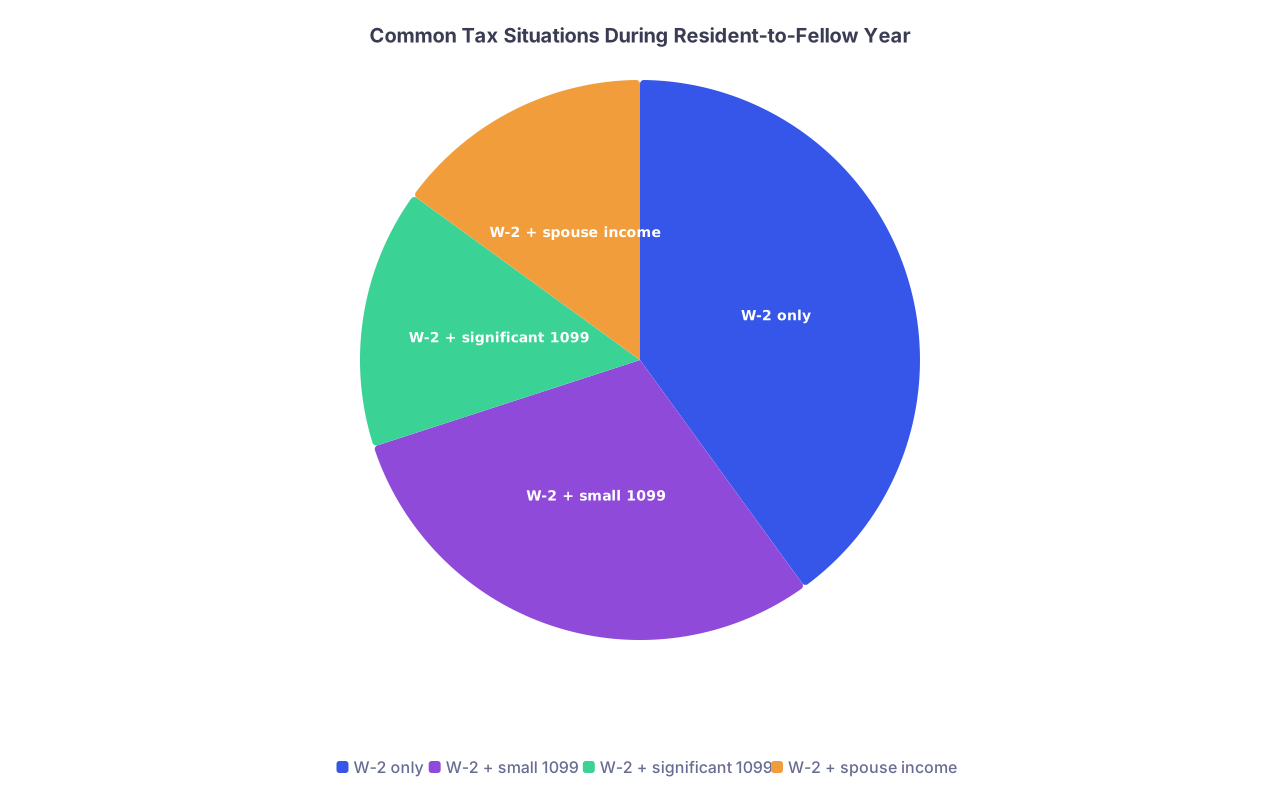
| Category | Value |
|---|---|
| W-2 only | 40 |
| W-2 + small 1099 | 30 |
| W-2 + significant 1099 | 15 |
| W-2 + spouse income | 15 |
Week 3–4: Adjust Your Withholdings (Resident Job)
Once last year’s return is done, use it.
- If you owed last year:
- Increase federal withholding on your current W‑4 (Box for “extra amount per paycheck”).
- If you had lots of refund:
- You can ease off slightly, but remember your combined income will be higher this year.
At this point you should:
- Submit a new W‑4 through your residency’s HR/Payroll portal.
- Note what you did in your “Taxes – 20XX” document.
3 Months Before Fellowship Start (April)
Now you’re overlapping:
- Finishing interview season
- Negotiating move dates
- Getting ready for graduation
- IRS deadlines
This month is about locking in your current‑year strategy for the resident‑to‑fellow year.
By April 15th: Deal With Payments and Estimates
If you owed for last year and wrote a big check:
- Ask your CPA (or software) if you need to make estimated taxes for this year, especially if:
- You have substantial moonlighting 1099 income, and
- Withholding won’t cover it.
If your 1099 income is:
- < $5k/year: You can often increase W‑2 withholding instead of doing formal estimated payments.
$10k–15k/year: You’re moving into “should probably do quarterly estimates” territory.
Week 2–4: Plan Around Student Loans
During the transition, loan status is a mess for a lot of people.
Questions to answer:
- Are you going for PSLF?
- Will your income jump high enough with fellowship + spouse that your IDR payment spikes?
- Are you allowed a new IDR recertification after fellowship starts using a lower income year?
At this point you should:
- Coordinate timing: sometimes filing your tax return sooner (showing lower prior‑year income) can lock in lower payments just as fellowship starts.
- Keep your AGI in mind when deciding on pre‑tax contributions (403(b), HSA). Lower AGI can help student loan strategy and some credits.
2 Months Before Fellowship Start (May)
By now, last year’s taxes are done, and you’re in full “end of residency” mode.
This month is about cleanup and preparation.
Week 1: Maximize What You Can in Your Final Resident Months
You’re probably not maxing anything at resident pay, but you still have levers.
Review:
- Are you contributing at least enough to get the full match on your resident plan (if any)?
- If loan strategy + cashflow allow, bump contributions for the remaining months as a resident to lower AGI.
If you’re saving for a move:
- Do not cripple your cash just to save a bit on taxes. Moving deposits and overlap rent eat people alive.
Week 2–3: Build Your Tax/Budget Projection for the Transition Year
Simple, not perfect.
Create a quick table for the calendar year:
| Period | Source | Gross Pay (approx) |
|---|---|---|
| Jan–Jun | Residency salary | $___ |
| Jan–Jun | Moonlighting | $___ |
| Jul–Dec | Fellowship salary | $___ |
| Jul–Dec | Moonlighting | $___ |
| One-time | Moving stipend / sign-on | $___ |
Sum it. That’s your rough total income for the year.
Then:
- Compare this projected total to last year’s AGI.
- If it’s much higher, assume taxes owed could increase meaningfully.
Week 4: Start Setting Up for Fellowship Withholding
Email or call fellowship HR:
- Ask when and how you’ll complete your new hire tax paperwork (W‑4, state forms).
- Ask when your first paycheck will be and what pay frequency is (biweekly vs monthly).
At this point you should calendar:
- “Submit W‑4 for fellowship” on your start‑date onboarding week.
- “Check first fellow paycheck withholding” 1–2 days after you get it.
1 Month Before Fellowship Start (June)
Graduation month. You’re exhausted. Perfect time to do annoying paperwork.
This month is largely about setting the foundation with your new employer and avoiding duplication or under‑withholding.
Week 1: Close Out Resident Employment Cleanly
Confirm:
- Last paycheck date
- Any unused vacation payout (taxable, might bump that check)
- Whether any last‑minute bonus/award will hit after you leave
Save:
- Final resident pay stub
- Access info to your old institution’s pay portal (you’ll need it next January for your last W‑2)
At this point you should:
- Download at least the final 2–3 pay stubs as PDFs. HR portals have a way of vanishing.
Week 2–3: Prepare Your Fellowship W‑4 Strategy
You’ll soon be filling out a new W‑4. Most people just click through. That’s lazy.
Remember: The IRS assumes each employer is your only job. You’ll have had two.
Options:
- If you’re single with no dependents and two W‑2 jobs in one year, consider:
- Marking “multiple jobs” on the W‑4 or
- Adding a flat “extra amount” per paycheck ($100–$300 depending on your projections).
- If you’re married and your spouse has income:
- Use the IRS estimator with both incomes before finalizing the W‑4.
Do not just copy whatever you did at residency. The income picture changed.
Week 4: Organize Documents for the Upcoming Tax Year
You’re about to cross into the new institutional world. Set your system now:
- Update your tracking doc to include:
- Fellowship employer name
- Start date
- Plan types you’re eligible for (403(b), 457(b), HSA, FSA)
- Make a simple checklist for next year’s tax season:
- W‑2 from Residency
- W‑2 from Fellowship
- 1099s (moonlighting, bank, brokerage)
- Moving stipend reporting (if any special docs)
- Student loan interest (1098‑E)
Stick that checklist in your “Taxes – 20XX” folder as a pinned note.
Fellowship Start (Month 0) – July
You show up for your first day of fellowship orientation. They hand you a stack of onboarding forms or a clunky HR portal login.
At this point you should be very deliberate with anything related to pay, benefits, and taxes.
Week 1: Onboarding Forms – Slow Down Here
When you hit the W‑4:
- Use the “multiple jobs” checkbox if appropriate.
- If you expect higher total tax this year, add an extra withholding amount per paycheck.
- $100–$200 per paycheck isn’t crazy for many fellow‑level incomes with two jobs in the year.
For benefits:
- Pre‑tax vs post‑tax matters for AGI and student loans.
Pay attention to:
- 403(b)/401(k) deferral choices
- 457(b) (if available)
- HSA eligibility (only with high‑deductible health plan)
If you’re doing PSLF:
- Pre‑tax retirement and HSA contributions can legitimately lower your AGI and therefore your IDR payment. That’s real money over 10 years.
Week 2: First Fellow Paycheck Autopsy
Do not ignore that first stub.
Go line by line:
- Federal withholding amount
- State withholding
- Social Security and Medicare (normal)
- Retirement deferral (correct %?)
- Any weird pre‑tax or post‑tax deductions
At this point you should:
- Ask: “Based on this withholding pattern, am I on pace or short?”
- Adjust your W‑4 immediately if something looks too low.
Rough mental check:
- If your total federal withholding for the year (estimate from both jobs) is way below what last year’s total tax was — and this year’s income is higher — that’s a problem.
1–3 Months Into Fellowship (August–September)
The dust settles. This is the time to fine‑tune.
Monthly: 20‑Minute Tax Check‑In
Use that recurring reminder you set months ago.
Once a month, do this:
- Glance at:
- Year‑to‑date gross income
- Year‑to‑date tax withheld
- Update your simple projection:
- Take YTD withholding ÷ (months so far) × 12 for a rough annualized withholding number.
- Compare that to a ballpark tax bill for your expected income range using last year’s return or a quick estimator.
If the gap is huge:
- Increase W‑4 withholding or
- Start setting aside money for a potential tax bill in April.
Moonlighting & 1099 Reality Check
If you’re moonlighting as a fellow with 1099 income:
- Remember: No one is withholding for you.
- Self‑employment tax (Social Security + Medicare on 1099 income) adds ~15.3% on top of income tax.
At this point you should:
- Always set aside at least 25–30% of net 1099 pay into a separate “tax” savings account if you’re not doing formal quarterly estimates.
- If 1099 income is substantial, talk to your CPA before October.
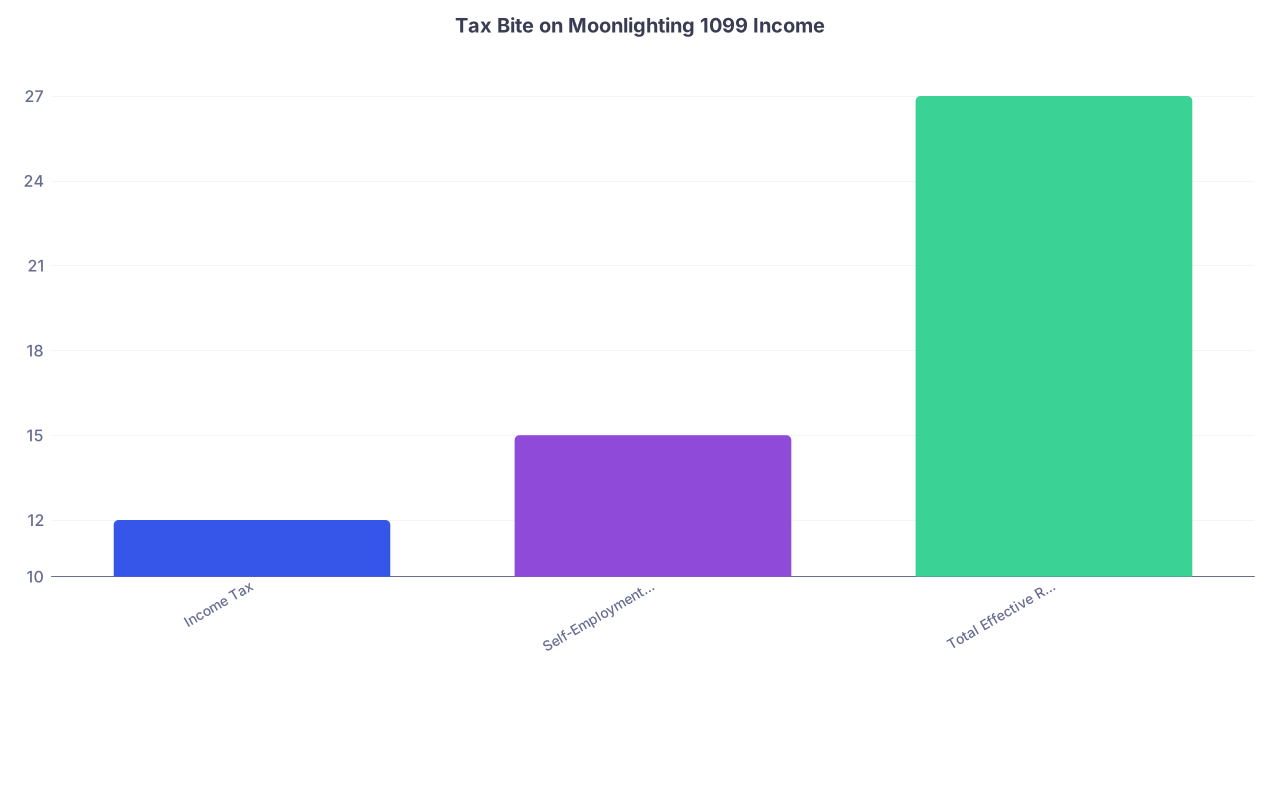
| Category | Value |
|---|---|
| Income Tax | 12 |
| Self-Employment Tax | 15 |
| Total Effective Rate | 27 |
6–9 Months After Fellowship Start: Your First Return Covering Both Roles
Fast‑forward. It’s the following February/March. You now have:
- W‑2 from your residency
- W‑2 from your fellowship
- 1099s for any side income
- Moving stipend info
- Student loan interest and recertification concerns
At this point you should file like an adult, not a panicked PGY‑1.
Step 1: Confirm You Have Every Document
Use the checklist you built:
- Two W‑2s (old and new institutions)
- 1099‑NEC/MISC for moonlighting
- 1099‑INT/1099‑DIV
- 1098‑E (loans)
- Any childcare/education docs if applicable
If a prior institution’s HR portal is locked:
- Call HR early (February, not April).
Step 2: Handle Moving Stipend Correctly
Most of the time:
- It’ll show up on one of your W‑2s as taxable wages (often at the new employer).
Confirm:
- That any amount they told you was “relocation” is either:
- Properly included in your W‑2, or
- Documented in a separate statement if it’s handled differently.
Don’t try to “deduct moving expenses” unless you’re active‑duty military. That ship sailed years ago.
Step 3: Use This Return to Plan Forward
Once the return is drafted but before you file:
- Look at:
- Total tax
- Total withholding
- Did you owe or overpay?
- Compare projected next‑year income (full year of fellowship, no residency)
At this point you should:
- Adjust your current year W‑4 based on:
- This final calculation
- Next year’s income (fellow-only year, possibly more moonlighting)
- Confirm your PSLF and IDR strategy based on AGI and future expected AGI.
Visual Roadmap: 18‑Month Transition Timeline
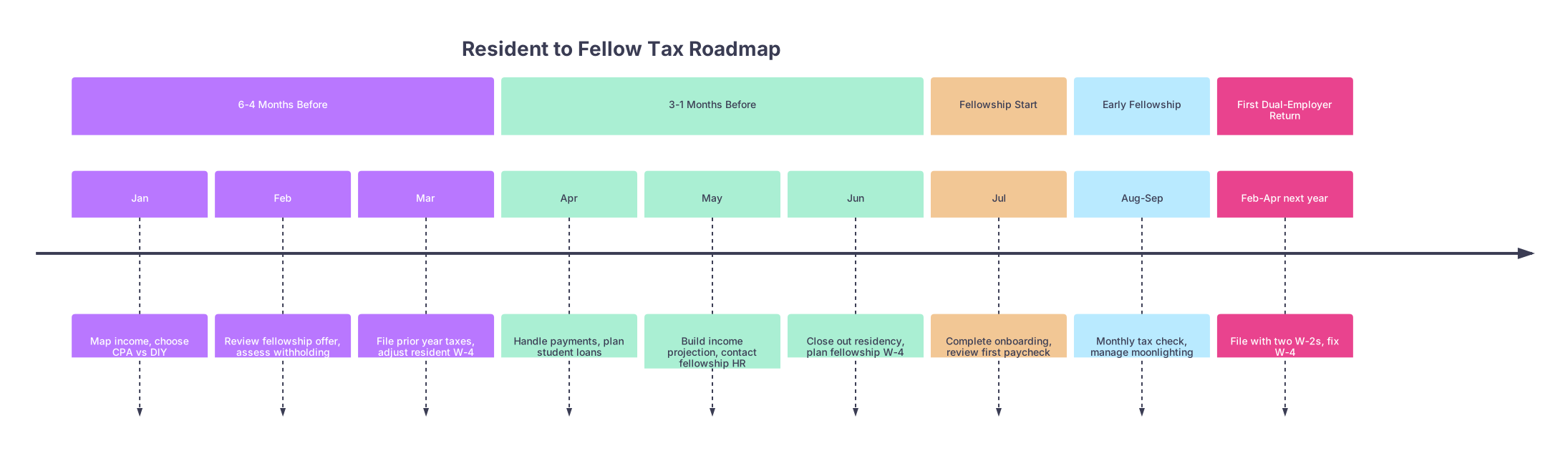
| Period | Event |
|---|---|
| 6-4 Months Before - Jan | Map income, choose CPA vs DIY |
| 6-4 Months Before - Feb | Review fellowship offer, assess withholding |
| 6-4 Months Before - Mar | File prior year taxes, adjust resident W-4 |
| 3-1 Months Before - Apr | Handle payments, plan student loans |
| 3-1 Months Before - May | Build income projection, contact fellowship HR |
| 3-1 Months Before - Jun | Close out residency, plan fellowship W-4 |
| Fellowship Start - Jul | Complete onboarding, review first paycheck |
| Early Fellowship - Aug-Sep | Monthly tax check, manage moonlighting |
| First Dual-Employer Return - Feb-Apr next year | File with two W-2s, fix W-4 |
Core Takeaways
- Plan for the year, not the job. Your tax bill follows the calendar year, which doesn’t care that you switched from resident to fellow on July 1st.
- Use your W‑4s aggressively. Both institutions will pretend they’re your only employer. They’re wrong. Fix it with specific withholding choices and extra amounts.
- Don’t ignore moonlighting and “small” stipends. 1099 work and taxable relocation can easily turn a mild refund year into a surprise four‑figure bill if you don’t plan ahead.