

The worst mistake unmatched students make in spring is waiting for bad news to become official. By then, you have already lost weeks you will not get back.
If you suspect you might not match, you must treat that suspicion like a clinical red flag. Act on it. Early. Systematically.
This is your timeline.
Late January–Early February: Reality Check and Risk Assessment
At this point you should stop guessing and start quantifying your risk.
Step 1: Audit your application honestly (1–2 days)
Sit down with your ERAS application and outcomes so far.
Create a simple table:
| Area | Question | High-Risk Answer |
|---|---|---|
| Interview count | For your specialty, do you have ≥12 interviews? | No |
| Step/COMLEX | Any failure attempts? | Yes |
| Specialty | Is your field highly competitive (e.g., Derm, Ortho, Plastics)? | Yes |
| Red flags | LOA, professionalism issues, unexplained gaps? | Yes |
| Geography | Extremely narrow geographic preference? | Yes |
If you have:
- Fewer than ~10–12 interviews in a moderately competitive specialty, or
- Major red flags (exam failures, LOA, failed prior match), or
- You are couples matching with imbalanced applications
…you must plan as if you may not match.
At this point you should:
- Write down your:
- Total interviews
- Types of programs (university vs community)
- Any cancelled interviews (and why)
- Compare yourself to peers in your specialty. If everyone else has 15–20+ interviews and you have 4–5, do not tell yourself “anything can happen.”
Be blunt. I have watched too many students cling to magical thinking in February and pay for it in April.
Mid–Late February: Build Your Dual Path Plan
While others are fine-tuning rank lists, you are doing that plus constructing a contingency plan.
Think in two parallel tracks:
- If I match → proceed with normal graduation and transition.
- If I do not match → I already have a concrete plan I can execute on SOAP Monday.
Step 2: Clarify your goals and limits (1–2 days)
At this point you should define:
- What specialties you are willing to consider in SOAP (FM, IM, Psych, Peds, Transitional Year, etc.).
- Whether you are willing to:
- Change specialties entirely
- Accept preliminary-only years
- Move anywhere in the country
- Your absolute no-go constraints (family responsibilities, visa issues, medical issues).
Write this out, not just in your head. When SOAP hits, you will be tired, emotional, and time-limited. This written framework will keep you from panicking into either:
- Applying too narrowly and striking out again, or
- Saying yes to something you genuinely cannot follow through on.
Late February–Early March: Pre–Match Week Preparation
This is the quiet-but-crucial phase. You are still a “normal” applicant outwardly, but internally you are building your unmatched playbook.
Step 3: Update materials for SOAP and reapplication (3–5 days)
At this point you should have two versions of your materials:
- Original specialty ERAS (the one you already submitted).
- SOAP-ready primary care / broad specialty version (if applicable).
You need:
- Updated:
- Personal statement tailored to:
- Internal Medicine
- Family Medicine
- Psychiatry
- Pediatrics
(pick the ones you could realistically do and that typically have SOAP positions)
- Personal statement tailored to:
- An additional statement (short) that can go into emails or messages:
- 2–3 lines explaining your interest and recent experiences.
You also need to:
- Confirm your transcript and MSPE are correct and uploaded.
- Ensure all Step/COMLEX scores are in ERAS. Delays here can quietly kill SOAP chances.
Do not wait for the “you did not match” email to start this. You will not have time.
Match Week Overview: What You Should Be Doing Each Day
Let me lay it out clearly. Match Week is controlled chaos. You need a day-by-day plan before it starts.
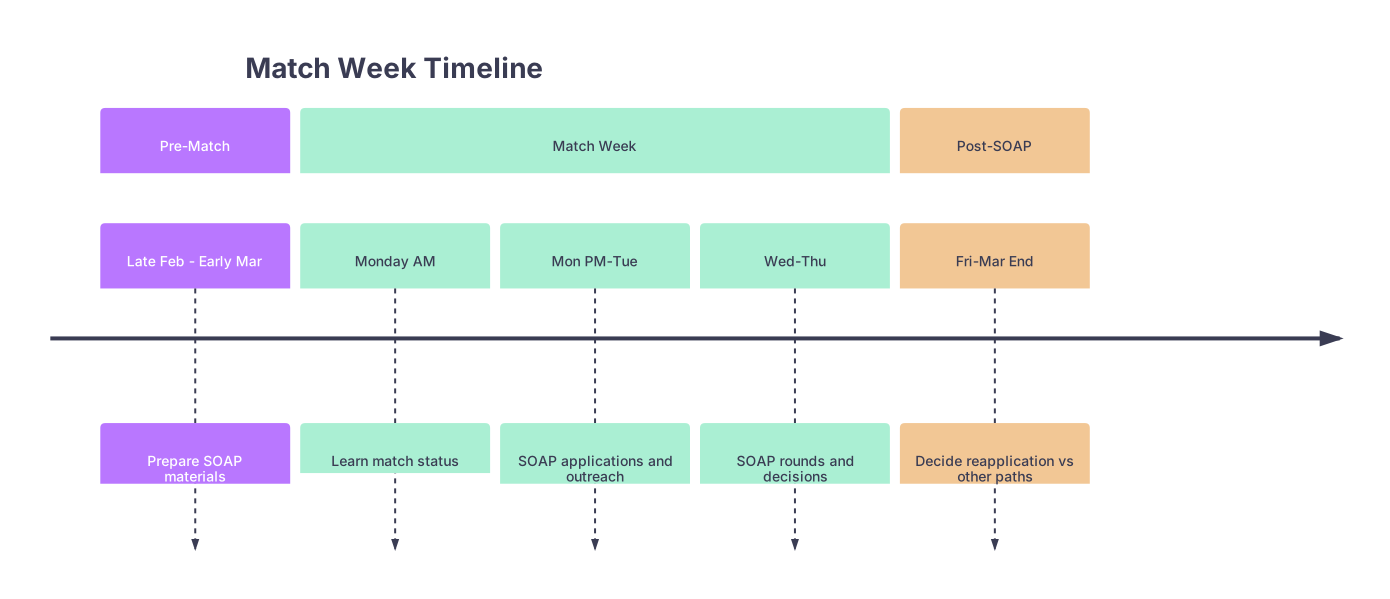
| Period | Event |
|---|---|
| Pre-Match - Late Feb - Early Mar | Prepare SOAP materials |
| Match Week - Monday AM | Learn match status |
| Match Week - Mon PM-Tue | SOAP applications and outreach |
| Match Week - Wed-Thu | SOAP rounds and decisions |
| Post-SOAP - Fri-Mar End | Decide reapplication vs other paths |
Match Week Monday: The 11:00 AM Email and Immediate Response
At this point you should clear your schedule. No clinic. No rotation. Nothing. You are on call for your own career.
11:00 AM ET – You learn your status
There are 3 possibilities:
- You matched – this article becomes background noise. Congratulations.
- You partially matched (e.g., prelim but no advanced, or couples mismatch).
- You did not match.
If you fall into #2 or #3, your day is now a sprint.
Step 4: Immediate actions (Monday midday)
Within the first 2–3 hours you should:
- Contact:
- Your Dean’s office / Student Affairs
- Your specialty advisor
- Any trusted mentor who will give you unvarnished advice
- Ask explicitly:
- “For SOAP, which specialties should I prioritize?”
- “Are there programs that know me who might be open to SOAP applicants?”
- “Given my exam history and grades, where do I realistically fit?”
You must also:
- Ensure your phone and email are fully functional and monitored.
- Set up a quiet space where you can take calls without noise or interruptions.
Monday Afternoon–Tuesday Morning: SOAP Application Execution
NRMP gives you a list of unfilled programs. It will be ugly and surprising. Ignore your pride and start treating it like a problem set.
Step 5: Analyze the SOAP List (Same day, within hours)
At this point you should:
- Sort unfilled programs by:
- Specialty (start with your agreed backup fields)
- Visa status (if relevant)
- Geography (but this is secondary right now)
- Circle or list:
- All programs in:
- IM
- FM
- Psych
- Peds
- TY/Prelim (if you need a year to reapply to your original specialty)
- All programs in:
Then answer:
- Am I willing to pivot to a categorical spot in one of these?
- Or is my strategy a strong prelim year then reapply to my desired specialty?
Be honest: some “I’ll just do a prelim year” plans never lead back to the original specialty. Competitive fields do not magically open up after a generic prelim. I have seen people get stuck.
Step 6: Prepare targeted documents (Monday evening)
You do not have the luxury to write 50 personalized letters from scratch. But you can prepare:
- A base email template of 4–6 sentences:
- Who you are (school, graduation year)
- Original specialty and genuine reason for interest in their field
- 1–2 specific strengths (e.g., strong clinical evals, Step 2 245, significant FM clinic time)
- Clear statement: “I am very interested in a position in your program and would be grateful for consideration.”
Then:
- Customize the opening line and one detail for each program you contact:
- Reference region, academic vs community, or a feature you actually like.
Tuesday: SOAP Applications and Outreach
Step 7: Submit SOAP applications early (Tuesday morning)
At this point you should:
- Rank-order your SOAP targets by realism + desirability:
- Realistic categorical positions in broad specialties
- Realistic prelim/TY positions that could set you up for a second try
- Stretch categorical spots in somewhat aligned specialties
Remember:
- SOAP limits how many programs you can apply to per round. Do not waste them on fantasy programs that would have rejected you in the regular cycle.
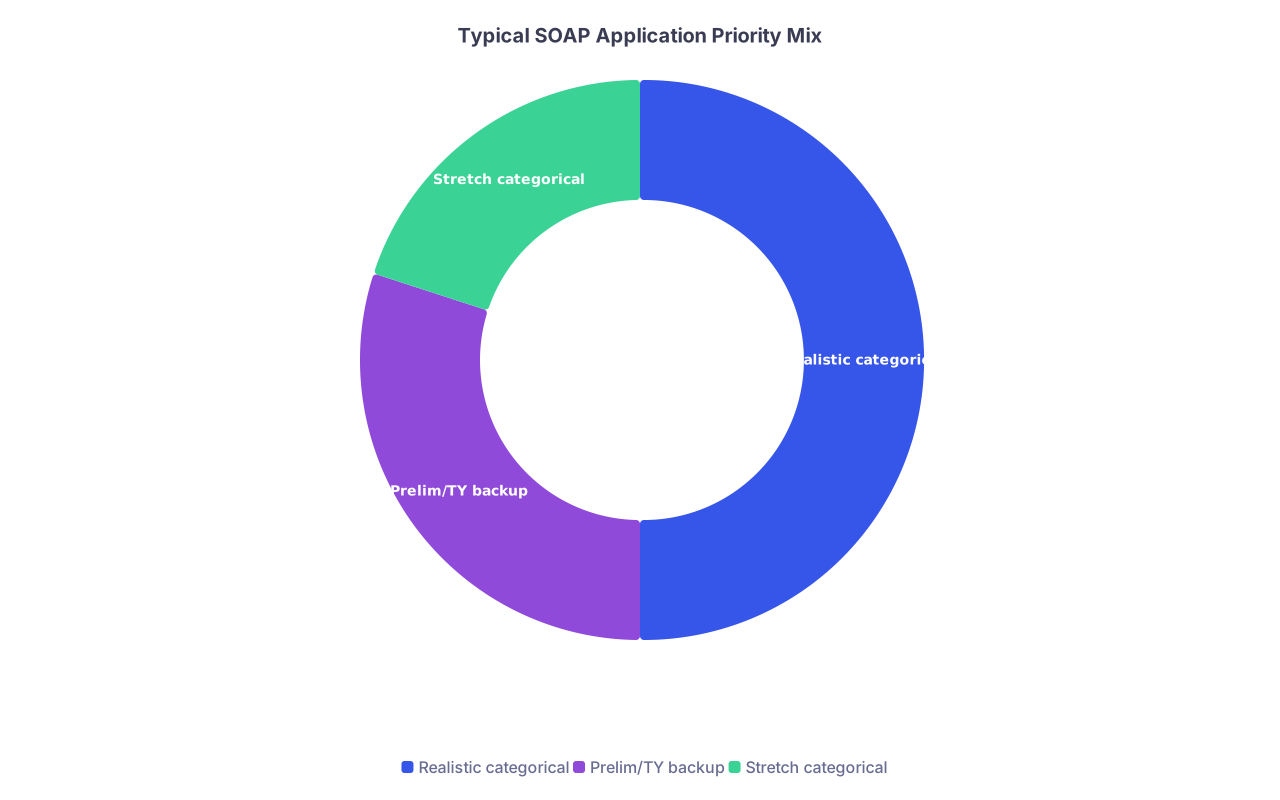
| Category | Value |
|---|---|
| Realistic categorical | 50 |
| Prelim/TY backup | 30 |
| Stretch categorical | 20 |
Step 8: Coordinated communication with programs (Tuesday midday–evening)
Once applications are in:
- Email program coordinators / PDs for your top set (not all 45; focus on 10–20 high-priority targets).
- Keep it short, focused, and professional.
- Do not harass with multiple follow-ups. One well-written note is plenty.
At this point you should also brief:
- Your Dean’s office on where you have applied.
- Any faculty who might be willing to send a quick email or make a call on your behalf.
The students who do best in SOAP are rarely the ones who sent the most emails. They are the ones whose school and mentors were actively pushing for them behind the scenes.
Wednesday–Thursday: SOAP Offers, Decisions, and Damage Control
This is when SOAP offers are extended in rounds. You may get:
- No interviews
- Last-minute calls or video chats
- Formal SOAP “interviews” that feel more like brief screens
Step 9: Be constantly available (all day, both days)
At this point you should:
- Have your phone fully charged, ringer on, voicemail cleared.
- Keep your schedule almost completely open.
- Have:
- A 30-second “tell me about yourself” answer rehearsed
- A 60–90 second explanation ready if asked, “Why are you in SOAP?” (Be honest and concise: e.g., low interview numbers, competitive specialty, exam timing.)
Common mistake: over-explaining or sounding defensive about not matching. Own it briefly, then pivot to what you learned and why you fit this specialty and this program.
Step 10: Make rapid but rational decisions (SOAP rounds)
Offers have response deadlines measured in minutes, not hours.
At this point you should know, in writing:
- Your prioritization:
- Would you choose:
- A categorical FM spot in a distant state
- Over a prelim medicine year at your home institution?
- How do you rank:
- Psych vs IM vs Peds offers?
- Would you choose:
Do not start this debate in your head after an offer arrives. Decide your values beforehand.
If you get no offers by the final SOAP rounds, your plan shifts immediately to “post-SOAP unmatched strategy.”
Friday of Match Week: Processing Results and Choosing a Path
By Friday, you either:
- Matched in SOAP,
- Or you are officially unmatched for July 1.
There is no hiding from this. What you do in the next 2–4 weeks matters more than the last 6 months.

Late March: Week-by-Week Plan if You Did Not Match or SOAP
Week 1 (Immediately Post-Match): Stabilize and Get Data
At this point you should:
Meet formally with:
- Dean of Students / Student Affairs
- Your specialty advisor
- If needed, mental health support (this hits hard; pretending it does not is foolish).
Request concrete feedback:
- From:
- Programs where you interviewed but did not rank you high enough
- Your home department (be prepared for vague or sugar-coated answers; push gently for specifics).
- From:
Define your reapplication category:
- First-time applicant reapplying same specialty
- Reapplying with a different specialty target
- Planning a research year
- Planning a prelim/TY the next cycle
Write your preliminary plan in one paragraph. Share it with your Dean and get a reality check.
Week 2: Decide Your Primary Strategy for the Next 12 Months
There are four main routes. None are perfect.
| Path | Main Goal | Typical Duration |
|---|---|---|
| Research year | Strengthen CV for same field | 1 year |
| Prelim/TY reapply | Clinical experience + LORs | 1 year |
| Switch specialty | Match into less competitive field | 1 cycle |
| Non-clinical work | Maintain income + regroup | Variable |
At this point you should choose one as your primary route, even if you keep a secondary option in reserve.
Research year – Best if:
- You are targeting competitive specialties (Derm, ENT, Ortho, etc.)
- You can secure a position at a reputable institution in that field
- You will get publications, meaningful projects, and face time with faculty
Prelim/TY year with planned reapplication – Best if:
- You are aiming for medicine, anesthesia, radiology, etc.
- You can match into a prelim that actually supports reapplicants (ask about recent outcomes).
Switching specialty completely – Best if:
- You already had weak fit with original specialty
- You are genuinely open to fields like FM, Psych, Peds, IM
- You value guaranteed training over holding out another year for a competitive match
Non-clinical work – Last resort, but sometimes necessary:
- Teaching, MPH, MBA, consulting, etc.
- Must be framed as intentional and relevant, not as “I had nothing else.”
Week 3–4: Secure a Concrete Role for the Coming Year
At this point you should move from plan to action.
Depending on your chosen path:
Research year:
- Email PIs and department chairs with:
- CV
- Brief statement of interest
- Clear ask: “Are you aware of any funded or unfunded research positions for a year starting July/August?”
- Target labs/programs that already produce residents in your field.
- Email PIs and department chairs with:
Prelim/TY:
- Watch carefully for:
- Off-cycle openings
- Newly accredited programs
- Have:
- Your ERAS updated
- A brief “unmatched” explanation ready for PDs
- Watch carefully for:
Switching specialties:
- Meet with that department’s leadership at your school.
- Ask:
- “If I commit to applying to your specialty next year, what experiences would you want me to have between now and September?”
April–May: Set Up for a Strong Reapplication
Most unmatched students waste these months. They sit in a haze of embarrassment while time bleeds away. You cannot afford that.
At this point you should be:
- Finalizing:
- A research or clinical role with a clear supervisor who will write you a strong letter.
- Mapping your upcoming:
- Rotations (if still on the schedule)
- Away rotations or observerships (if allowed)
- Building a short list of:
- Programs that historically welcomed reapplicants or non-traditional paths.
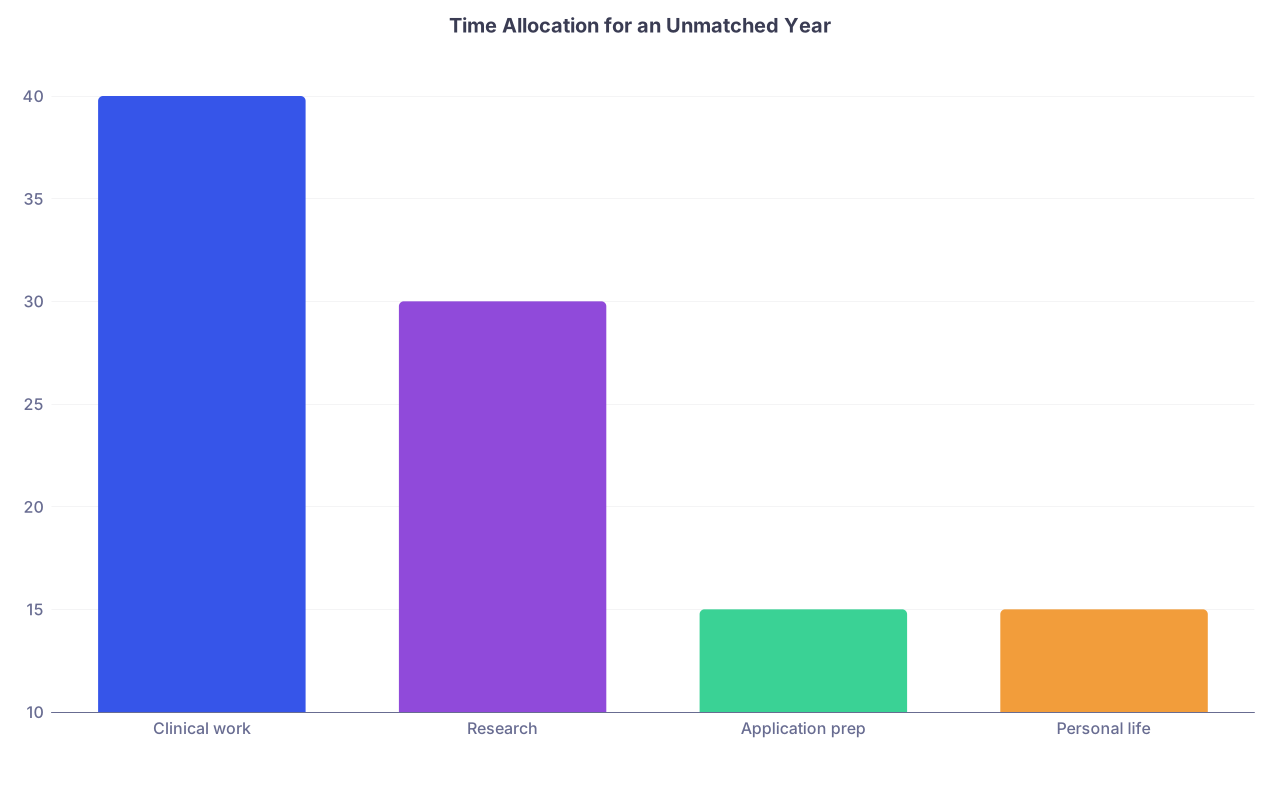
| Category | Value |
|---|---|
| Clinical work | 40 |
| Research | 30 |
| Application prep | 15 |
| Personal life | 15 |
Emotional and Professional Cleanup (Ongoing Through Spring)
You are not just fixing your CV. You are holding your professional identity together.
At this point you should:
- Tell your close peers the truth in simple language:
- “I did not match this year. I am planning to do X next year and reapply.”
- Resist:
- Vanishing from group chats
- Skipping graduation
- Hiding from faculty
Why? Because people remember how you carried yourself when things went badly. That matters for letters, jobs, and your own sanity.

Quick Endgame Summary
Act early, not after bad news is official. By late February, if your numbers and interviews are weak, you prepare SOAP materials and a backup specialty list. No denial.
Treat Match Week like a scheduled emergency. Clear your calendar, follow a day-by-day plan, and make decisions you already thought through, not improvisations under pressure.
If you do not match, convert shock into structure within 2–4 weeks. Choose a primary path (research, prelim/TY, new specialty, or non-clinical), secure a concrete role for the next year, and build a stronger, cleaner story for your next application cycle.


