
How Many Times Is Reasonable to Reapply Before Changing Paths?
How many unmatched seasons do you go through before you have to admit: “This path isn’t working”?
Let me be direct: for most people, 2–3 serious, optimized attempts at the Match is the upper limit before you should strongly consider changing strategy or even changing paths. That doesn’t mean you give up on medicine as a whole after one bad year. But it does mean you need a structured way to decide when to stop repeating the same cycle and expecting a different result.
Let’s break this down in a way that’s actually useful, not sugar‑coated.
The Short Answer (With Numbers)
Here’s the blunt framework I use when advising unmatched grads:
If you’ve applied once and didn’t match:
Reapplying is usually reasonable – if you’re willing to fix what went wrong in a real way (not just “better personal statement”).If you’ve applied twice and didn’t match:
This is a big red flag. A third attempt should only happen after major changes: specialty, application strategy, geography, or career plan.If you’ve applied three times and didn’t match:
For 90% of people, it’s time to pivot. That might mean a different specialty, a different role in healthcare, or an entirely different career.
The more risk factors you have (IMG, older grad, low scores, big gaps), the lower that reasonable reapply number gets.
Here’s a quick comparison view:
| Attempt # | Reasonable? | Recommended Action |
|---|---|---|
| 1st | Yes | Analyze gaps, improve, reapply same or adjacent specialty |
| 2nd | Maybe | Strongly consider changing specialty/strategy |
| 3rd | Rarely | Only with dramatic change; otherwise pivot paths |
| 4th+ | Almost no | Very strong case to fully change paths |
The More Honest Question: Should You Reapply?
The number of times is the wrong first question. The right one is:
“Given my profile and what I’m actually willing to change, does reapplying give me a realistic shot?”
Here’s the rough mental decision tree I use with people:

| Step | Description |
|---|---|
| Step 1 | Unmatched after Match |
| Step 2 | Analyze application honestly |
| Step 3 | Consider non-residency paths |
| Step 4 | Reapply with improvements |
| Step 5 | Strongly consider new specialty or location |
| Step 6 | Identifiable fixable issues? |
| Step 7 | Willing to make major changes? |
| Step 8 | How many attempts so far? |
If you can’t identify something substantial that will be different next year, reapplying is usually just an expensive way to relive the same disappointment.
“Substantial” means things like:
- Switching to a less competitive specialty
- Dramatically increasing application volume and geographic spread
- Getting a strong US clinical year with powerful letters
- Fixing a professionalism issue or academic red flag
- Improving a Step 2/Level 2 score that was a hard filter
Not: “I’ll tweak my personal statement and hope.”
How Many Times Is Reasonable? Breakdown by Situation
Let’s get specific. Because an AMG with a 225 vs an IMG with a 205 are playing different games.
1. US MD/DO, No Major Red Flags
You’re a US grad, no failures, decent but not stellar scores, maybe applied to a competitive specialty or applied too narrowly.
- Reasonable attempts before major pivot:
Usually 2 attempts, sometimes 3 if each attempt is genuinely different.
What this might look like:
- Year 1: Unmatched in EM after applying to 40 programs, only in certain regions.
- Year 2: Switch to IM or FM, apply to 120+ programs nationwide, add a prelim year as backup.
- Year 3 (maybe): Only if Year 2 included a prelim year with strong letters and your application is now clearly stronger.
If you’re a US grad and you’ve gone through 3 cycles with serious effort and still haven’t matched anywhere (even prelim or less competitive fields), that’s not a “bad luck” problem anymore. That’s a signal.
2. US MD/DO with Red Flags (Fails, Gaps, Remediations)
Here, programs are risk‑averse. You can’t brute force your way past repeated fails with volume alone.
- Reasonable attempts: Often 2 total, and the second needs a major rebuild.
You should only reapply if you can do at least one of these:
- Complete a strong prelim year and get great letters
- Build a substantial, credible story of growth (research, MPH, teaching, etc.)
- Target specialties that really take people with your profile (FM, psych, IM, maybe pathology depending on the year)
If you’ve applied twice with a known red flag and fully tried to compensate (extra degrees, research years, clinical work) and still no match, a third attempt usually isn’t the thing that changes your life. A career pivot likely is.
3. US-IMG / Non-US IMG
This is where people get stuck in the “one more year” loop the most.
You’re dealing with:
Visa problems
Program bias
Massive competition from other IMGs and AMGs
Reasonable attempts: Usually 2, sometimes 3 only if both your profile and your strategy changed a lot between cycles.
I’ve seen this play out:
- Year 1: IMG applies IM only, 60 programs, mediocre personal statement, no US letters. No interviews.
- Year 2: Takes US observerships, gets 2 US letters, applies more broadly (IM + FM, 180+ programs). Gets a few interviews, no match.
- Year 3: Maybe. If they’ve now done a research year at a US institution, significantly boosted connections, and can show clearly stronger letters and clinical exposure.
But if it’s:
- Year 1: 205 Step 1, multi‑year graduation gap, no USCE, no interviews
- Year 2: Same scores, low‑value observership, 1 weak US letter, minimal interviews
A Year 3 with “better personal statement” isn’t your solution. That’s when you have to seriously look at other roles.
Track Record: How Much Improvement Are You Actually Seeing?
You don’t decide reapplication based on vibes. You decide based on trajectory.
Look at hard data:
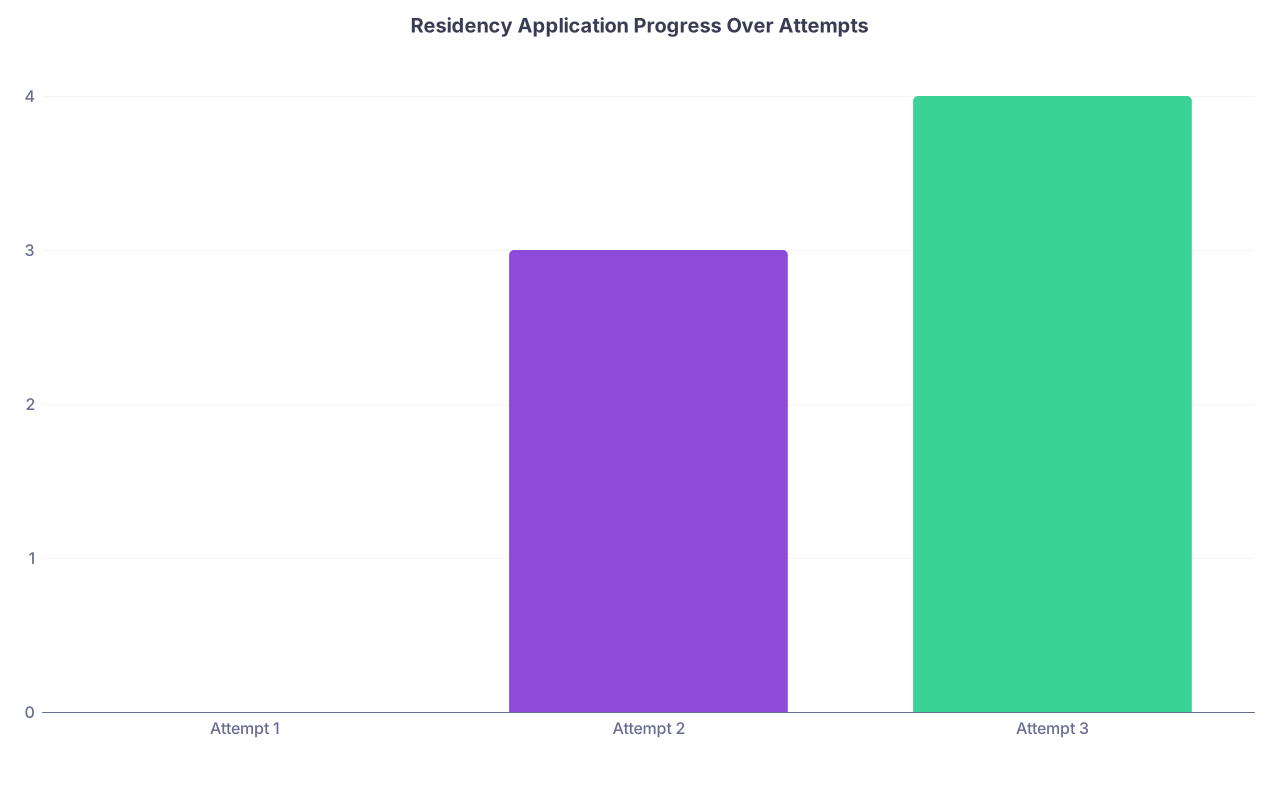
| Category | Value |
|---|---|
| Attempt 1 | 0 |
| Attempt 2 | 3 |
| Attempt 3 | 4 |
Maybe your numbers look like this:
- Attempt 1:
0–1 interviews
Mostly generic rejections - Attempt 2:
3–5 interviews
On some waitlists, closer but not matched - Attempt 3:
6–8 interviews, a few programs ranking you but just missing
Someone going 0 → 5 → 8 interviews across attempts? That person might justify a third swing.
Someone stuck at 0–2 interviews each time, with no obvious barrier changing? They’re just hitting “refresh” on the same failed plan.
You reapply if:
- Your number of interviews is increasing
- Feedback from mentors/programs suggests you’re competitive but squeezed
- Your application is objectively stronger (scores, letters, USCE, specialty fit)
You don’t reapply if:
- Interviews stay flat or decrease
- You can’t get brutally honest reasons from anyone about why you’re not matching
- Your life is on hold and you’re piling on financial/emotional damage each year
Signs It’s Time to Change Paths (Or at Least Specialty)
You shouldn’t wait until attempt #4 to ask this.
Pay attention if:
You’re emotionally cooked.
If the thought of “one more application cycle” makes you feel physically sick, that’s not trivial burnout. That’s your brain telling you this isn’t sustainable.You’re no longer improving your profile in a meaningful way.
Another year of half‑hearted observerships and random volunteering isn’t going to flip your odds.You’re chasing a specialty that doesn’t want your numbers.
Applying to ortho with a 215. Derm with multiple fails. EM in a saturated cycle with no interviews the last time. At some point this isn’t grit, it’s denial.You’re already compromising your life heavily.
Massive debt, putting off family, working low‑pay jobs just to “stay clinical” while everything else in your life feels stuck.
When several of those are true at the same time, that “one more year” thinking becomes dangerous.
What “Changing Paths” Can Actually Mean
“Change paths” doesn’t always mean “never do residency ever.” It can mean:
Change specialty
EM → IM
Surgery → FM
Anesthesia → prelim year + IM reapplication
Competitive → primary careChange role in medicine
Physician assistant (if your region/visa makes this realistic)
Nurse practitioner (more steps, but some people do it)
Clinical research coordinator → PhD → academic track
Hospital administration, informatics, quality improvementChange to a related but nonclinical career
Medical writing
Pharma/biotech (medical science liaison, safety, clinical operations)
Health tech, digital health, consultingChange entirely
You’re allowed to say, “This path isn’t worth it to me anymore,” and do something totally different. That’s not failure. That’s self-preservation.
A Simple Framework: Decide in Advance
If you’re on attempt #1 or #2, do this right now:
Set a maximum number of total attempts you’re willing to do. Write it down.
“I will not go beyond 3 total attempts at residency.”Decide what has to be different to justify each reattempt.
Example for Year 2: “I will only reapply if I’ve done 6+ months US clinical, added 2 strong US letters, and broadened specialty list.”Agree with yourself on a Plan B and Plan C.
Plan B: Less competitive specialty or prelim year
Plan C: Non-residency path
This prevents you from sliding into a 6‑year loop of “just one more try.”
FAQs
1. Is it ever reasonable to apply more than 3 times?
Very rarely, and only if each attempt is genuinely a new situation. For example: first attempt as an international grad with no USCE; second after USCE; third after a strong US research year at a big academic center; fourth after a successful prelim year with powerful letters and clearly better interviews. Even then, I’d still ask if you’re okay spending another year in limbo. More than three is the exception, not the default.
2. Should I switch to a less competitive specialty after my first unmatched cycle?
If you applied to a very competitive field (derm, ortho, ENT, plastics, integrated vascular, etc.) and got zero or almost zero interviews, then yes, you should seriously consider switching earlier instead of wasting 2–3 years chasing noise. One more attempt might make sense if you had a few interviews and clear feedback about how to improve, but staying in a black‑hole specialty with an average or below‑average profile is how people end up five years deep with nothing.
3. Is doing an unpaid observership year enough to justify reapplying?
No. Not by itself. Observerships plus strong US letters can support a reapplication, but they’re not magic. Programs care more about: exam performance, recency of graduation, real responsibility (sub‑internships, prelim years), and clear specialty fit. Observerships are background noise unless they’re at programs that will actually advocate for you, or they’re part of a much larger package of improvement.
4. If I go into a different career now, can I ever come back and try again later?
Technically yes, practically very hard. The longer you’re away from clinical medicine, the colder your application gets. After 3–5 years out of med school with no meaningful clinical activity, getting into residency becomes extremely unlikely for most specialties. If you’re thinking “I’ll do something else and maybe come back someday,” be aware you’re probably closing that door, or at least making it very, very narrow. That’s not necessarily bad—but make the choice with open eyes.
5. What’s one clear sign I should not reapply this year?
The clearest sign: if nothing substantial will change in your application between last cycle and this one. Same scores, same letters, same lack of USCE, same narrow specialty, same geographic restrictions—then reapplying is just paying for a slightly rearranged version of last year’s rejection. If you can’t point to at least two or three big differences, use this year to rebuild or pivot instead of recycling your file.
Open a blank page and write this sentence: “The maximum number of residency application attempts I’m willing to make is ___, and I will only reapply if ________ has changed significantly.” Fill that in. If you can’t convincingly complete that second blank, you already have your answer.