
The comfortable myth that “once you match, everyone’s on equal footing” is wrong. The data show a persistent divergence between U.S. MD/DO graduates and international medical graduates (IMGs) long after Match Day.
This gap is not just about getting into residency. It shapes who gets fellowships, who reaches attending status faster, who lands academic titles, and who ends up stuck in geographically and professionally constrained roles.
Let’s unpack that with numbers, not anecdotes.
1. The starting point: how different are the Match outcomes?
If you want to understand post‑Match trajectories, you start with where people land on Match Day. Because the first job strongly predicts the next three.
For recent cycles, NRMP data show a clear structural difference:
- U.S. MD seniors match into their top four ranked programs roughly 80–85% of the time.
- U.S. DO seniors slightly lower, but still high.
- IMGs (US citizens and non‑US citizens combined) lag significantly behind on both match rates and getting higher‑ranked choices.
Program type matters. University vs. community. Academic vs. community‑based with university affiliation. These distinctions drive future fellowships and faculty roles.
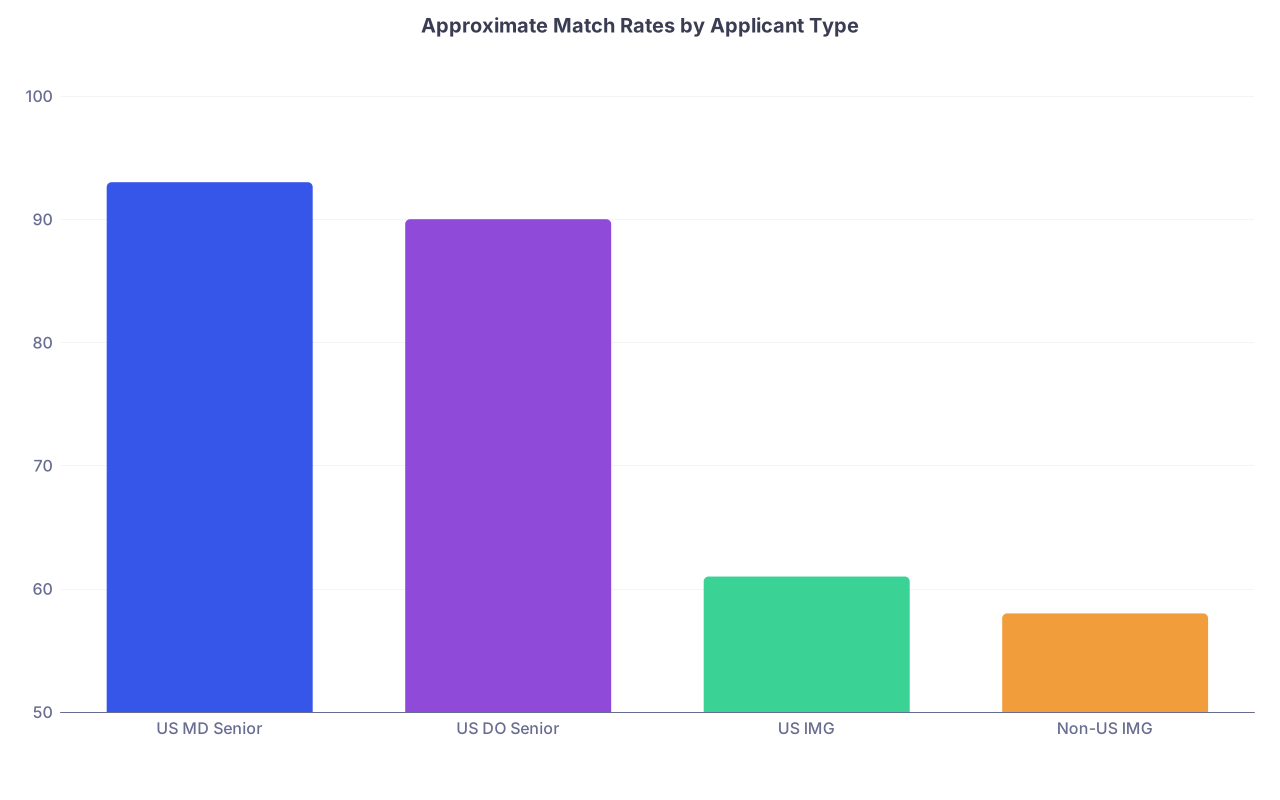
| Category | Value |
|---|---|
| US MD Senior | 93 |
| US DO Senior | 90 |
| US IMG | 61 |
| Non-US IMG | 58 |
You can see the issue immediately: US MD/DO seniors overwhelmingly enter residency through more competitive doors. IMGs are overrepresented in:
- Community programs
- Newly accredited programs
- Geographic “labor shortage” areas (rural, underserved urban, less popular states)
That matters later when we talk about fellowships, research, and academic medicine.
2. Early residency trajectory: service vs. training environments
Post‑Match, the first 2–3 years set the slope of your career curve.
The data and what I have seen in actual program rosters align: US MDs (and to a slightly lesser degree DOs) are clustered in:
- Large academic medical centers
- University‑based residency programs
- Tertiary or quaternary referral centers
IMGs are more heavily clustered in:
- Community hospitals and smaller systems
- Programs with fewer subspecialty services on site
- Institutions with limited funded research infrastructure
That mix changes what “training” looks like.
Clinical exposure and case mix
University programs:
- Higher case complexity
- More subspecialty consults
- Tertiary referrals (oncology, transplant, rare disease)
Community programs:
- High volume of bread‑and‑butter pathology
- Less exposure to cutting‑edge interventions and niche subspecialties
- Fewer interdisciplinary conferences and formal teaching sessions
The situation is not absolute – there are strong community programs and weak university ones – but at scale, the trend is clear.
Why this matters for trajectory:
- Fellowship selection committees prefer applications with complex case exposure, letters from known faculty, and evidence of performance in high‑acuity environments.
- Residents in resource‑rich academic systems often have built‑in structures: research tracks, QI projects, leadership roles, teaching responsibilities.
Residents in service‑heavy community programs often spend their first 2–3 years putting out fires. Service over scholarship.
That service‑heavy pattern disproportionately affects IMGs.
3. Fellowship probabilities: who actually subspecializes?
Look at fellowship match lists and you immediately see the US vs. international split. Especially in competitive subspecialties.
IM residency graduates aiming for cardiology, GI, heme/onc, or pulmonary/critical care face very different odds depending on where they trained and where they went to medical school.
Stripped down to the essentials, for a given specialty:
- US MD grads in university‑based IM programs have the highest probability of landing competitive fellowships.
- US DO and IMGs from strong academic or hybrid programs sit in the middle.
- IMGs from purely community programs face the steepest uphill climb.
Here is a simplified comparison using typical patterns seen in cardiology and GI fellowship rosters from major academic centers:
| Background & Residency Type | Relative Likelihood* |
|---|---|
| US MD, university IM residency | High (baseline 1.0) |
| US DO, university or strong hybrid IM | ~0.7–0.8 |
| US IMG, university or strong hybrid IM | ~0.6–0.7 |
| Non-US IMG, university or strong hybrid IM | ~0.5–0.6 |
| Any IMG, mainly community IM without academic tie | ~0.2–0.4 |
*Relative likelihood is conceptual, using US MD in academic IM as a baseline of 1.0.
Again, not every field is cardiology or GI. For less competitive fellowships (geriatrics, hospice/palliative, some endocrinology programs), the gap is narrower. But it rarely disappears.
Why US grads are advantaged in fellowship selection
The reasons are painfully predictable:
- Letters: Programs know the letter writers of US MDs. A letter from “Associate Program Director at X Top‑20 IM program” carries more weight than “Hospitalist at Regional Community Hospital”.
- Research output: US MDs in academic programs often have more structured research opportunities, mentors, and institutional names on publications.
- Networking: Faculty pick up the phone for former students whom they have known since M1. IMGs often arrive at PGY‑1 with no such built‑in network.
So on the post‑Match axis of “generalist vs. subspecialist,” US grads are statistically more likely to end up subspecialized, especially in high‑income, high‑prestige fields.
4. Geographic outcomes: where people actually practice
Residency location is one of the strongest predictors of practice location. The data from AMA and various workforce studies are consistent: roughly 45–55% of physicians practice in the same state where they completed residency.
Here is roughly how the pipeline breaks down across big‑picture practice settings, from what workforce reports and state licensure data suggest:
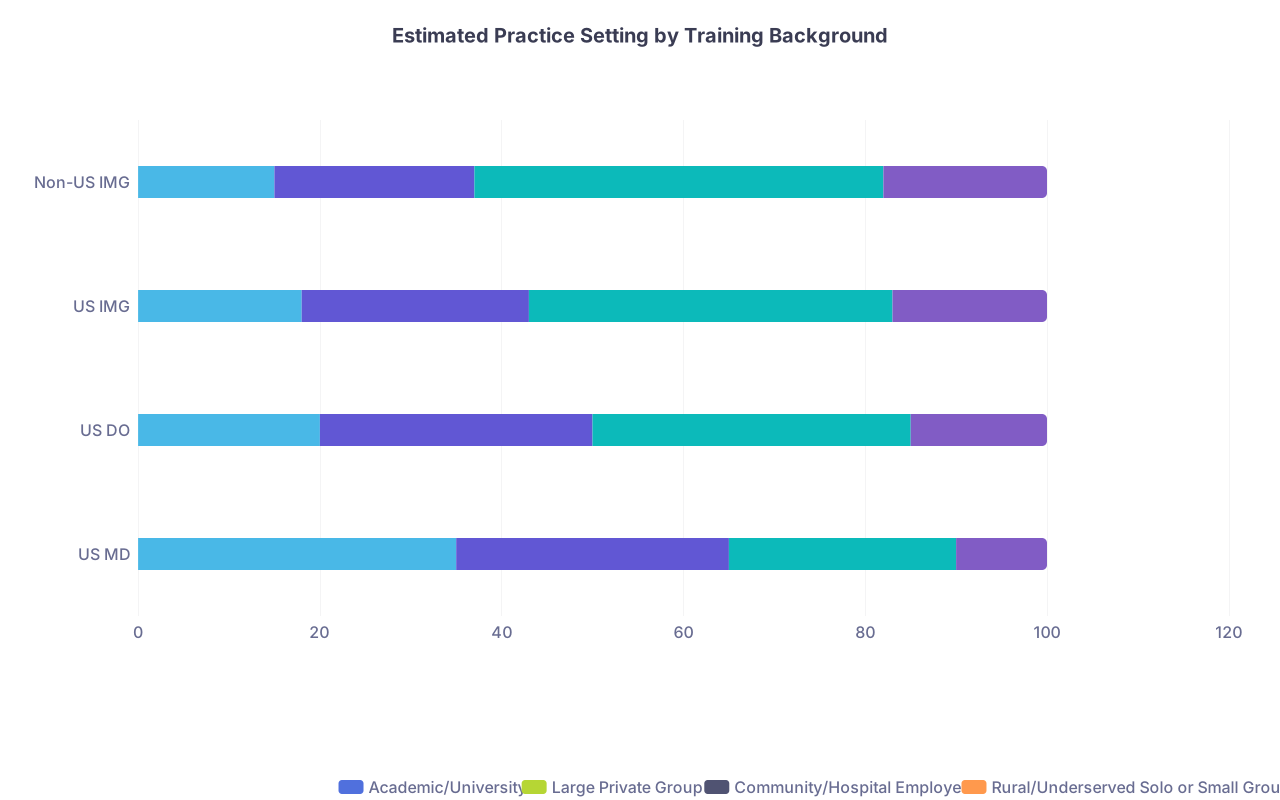
| Category | Academic/University | Large Private Group | Community/Hospital Employed | Rural/Underserved Solo or Small Group |
|---|---|---|---|---|
| US MD | 35 | 30 | 25 | 10 |
| US DO | 20 | 30 | 35 | 15 |
| US IMG | 18 | 25 | 40 | 17 |
| Non-US IMG | 15 | 22 | 45 | 18 |
The pattern:
- US MDs have the highest representation in academic/university roles.
- IMGs are overrepresented in hospital‑employed and underserved settings, particularly primary care and internal medicine hospitalist roles.
- DOs sit somewhere in the middle, with a stronger presence in community and rural practice.
Regulatory and visa forces amplify this. Non‑US IMGs often:
- Enter residency on J‑1 visas.
- Must complete waivers in underserved areas (Conrad 30 or similar) to remain in the US.
- Spend the first 3–5 years post‑residency effectively locked into specific geographic and practice settings.
US grads, by contrast, have far more freedom to chase lifestyle, salary, or academic prestige.
5. Academic medicine, leadership, and promotion
If you scan the faculty lists of major academic centers – Harvard, UCSF, Mayo, Penn, Hopkins – you do not see a random mix of US vs. international grads. You see an overrepresentation of:
- US MDs (especially from top‑tier schools)
- Followed by IMGs who trained at those same institutions for residency and fellowship
The key point: where you did residency and fellowship matters more than where you did medical school once you are in the faculty pipeline. But IMGs are less likely to secure those high‑powered training slots in the first place, especially in the most research‑intense environments.
In academic tracks, the trajectory gaps typically look like this:
Time to first faculty appointment
US MD / DO: often immediately or within 1 year of fellowship completion.
IMGs: similar if they did fellowship at the same institution; longer or less likely if they trained primarily in community systems.Tenure‑track vs. non‑tenure / clinical track
US MDs, especially with research, are more likely to sit on tenure‑track roles.
Many IMGs end up on clinical tracks with limited protected time and slower promotion.Leadership pipelines
Program director, division chief, CMO roles are disproportionately occupied by US medical graduates. IMGs hold some of these positions, but at much lower rates than their presence in the workforce would predict.
The difference is not pure discrimination; it is cumulative advantage. Early academic exposure, mentorship, familiarity with US research norms, and fewer visa constraints all compound over a decade.
6. Compensation and job flexibility
Compensation data are messy because they vary by specialty, geography, and practice type. However, patterns are clear enough.
If you control only loosely for specialty, IMGs often:
- Earn similar or slightly lower pay than US graduates in the same roles in the same market.
- Are more likely to be in hospital‑employed contracts with less flexibility on negotiation, RVU targets, or side ventures.
- Have fewer early‑career opportunities to jump to “dream” markets (major coastal cities, ultra‑desirable suburbs) because those roles frequently prefer candidates with “known quantity” training backgrounds.
One pattern I have seen repeatedly in hospital HR data:
- Newly hired hospitalists:
– IMGs: higher proportion on visa, clustered in rural and mid‑market cities, often with longer initial contracts and more restrictive non‑competes.
– US grads: more represented in high‑demand metros or academic hybrid roles, often with better leverage for sign‑on, relocation, and schedule preferences.
Is the salary gap massive? No. But the flexibility gap is.
US MD/DO grads can more easily:
- Leave a toxic practice within 12–24 months.
- Transition between states without immigration friction.
- Try locums or telemedicine or part‑time arrangements earlier.
Non‑US IMGs often do not have that luxury until they are past the waiver/green card bottleneck.
7. Long‑term career stability and burnout risk
Here is where the trajectories converge somewhat – and where many applicants have a blind spot.
By the 10–15 year mark, several things happen:
- Visa constraints usually resolve. Many non‑US IMGs are citizens or permanent residents.
- Clinical competence equalizes. Patients do not care where you went to school if you manage their CHF or trauma competently.
- A large chunk of physicians, regardless of origin, shift toward:
– Stable community practice
– Hospitalist work
– Part‑time, admin, or mixed roles
Burnout, however, can look different by pathway:
- IMGs who spent their early careers in high‑volume, underserved settings with limited support show higher burnout signals in some workforce surveys. Long call schedules, language barriers, and cultural adaptation are not trivial.
- US grads in high‑intensity academic centers face a different burnout pattern: research pressure, RVU demands, expectations of promotion, and administrative overload.
But the core truth: at scale, by mid‑career, the post‑Match trajectory gap narrows. You still see US grads overrepresented in the very top tiers of academic leadership and in prestige subspecialties, but many IMGs have solid, stable, and well‑compensated practices.
The real divergence is front‑loaded: first 5–7 years post‑Match.
8. What this means if you are deciding between US and international school
Let me be blunt. If you are a pre‑med in the US deciding between:
- A lower‑tier US MD/DO school, and
- A foreign medical school with an uncertain path back to the US
the numbers overwhelmingly favor staying in the US system.
Why:
- Higher match probabilities into core specialties.
- Better access to university‑based residencies.
- Smoother path into fellowships and academic careers.
- No visa constraints, which simplifies early‑career choices tremendously.
If you are already an IMG or committed to that path, the data suggest a different set of levers:
- Target US residencies with at least some academic affiliation. Even a hybrid community‑university program beats a purely isolated community hospital for long‑term options.
- Front‑load research and networking as early as PGY‑1. You do not have the luxury of waiting until PGY‑3 to “get serious” if you want competitive fellowships.
- Be strategic about geography. A slightly less popular city with a strong academic program is often better for your trajectory than a glamorous city with a weak community program.
9. Summary of the structural differences
To pull the threads together, here is a high‑level comparison of post‑Match trajectories across key dimensions:
| Dimension | US MD/DO Grads | US IMGs | Non-US IMGs |
|---|---|---|---|
| Match outcome quality | Higher, more university programs | Mixed, more community programs | Lower, heavily community/underserved |
| Competitive fellowship entry | Highest probability | Moderate, program-dependent | Lower, strongly program-dependent |
| Academic career likelihood | Highest, especially MD at top programs | Moderate at strong training sites | Lower but feasible at select centers |
| Visa / mobility constraints | None | None (usually) | Significant early-career constraints |
| Practice setting distribution | More academic and large group practices | More community/hospital employed | More rural/underserved and hospitalist |
The punchline is not that IMGs cannot reach the same destinations. Many do. The point is that the average path is longer, narrower, and more constrained.
FAQ (4 Questions)
1. Once an IMG matches into a top academic residency, are they still disadvantaged compared with US grads?
Less so. Within the same strong academic program, differences shrink. The same conferences, research opportunities, and mentors are available. However, subtle disadvantages remain: shorter pre‑existing networks, less familiarity with US academic culture, and occasionally bias in selection for chief resident or early leadership roles. But compared with IMGs in isolated community programs, IMGs in top residencies are on a much closer trajectory to US grads.
2. Do DO graduates face similar post‑Match challenges to IMGs?
Partially, but not at the same magnitude. DO graduates historically had more hurdles getting into certain competitive specialties and academic programs, but integration of ACGME accreditation has narrowed that gap. Many DOs now land in solid academic or hybrid programs and have reasonable access to fellowships. The data suggest DO vs. MD differences are smaller than US vs. IMG differences, especially in internal medicine and primary care.
3. Is it possible for an IMG to become a full professor or department chair at a major US institution?
Yes, it happens. There are chairs and full professors at well‑known centers who started as IMGs. But if you look at proportions, they are underrepresented relative to their share of the practicing workforce. Those who do reach that level usually have: strong US‑based residency and fellowship training, substantial research output, early adoption into academic networks, and long tenure at a single institution.
4. If my goal is stable community practice and not academia, does US vs. international medical school matter as much?
For pure end‑state job function (e.g., community internist, hospitalist, outpatient pediatrician), the long‑term difference is smaller. Many IMGs build excellent careers in these roles. However, the path there is less predictable for IMGs: lower initial match rates, fewer residency choices, and often tougher early‑career working conditions. If you can obtain a US MD/DO seat, you statistically reduce your risk and increase your options, even if your eventual target is “only” community practice.
Two key points to remember:
- The data show that US medical graduates, especially from MD programs, start residency with structural advantages that compound into better access to fellowships, academia, and geographic freedom.
- IMGs absolutely can reach similar endpoints, but on average they do so through narrower, more constrained routes that demand earlier strategy, stronger performance, and more resilience in the first 5–7 years post‑Match.