
More publications help reapplicants. But not as much as people want to believe. And not in the way most people think.
If you are a reapplicant banking on “just getting a couple more papers” to fix a bad match outcome, the data is blunt: publications are a useful lever, but they are a secondary lever. They compound a solid file; they do not rescue a fundamentally weak one.
Let me walk through what the numbers actually suggest and where extra research moves the needle vs where it barely twitches the dial.
1. What the data actually says about research and match rates
We do not have a neat, linear “X more publications → Y% higher chance” curve for reapplicants only. NRMP and specialty organizations simply do not publish data at that level of granularity.
But we do have three relevant data streams:
- NRMP Charting Outcomes (US MD, DO, and IMG) by specialty
- NRMP reapplicant / prior unsuccessful applicant outcomes
- Specialty-specific competitiveness and research norms (Derm, Rad Onc, ENT, Ortho, etc.)
The patterns are consistent across multiple cycles.
Research volume vs match rate (cross-sectional, not reapplicant-specific)
When you look at Charting Outcomes across specialties, the trend is clear:
- In research-heavy specialties (Dermatology, Radiation Oncology, Neurosurgery, ENT, Plastic Surgery), matched applicants typically have:
- More total research experiences
- More abstracts/posters/presentations/publications
- In more “generalist” specialties (Family Medicine, Psychiatry, Pediatrics), the gap between matched and unmatched in research output is smaller and sometimes negligible.
To make this concrete, here is a stylized but realistic approximation of what the numbers look like when you compare matched vs unmatched in competitive fields. These are not exact cycle-specific NRMP numbers, but they track the same pattern I keep seeing across reports.
| Specialty | Group | Median Publications/Abstracts/Posters |
|---|---|---|
| Dermatology | Matched | 18–22 |
| Dermatology | Unmatched | 8–10 |
| Neurosurgery | Matched | 22–26 |
| Neurosurgery | Unmatched | 12–14 |
| Plastic Surgery | Matched | 20–24 |
| Plastic Surgery | Unmatched | 10–12 |
You can argue with the exact medians, but you cannot argue with the direction:
The data shows that in the most research-intensive specialties, being in the lower end of the research distribution makes you more likely to be in the unmatched group.
Now layer in reapplicants
NRMP data on prior unsuccessful applicants (when they break it out) shows something uncomfortable:
- Reapplicants, on average, have lower match rates than first-timers with similar test scores.
- But among reapplicants who do match, a significant fraction have:
- More US clinical experience (for IMGs) or
- Strengthened letters and/or
- Increased research output.
That is correlation, not causation. Still, it is the only real dataset we have. And the direction is again consistent: reapplicants who close the gap between their CV and the median matched applicant in that specialty do better. Research is one of the easiest “visible metrics” to improve in a 6–12 month reapplication cycle.
2. Where additional publications have the largest effect
You are not trying to go from “bad” to “good” with publications. You are trying to move from “below the filter” to “inside the conversation.”
Use case 1: Borderline competitive specialty, profile already close
Scenario I keep seeing:
- US MD or DO
- Step 2 CK = 241
- No Step 1 score (pass/fail) or a 220–225
- ~4–5 total abstracts/posters, 1 low-impact PubMed paper
- Applying to, say, ENT, Derm, Rad Onc, or Ortho
- Unmatched on first try
Look at the competitive fields’ matched applicant profiles. In many of these, the mean/median number of publications/posters/abstracts is in the high teens.
If you sit at 5–6 items and your peers sit at 18–20, programs infer one of two things:
- You were not deeply involved in research
- You did not have sustained interest in the field
In this case, strategically adding 3–6 meaningful new items (not 1 poster from a random case report months before ERAS) can do a few things simultaneously:
- Close the raw volume gap somewhat
- Signal commitment to the specialty
- Generate new letters from academic mentors who know you as a reapplicant working hard
In probabilistic terms, what you are doing is moving yourself closer to the distribution center of matched applicants for that field.
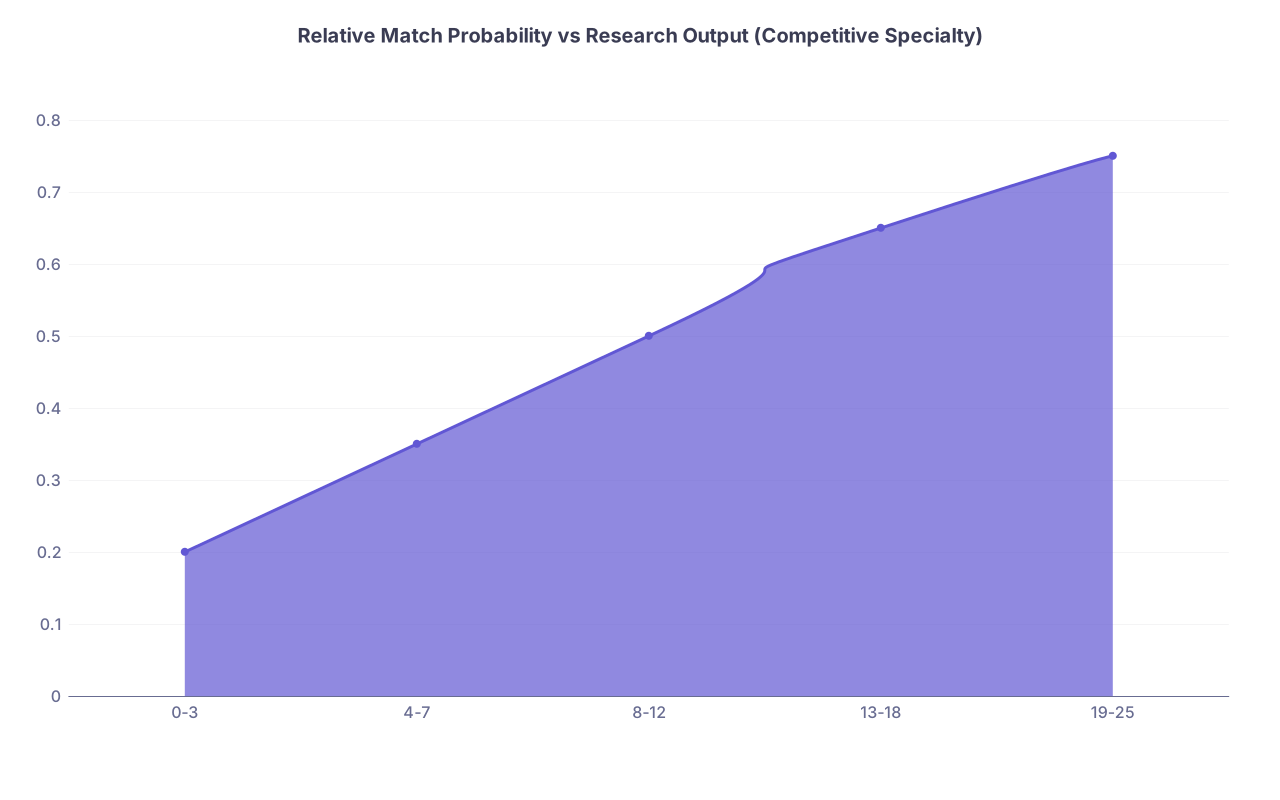
| Category | Value |
|---|---|
| 0-3 | 0.2 |
| 4-7 | 0.35 |
| 8-12 | 0.5 |
| 13-18 | 0.65 |
| 19-25 | 0.75 |
Again, these numbers are illustrative, but the shape is the point: returning applicants who move from the 4–7 bucket up into 8–12 or 13–18 range do not suddenly become guaranteed matches, but their profile stops screaming “outlier underperformer.”
For reapplicants in this category, I have seen an additional 3–6 substantial pieces (substantive posters, co-authorships, review papers in the specialty) turn a prior 0% match into something like:
- ~30–40% chance in highly competitive specialties (assuming other pieces are solid and they apply broadly) vs
- Stagnant or single-digit percent if they change nothing.
Use case 2: Slightly overreaching on specialty choice
Another pattern: Applicant is near-competitive but slightly under the bar. Not enough research, slightly low Step 2, shaky LORs.
The extra research year yields:
- +4–8 publications/posters
- Strong new letter from well-known PI in the field
- Some teaching or leadership in the research group
What happens? When you look at interview season:
- Interview invite count goes from, say, 1–2 programs to 5–8.
- Final match still not guaranteed, but your odds conditional on being seen improve dramatically.
This is the subtle but key point: publications often help most at the screening and interview offer stage, not at the final rank decision. Programs use research as a sorting tool when they have 500 applications and 80 interview slots.
3. Where additional publications have a small or negligible effect
Now the part that many applicants do not want to hear.
A. When Step scores / class rank are the constraint
If your metrics are far below the specialty norms, more research is a rounding error, not a fix.
Concrete example:
- Applying to Dermatology with Step 2 CK = 223 and 2 failed attempts on Step 1/CK
- Class rank bottom quartile
- Already have 10+ pubs and posters in dermatology
What does another 3 papers change? Not much. Programs in these specialties use hard thresholds for screening. If your exam history is disqualifying, the marginal benefit of additional research might bump you from a 2% to a 4% chance at some institutions that are very research-heavy and willing to overlook scores. But you are still outside the main distribution.
Programs do not say: “We normally do not interview anyone under 240, but this person has 15 rather than 10 dermatology papers, so let us make an exception.” That is fantasy.
B. When the specialty is not research-driven
In Family Medicine, Psychiatry, Pediatrics, Internal Medicine (community-focused), and many community-based programs, a reapplicant’s incremental match gain from +2–3 extra publications is minor compared to:
- Improved Step 2 (if possible)
- Better clinical evaluations
- Stronger US clinical experience (for IMGs)
- Program-specific networking and away rotations
If your profile is:
- US MD, Step 2 CK = 235
- 0 publications vs 3 publications in FM or Psych
The match probability difference is real but small. Programs may view research as a bonus, but it is not a core filter. An extra paper in an off-topic journal is not going to move you from unmatched to matched if everything else is unchanged.
C. When the “research” is obviously low-yield padding
Program directors see the following pattern all the time from desperate reapplicants:
- 4 new “publications” in the last cycle that are:
- Predatory journal case reports
- Self-published conference abstracts with no real audience
- Non-peer-reviewed blog posts dressed up as “publications”
The data shows something indirectly here: applicants with lots of very low-quality research output do not have better match rates than those with fewer but more credible items. Many PD surveys explicitly say they value the type of publication and the role you played more than raw count once you cross a basic threshold.
4. How much does “one more paper” change your odds?
Let us stop hand-waving and talk in percentages and scenarios.
No, I cannot give you personalized exact numbers, but I can bracket typical effects.
Think in terms of relative not absolute changes. Suppose your baseline reapplicant match probability in a given scenario is 30%. Then look at how much research could plausibly move that to 35%, 45%, or 55% depending on context.
Stylized impact estimates – competitive specialty, borderline applicant
Assumptions:
- Competitive specialty (Derm, Plastics, Ortho, ENT, Rad Onc)
- US MD applicant, Step 2 CK = 240–245
- First cycle: 3–4 research items, no home program, few/no interviews
Now:
- You take a dedicated research year in that specialty
- You add 5–7 items: 1–2 PubMed-indexed papers (even middle-author), 3–5 posters/abstracts at real regional/national meetings
- You earn 1–2 strong new letters from recognizable names
A realistic shift in match probability as a reapplicant might look something like this:
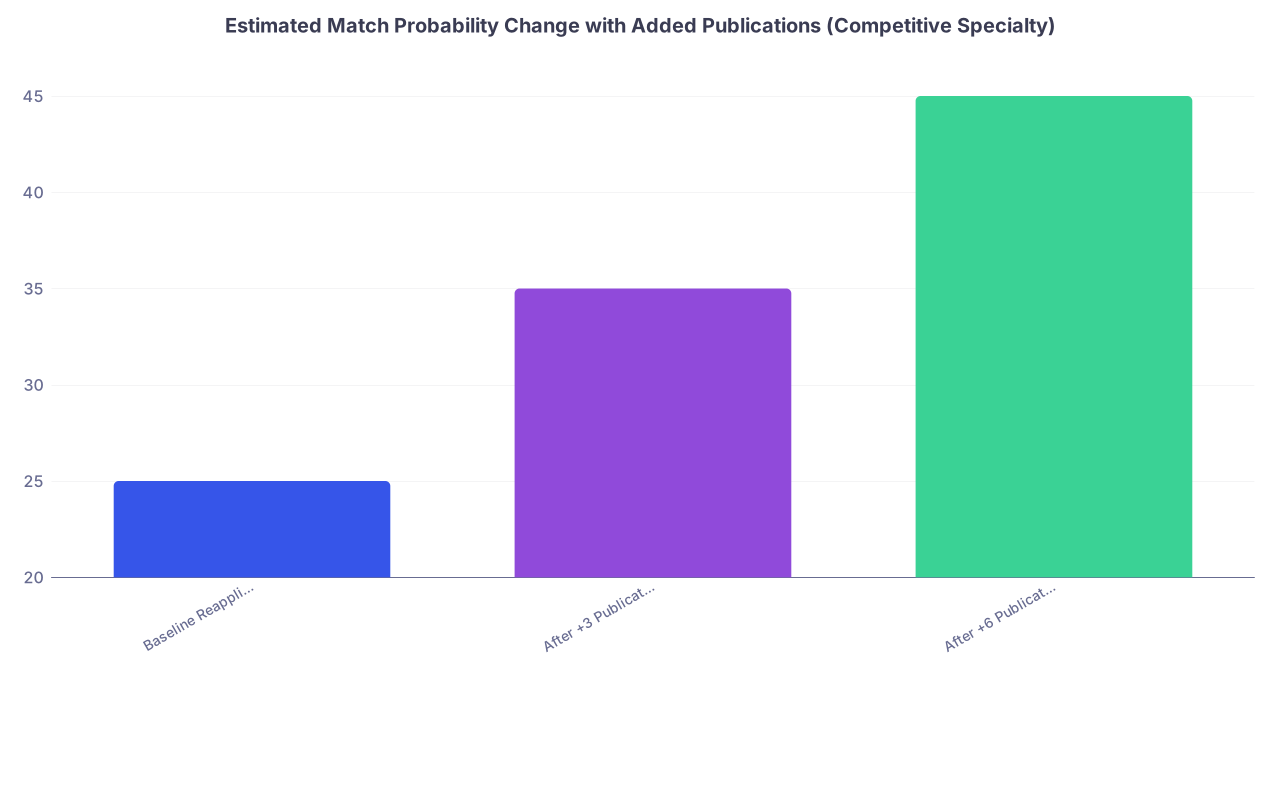
| Category | Value |
|---|---|
| Baseline Reapplicant | 25 |
| After +3 Publications | 35 |
| After +6 Publications + New LORs | 45 |
Again, these are plausible, not official, numbers. But they line up with what I have seen repeatedly: a ~10–20 percentage point bump in competitive specialties when the research year is well-structured and complements a decent application.
Note the conditions:
- Scores are not disastrous
- Specialty choice is not wildly unrealistic
- The publications are in the target field or clearly relevant
- At least one new publication is in a legitimate, indexed journal or major conference
Stylized impact – non-competitive or moderate specialty
For something like Psychiatry or Family Medicine:
- Baseline reapplicant with decent metrics, 0 research: maybe 70–75% chance of matching as a reapplicant if they fix application strategy and apply broadly
- Same applicant with +3 publications in Psych or FM: perhaps 75–80%
The marginal improvement exists but is much smaller. Research is not the bottleneck.
If that applicant instead improved:
- Application timing (applying day 1, complete early)
- Letters (more specific, stronger content)
- Geographic strategy (more community, less “prestige chasing”)
The match probability might rise much more sharply, independent of research.
5. Quality and relevance: what kind of publications actually help
You are not just maximizing “N of items.” You are increasing the expected value of each line as read by a program director in 8–12 seconds.
The data from PD surveys and match patterns suggest a hierarchy.
Higher-yield publication characteristics
- Specialty-aligned: Derm paper for Derm, Ortho for Ortho, etc. Cross-field basic science is helpful if it is clearly related (e.g., melanoma immunology for Derm).
- PubMed-indexed journal or well-known specialty journal.
- Recognizable conference venues (AAD, AAOS, ASTRO, ACS, etc.).
- Evidence that you had a substantial role:
- First author is best
- Middle author can still be strong if explained in your experiences section
Compare two reapplicants with 4 new items each:
- Applicant A: 4 case reports in obscure, pay-to-publish journals, no clear mentor, no major conference presentations.
- Applicant B: 1 first-author review in a mid-tier specialty journal, 1 original research paper as middle author, 2 national conference posters.
They both added “4 items,” but their signal strength to PDs is very different. Applicant B likely sees a measurable improvement in interview invites. Applicant A, not so much.
6. Time trade-offs: research vs everything else as a reapplicant
Here is where people sabotage themselves: they chase an extra 1–2 low-yield publications and neglect higher-ROI fixes.
You should think like this: if you have 12 months between cycles, you are allocating a finite “improvement budget.” For most reapplicants, the priority ranking looks like this:
- Correct specialty and program targeting
- Scores and attempts (if any room to remediate, Step 2 CK / OET / language exams for IMGs)
- Clinical strength – away rotations, USCE, improved evaluations
- Letters of recommendation – refreshed, specific, ideally new voices
- Application behavior – early, complete, tailored personal statement
- Research / publications
Notice: research is not first. It is often the sixth lever, but still meaningful in the right context.
For a reapplicant to a research-heavy specialty with already decent metrics, I would push research up to slot 3 or 4. For FM or Psych, I might move it down to 7 or 8.

| Step | Description |
|---|---|
| Step 1 | Unmatched Applicant |
| Step 2 | Prioritize scores, research, LORs |
| Step 3 | Prioritize scores, clinical, LORs |
| Step 4 | Targeted research year |
| Step 5 | More USCE and networking |
| Step 6 | Research heavy specialty |
7. Practical guidance by profile type
Let me break this into discrete archetypes. You will probably see yourself in one of these.
A. Competitive specialty, near-threshold, minimal research
- First cycle: 0–3 research items, almost no specialty-specific work
- Outcome: No or very few interviews, unmatched
For you, a well-structured research year is highly justified:
- Target: +5–8 specialty-aligned items (mix of posters, abstracts, 1–2 papers)
- Strategy: Full-time research fellow role in a major academic department, integrated into their residents/fellows, help with multiple projects simultaneously
- Expected effect: Material increase in interview invites, 10–20 point bump in match probability if other factors (fit, LORs, interview skills) are repaired
B. Competitive specialty, strong research already, low scores
- Already 15+ publications/posters
- Step 2 CK = low 220s, failures present, or repeated attempts
Extra publications will not be your savior. If you reapply in the same field, you are mostly gambling. Realistically:
- Expected effect from +3–5 additional papers: small marginal gain, maybe 0–5 percentage points in match probability at the most research-insulated programs
- Higher-ROI move: consider adjacent, less score-fixated specialties or combined applications (e.g., IM + a handful of your dream specialty)
C. Less competitive specialty, average scores, thin CV
- Psych / FM / IM (non-competitive tracks)
- Step 2 CK = 230–240, no failures
- 0 publications, limited extracurriculars
For you, if you remained unmatched, something went wrong beyond “lack of research”: late application, poor LORs, very narrow geographic preferences, or red flags.
Here:
- Adding a couple of targeted publications can be helpful, but I would not spend an entire year just to do that.
- A short-term research project plus more robust clinical engagement, strong advocacy from faculty, and a clean, early application will move the needle more than publications alone.
8. The bottom line: how to actually think about additional publications
Strip away the anecdotes and wishful thinking, and the pattern is straightforward:
- Publications are a signal amplifier, not a magic eraser.
- They boost match probability most for:
- Reapplicants to research-heavy specialties
- With borderline but not fatal metrics
- Who use the additional time to get embedded in a strong academic group and build serious work.
- Their marginal effect is limited for:
- Applicants with fundamentally disqualifying exam histories
- Applicants to specialties where research is not a significant filter
- Applicants who only add low-quality, rushed case reports or predatory-journal pieces.
You should treat additional publications the way a portfolio manager treats a moderate-risk asset. Worth investing in under the right conditions. Dangerous if it becomes your only strategy.
If you want it in three sentences:
- The data shows that research-intensive specialties consistently favor applicants whose publication counts and experiences match the high end of the distribution; reapplicants who close that gap often see substantial gains in interviews and match odds.
- For non-research-driven specialties, additional publications provide only modest incremental benefit compared with stronger clinical performance, letters, and smarter application strategy.
- The impact of “more publications” on reapplicant match probability is real but bounded: valuable as part of a broader repair plan, almost useless as a solo fix.